Lana Rhoades
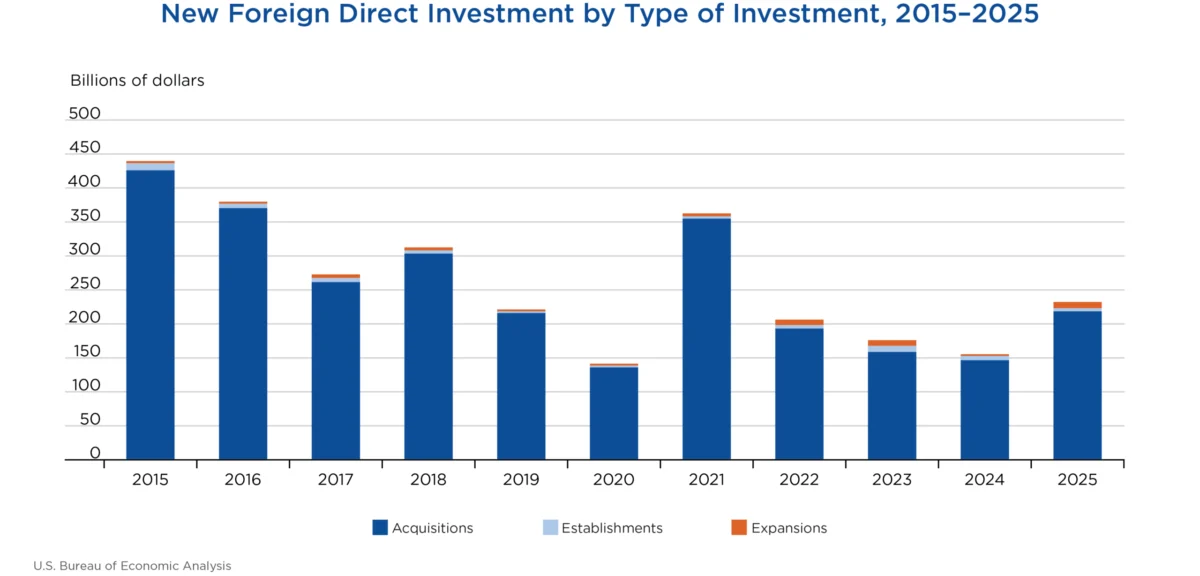
Expenditures by foreign direct investors to acquire, establish, or expand U.S. businesses totaled $232.2 billion in 2025, according to preliminary statistics released today by the U.S. Bureau of Economic Analysis (BEA). This figure represents a substantial increase of $76.8 billion, or 49.5 percent, from the $155.3 billion recorded in 2024, underscoring a robust surge in international capital flowing into the American economy. As has been the trend in previous years, the acquisition of existing U.S. businesses constituted the dominant portion of these expenditures, signaling a strong investor appetite for established market presence and operational capacity.
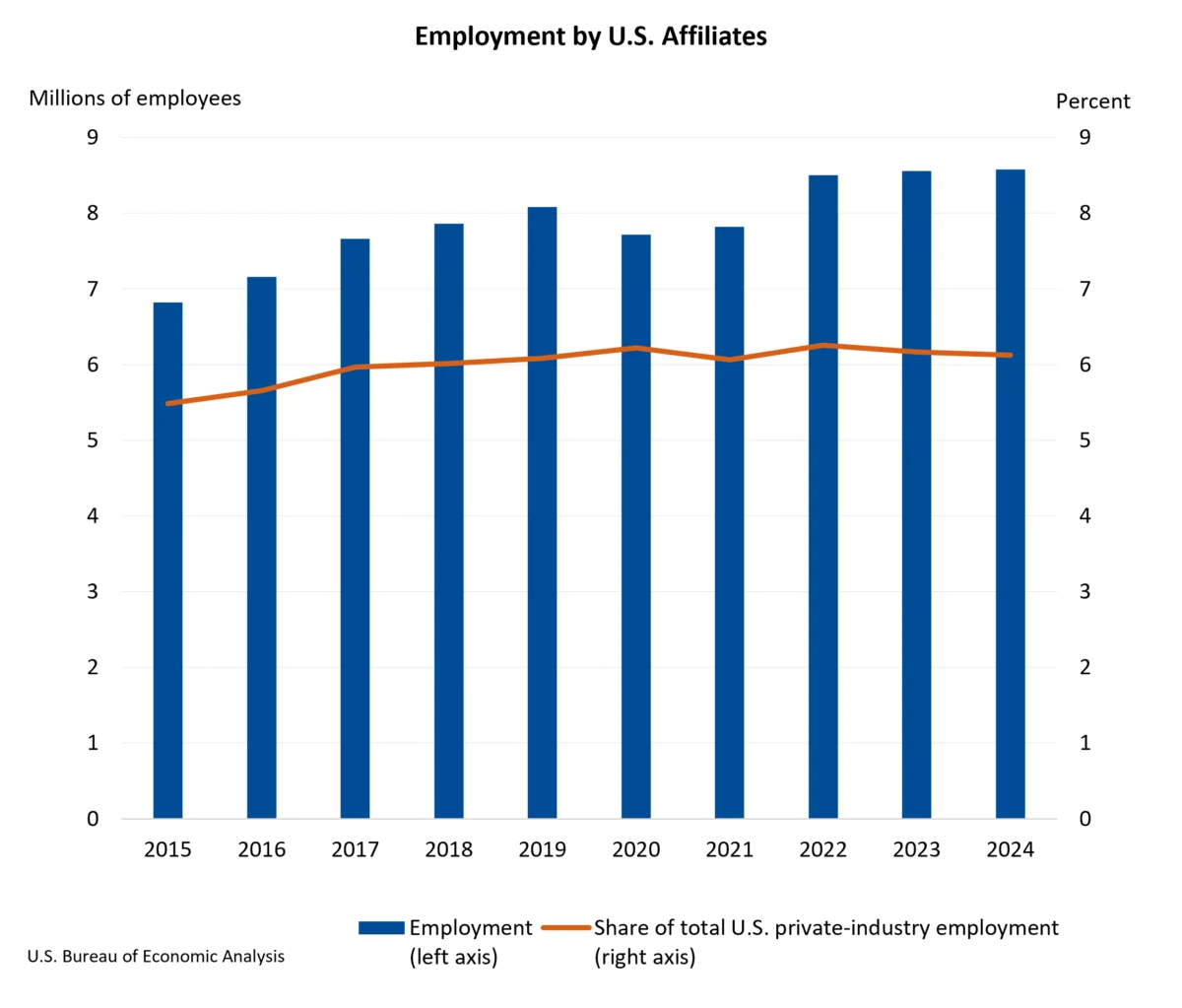
The BEA’s detailed breakdown reveals that acquisition expenditures alone reached $218.4 billion in 2025. This was supplemented by $4.6 billion directed towards the establishment of new U.S. businesses and $9.2 billion allocated to the expansion of existing foreign-owned enterprises within the United States. Beyond the immediate first-year outlays, planned total expenditures, encompassing both initial investments and projected future commitments, were estimated at a significant $284.5 billion, indicating a sustained long-term interest from foreign investors. This influx of capital is directly correlated with job creation, with employment at newly acquired, established, or expanded foreign-owned businesses reaching 213,100 individuals in 2025.
A Deep Dive into Investment Trends: Industries, Origins, and Geographic Distribution
The manufacturing sector emerged as a primary beneficiary of this foreign direct investment (FDI) surge, accounting for an impressive $121.8 billion, or 52.5 percent, of the total expenditures. Within manufacturing, specific sub-sectors demonstrated particularly strong investor interest. Publishing industries led the pack with $50.7 billion in new direct investment, followed closely by chemicals manufacturing at $45.4 billion. Plastics and rubber products manufacturing also saw substantial investment, attracting $19.0 billion.
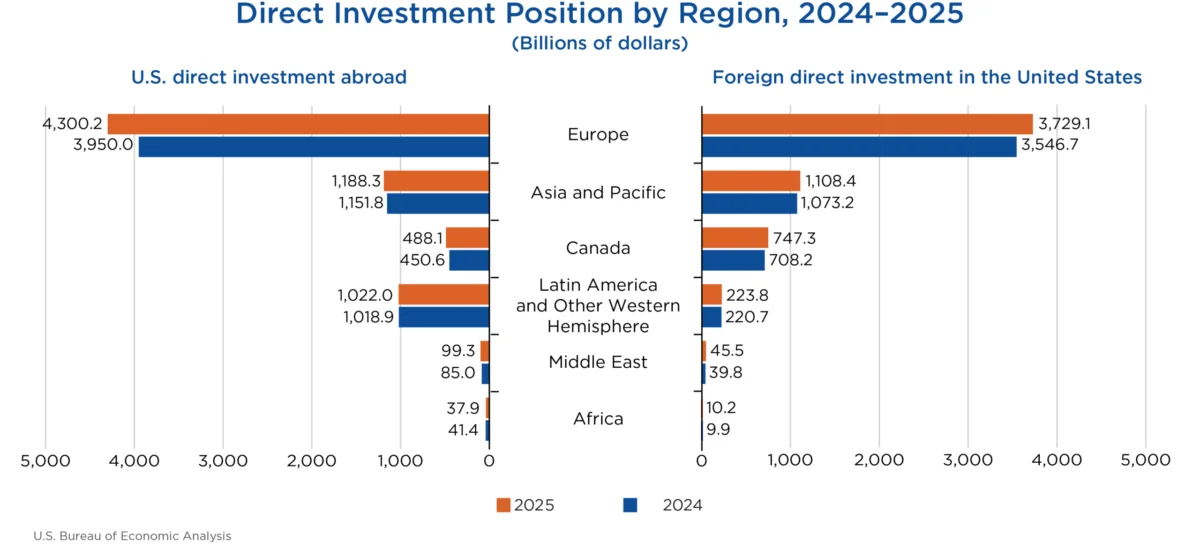
On a country-of-origin basis, Japan was the leading investor in the U.S. economy in 2025, committing $50.5 billion. Germany followed with $26.7 billion, and Canada contributed $23.5 billion. Geographically, Europe collectively represented the largest source of new FDI, injecting $116.6 billion, which equates to 50.2 percent of all new investment. The Asia and Pacific region was the second-largest investing bloc, with expenditures totaling $71.9 billion.
At the sub-national level, California continued to be a magnet for foreign investment, receiving $59.7 billion in first-year expenditures. Texas secured the second-highest amount with $21.5 billion, followed by Pennsylvania, which attracted $20.9 billion. These figures highlight the persistent concentration of FDI in states with robust economies, skilled workforces, and established infrastructure.
Greenfield Investments: Building the Future of American Industry
Greenfield investments, which involve the establishment of new businesses or the expansion of existing foreign-owned operations, also saw significant activity, totaling $13.8 billion in 2025. This category is crucial for understanding the organic growth and new job creation spurred by FDI. The transportation and warehousing sector led greenfield expenditures with $3.6 billion, indicating an investment in logistical infrastructure and supply chain enhancements. Computers and electronics products manufacturing followed with $2.0 billion, and chemicals manufacturing attracted $1.8 billion.
Investors from the Asia and Pacific region were the principal drivers of greenfield investment, contributing $8.3 billion. Notably, Australia led this regional effort with $3.0 billion, followed by South Korea ($2.2 billion) and Japan ($1.7 billion). At the state level, Louisiana attracted the largest share of greenfield investment, with $3.0 billion, suggesting a strategic focus on port access and resource development. Arizona received $2.7 billion, and Texas attracted $1.9 billion in greenfield investments. The planned total expenditures for greenfield investments initiated in 2025, including future commitments, reached $66.1 billion, underscoring the long-term development pipeline these investments represent.
Employment Implications: A Growing Workforce Fueled by Foreign Capital
The impact of this surge in foreign direct investment is most tangibly felt in the labor market. In 2025, current employment at newly acquired U.S. enterprises stood at 211,700. When considering the planned employment for newly established businesses and expansions, the total projected workforce for these foreign-invested entities reached 232,400. This signifies a substantial boost to U.S. employment figures, particularly in sectors experiencing significant foreign capital infusion.
Analyzing employment by industry, the plastics and rubber parts manufacturing sector reported the largest number of current employees, with 21,800 individuals. Transportation equipment manufacturing followed with 17,300 employees, and primary and fabricated metals manufacturing employed 16,400. By country of origin, Mexico accounted for the largest number of current employees, with 54,600 individuals working in U.S. businesses funded by Mexican FDI. Canada was the second-largest contributor to employment with 29,500 employees, followed by the United Kingdom with 26,800.
California once again demonstrated its economic prowess, leading the nation in current employment resulting from new FDI with 37,200 jobs. Illinois followed with 17,600 employees, and Texas reported 16,500. These figures highlight the broad economic influence of FDI, extending beyond financial metrics to tangible job opportunities across various regions and industries.
Revisions to 2024 Data: A Dynamic Economic Landscape
The BEA also provided updated figures for 2024, indicating a revision in previously published statistics for new foreign direct investment. First-year expenditures for 2024 were revised upward to $155.3 billion from an earlier estimate of $151.0 billion. This revision was driven by increases in acquisitions ($146.4 billion from $143.0 billion), establishments ($6.4 billion from $6.3 billion), and expansions ($2.5 billion from $1.8 billion). Similarly, planned total expenditures for 2024 were revised to $164.0 billion from $157.0 billion, reflecting adjusted projections for future investment commitments across all categories of FDI. These revisions underscore the dynamic nature of economic data and the continuous refinement of statistical reporting.
Context and Analysis: A Boon for U.S. Economic Growth
The substantial increase in foreign direct investment in 2025 signals a strong vote of confidence in the U.S. economic outlook by international investors. This surge is likely influenced by a combination of factors, including the relative stability of the U.S. market, attractive investment opportunities across various sectors, and potentially favorable economic policies. The BEA’s data, particularly the emphasis on acquisitions, suggests that foreign investors are leveraging existing U.S. business infrastructure and market share to expand their global reach.
The significant investment in manufacturing, especially in chemicals and materials, indicates a strategic focus on bolstering domestic production capabilities and potentially reshoring or near-shoring certain supply chains. The robust greenfield investment figures further suggest a commitment to long-term growth and the creation of new economic hubs within the United States.
The concentration of investment in states like California, Texas, and Pennsylvania reflects established economic ecosystems that attract and support large-scale foreign ventures. However, the notable greenfield investment in states like Louisiana and Arizona points to emerging opportunities and the potential for economic diversification across a broader geographic landscape.
Future Outlook and Data Accessibility
The BEA’s commitment to transparency and data dissemination is evident in the detailed breakdown of its findings and the provision of extensive related data tables. These resources allow for deeper analysis of FDI trends, enabling policymakers, researchers, and businesses to gain a comprehensive understanding of international investment flows. The next release of New Foreign Direct Investment in the United States data is anticipated in June 2027, which will cover the 2026 fiscal year, promising further insights into the evolving landscape of global capital engagement with the U.S. economy.
The BEA’s adoption of an updated disclosure avoidance method, employing coarsening techniques like rounding and aggregation, allows for the publication of more granular data while maintaining confidentiality for survey respondents. This approach enhances the utility of the released statistics for analytical purposes without compromising the privacy of businesses. The continued publication of these detailed statistics is vital for understanding the intricate relationship between global capital and domestic economic development.
Timeline of Key Events and Data Releases:
- 2024: U.S. Bureau of Economic Analysis (BEA) reports preliminary foreign direct investment expenditures.
- Early 2025: BEA releases revised data for 2024 foreign direct investment, showing an increase in first-year and planned total expenditures.
- Present Day (Date of Article Publication): BEA releases preliminary statistics for 2025 foreign direct investment, revealing a significant surge in expenditures and employment.
- June 2027: BEA is scheduled to release the next set of data, covering New Foreign Direct Investment in the United States for the 2026 fiscal year.
Implications for the U.S. Economy:
The record levels of foreign direct investment in 2025 suggest several positive economic implications for the United States. Firstly, the substantial capital infusion directly contributes to economic growth through increased business activity, production, and consumption. Secondly, the creation of over 213,000 jobs in acquired, established, and expanded foreign-owned businesses provides a significant boost to employment, reducing unemployment rates and increasing household incomes. This influx of capital can also lead to the transfer of technology, management expertise, and best practices, enhancing the competitiveness of U.S. industries. Furthermore, increased FDI can foster innovation and competition, potentially leading to lower prices and greater product variety for consumers. The investment in manufacturing, in particular, may contribute to strengthening domestic supply chains and reducing reliance on foreign production. The sustained interest from major economies like Japan, Germany, and Canada underscores the continued attractiveness of the U.S. as a stable and profitable investment destination, reinforcing its position in the global economic landscape. The BEA’s detailed reporting will be crucial for monitoring these trends and their long-term impact on U.S. economic resilience and prosperity.