Nila Kartika Wati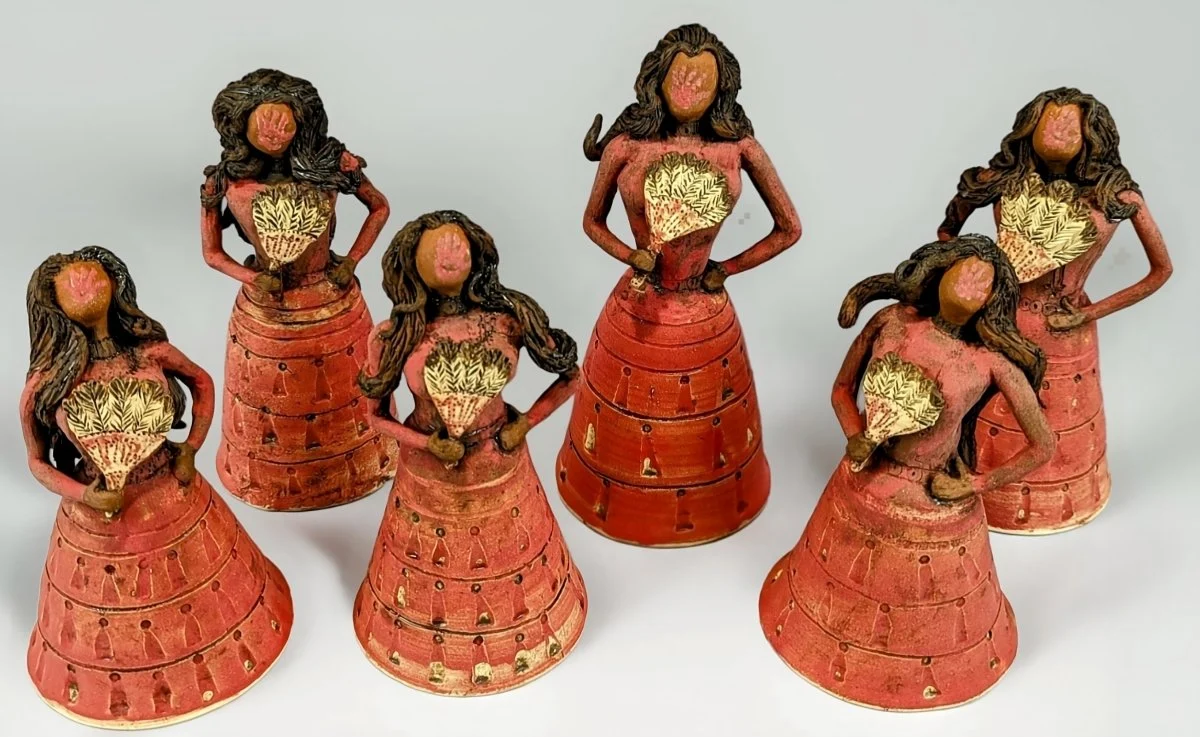
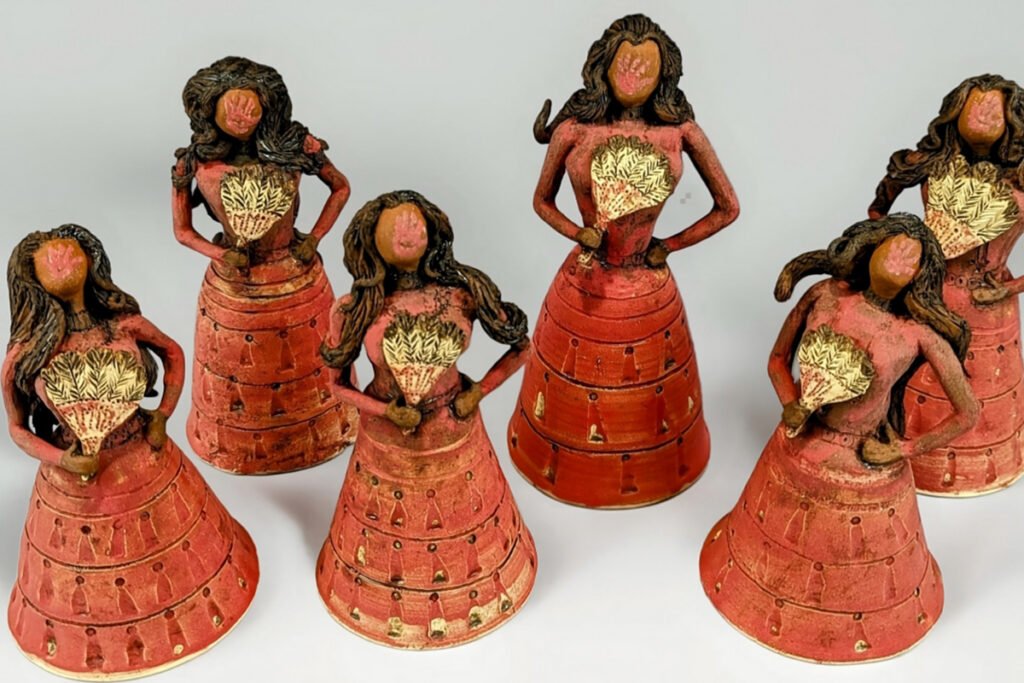
The crisis of Missing and Murdered Indigenous Women and People (MMIW/MMIP) has long been a silent epidemic, but a growing movement of artists and advocates is working to ensure that those who have vanished are never forgotten. Among the most poignant tributes to these individuals is a series of clay figurines created by Karen Sixkiller, a contemporary sculptor and citizen of the Cherokee Nation. These figures, characterized by their long red dresses and the striking image of a red handprint across their featureless faces, serve as a visual manifestation of a profound societal tragedy. Sixkiller’s work is not merely an aesthetic endeavor; it is a calculated effort to use the medium of sculpture to confront the harrowing statistics and systemic failures that have allowed violence against Indigenous people to persist at disproportionate rates.
The symbolism embedded within Sixkiller’s figurines is deeply rooted in the iconography of the MMIW movement. The red dress has become the international symbol for missing and murdered Indigenous women, a concept popularized by Métis artist Jaime Black to represent the spirits of those who are no longer with us. The red handprint, often seen in protest and commemorative art, signifies the silencing of Indigenous voices and the lack of response from governmental and judicial systems. By leaving the faces of her figurines featureless, Sixkiller represents the vast, often uncounted number of individuals whose identities are erased by a lack of media coverage and inadequate police investigations. Each figure holds an eagle feather fan, a symbol of the inherent sacredness of their souls, and stands in a defiant posture. This stance reflects the ongoing struggle of those who remain—the families, activists, and artists who continue to fight for justice and an end to the violence.
The Statistical Reality of an Epidemic
The urgency of Sixkiller’s work is underscored by staggering data that highlights the vulnerability of Native American communities. While Native Americans constitute approximately one percent of the United States population, they are disproportionately represented in statistics related to violence and exploitation. Data indicates that 40 percent of human trafficking victims identified as sex slaves are Native American. This disparity points to a systemic failure to protect Indigenous individuals from predatory networks that often operate in the "legal shadows" of tribal and federal jurisdictions.
Furthermore, the nature of the violence perpetrated against Native American women differs significantly from that of other demographics. In approximately 90 percent of all murders involving other ethnicities, the victim and the perpetrator share the same race or ethnicity. However, the data regarding Native American victims reveals a different and more disturbing trend. According to reports from 2016 and subsequent studies, 96 percent of sexual violence against Native women is perpetrated by non-Native individuals. Broadening the scope to all violent crimes, data suggests that up to 97 percent of crimes against female Native Americans and 90 percent of crimes against male Native Americans are committed by non-Native individuals. In certain counties, particularly those near "man camps" associated with extractive industries or areas with complex jurisdictional boundaries, Native American women are murdered at a rate up to ten times higher than the national average.
Historical and Jurisdictional Context
To understand why this crisis persists, it is necessary to examine the historical and legal framework that governs Indian Country. For decades, tribal nations have faced significant hurdles in prosecuting non-Native offenders who commit crimes on reservation land. The 1978 Supreme Court decision in Oliphant v. Suquamish Indian Tribe stripped tribal courts of the authority to prosecute non-Natives, creating a jurisdictional "maze" that often leaves victims without recourse. When a crime occurs, it may fall under the jurisdiction of tribal police, the Federal Bureau of Investigation (FBI), or state authorities, depending on the nature of the crime and the identities of the parties involved.
This complexity often leads to "jurisdictional handoffs" where cases are dropped or neglected due to a lack of resources or clear authority. It was not until the reauthorization of the Violence Against Women Act (VAWA) in 2013, and its subsequent updates, that tribes began to regain limited "special domestic violence criminal jurisdiction" over non-Native perpetrators. However, these provisions are often narrow and do not cover all types of crimes, leaving many Indigenous people vulnerable to outside predators who are aware of these legal loopholes.
A Timeline of the MMIW Movement
The MMIW movement has gained significant momentum over the last decade, transitioning from grassroots activism to national policy discussions.
- 2010: The "Red Dress Project" by Jaime Black begins in Canada, sparking a visual language for the movement that quickly spreads to the United States.
- 2016: The Urban Indian Health Institute (UIHI) begins collecting data on MMIW cases in urban areas, revealing a massive discrepancy between actual cases and those recorded in law enforcement databases.
- 2017: The first National Day of Awareness for Missing and Murdered Indigenous Women and Girls is recognized on May 5th, the birthday of Hanna Harris, a member of the Northern Cheyenne Tribe who was murdered in 2013.
- 2019: The "Operation Lady Justice" task force is established via executive order to address the concerns of missing and murdered Indigenous people.
- 2020: Two landmark pieces of legislation, Savanna’s Act and the Not Invisible Act, are signed into law. Savanna’s Act, named after Savanna LaFontaine-Greywind, aims to improve federal coordination and data collection. The Not Invisible Act seeks to increase coordination between federal agencies and tribal governments.
- 2021: Deb Haaland is sworn in as the first Native American Secretary of the Interior, subsequently establishing the Missing & Murdered Unit within the Bureau of Indian Affairs.
The Role of Data and Invisibility
A major hurdle in addressing the MMIW crisis is the "epidemic of invisibility" regarding data. For years, Indigenous victims were frequently misclassified as "White," "Hispanic," or "Other" in police reports, leading to an undercounting of the true scale of the problem. A 2018 report by the Urban Indian Health Institute found that while there were 5,712 reports of missing American Indian and Alaska Native women and girls in 2016, only 116 were logged into the Department of Justice’s federal missing persons database, NamUs.
This lack of accurate data hampers the ability of law enforcement to identify patterns, such as the correlation between human trafficking and areas with high concentrations of transient workers in the oil and gas industries. By utilizing social psychology and scientific research methods, artists like Karen Sixkiller aim to bridge the gap between these cold statistics and the human lives they represent. Sixkiller’s background in public health and her experience working for the Indian Health Service have informed her understanding of the systemic nature of this violence, allowing her to create art that serves as both a memorial and a sociological critique.

Broader Implications and the Path Forward
The impact of the MMIW crisis extends beyond the immediate victims and their families; it affects the social fabric of tribal nations and the psychological well-being of Indigenous communities across North America. The persistent threat of violence creates an environment of perpetual mourning and fear. However, the work of activists and artists is fostering a new era of resilience.
Legislative progress, while slow, is beginning to provide tribal governments with more tools to protect their citizens. The ongoing implementation of the Not Invisible Act Commission’s recommendations is expected to streamline how the federal government responds to these cases. Furthermore, increased media attention—driven in part by the visual power of the MMIW movement’s symbols—is forcing a public reckoning with the historical neglect of Indigenous lives.
Karen Sixkiller’s sculptures are a testament to this shift. By placing her work in public installations across Oklahoma, Washington, Idaho, and Oregon, she ensures that the conversation remains visible to both Indigenous and non-Indigenous audiences. Her figurines do not just represent the dead; they represent a demand for a future where Native American lives are treated with the same value and protection as any other. The "defiant" stance of her clay figures serves as a reminder that while the system may have failed these individuals in the past, the community will no longer remain silent.
As the MMIW movement continues to evolve, the integration of art, data, and policy will be essential. The goal remains clear: to close the jurisdictional loopholes that protect predators, to fix the data systems that erase victims, and to ensure that no more families have to experience the agony of a loved one becoming a featureless face in a tragic statistic. Through the preservation of stories and the creation of visual tributes, the "missing" are being brought back into the national consciousness, transforming a legacy of loss into a movement for justice and systemic change.