Lana Rhoades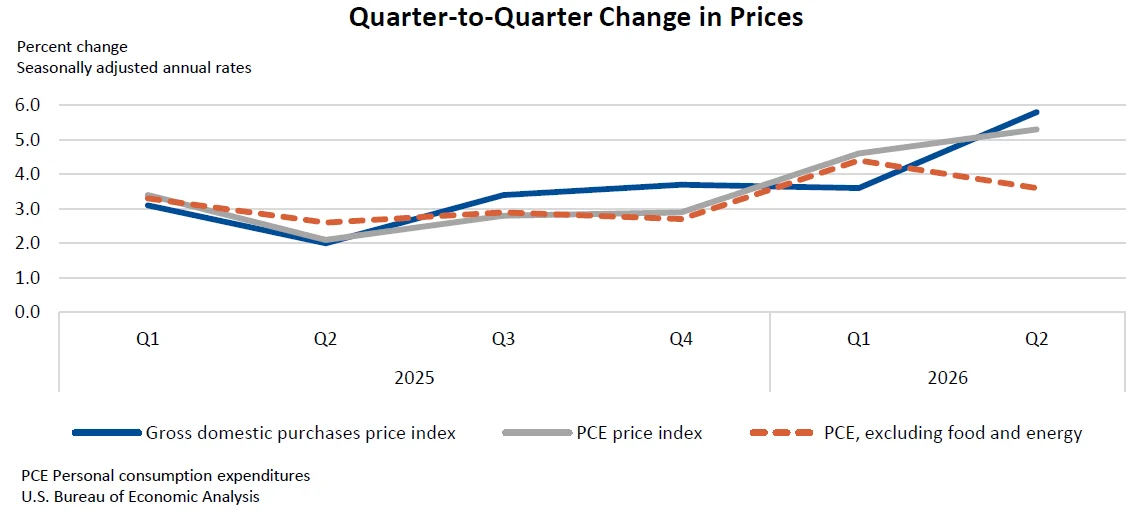
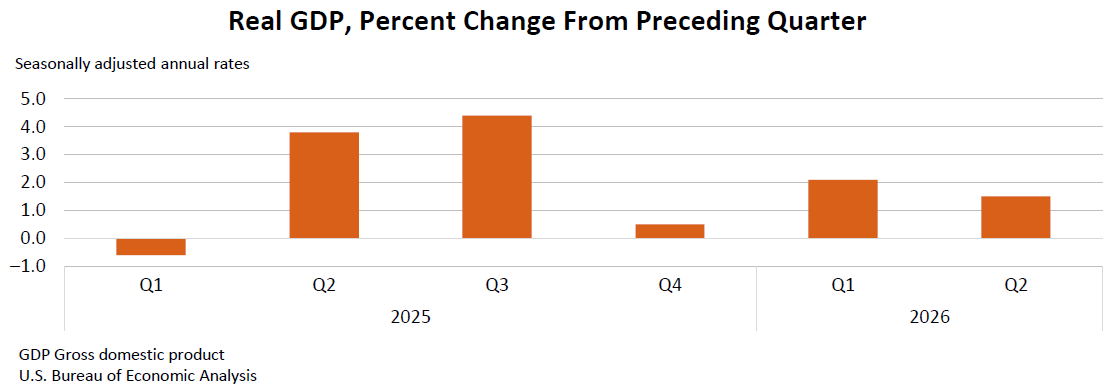
The U.S. economy experienced a moderate expansion in the second quarter of 2026, with real gross domestic product (GDP) increasing at an annual rate of 1.5 percent, according to the second estimate released by the U.S. Bureau of Economic Analysis (BEA). This figure represents a slight deceleration from the 2.1 percent growth recorded in the first quarter of the year, indicating a cooling but still positive economic trajectory. The revised data confirms the initial estimate, reflecting an upward adjustment in consumer spending that was partially counterbalanced by an increase in imports.
Key Drivers of Second-Quarter Growth
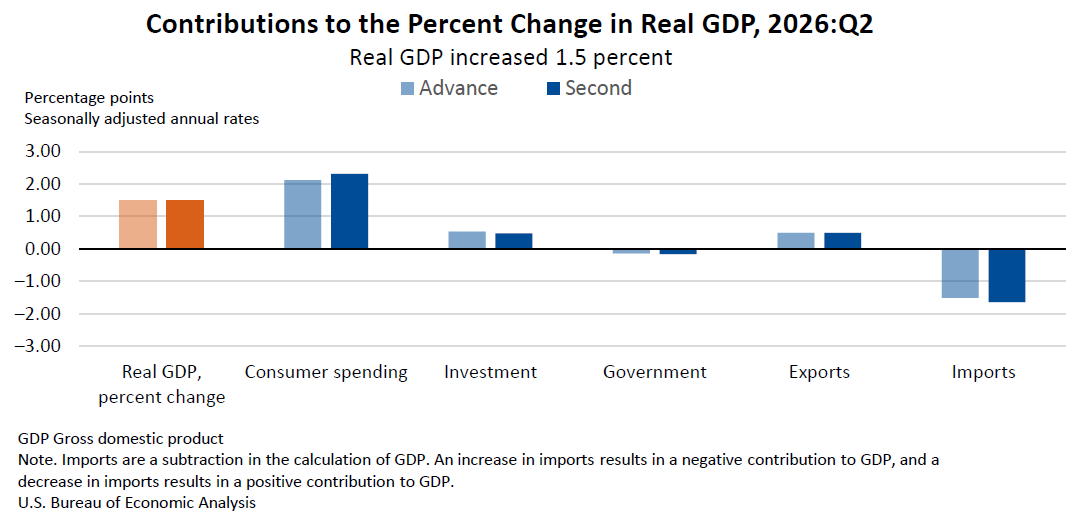
The expansion in real GDP during the second quarter was primarily fueled by robust consumer spending, a surge in exports, and continued investment. However, these positive contributions were tempered by a notable decline in government spending and an increase in imports, which are subtracted in the calculation of GDP. While the overall GDP growth rate remained steady compared to the advance estimate, underlying components saw revisions. Consumer spending experienced an upward revision, a positive signal for the domestic economy. Conversely, imports also saw an upward revision, indicating a greater demand for foreign goods and services, which has a dampening effect on the net GDP figure.
The BEA’s detailed breakdown of contributions to the second-quarter GDP growth reveals a dynamic interplay of economic forces. An acceleration in consumer spending was a significant positive factor, suggesting that households continued to spend, even as other sectors saw slower momentum. This acceleration in consumer demand played a crucial role in offsetting the drag from other components.
Deceleration and Shifting Economic Landscape
When compared to the first quarter, the slowdown in real GDP growth was attributed to several factors. A significant downturn in government spending acted as a drag on the overall economic expansion. Additionally, decelerations in both investment and export growth contributed to the moderation. Investment, a key indicator of business confidence and future economic activity, showed a slower pace of increase. Similarly, the export sector, which had been a strong performer in previous periods, also experienced a slowdown in its growth rate.
The increase in imports was more pronounced in the second quarter than in the first, further impacting the net GDP calculation. This suggests a growing appetite for imported goods, potentially reflecting a variety of factors including supply chain dynamics, consumer preferences, and relative price competitiveness.
Strong Performance in Private Domestic Demand
Despite the overall deceleration in GDP growth, real final sales to private domestic purchasers, a key measure of domestic demand excluding inventories and government spending, demonstrated a strong performance. This metric, which encompasses consumer spending and gross private fixed investment, increased by 4.2 percent in the second quarter. This revision, up by 0.3 percentage point from the previous estimate, underscores the resilience of private sector activity and suggests underlying strength in the economy beyond the headline GDP figure. The robust growth in private domestic sales indicates that businesses and consumers were actively engaging in transactions, driving economic activity at the household and firm level.
Inflationary Pressures Persist
The second quarter of 2026 also saw continued inflationary pressures, as indicated by the price indexes. The price index for gross domestic purchases, which measures the prices of goods and services purchased by domestic entities, increased by 5.8 percent. This represents a slight upward revision from the initial estimate.
The personal consumption expenditures (PCE) price index, a closely watched inflation gauge, rose by 5.3 percent. This index also saw an upward revision of 0.2 percentage point, signaling that consumer prices were increasing at a slightly faster pace than previously estimated. Furthermore, the core PCE price index, which excludes volatile food and energy components, increased by 3.6 percent, also revised upward by 0.2 percentage point. This persistent increase in core inflation suggests that underlying price pressures remain a concern for policymakers and consumers alike.
Gross Domestic Income and Average Measures
In parallel with GDP, real gross domestic income (GDI) also showed positive growth in the second quarter, increasing by 2.2 percent. This contrasts with a 1.2 percent increase in the first quarter, indicating an acceleration in income generation within the economy. GDI measures the income side of economic activity, and its growth alongside GDP provides a more comprehensive picture of economic health.
The average of real GDP and real GDI, a measure that smooths out potential statistical discrepancies between the output and income approaches to measuring economic activity, increased by 1.8 percent in the second quarter. This represents an improvement from the 1.7 percent increase recorded in the first quarter, suggesting a more consistent picture of economic expansion when both measures are considered.
Corporate Profits Show Significant Increase
Corporate profits from current production, adjusted for inventory valuation and capital consumption, experienced a substantial increase in the second quarter, rising by $400.9 billion. This marks a significant jump from the $74.4 billion increase observed in the first quarter, indicating a strong performance by U.S. corporations. This surge in profits could be attributed to a combination of factors, including increased sales driven by consumer demand, improved operational efficiencies, and potentially beneficial pricing power in certain sectors.
Context and Historical Perspective
The 1.5 percent growth rate in the second quarter of 2026 places the U.S. economy in a period of sustained, albeit moderate, expansion. Following a period of rapid recovery from previous economic shocks, the current growth rate suggests a maturing economic cycle. The comparison with the first quarter’s 2.1 percent growth highlights a gradual cooling, which is often a natural progression in an economic cycle as stimulus measures fade and demand normalizes.
The persistent inflationary pressures, as indicated by the PCE price indexes, remain a key concern for the Federal Reserve. While the core PCE inflation at 3.6 percent is still elevated, the upward revisions suggest that the path back to the Federal Reserve’s target inflation rate may be more gradual than anticipated. This could influence future monetary policy decisions, potentially leading to a more cautious approach to interest rate adjustments.
Annual Updates and Future Outlook
The U.S. Bureau of Economic Analysis also announced the schedule for its 2026 annual updates to national, industry, and regional economic data. For the first time, these updates will commence on the same day: September 30, 2026. This consolidated update will encompass a comprehensive revision of GDP, GDI, industry-specific economic output, monthly personal income and outlays, and other key statistics within the National Income and Product Accounts (NIPAs) and the Industry Economic Accounts. Concurrently, the Regional Economic Accounts will be updated with data on GDP by state and county, personal income by state and county, and related metrics. This synchronized release aims to enhance the efficiency and consistency of BEA’s statistical production.
Broader Economic Implications
The second-quarter GDP figures provide a snapshot of the U.S. economy’s performance and offer insights into potential future trends. The continued strength in consumer spending is a positive indicator, suggesting that household balance sheets and confidence remain robust enough to support ongoing consumption. However, the deceleration in government spending and the slowdown in investment growth warrant attention, as these components are crucial for long-term economic health and productivity.
The persistent inflationary pressures, despite the moderating GDP growth, present a complex challenge for policymakers. Balancing the need to control inflation with the goal of sustaining economic growth is a delicate act. The BEA’s revised data will likely be closely scrutinized by economists, investors, and policymakers as they assess the overall economic landscape and formulate their strategies.
The upcoming release on September 30, 2026, which will include the third estimate for second-quarter GDP, along with industry and corporate profit data, state GDP, and state personal income, will provide a more definitive picture of the economic performance during that period. Furthermore, the annual updates will incorporate revised historical data, offering a more accurate understanding of economic trends over time.
Conclusion
In summary, the U.S. economy in the second quarter of 2026 demonstrated resilience, driven by strong consumer demand and a notable increase in exports. While the overall GDP growth rate moderated from the previous quarter, the underlying economic activity, particularly in private domestic purchases, remained robust. The persistent inflationary pressures, however, continue to be a significant consideration. The BEA’s revised data offers a clearer, albeit nuanced, view of the economic dynamics at play, setting the stage for further analysis as the year progresses and new data becomes available. The upcoming annual updates will provide an even more comprehensive and refined understanding of the U.S. economic landscape.