Lana Rhoades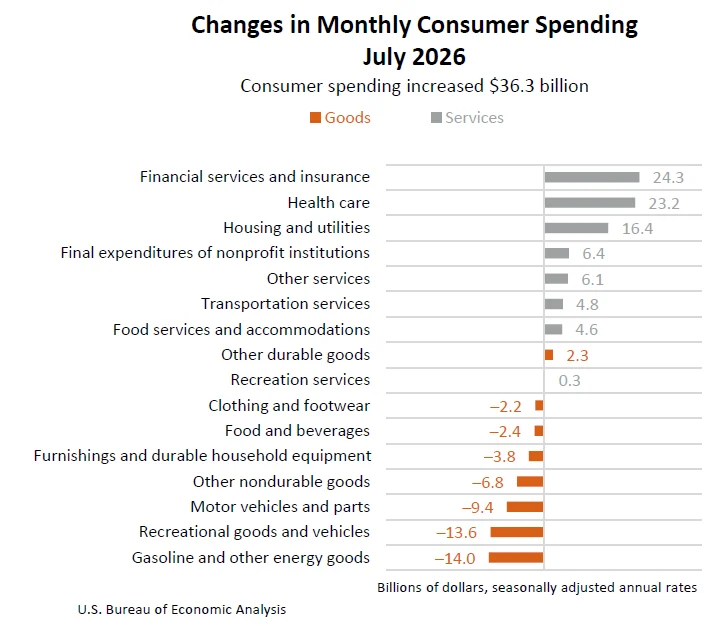
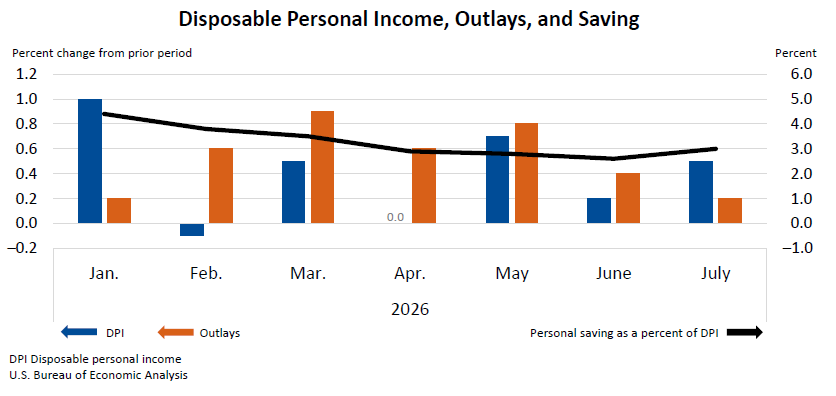
WASHINGTON D.C. – Personal income in the United States experienced a moderate increase of $115.1 billion, or 0.4 percent at a monthly rate, in July, according to the latest estimates from the U.S. Bureau of Economic Analysis (BEA). This uptick was primarily fueled by gains in employee compensation, government social benefits, and income derived from assets. Concurrently, disposable personal income (DPI), which represents income after taxes, saw a more robust rise of $125.9 billion, a 0.5 percent increase. However, personal consumption expenditures (PCE), a key indicator of consumer spending, demonstrated a more restrained growth of $36.3 billion, or 0.2 percent, signaling a more cautious approach to spending among consumers.
The interplay between income growth and consumer spending in July offers a nuanced picture of the American economy. While individuals’ earning capacity expanded, their willingness or ability to translate that income into immediate purchases was more subdued. This divergence can have significant implications for economic growth, inflation, and overall consumer confidence, as it reflects a complex economic environment influenced by various factors, including prevailing inflation rates, employment conditions, and consumer sentiment.
A Closer Look at Income Components
The BEA’s report highlighted that the increase in current-dollar personal income in July was broadly distributed across several key components. Compensation of employees, a significant driver of income, showed a positive trend. This category typically includes wages and salaries, as well as employer contributions for employee benefits. Government social benefits also played a crucial role in boosting personal income. This encompasses a range of programs such as Social Security, Medicare, Medicaid, and unemployment benefits, which provide a vital safety net and contribute to household financial stability. Furthermore, personal income receipts on assets, which include dividends, interest, and rent, contributed to the overall income growth, reflecting returns on investments and property ownership.
This multifaceted income growth suggests a broad-based improvement in the nation’s earning power during July. However, the subsequent impact on spending patterns is what economists closely scrutinize to gauge the economy’s momentum.
Consumer Spending Trends: A Mixed Bag
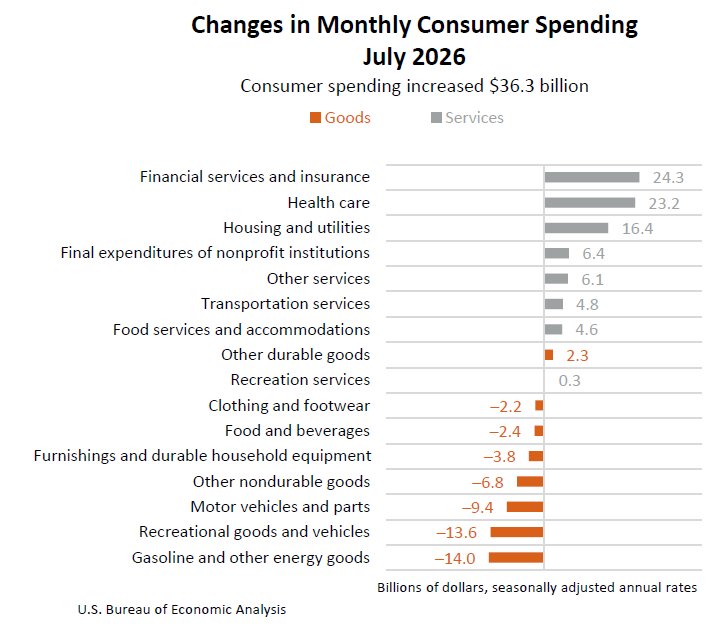
Personal consumption expenditures (PCE), a critical measure of consumer spending that accounts for a significant portion of U.S. economic activity, rose by $36.3 billion in July. This increase was predominantly driven by a substantial surge in spending on services, which grew by $86.2 billion. This rise in services spending could encompass a variety of areas, such as healthcare, education, transportation, and entertainment. The robust performance in the services sector often indicates a return to pre-pandemic spending habits or an adaptation to evolving consumer preferences.
However, this positive momentum in services was significantly offset by a notable decrease in spending on goods, which declined by $49.9 billion. This contraction in goods spending might suggest that consumers are becoming more selective about their purchases of tangible items, potentially due to higher prices, a shift in priorities, or a general sense of economic uncertainty. Durable goods, non-durable goods, and the specific components within each category will be crucial for understanding the underlying reasons for this trend.
When adjusted for inflation, personal consumption expenditures, known as real PCE, saw a more modest increase of $1.3 billion, translating to less than 0.1 percent at a monthly rate. This minimal real growth indicates that much of the nominal increase in spending was absorbed by rising prices, rather than an actual expansion in the volume of goods and services consumed.
Disposable Income and Personal Saving
Disposable personal income (DPI), the income available to households for spending or saving after taxes, demonstrated a stronger upward trajectory than overall personal income, increasing by 0.5 percent. This suggests that tax burdens may have remained relatively stable or even decreased for some segments of the population, leaving them with more discretionary funds.
Despite the increase in disposable income, the personal saving rate, calculated as personal saving as a percentage of DPI, stood at a relatively low 3.0 percent in July. Personal saving itself was recorded at $712.0 billion. A lower saving rate can imply that households are utilizing a larger portion of their disposable income for immediate consumption. While this can stimulate economic activity in the short term, a persistently low saving rate could raise concerns about long-term financial security and the ability to weather economic downturns.
Personal outlays, which encompass PCE, personal interest payments, and personal current transfer payments, rose by $36.6 billion in July. This figure closely tracks the increase in PCE, underscoring the dominant role of consumer spending in household expenditures.
Inflationary Pressures Persist
The inflation landscape, as measured by the Personal Consumption Expenditures (PCE) price index, continued to show upward movement in July. The index increased by 0.2 percent from the previous month. Crucially, this inflationary pressure was also evident in the core PCE price index, which excludes volatile food and energy components, also rising by 0.2 percent. This indicates that broader inflationary forces are at play, impacting a wide range of goods and services.
On a year-over-year basis, the PCE price index saw a more significant increase of 3.7 percent. The core PCE price index also climbed by 3.3 percent compared to the same month in the previous year. These figures suggest that while monthly inflation might be moderating in some respects, the cumulative impact of price increases over the past year remains a significant concern for consumers and policymakers alike. Persistent inflation can erode purchasing power, affect business investment decisions, and influence monetary policy stances.
Revisions and Contextualizing the Data
The BEA also provided updates to estimates for April through June, incorporating revised data from sources such as the U.S. Bureau of Labor Statistics (BLS) Quarterly Census of Employment and Wages program and the Centers for Medicare & Medicaid Services. These revisions are a standard part of the economic data collection process and aim to enhance the accuracy and reliability of the reported figures. For instance, revised wage and salary data from the BLS and updated Medicaid benefit information contribute to a more precise understanding of income flows.
The annual update of the National and Regional Economic Accounts, scheduled for September 30, 2026, will further refine these statistics, integrating a comprehensive set of national, industry, and regional data. This upcoming update is notable as it marks the first time that the annual updates for these different accounts will commence on the same day, signaling an effort by the BEA to streamline its data dissemination and provide a more cohesive economic picture.
Broader Economic Implications
The July report on personal income and outlays provides a snapshot of an economy navigating a complex environment. The steady growth in personal income, bolstered by compensation and government support, suggests underlying economic resilience. However, the more subdued rise in consumer spending, particularly the contraction in goods purchases, coupled with persistent inflation, indicates potential headwinds.
The divergence between nominal and real PCE growth highlights the impact of inflation on consumer purchasing power. Even as households earned more and spent more in dollar terms, the actual volume of goods and services they could acquire was only marginally higher. This scenario can lead to consumer fatigue and a potential slowdown in demand if inflationary pressures do not abate.
For policymakers, particularly the Federal Reserve, these figures offer critical insights into the ongoing battle against inflation and the health of the consumer. The central bank closely monitors PCE price index data as a key inflation gauge. While the moderate increase in real PCE might suggest that demand is not overheating, the persistent inflation in both headline and core measures necessitates continued vigilance. The Federal Reserve’s decisions on interest rates are heavily influenced by such data, as it seeks to achieve price stability without unduly stifling economic growth.
Furthermore, the personal saving rate’s current level could be a point of discussion regarding household financial preparedness. While a 3.0 percent saving rate might be sustainable in certain economic conditions, a prolonged period of low savings could leave households vulnerable to unexpected expenses or economic shocks.
Looking Ahead
The next release of Personal Income and Outlays data, covering August 2026, is anticipated on September 30, 2026, at 8:30 a.m. EDT. This upcoming report will provide further insight into the trajectory of consumer behavior and income trends, offering a crucial update on the economy’s evolving dynamics. Economists and market observers will be keen to observe whether the trends observed in July – a robust income increase met with cautious consumer spending and persistent inflation – continue, accelerate, or reverse in the subsequent months. The ongoing economic narrative will undoubtedly be shaped by the interplay of these fundamental indicators.