Lana Rhoades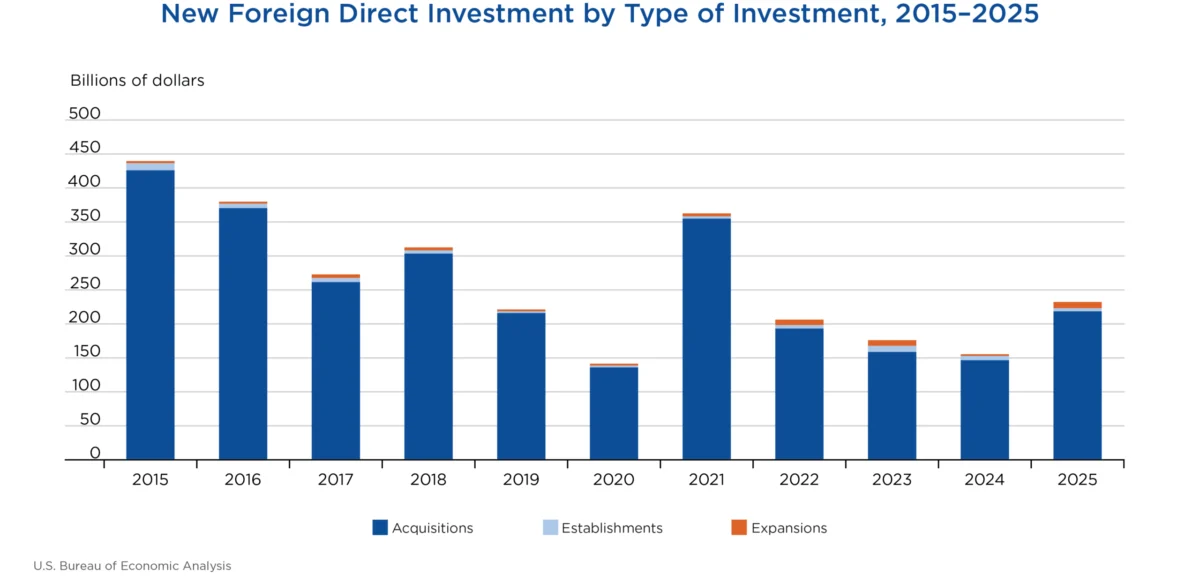
Expenditures by foreign direct investors to acquire, establish, or expand U.S. businesses reached an unprecedented $232.2 billion in 2025, marking a significant surge of $76.8 billion, or 49.5 percent, compared to the previous year, according to preliminary statistics released today by the U.S. Bureau of Economic Analysis (BEA). This substantial increase underscores the enduring appeal of the American market for global capital, with acquisitions of existing U.S. businesses continuing to represent the dominant form of foreign direct investment (FDI).
The BEA’s latest report details a robust investment landscape, with acquisitions accounting for the lion’s share of the $232.2 billion in first-year expenditures. Specifically, $218.4 billion was channeled into acquiring established U.S. companies, while $4.6 billion was allocated to establishing entirely new businesses and $9.2 billion to expanding operations of existing foreign-owned enterprises. Beyond immediate outlays, planned total expenditures, encompassing both initial investments and projected future spending, reached an even more impressive $284.5 billion, signaling strong long-term commitment from international investors.
This influx of foreign capital translated directly into job creation and economic activity. In 2025, newly acquired, established, or expanded foreign-owned businesses provided employment for 213,100 individuals. Of these, current employment within acquired enterprises stood at 211,700. The projected total employment, including the planned workforce for new ventures and expansions, is expected to reach 232,400 once these operations are fully realized, indicating a significant boost to the U.S. labor market.
Sectoral Breakdown: Manufacturing Leads the Pack
The BEA’s granular analysis reveals key sectoral preferences among foreign investors. The manufacturing sector emerged as the primary beneficiary, attracting a substantial $121.8 billion, representing 52.5 percent of all new FDI expenditures. Within manufacturing, the chemicals industry, with $45.4 billion in investment, and the plastics and rubber products manufacturing sector, with $19.0 billion, were particularly strong performers. However, the publishing industries also saw a significant influx, drawing $50.7 billion in FDI, highlighting a diversified investment appetite.
Global Investors Eyeing American Opportunities
The United States continues to be a magnet for investors from across the globe. In 2025, Japan was the leading source of FDI, injecting $50.5 billion into the U.S. economy. Germany followed with $26.7 billion, and Canada with $23.5 billion. Regionally, Europe remained the most significant contributor, accounting for $116.6 billion, or 50.2 percent of all new foreign investment. The Asia and Pacific region also demonstrated robust engagement, with $71.9 billion in expenditures.
State-Level Impact: California and Texas Lead Attraction
On a state-by-state basis, California once again proved to be a prime destination for foreign investment, attracting $59.7 billion in first-year expenditures. Texas followed with $21.5 billion, and Pennsylvania secured the third position with $20.9 billion. These figures highlight the concentration of investment in states with strong economies, skilled workforces, and favorable business environments.
Greenfield Investment: A Focus on New Growth and Expansion
Beyond acquisitions, greenfield investments—expenditures aimed at establishing new U.S. businesses or expanding existing foreign-owned ones—totaled $13.8 billion in 2025. This category is crucial for understanding the creation of new economic capacity and job opportunities. Transportation and warehousing led greenfield investment by industry, attracting $3.6 billion. This was followed by computers and electronics products manufacturing ($2.0 billion) and chemicals manufacturing ($1.8 billion).
Investors from the Asia and Pacific region were particularly active in greenfield initiatives, contributing $8.3 billion. Australia led this group with $3.0 billion in greenfield investment, followed by South Korea ($2.2 billion) and Japan ($1.7 billion). At the state level, Louisiana emerged as a significant recipient of greenfield investment, securing $3.0 billion, with Arizona ($2.7 billion) and Texas ($1.9 billion) also seeing substantial inflows. Planned total expenditures for greenfield investments initiated in 2025 reached $66.1 billion, indicating a strong pipeline of future growth initiatives.
Employment Dynamics: Sectoral and National Contributions
The employment impact of FDI is a critical measure of its contribution to the U.S. economy. In 2025, the plastics and rubber parts manufacturing sector reported the largest number of current employees within acquired foreign-owned enterprises, with 21,800 individuals. Transportation equipment manufacturing followed with 17,300 employees, and primary and fabricated metals manufacturing with 16,400.
By country of origin, Mexican investors accounted for the largest number of current employees, with 54,600 individuals employed in their U.S. ventures. Canadian investors supported 29,500 jobs, and those from the United Kingdom employed 26,800. At the state level, California once again led in job creation, with 37,200 current employees in foreign-owned businesses. Illinois followed with 17,600 employees, and Texas with 16,500.
Revisions to 2024 Data Highlight Ongoing Trends
The BEA also released revised figures for 2024, offering a clearer perspective on the trajectory of FDI. First-year expenditures for 2024 were revised upward to $155.3 billion from a previously reported $151.0 billion. This upward revision was largely driven by an increase in acquisitions, which were adjusted to $146.4 billion from $143.0 billion. Similarly, planned total expenditures for 2024 were revised to $164.0 billion from $157.0 billion, reflecting a more optimistic outlook on future investment commitments. These revisions underscore the dynamic nature of FDI data and the consistent upward trend observed over the past two years.
Analysis: A Strong Signal of Economic Confidence
The substantial increase in FDI in 2025, particularly the surge in acquisitions, can be interpreted as a strong vote of confidence in the U.S. economic outlook. Foreign investors are demonstrating a willingness to commit significant capital, suggesting they anticipate continued growth, stability, and profitability within the American market. The robust figures in manufacturing, a sector critical to national economic health and technological advancement, are particularly encouraging.
The emphasis on acquisitions indicates that foreign entities are leveraging existing U.S. infrastructure, established customer bases, and skilled workforces to expand their global reach. This can lead to efficiencies, technological transfers, and increased competitiveness for acquired companies. Simultaneously, the significant greenfield investment signals a commitment to building new capacity and creating novel economic opportunities within the United States, fostering innovation and long-term job growth.
The geographic distribution of investment, with California and Texas leading, highlights the continued importance of innovation hubs and energy-rich states in attracting foreign capital. However, the significant greenfield investment in states like Louisiana suggests a broadening of investment appeal, potentially driven by specific industry strengths or attractive business incentives.
Implications for the U.S. Economy
The surge in FDI in 2025 carries several positive implications for the U.S. economy. It contributes to capital formation, which can fuel business expansion and innovation. The creation of new jobs and the expansion of existing ones directly benefit American workers. Furthermore, FDI can introduce new technologies, management practices, and access to global markets, enhancing the competitiveness of U.S. industries. Increased competition from foreign-owned firms can also lead to greater efficiency and lower prices for consumers.
However, policymakers and economic observers will continue to monitor the nature of this investment. While acquisitions can bring immediate benefits, a sustained focus on greenfield investment is crucial for long-term, organic growth and the creation of entirely new economic ecosystems. The BEA’s commitment to refining its disclosure avoidance methods, as noted in its technical guidance, ensures that such data can be released more comprehensively while maintaining confidentiality, providing a clearer picture for economic analysis and policy formulation.
Future Outlook
The BEA’s announcement also provides a preview of future data releases, with the next update on New Foreign Direct Investment in the United States scheduled for June 2027, covering the 2026 investment year. This consistent reporting cycle allows for ongoing monitoring of trends and the impact of global economic conditions on U.S. investment attractiveness. The strong performance in 2025 sets a high benchmark, and continued global economic stability and favorable business conditions will be key to sustaining this momentum in the coming years. The detailed data tables made available by the BEA will continue to serve as an invaluable resource for researchers, policymakers, and businesses seeking to understand the intricate landscape of foreign direct investment in the United States.