Lana Rhoades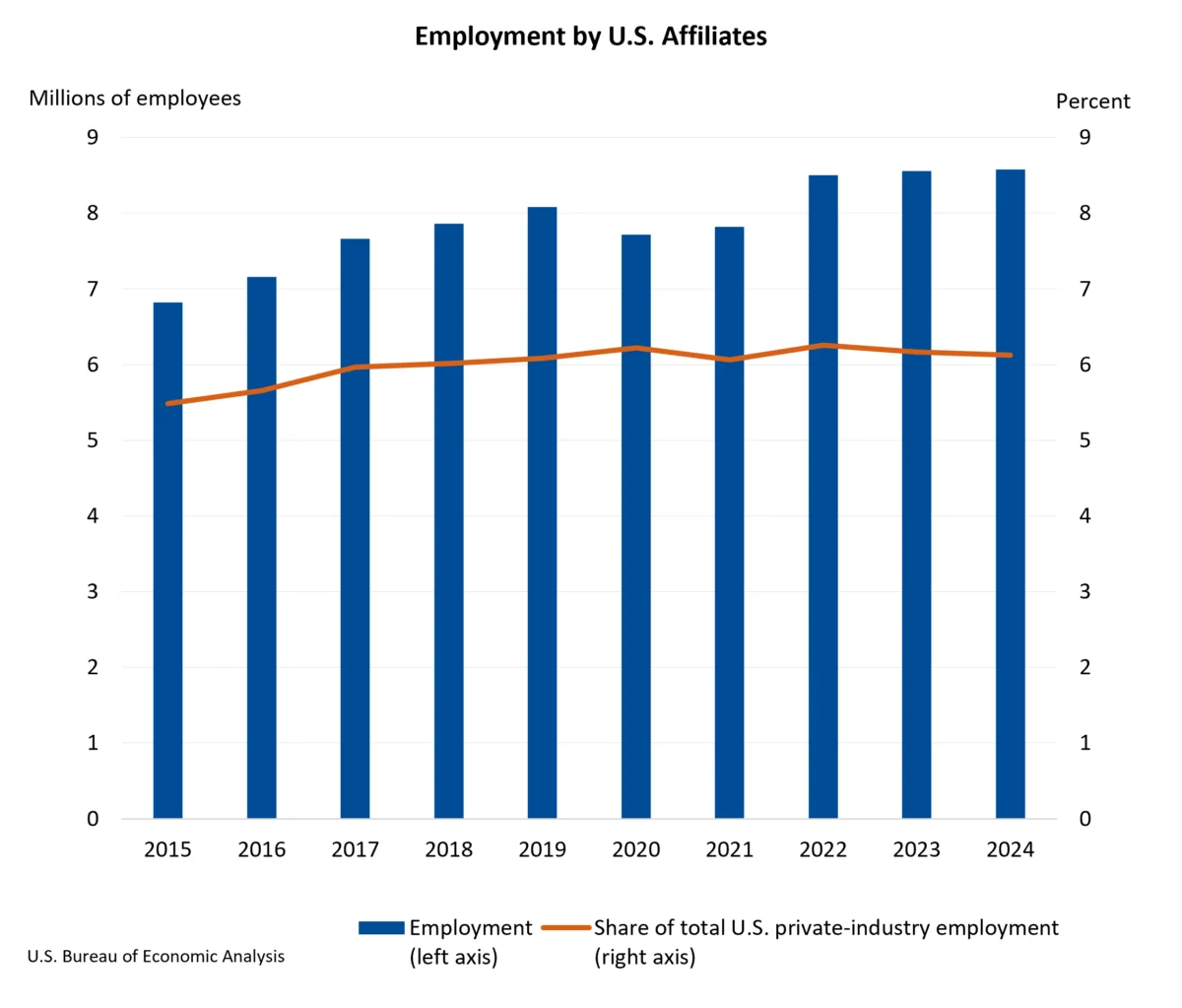
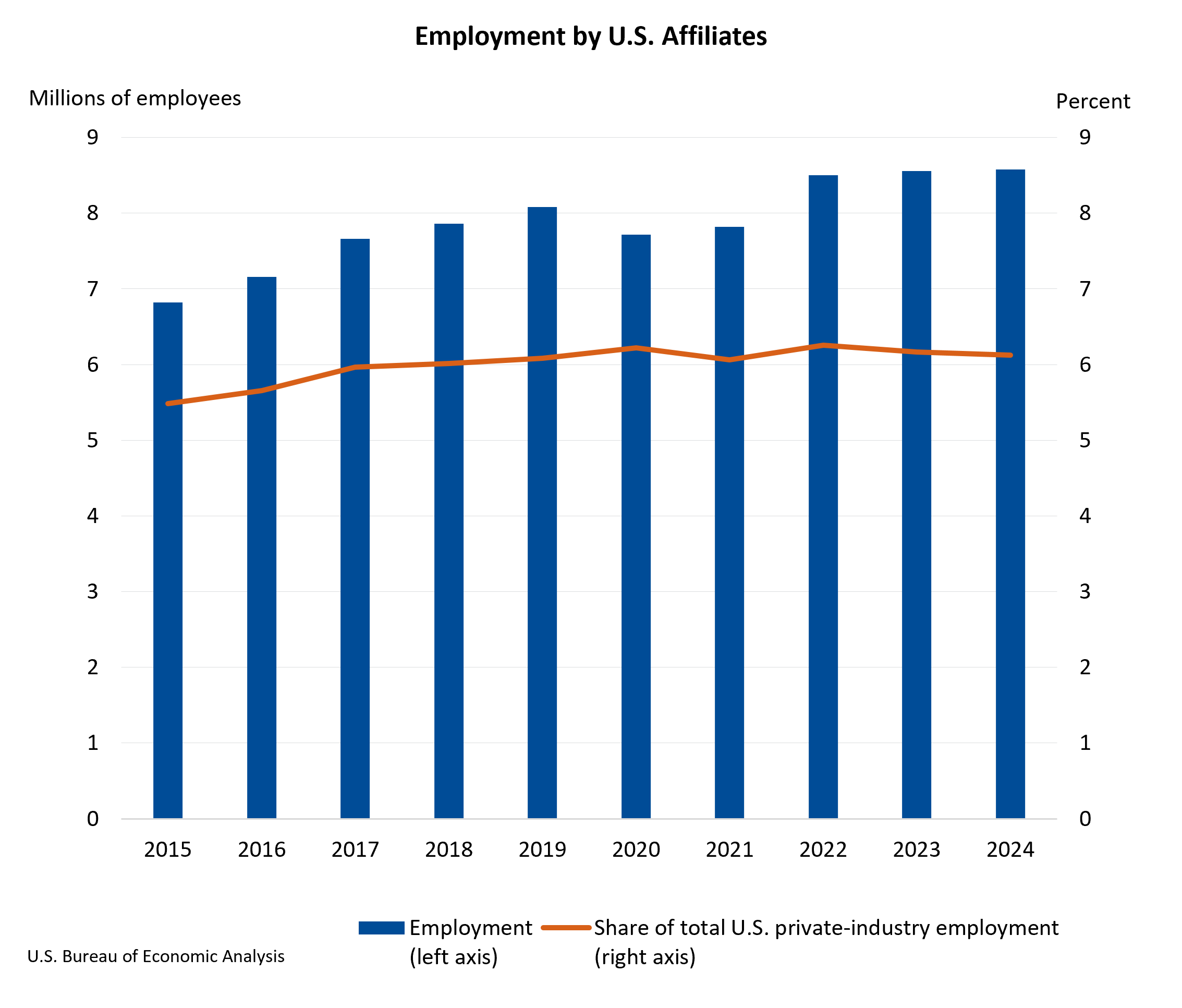
Majority-owned U.S. affiliates of foreign multinational enterprises (MNEs) employed 8.57 million workers in the United States in 2024, marking a modest 0.2 percent increase from the 8.56 million recorded in 2023. This consistent employment growth, as detailed in newly released statistics by the U.S. Bureau of Economic Analysis (BEA), underscores the significant and enduring role of foreign direct investment in the American labor market. While the percentage increase is incremental, it reflects a sustained commitment by foreign-owned entities to maintaining and slightly expanding their workforce within the U.S. economy.
These U.S. affiliates, which represent the domestic operations of companies where a foreign entity holds a controlling stake, collectively accounted for 6.1 percent of total private-industry employment across the nation in 2024. This figure represents a slight decrease from 6.2 percent in the preceding year, indicating that while the absolute number of jobs has grown, the overall share of employment within the broader private sector has seen a marginal contraction. This subtle shift may be attributed to various factors, including faster growth in other sectors of the U.S. economy or a more dynamic pace of job creation by domestic U.S. companies.
The distribution of employment within these foreign-affiliated companies reveals key sectoral concentrations. The manufacturing sector and the retail trade sector emerged as the largest employers among U.S. affiliates. This highlights the continued importance of these industries in absorbing labor provided by international investors, reinforcing their foundational role in the U.S. economic landscape. These sectors often require substantial workforces for production, distribution, and customer service, making them natural magnets for foreign investment seeking to tap into the American consumer base and industrial capacity.
Further analysis of the BEA data indicates that U.S. affiliates with ultimate beneficial owners (UBOs) in the United Kingdom, Japan, and Germany were the most significant contributors to overall employment. This geographical concentration of investment reflects long-standing economic ties and strategic business relationships between the United States and these key global economic powers. Companies from these nations have historically demonstrated a strong propensity for investing in the U.S. market, leveraging its stability, market size, and skilled labor force. The United Kingdom, Japan, and Germany, through their respective companies, have consistently ranked among the top foreign investors in the U.S., and their affiliates continue to be major job creators.
Beyond employment figures, the economic footprint of these majority-owned U.S. affiliates extends significantly into the nation’s Gross Domestic Product (GDP). The current-dollar value added by these affiliates, a key metric representing their direct contribution to U.S. economic output, experienced a robust increase of 4.3 percent in 2024, reaching a substantial $1.52 trillion. This growth rate outpaced the employment growth, suggesting an increase in productivity or a shift towards higher-value activities within these firms. Collectively, these affiliates accounted for 6.7 percent of total U.S. business-sector value added in 2024, a slight dip from 6.8 percent in 2023. Similar to employment, this marginal decrease in their share of value added, despite absolute growth, points to the broader dynamism of the U.S. economy.
Investment in the future productive capacity of the United States is also evident in the capital expenditures of these foreign-affiliated companies. Expenditures for property, plant, and equipment by U.S. affiliates saw a notable increase of 3.3 percent, totaling $328.0 billion. This expansion in physical assets signals confidence in the long-term economic outlook of the U.S. and a commitment to enhancing operational capabilities. Such investments are crucial for modernizing infrastructure, increasing efficiency, and supporting future job growth.
Innovation and technological advancement are also areas where U.S. affiliates of foreign MNEs are making significant contributions. Research and development (R&D) performed by these entities surged by 5.3 percent, reaching $95.5 billion. This upward trend underscores the role of foreign investment in fueling innovation within the U.S. These affiliates accounted for a significant 12.4 percent of total U.S. business R&D in 2024, demonstrating their crucial role in driving technological progress and competitiveness across various industries. This substantial investment in R&D not only benefits the parent companies but also contributes to the U.S. knowledge economy, fostering a pipeline of new ideas, products, and processes.
Geographically, the impact of U.S. affiliate employment is widely distributed across the nation, with California, Texas, and New York leading as the top states for job creation. California reported the highest number of employees at 885,200, followed by Texas with 717,400, and New York with 556,700. In all three of these major economic hubs, the manufacturing sector stood out as the primary employer among U.S. affiliates. This concentration in manufacturing in these key states reflects a continued demand for skilled labor in production and related support roles, as well as the strategic importance of these states as centers for trade and industry.
The BEA’s release provides a comprehensive dataset, offering further insights into various aspects of U.S. affiliate operations, including sales, balance sheet and income statement items, compensation of employees, and trade flows. This detailed information allows for a deeper understanding of the multifaceted contributions of foreign direct investment to the U.S. economy. The availability of industry-, country-, and state-level details enables policymakers, researchers, and businesses to conduct granular analyses and make informed strategic decisions.
Updates and Revisions to 2023 Statistics
In conjunction with the release of the 2024 data, the BEA also presented revised statistics for 2023. These revisions incorporate newly available and updated source data, offering a more accurate picture of the economic activities of U.S. affiliates during that year. Preliminary estimates for 2023 were initially released in December 2025, and the subsequent revisions highlight the iterative nature of economic data collection and analysis.
Key revisions for 2023 include:
- Number of employees: The revised estimate shows 8,556.9 thousand employees, a slight adjustment from the preliminary estimate of 8,661.8 thousand. This indicates a minor downward revision to the total workforce employed by these affiliates in 2023.
- Value added: The revised value added figure stands at $1,456.3 billion, compared to the preliminary estimate of $1,469.1 billion. This suggests a marginal decrease in the initial assessment of the contribution to GDP for that year.
- Expenditures for property, plant, and equipment: The revised estimate for capital expenditures is $317.6 billion, down from the preliminary $322.7 billion. This indicates a slight recalibration of investment in fixed assets.
- Research and development expenditures: Notably, the R&D expenditure figure saw an upward revision, from $87.8 billion preliminarily to $90.6 billion. This suggests that foreign-affiliated companies invested more in innovation in 2023 than initially reported, reinforcing the trend of strong R&D investment.
These revisions, while sometimes minor, are critical for ensuring the accuracy and reliability of economic indicators used for policy-making and economic forecasting. The BEA’s commitment to refining its data underscores its dedication to providing the most precise economic intelligence possible.
Broader Implications and Economic Context
The consistent growth in employment by majority-owned U.S. affiliates of foreign MNEs is a positive indicator for the U.S. economy. It signifies that foreign companies continue to view the United States as an attractive destination for investment, a testament to its stable economic and political environment, large consumer market, and skilled workforce. This inflow of foreign capital not only creates jobs but also spurs competition, introduces new technologies and management practices, and contributes to the overall dynamism of the U.S. business landscape.
The sectors that are major recipients of this foreign investment—manufacturing and retail trade—are critical pillars of the U.S. economy. The continued strength of foreign investment in manufacturing, in particular, is important for domestic industrial capacity, supply chain resilience, and the creation of well-paying jobs. In an era of increasing global economic uncertainty and supply chain disruptions, the presence of robust foreign-owned manufacturing operations within the U.S. contributes to national economic security.
The significant investment in R&D by these affiliates is also a crucial element. In a global economy driven by innovation, the substantial contribution of foreign-owned companies to U.S. R&D efforts helps maintain the nation’s technological edge and fosters the development of next-generation industries. This symbiotic relationship between foreign investment and domestic innovation is vital for long-term economic competitiveness and growth.
While the overall share of employment and value added by these affiliates saw a slight decline as a percentage of the total U.S. economy, this should be viewed within the context of a dynamic and growing U.S. economy. The absolute growth in jobs and economic output generated by these foreign-owned entities remains substantial and critically important. The slight shift in percentages might reflect the robust performance of domestic U.S. companies or faster growth in sectors less dominated by foreign affiliates.
Future Outlook and Data Availability
The BEA anticipates releasing the next set of statistics on the activities of U.S. affiliates of foreign multinational enterprises in the spring of 2027, covering the 2025 activities. This ongoing data collection and dissemination by the BEA provides a vital resource for understanding the evolving landscape of foreign direct investment in the United States.
Additional detailed statistics, including data on sales, balance sheet and income statement items, compensation of employees, and trade, are readily available on the BEA’s website. The agency also provides comprehensive data tables and an interactive data application, allowing users to explore industry-, country-, and state-level details. This commitment to data transparency and accessibility empowers stakeholders to gain a granular understanding of the impact of foreign investment.
It is important to note that the BEA has updated its disclosure avoidance methods to include coarsening techniques such as rounding, aggregation, and the use of ranges. This methodological enhancement aims to publish more data while ensuring the confidentiality of survey respondents, striking a balance between transparency and privacy.
The ongoing trends in employment, investment, and R&D by majority-owned U.S. affiliates of foreign multinational enterprises paint a picture of sustained foreign commitment to the American economy. As these companies continue to grow and invest, they will undoubtedly remain a significant force in shaping the future of U.S. employment, innovation, and economic output. The data released by the BEA serves as a crucial barometer, offering insights into the intricate and vital relationship between global capital and the American marketplace.