Lana Rhoades
The U.S. current-account deficit, a key measure of a nation’s international economic transactions, expanded by a substantial $33.4 billion, or 15.7 percent, to reach $246.0 billion in the second quarter of 2026. This widening, as reported by the U.S. Bureau of Economic Analysis (BEA), signals a growing imbalance in the nation’s trade with the rest of the world and has implications for domestic investment and global economic dynamics. The revised figure for the first quarter of 2026 stood at a deficit of $212.6 billion.
This increased deficit represented 3.0 percent of current-dollar gross domestic product (GDP) in the second quarter, a notable uptick from 2.7 percent in the preceding quarter. This suggests that the nation’s international borrowing needs, relative to its economic output, have grown. The BEA’s comprehensive report, released today, provides a detailed breakdown of the transactions contributing to this shift, highlighting the dominant role of the goods trade balance.
Deep Dive into the Contributing Factors
The $33.4 billion expansion of the current-account deficit in the second quarter was primarily fueled by a worsening deficit in the trade of goods. This was a significant drag on the overall balance. However, this negative impact was partially mitigated by narrower deficits in primary income (earnings from investments abroad and wages) and secondary income (current transfers like remittances and foreign aid).
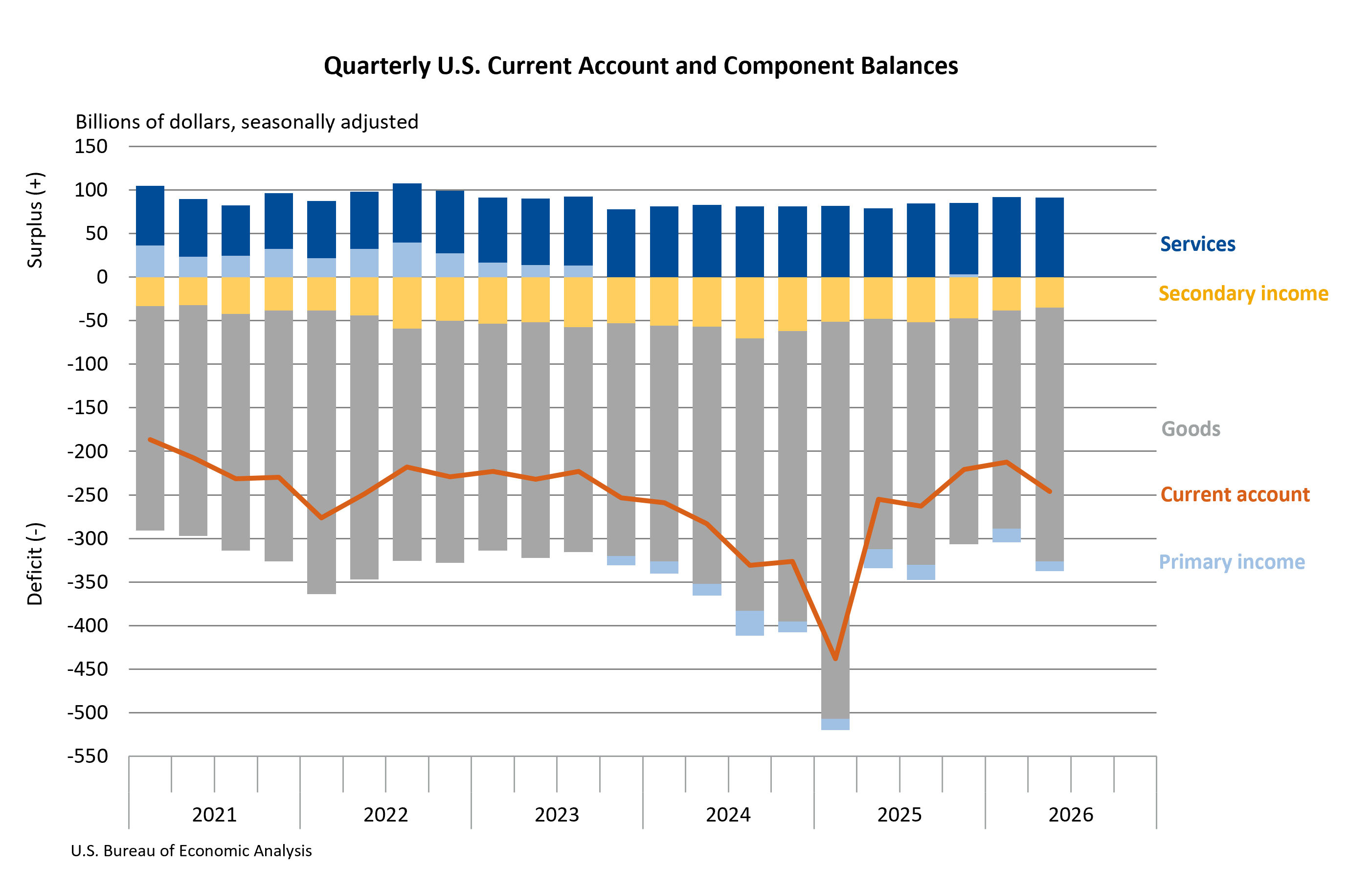
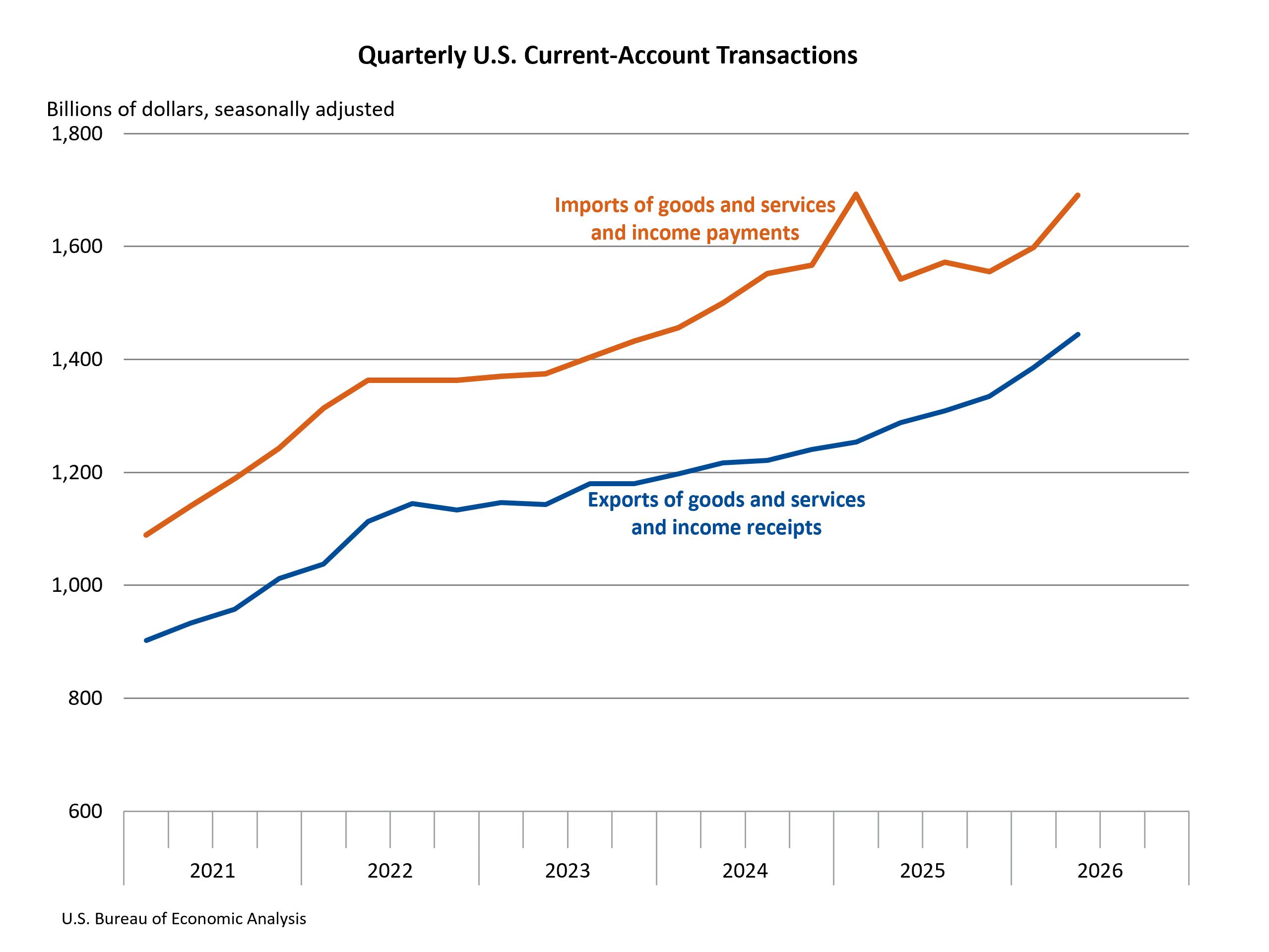
Exports of goods and services, along with income received from foreign residents, collectively saw an increase of $58.8 billion, bringing the total to $1.44 trillion. This growth was attributed to higher receipts from both goods exports and primary income earned abroad. On the flip side, imports of goods and services, as well as income paid to foreign residents, experienced a more pronounced rise of $92.2 billion, reaching $1.69 trillion. This surge in imports was largely driven by increased purchases of goods from abroad and higher primary income payments to foreign entities.
The deficit on goods, a persistent concern for U.S. trade policy, widened considerably. While the services sector continued to contribute positively to the current account with a surplus of $92.1 billion in the first quarter (revised from preliminary estimates), the growth in goods imports outpaced that of goods exports, exacerbating the overall trade imbalance. The primary income balance, while narrowing its deficit, still represented a significant outflow of funds, reflecting the substantial foreign holdings of U.S. assets and U.S. investments abroad.
Secondary income, which encompasses a range of current transfers, saw its deficit shrink. This suggests a reduction in net outflows related to remittances, foreign aid, and other forms of unrequited transfers.
Capital Transfers and Financial Account Dynamics
Beyond the current account, the BEA report also sheds light on capital transfers and the financial account. Capital-transfer receipts, which represent transfers of ownership of fixed assets or forgiveness of liabilities without any consideration, decreased by $1.1 billion to $2.3 billion in the second quarter. Similarly, capital-transfer payments saw a reduction of $0.9 billion, totaling $1.0 billion. These movements, while smaller in magnitude compared to the current account, contribute to the overall international financial picture.
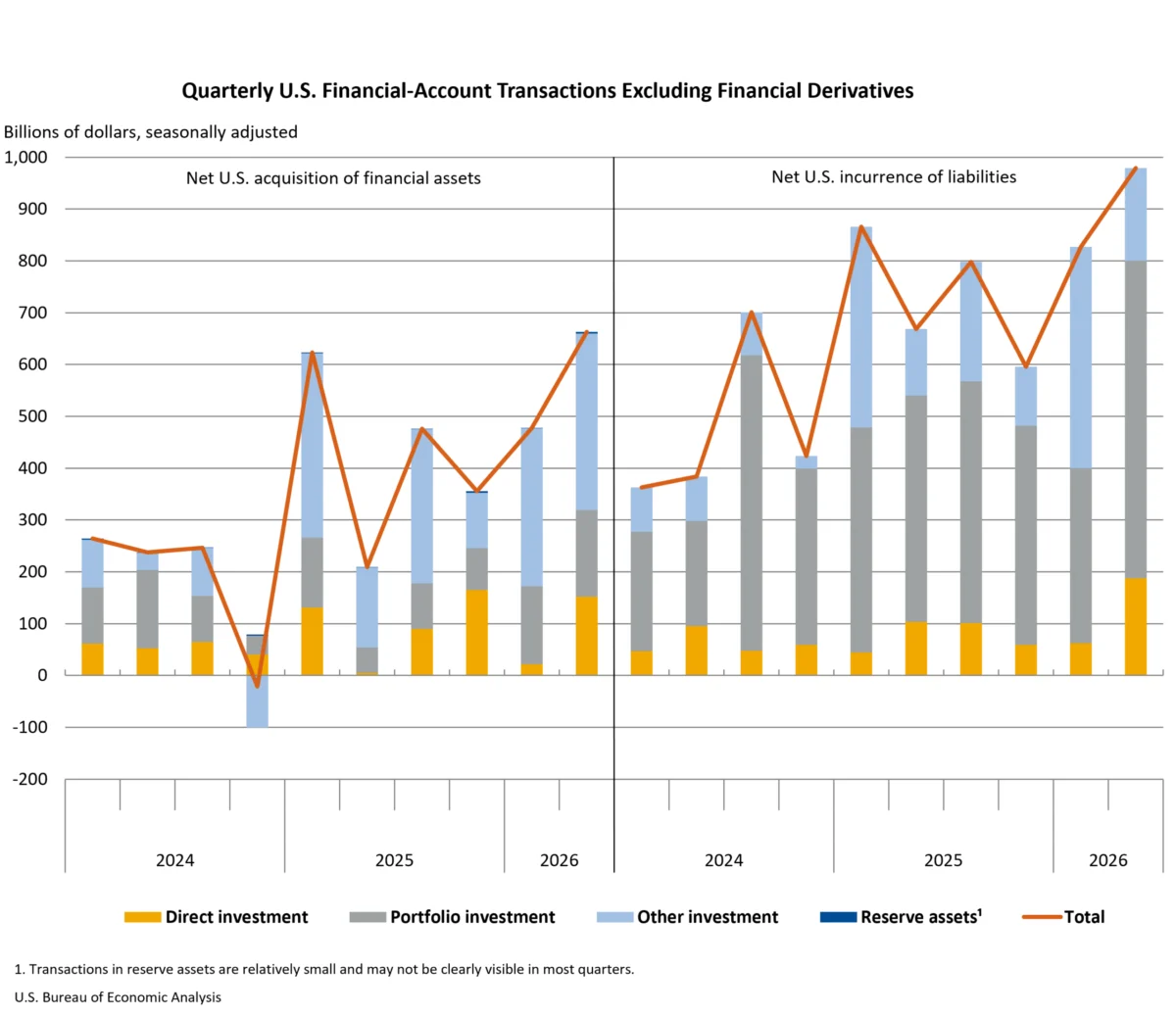
The financial account, which tracks the flow of investments between the U.S. and the rest of the world, recorded net transactions of -$369.7 billion in the second quarter. This substantial negative balance signifies that the U.S. was a net borrower from foreign residents during this period. Specifically, U.S. residents increased their holdings of foreign financial assets by $663.3 billion, while simultaneously increasing their liabilities to foreign residents by a larger $978.9 billion. This net outflow of capital indicates a reliance on foreign funding to finance domestic activities or investments.
Net International Investment Position: A Persistent Debt
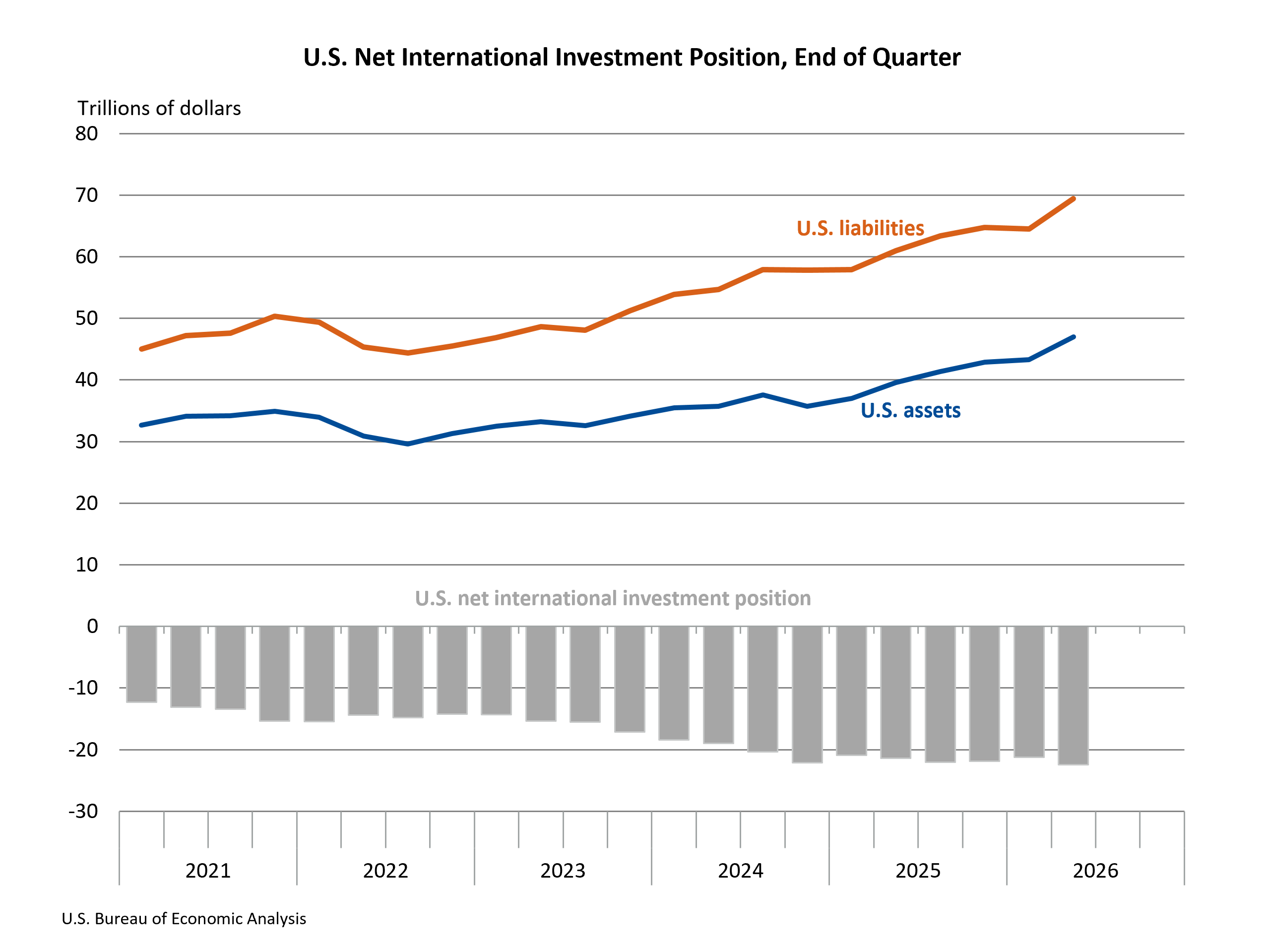
The nation’s net international investment position, which represents the difference between U.S. residents’ foreign financial assets and liabilities, remained significantly in deficit. At the end of the second quarter of 2026, this net position stood at -$22.42 trillion. This figure is a cumulative result of years of international transactions. U.S. assets abroad totaled $46.97 trillion, while U.S. liabilities to foreign residents amounted to $69.39 trillion. This substantial negative net investment position underscores the long-standing reliance of the U.S. economy on foreign capital.
Compared to the end of the first quarter of 2026, the net investment position deteriorated from a revised -$21.27 trillion. This widening of the net debtor position is a consequence of the financial account flows and valuation changes.
Drivers of Asset and Liability Changes
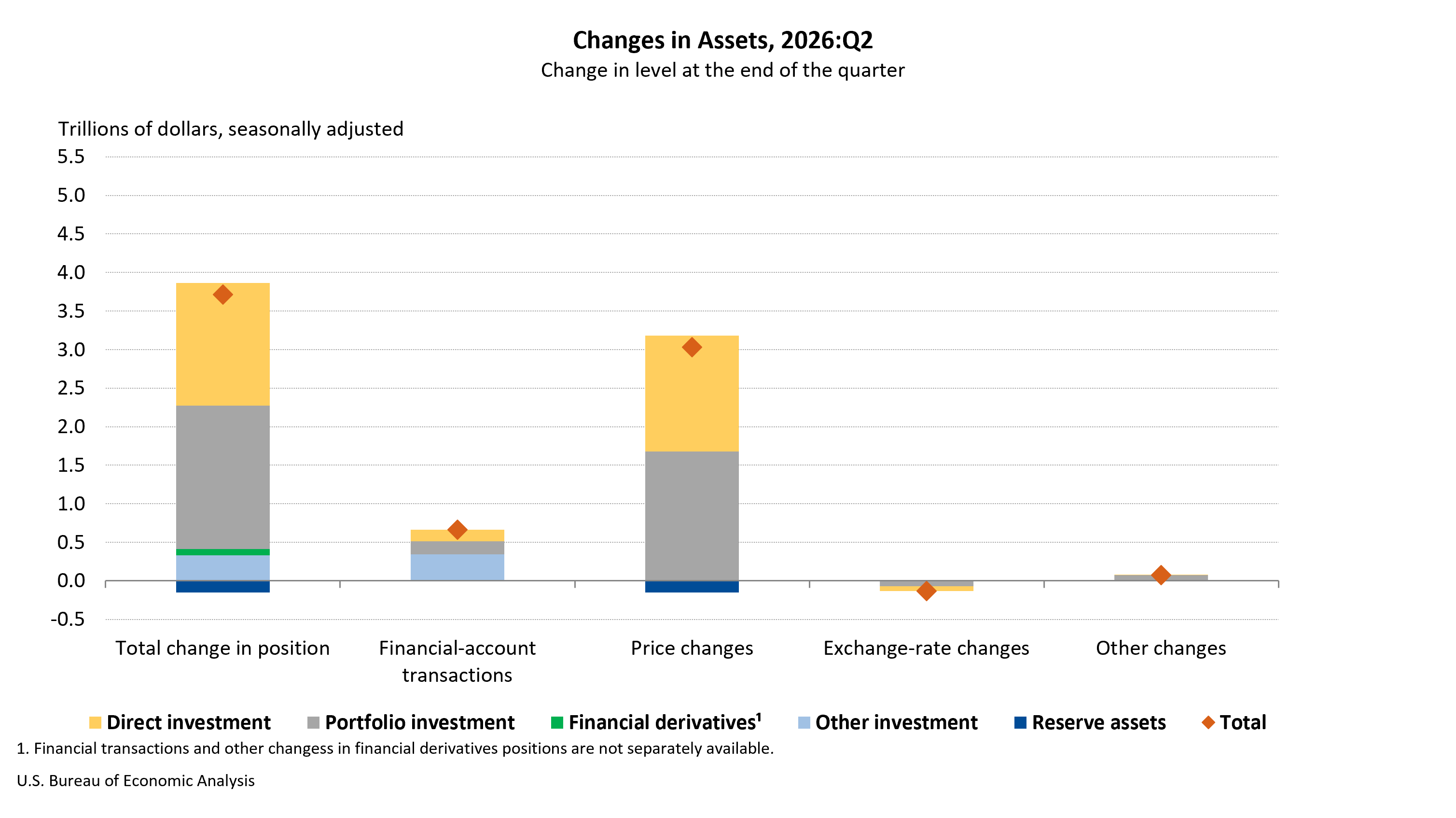
The significant increases in both U.S. assets and liabilities in the second quarter were influenced by a combination of financial transactions and valuation effects (changes in prices). U.S. assets abroad increased by $3.72 trillion. This rise was broad-based, with notable increases across most major investment categories, excluding reserve assets. The primary drivers of this increase were price changes, accounting for $3.03 trillion, and financial transactions, which contributed $663.3 billion. This suggests that the value of U.S. investments abroad appreciated, alongside new investments made by U.S. residents.
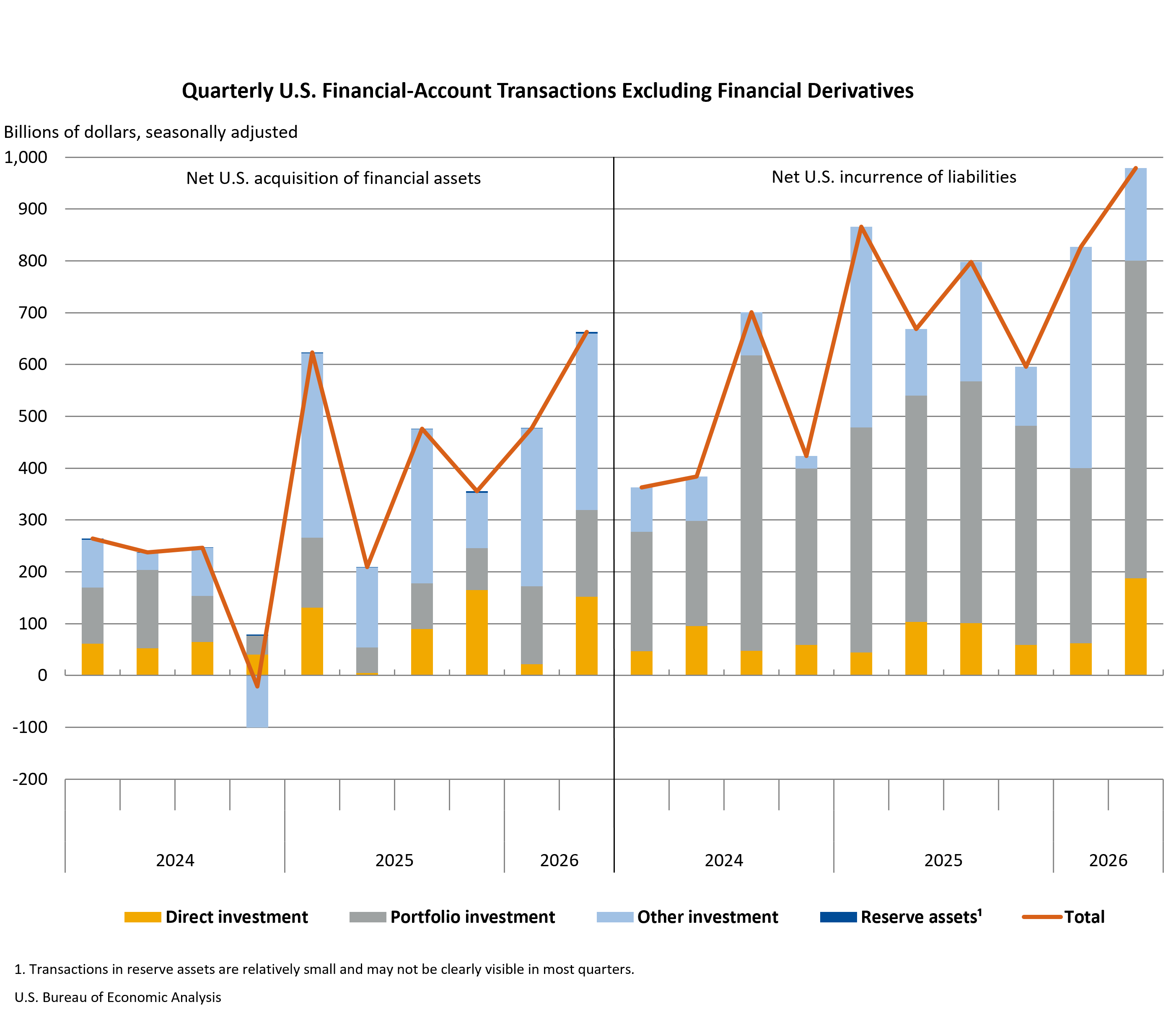
Conversely, U.S. liabilities to foreign residents surged by $4.87 trillion. This increase was also widespread across investment categories, with a particularly strong uptick in portfolio investment, which includes stocks and bonds. Similar to assets, price changes played a dominant role, contributing $3.95 trillion to the increase in liabilities, while financial transactions accounted for $978.9 billion. This indicates that the value of foreign investments in the U.S. also appreciated significantly, alongside new capital inflows from foreign entities.
Background and Context: The Current Account Deficit
The current account is a broad measure of a country’s economic transactions with the rest of the world. It includes the balance of trade in goods and services, net income from abroad (primary income), and net current transfers (secondary income). A persistent current account deficit means a country is importing more goods, services, and capital than it is exporting. This typically implies that the country is a net borrower from the global economy, financing its consumption and investment through foreign capital.
For the United States, a current account deficit has been a long-standing feature of its economic landscape. Historically, this has been financed by the U.S. dollar’s status as the world’s primary reserve currency, attracting foreign investment. However, sustained and widening deficits can raise concerns about long-term economic sustainability, potential currency depreciation, and reliance on foreign creditors.
Timeline of Recent Trends
-
First Quarter 2026 (Revised): The current-account deficit stood at -$212.6 billion. Preliminary estimates had shown a deficit of -$226.8 billion, indicating upward revisions in certain components. The net financial-account transactions were revised to -$295.2 billion from a preliminary -$209.0 billion. The U.S. net international investment position remained unchanged at -$21.27 trillion in preliminary and revised estimates.
-
Second Quarter 2026: The current-account deficit widened to -$246.0 billion, an increase of $33.4 billion or 15.7 percent from the revised first-quarter figure. This quarter saw a notable expansion in the goods deficit, partially offset by reductions in primary and secondary income deficits. Net financial-account transactions were -$369.7 billion, indicating increased net borrowing. The U.S. net international investment position declined to -$22.42 trillion.
Broader Economic Implications and Analysis
The widening current-account deficit in the second quarter of 2026 signals a continuing trend of the U.S. economy absorbing more resources from the global economy than it provides. This can be driven by various factors, including strong domestic demand, investment opportunities attracting foreign capital, and competitive disadvantages in certain export sectors.
From an analytical perspective, a widening deficit, especially when coupled with a growing net international investment position deficit, suggests a country is accumulating debt on the global stage. While foreign capital can fuel domestic growth and investment, excessive reliance can create vulnerabilities. A significant portion of the recent increase in U.S. liabilities was driven by valuation effects, meaning the market value of foreign-held assets in the U.S. increased. This can be positive in the short term, reflecting a strong U.S. asset market, but it also means a larger debt burden if these assets are to be repaid or divested.
The increase in the goods deficit remains a critical area of focus. Policies aimed at boosting U.S. manufacturing competitiveness, diversifying supply chains, and addressing trade barriers could be crucial in moderating this component of the current account. The role of primary income payments is also significant; a growing deficit here can reflect increased foreign ownership of U.S. companies or debt instruments, leading to higher profit and interest outflows.
Official Responses and Future Outlook
While the Bureau of Economic Analysis provides the data, official responses from government bodies like the Treasury Department or the Federal Reserve typically offer context and policy perspectives. In the absence of specific statements tied to this report, it can be inferred that policymakers would likely view this widening deficit with a degree of concern, particularly if it signals a structural imbalance rather than a temporary cyclical phenomenon.
The BEA’s report also highlights the dynamic nature of international economic data. The revisions to first-quarter estimates underscore the complexity of these measurements and the ongoing process of data refinement. The next release, scheduled for December 18, 2026, will provide the third-quarter 2026 statistics, offering further insight into the trajectory of the U.S. current account and its international investment position. Investors, policymakers, and economists will be closely watching these figures for signs of stabilization or continued deterioration in the nation’s external economic balance.
The data presented by the BEA serves as a crucial indicator for understanding the intricate web of global economic relationships and the financial health of the United States on the international stage. The widening current-account deficit in the second quarter of 2026 warrants continued monitoring and analysis to assess its long-term implications for the U.S. economy.