Lana Rhoades
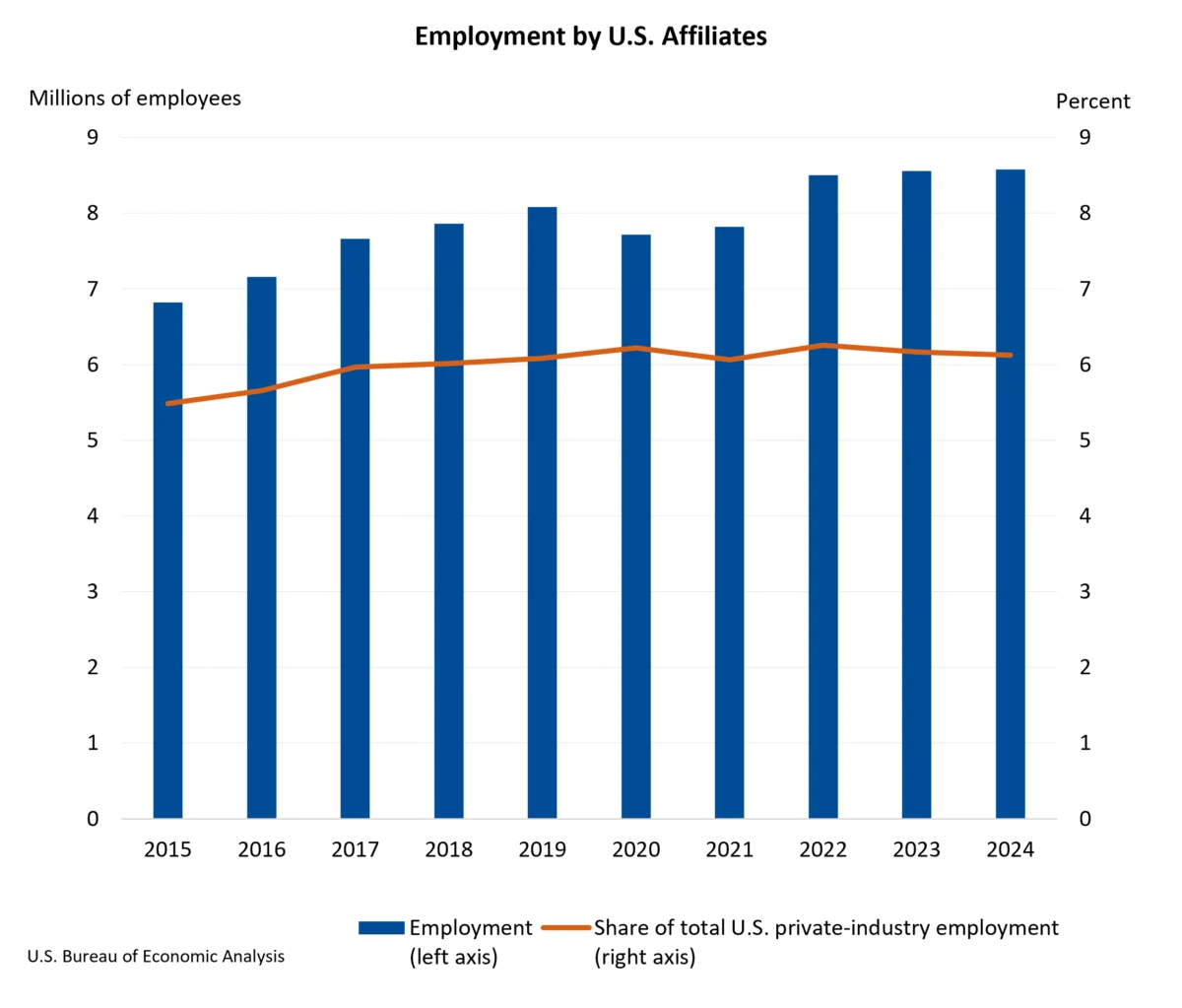
Majority-owned U.S. affiliates of foreign multinational enterprises (MNEs) provided employment for 8.57 million individuals across the United States in 2024, marking a slight increase of 0.2 percent from the 8.56 million jobs reported in 2023. This sustained level of employment underscores the significant and ongoing role foreign direct investment plays in the American labor market, according to the latest statistics released by the U.S. Bureau of Economic Analysis (BEA). These figures represent a crucial indicator of the economic contributions made by foreign-owned companies operating within the U.S. economy, encompassing their employment figures, value added, and investment activities.
While the overall employment figure saw a marginal uptick, the share of total private-industry employment accounted for by these U.S. affiliates dipped slightly to 6.1 percent in 2024, down from 6.2 percent in the preceding year. This minor contraction in proportional representation, despite an increase in absolute numbers, reflects the broader dynamics of the U.S. labor market and the growth of domestic industries. The manufacturing and retail trade sectors continued to be the largest employers of workers within U.S. affiliates, highlighting their foundational importance in the distribution of foreign-owned enterprise employment. Geographically, affiliates with ultimate beneficial owners in the United Kingdom, Japan, and Germany remained the most substantial contributors to this employment base, reflecting long-standing investment relationships and strategic interests in the U.S. market.
The economic footprint of these foreign-owned entities extends beyond employment. Their current-dollar value added, a key measure of their direct contribution to the U.S. gross domestic product (GDP), experienced a more robust increase of 4.3 percent, reaching $1.52 trillion in 2024. This figure signifies a significant injection of economic activity into the nation’s output. However, similar to employment, their proportional contribution to total U.S. business-sector value added saw a slight decrease, settling at 6.7 percent in 2024 from 6.8 percent in 2023. This nuanced performance suggests that while foreign affiliates are expanding their economic output, the overall U.S. business sector may be growing at a slightly faster pace in certain areas.
Investment in the future of their U.S. operations also saw positive growth. Expenditures for property, plant, and equipment by these affiliates rose by 3.3 percent to $328.0 billion. This capital investment is a critical signal of foreign companies’ commitment to their U.S. facilities and operations, indicating plans for expansion, modernization, and enhanced productivity. Furthermore, research and development (R&D) performed by U.S. affiliates demonstrated a strong upward trend, increasing by 5.3 percent to $95.5 billion. These affiliates now account for a substantial 12.4 percent of all R&D conducted by U.S. businesses, underscoring their role as significant drivers of innovation and technological advancement within the United States. This growing investment in R&D is particularly noteworthy, as it signals a move beyond basic operational presence towards contributing to the intellectual capital and future competitiveness of the U.S. economy.
Geographically, the impact of these foreign-owned enterprises is unevenly distributed, with certain states benefiting more significantly from their presence. California led the nation in employment by U.S. affiliates, reporting 885,200 jobs. Texas followed with 717,400 employees, and New York secured the third position with 556,700 workers. In each of these leading states, the manufacturing sector was the primary engine of employment for foreign-affiliated companies, indicating a strong concentration of industrial and production activities.
The BEA’s comprehensive data release also provides an update on the statistics for 2023, incorporating newly available and revised source data. This revision process is crucial for ensuring the accuracy and reliability of economic indicators. For instance, the initial preliminary estimates for 2023 indicated 8,661.8 thousand employees, which has now been revised to 8,556.9 thousand. Similarly, value added for 2023 was revised from $1,469.1 billion to $1,456.3 billion. Expenditures for property, plant, and equipment saw a revision from $322.7 billion to $317.6 billion, and R&D expenditures were revised from $87.8 billion to $90.6 billion. These adjustments highlight the dynamic nature of economic data collection and the importance of periodic revisions to reflect the most accurate picture of economic activity.
Context and Background: The Role of Foreign Direct Investment
The data released by the BEA pertains to "majority-owned U.S. affiliates of foreign multinational enterprises." This designation refers to U.S.-based business enterprises that are more than 50 percent owned by a foreign person or entity. These affiliates are crucial components of the U.S. economic landscape, representing significant inflows of foreign capital and expertise. Foreign direct investment (FDI) has historically been a vital contributor to U.S. economic growth, job creation, and technological advancement.
The BEA’s mandate is to provide the official statistics on U.S. international investment positions and the international and national economic accounts. The statistics on U.S. affiliates of foreign MNEs are a key part of this mission, offering insights into the operations, finances, and economic impact of foreign-owned businesses in the United States. These statistics are collected through various surveys, including the Survey of Foreign Direct Investment in the United States, which gathers detailed financial and operational data from these enterprises.
The BEA’s methodology for collecting and presenting this data has undergone updates, including enhancements to its disclosure avoidance method. The BEA has adopted a strategy of "coarsening," which involves rounding, aggregation, and the use of ranges. This approach aims to strike a balance between providing a greater volume of publishable data and maintaining strict confidentiality for BEA’s survey respondents, thereby encouraging continued participation in data collection efforts.
Key Drivers and Sectoral Distribution
The consistent strength of employment in manufacturing and retail trade by U.S. affiliates underscores the strategic importance of these sectors for foreign investors. Manufacturing often represents a significant portion of FDI, driven by access to U.S. markets, skilled labor, and established supply chains. Similarly, the retail sector benefits from the large U.S. consumer base and established distribution networks. The prominence of the United Kingdom, Japan, and Germany as source countries for FDI and subsequent employment reflects historical trade relationships, cultural ties, and established business presences in the U.S. market. These nations have consistently been among the top investors in the U.S. economy, with their companies establishing extensive operations across various sectors.
The growth in value added and R&D expenditures is particularly encouraging. An increase in value added signifies that foreign-owned businesses are generating more economic output per employee or per dollar of investment, suggesting enhanced productivity and efficiency. The substantial rise in R&D investment is a strong indicator that foreign MNEs are not merely establishing manufacturing or service hubs but are also actively participating in the innovation ecosystem of the United States. This can lead to the development of new technologies, products, and processes that benefit the broader U.S. economy and maintain its competitive edge globally.
State-Level Economic Impact
The concentration of employment in states like California, Texas, and New York reflects their status as major economic hubs with robust infrastructure, skilled workforces, and favorable business environments. California’s dominance in affiliate employment, particularly within manufacturing, points to its significant industrial base and its role as a gateway to the Pacific Rim. Texas, with its strong energy sector and growing technological industries, offers a diverse landscape for foreign investment. New York, as a global financial and commercial center, attracts a wide array of foreign-owned businesses. The BEA’s detailed state-level data, often visualized through charts and tables, allows policymakers and economic developers to understand the specific impact of foreign investment within their jurisdictions and to tailor strategies for attracting and retaining such enterprises.
Updates and Revisions: A Commitment to Accuracy
The BEA’s practice of revising previously released data is a testament to its commitment to statistical rigor. Economic data is inherently complex, and initial estimates are often based on preliminary information that may be incomplete or subject to change. The subsequent incorporation of more comprehensive and refined source data allows for a more accurate representation of economic phenomena. The revisions to the 2023 data, as detailed in the accompanying table, illustrate this iterative process. The adjustments in employment figures, value added, and capital expenditures provide a clearer picture of the economic performance of U.S. affiliates in that year. This transparency in data revision is crucial for building trust in the official statistics and for informing economic analysis and policy decisions.
Broader Implications and Future Outlook
The sustained employment figures from majority-owned U.S. affiliates of foreign MNEs highlight the ongoing importance of FDI for the U.S. economy. While the slight decrease in the proportional share of private-industry employment might warrant further analysis, the absolute increase in jobs and the significant growth in value added and R&D expenditures paint a picture of continued foreign engagement and investment. The BEA’s commitment to providing detailed, up-to-date statistics on these activities is invaluable for understanding the intricate web of global economic integration and its impact on domestic prosperity.
The BEA’s announcement also points to future data releases, with the next update on the activities of U.S. affiliates of foreign multinational enterprises slated for Spring 2027, covering activities for 2025. This forward-looking perspective underscores the continuous monitoring of this critical economic segment. As global economic conditions evolve, the role and impact of foreign direct investment in the United States will continue to be a subject of significant interest, with BEA data serving as the primary source for informed analysis and discussion. The trend of increasing R&D investment, in particular, suggests a future where foreign-owned entities play an even more prominent role in driving innovation and technological leadership within the United States.
The data also provides a foundation for understanding the competitive landscape of various industries. For instance, the significant R&D spending by foreign affiliates suggests that they are not just participants but often leaders in their respective fields, contributing to the overall dynamism and competitiveness of the U.S. business environment. This competition can spur domestic firms to innovate and improve, ultimately benefiting consumers and the economy as a whole.
Looking ahead, the BEA’s ongoing efforts to refine its data collection and reporting methodologies, including the adoption of coarsening for disclosure avoidance, indicate a commitment to making more data accessible while upholding confidentiality. This adaptive approach is essential for providing timely and relevant economic intelligence in an increasingly complex global economy. The continued availability of detailed statistics on employment, value added, investment, and R&D will be critical for policymakers, businesses, and researchers seeking to understand and navigate the evolving landscape of international economic engagement. The BEA’s comprehensive data tables and interactive applications offer a rich resource for in-depth exploration of these trends at industry, country, and state levels, empowering stakeholders with the insights needed to make informed decisions.