Layla Zulfa
The bedrock of success in the homebuilding industry, particularly in navigating turbulent economic cycles, is built upon the unwavering foundation of trust. For Taylor Morrison, this principle transcends mere corporate rhetoric, manifesting as a tangible competitive advantage. This commitment has been recognized through multiple accolades, including being named the most trusted homebuilder on Time’s 2026 list of America’s Best Companies, an honor it has held for an unprecedented 11 consecutive years according to Lifestory Research’s 2026 rankings. Furthermore, the company’s dedication to its workforce was acknowledged with a spot on the 2026-2027 best companies to work for list by U.S. News & World Report.
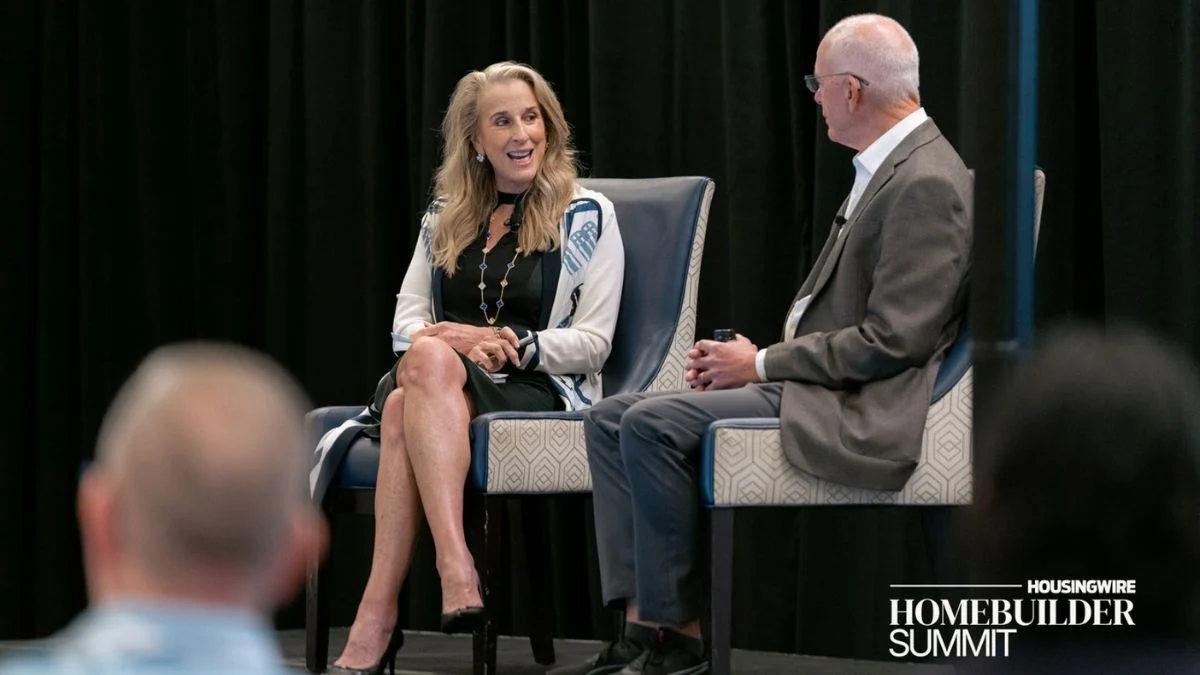
During a pivotal session at the HousingWire Homebuilder Summit on Tuesday, Taylor Morrison CEO Sheryl Palmer elaborated on how this deeply ingrained culture of trust serves as a crucial differentiator, especially when market conditions become more challenging. Palmer articulated that trust provides Taylor Morrison with the essential flexibility to adapt and persevere, whether it involves recalibrating land deals, resisting the pressure to engage in aggressive discounting, or empowering its employees to proactively resolve issues. The recent acquisition by Berkshire Hathaway further bolsters this strategic advantage, providing Taylor Morrison with a patient, long-term oriented parent company that allows for an enduring focus on trust and strategic vision over short-term financial pressures.
The Practicality of Trust: Navigating Market Volatility
Sheryl Palmer emphasized that trust at Taylor Morrison is not an abstract ideal but a practical, guiding principle that permeates every level of the organization. It dictates how leaders interact with partners and employees and shapes the daily operational cadence of the business. At its core, this philosophy is rooted in the Golden Rule: treating others as one wishes to be treated. "It’s just real relationships," Palmer stated during the summit, "and if you can give that forward in every relationship, I think good things happen."
This ethos is particularly evident in how Taylor Morrison approaches its relationships with land sellers. Land acquisition and development often span several years before a home is ultimately constructed and sold, a timeline that can expose deals to unforeseen market shifts. In periods of economic contraction or market recalibration, the assumptions underpinning these long-term agreements may no longer hold true, necessitating a re-evaluation of contractual terms. Taylor Morrison’s established trust-based relationships with land sellers are instrumental in facilitating these often-complex conversations.
Palmer clarified that renegotiations are not undertaken capriciously but are a strategic necessity driven by evolving economic realities. The company, like many in the industry, experienced a period of aggressive land acquisition during the pandemic-fueled housing boom. This led to significant price escalations, with Palmer noting that land prices saw increases of 20% to 30% in 2023. Reflecting on that period, she acknowledged that while the company aimed to exercise prudence, the highly competitive market made it challenging to resist overpaying for desirable parcels. "As good a job as I think we did, we still screwed it up," she candidly admitted, highlighting the inherent difficulties in forecasting such market dynamics.
In instances where land acquired years prior no longer presents a sound economic proposition, a strong foundation of trust allows Taylor Morrison to engage with sellers constructively. Without this trust, the company would face a stark lose-lose scenario: either adhering to a deal that is no longer financially viable or abruptly severing ties with a valued partner. Trust enables both parties to engage in good-faith negotiations, seeking mutually agreeable solutions. Palmer posed a pertinent question regarding market uncertainty: "I don’t know what the market’s going to do next year, and if we really believe that price is the problem and prices are going to drop, the land we’re buying today is probably not going to work. So how do we… have the courage to change the rules of engagement?" This highlights the proactive approach Taylor Morrison aims to take in adapting its strategies.
Consumer Trust and Navigating the Incentive Landscape
The cultivation of trust with internal stakeholders – including land sellers, trade partners, and frontline employees – is viewed by Palmer as a prerequisite for delivering exceptional customer service. Once this internal trust is firmly established, it naturally cascades down to the homebuyer. "Do what’s right for the customers. You know, it’s a business. So, you have to treat your internal customers that way to even begin to imagine you’re going to treat your external customers that way," Palmer advised.
Her core tenet of customer service centers on the principle of complete communication, even when delivering difficult news. "Our industry has suffered from not closing the loop on customer issues. Sometimes we get 80% there, but our customers deserve 100%…if we can, especially in this market where emotions are flying so hard. We don’t know what’s happening in our customers’ lives. Everything is going to be dramatized. We have to close the loop," she emphasized. This commitment to thoroughness aims to mitigate the heightened emotional responses often associated with significant life events like purchasing a home, especially in uncertain economic times.
Palmer also cautioned against over-reliance on technology, asserting that while it can enhance the customer experience, it cannot replace the irreplaceable value of human connection. "Technology cannot deliver emotion. It cannot deliver relationships. Don’t ever think that we can replace the human touch in this process," she stated.
However, this customer-centric philosophy is currently being tested by prevailing market conditions. Palmer argued that the homebuilding industry itself has inadvertently conditioned buyers to anticipate substantial concessions, particularly during economic downturns. "We, as builders, created this environment," she asserted. "We created this place where the longer the house has been sitting there, the more we’re going to give you." She likened the current incentive environment to an extensive restaurant menu, where buyers expect discounts and favorable terms at every stage of the transaction, from interest rate buydowns to other purchase incentives.
While acknowledging the reality of affordability challenges facing buyers, Palmer indicated that the solution is not to abandon incentives altogether but to reassert the inherent value of Taylor Morrison’s product and communities. The company aims to regain the confidence to sell based on these intrinsic strengths rather than solely on price reductions. "We have to gain the courage back to sell based on the strengths of our community and our product," she urged. This strategic shift is crucial for sustainable growth that is not solely reliant on reactive discounting.
Scaling Trust: A National Builder’s Approach
With an annual sales volume of approximately 25,000 homes, Taylor Morrison faces the inherent challenge of scaling its trust-based philosophy and accountability across a vast national footprint. No single individual can personally oversee every customer and partner interaction. The key lies in institutionalizing this culture of trust and responsibility throughout the organization.
Palmer’s approach begins with empowering individuals within the company to leverage their expertise, provided they operate within the established guiding principles. Taylor Morrison fosters this culture through scorecards, healthy internal competition, and daily team huddles. "You have to have guardrails. For us, they’re pretty light. It’s integrity and honesty, but beyond that, do what’s right for the customers," Palmer explained.
An illustrative example of Taylor Morrison’s "Love the Customer" philosophy in action, even post-sale, was shared by Palmer. She recounted a story of a Taylor Morrison employee who learned about a young girl in one of their communities battling leukemia and dreaming of visiting Disneyland. Unable to afford the trip, the employee took initiative, rallying neighbors, local law enforcement, and firefighters to organize a Disney-themed parade for the child. This initiative not only brought immense joy to the young girl and her family but also fostered a stronger sense of community among residents. The significance of this event extends beyond the extraordinary experience created; it underscores the employee’s autonomy to act decisively and compassionately without requiring extensive corporate approval. "You have to have the basic skills. You have to know what you’re doing. Once you’ve done that, you have to give [employees] room," Palmer elaborated.
This leadership style, characterized by empowerment and trust in employee judgment, traces its roots to Palmer’s own tenure as CEO following the merger of Taylor Woodrow and Morrison Homes. While she possessed operational experience, leading an integrated homebuilding company was a new frontier. Recognizing her own areas of expertise and her limitations, she intentionally surrounded herself with talented individuals who could complement her skill set. "It was a little bit of fake it till you make it back then," she admitted. "This was a whole new venture for me… but I think when that happens, you kind of fall back on the things that are most natural. And for me… it’s people, and you surround yourself with really talented people."
The Future Under Berkshire Hathaway’s Stewardship
The recent acquisition of Taylor Morrison by Berkshire Hathaway represents a significant development, and Palmer views it as a natural alignment of philosophies and operational approaches. Berkshire Hathaway’s renowned long-term perspective on capital allocation and strategic decision-making provides an ideal environment for Taylor Morrison to continue its trust-centric business model.
Palmer recounted a conversation with Berkshire Hathaway CEO Greg Abel shortly after the acquisition was finalized earlier this year. Abel’s directive was clear: "You get to do exactly what you’ve been doing. Run a responsible, good business, but you get to do it with real patience and a long-term lens. Don’t make any decisions for next quarter. Don’t even make decisions for next year. Do what’s right for the business as far out as you can see," Palmer recalled.
This long-term vision is particularly valuable in the current market environment, where economic conditions have continued to present challenges throughout 2026. As a publicly traded entity, Taylor Morrison previously faced the pressure of quarterly shareholder reporting, which could incentivize short-term decision-making. Berkshire Hathaway’s ownership structure, however, liberates the company from such immediate pressures, allowing for a more strategic and patient approach. This fosters an environment where Taylor Morrison can more effectively prioritize selling on the intrinsic merits of its communities and products, rather than succumbing to the temptation of offering excessive incentives and price concessions.
Ultimately, this emphasis on long-term strategic thinking aligns seamlessly with the culture of trust that Sheryl Palmer has diligently cultivated at Taylor Morrison over nearly two decades, positioning the company for sustained success in an evolving housing landscape. The strategic advantage derived from deep-seated trust, now amplified by the patient capital of Berkshire Hathaway, provides Taylor Morrison with a resilient framework to navigate future market cycles.