Lana Rhoades
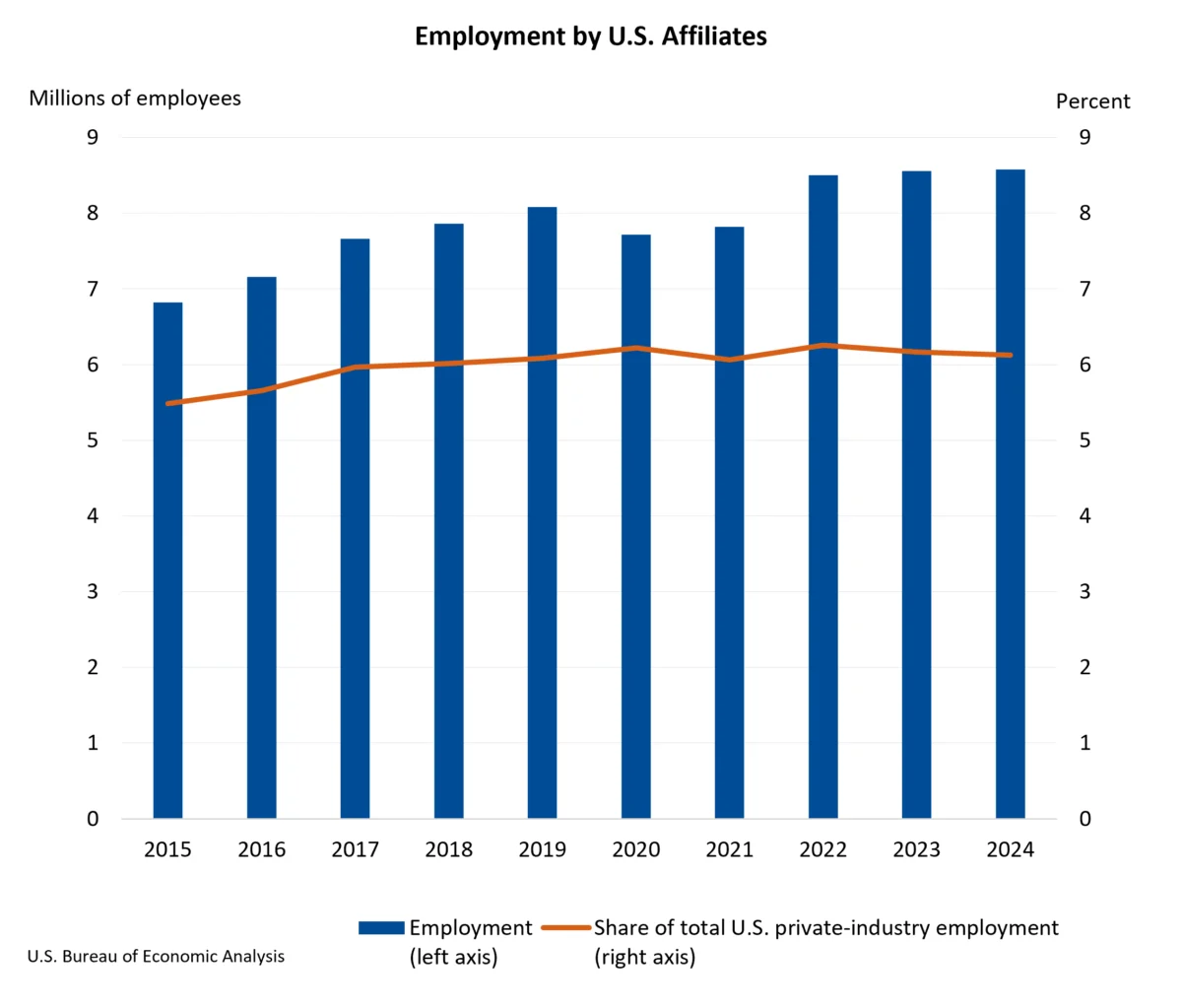
Majority-owned U.S. affiliates of foreign multinational enterprises employed 8.57 million workers in the United States in 2024, marking a modest 0.2 percent increase from the 8.56 million workers recorded in 2023. These figures, released by the U.S. Bureau of Economic Analysis (BEA), underscore the continued significance of foreign investment in shaping the American labor market and contributing to the nation’s economic output. While the employment growth represents a slight uptick, the overall share of private-industry employment attributed to these affiliates saw a marginal decrease, reflecting broader trends in the U.S. economy.
The data reveals that in 2024, U.S. affiliates accounted for 6.1 percent of total private-industry employment, a slight dip from 6.2 percent in the preceding year. This subtle shift highlights the dynamic nature of employment figures and the constant interplay between foreign direct investment and domestic economic expansion. Despite this fractional decline in proportion, the sheer volume of jobs supported by these foreign-owned entities remains substantial, solidifying their role as integral components of the U.S. economic fabric.
Key Sectors and Geographic Contributions
Analysis of employment by sector indicates that the manufacturing and retail trade industries continue to be the primary drivers of job creation within U.S. affiliates of foreign multinationals. These sectors, known for their broad reach and diverse operational needs, benefit from the capital infusion and global market access that foreign enterprises bring. The consistent strength in these areas suggests a sustained demand for labor and a robust operational presence by foreign-owned businesses within these key segments of the U.S. economy.
Geographically, the United States benefits from a diverse range of foreign investors. The statistics highlight that affiliates with ultimate beneficial owners (UBOs) in the United Kingdom, Japan, and Germany were the largest contributors to employment in 2024. These nations have long-standing economic ties with the United States, and their continued investment underscores a strategic commitment to the American market. The concentration of employment from these specific countries reflects established trade relationships, favorable investment climates, and the strategic importance these nations place on their U.S. operations.
Economic Value Added and Investment Trends
Beyond employment figures, the BEA report sheds light on the significant economic contributions of these foreign-owned entities. The current-dollar value added by U.S. affiliates, a key measure of their direct contribution to U.S. gross domestic product (GDP), surged by 4.3 percent in 2024, reaching an impressive $1.52 trillion. This growth signifies a robust expansion of economic activity generated by these firms, demonstrating their increasing productivity and output.
However, similar to employment, the proportion of total U.S. business-sector value added attributable to these affiliates saw a minor decrease, falling from 6.8 percent in 2023 to 6.7 percent in 2024. This trend suggests that while the absolute value added by foreign affiliates is growing, other sectors of the U.S. economy may be expanding at a slightly faster pace in relative terms. Nonetheless, the substantial absolute figure underscores the profound impact foreign investment has on the overall U.S. economic landscape.
Investment in the future is also evident in the capital expenditures of these affiliates. Expenditures for property, plant, and equipment saw a healthy increase of 3.3 percent, totaling $328.0 billion in 2024. This investment in physical assets is a crucial indicator of long-term commitment and expansion, signaling confidence in the U.S. market’s potential for growth and development. Such capital outlays not only create jobs during the construction and implementation phases but also enhance the operational capacity and competitiveness of these businesses, ultimately benefiting the broader economy.
Innovation and Research Driven by Foreign Investment
A particularly significant area of contribution lies in research and development (R&D). In 2024, U.S. affiliates of foreign multinationals performed $95.5 billion in R&D activities, an increase of 5.3 percent. This substantial investment underscores the role of foreign-owned companies in driving innovation within the United States. These affiliates accounted for a notable 12.4 percent of total U.S. business R&D, highlighting their critical role in advancing technological frontiers and fostering a culture of innovation across various industries. This commitment to R&D not only contributes to scientific and technological progress but also supports high-skilled employment and the development of intellectual property within the United States.
State-Level Employment Concentrations
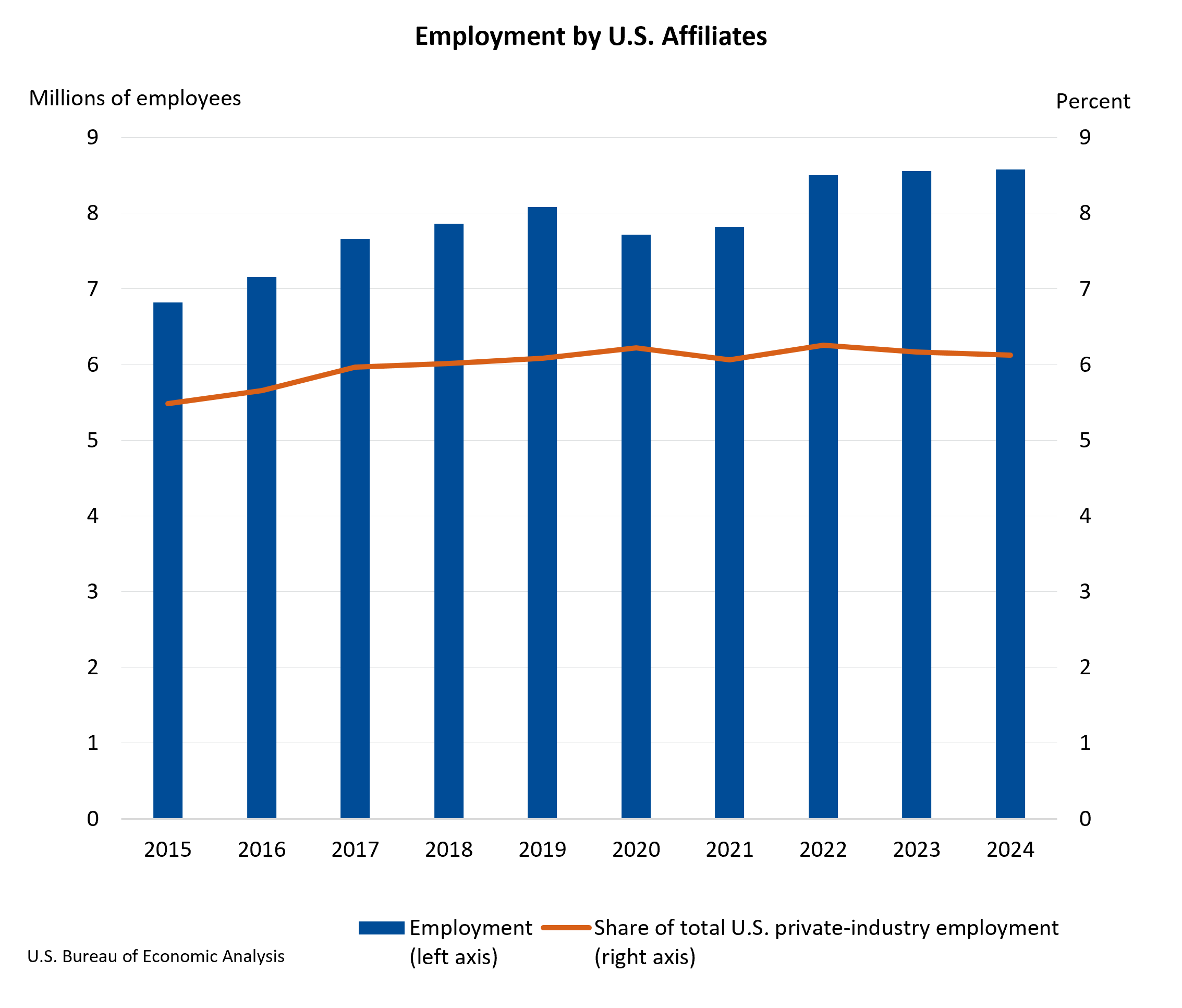
The impact of foreign multinational enterprises is not evenly distributed across the nation. The data reveals significant concentrations of employment by U.S. affiliates in key states. California led the nation with 885,200 workers employed by these entities, followed by Texas with 717,400, and New York with 556,700. In each of these leading states, the manufacturing sector was the largest employer among U.S. affiliates, reinforcing the sector’s importance in attracting and sustaining foreign investment. These states, with their robust economies, skilled workforces, and strategic locations, continue to be prime destinations for foreign direct investment, benefiting from the jobs and economic activity generated.
Historical Context and Evolution of Data
The statistics released by the BEA are part of a long-standing effort to track the activities of U.S. affiliates of foreign multinational enterprises. This data collection has evolved over time, providing increasingly granular insights into the economic contributions of foreign investment. The BEA periodically revises its preliminary estimates to incorporate newly available and updated source data, ensuring the accuracy and reliability of its findings.
For instance, the preliminary statistics for 2023, initially released in December 2025, underwent revisions. These updates led to adjustments in key metrics. The number of employees saw a revision from a preliminary estimate of 8,661.8 thousand to a revised figure of 8,556.9 thousand. Similarly, value added was revised from $1,469.1 billion to $1,456.3 billion. Expenditures for property, plant, and equipment were adjusted from $322.7 billion to $317.6 billion, and R&D expenditures were revised from $87.8 billion to $90.6 billion. These revisions are a standard part of the statistical process, aimed at reflecting the most comprehensive and accurate data available.
Broader Implications for the U.S. Economy
The consistent presence and growth of U.S. affiliates of foreign multinationals have several far-reaching implications for the U.S. economy. Firstly, they provide a vital source of capital, supplementing domestic investment and contributing to capital formation. This inflow of foreign capital can help finance new ventures, expand existing businesses, and create a more dynamic and competitive economic environment.
Secondly, these affiliates are significant employers, offering a wide range of job opportunities across various skill levels and industries. The jobs created by foreign-owned companies often come with competitive wages and benefits, contributing to the overall income and living standards of American workers. Furthermore, the presence of foreign firms can stimulate competition, pushing domestic companies to improve their efficiency, innovation, and product quality.
Thirdly, foreign direct investment can lead to technology transfer and the adoption of best practices. Multinational enterprises often bring with them advanced technologies, management techniques, and operational efficiencies that can be adopted by their U.S. affiliates and, through spillover effects, by domestic firms as well. This can enhance productivity, foster innovation, and improve the overall competitiveness of the U.S. economy on the global stage.
Future Outlook and Data Availability
The BEA continues to enhance its data collection and reporting methodologies. Recent updates to its disclosure avoidance method, including coarsening techniques like rounding, aggregation, and the use of ranges, allow for the publication of more data while maintaining confidentiality for survey respondents. This commitment to transparency and data integrity is crucial for policymakers, researchers, and businesses seeking to understand the intricacies of foreign investment in the United States.
The BEA’s commitment to providing comprehensive data is evident in the wealth of information available on its website. Beyond the headline figures, detailed statistics on sales, balance sheet and income statement items, compensation of employees, and trade are accessible. These granular datasets enable in-depth analysis of specific industries, countries of origin, and regional economic impacts.
Looking ahead, the BEA anticipates the next release of Activities of U.S. Affiliates of Foreign Multinational Enterprises data for 2025 in the Spring of 2027. This forward-looking schedule allows for thorough data compilation and analysis, ensuring that stakeholders have access to timely and accurate information to guide strategic decision-making in an ever-evolving global economic landscape. The continued monitoring and analysis of these statistics will be vital for understanding the long-term trajectory of foreign investment and its ongoing influence on the U.S. economy.
The data on U.S. affiliates of foreign multinationals serves as a crucial barometer of international economic engagement. The steady growth in employment and the significant contributions to value added and R&D demonstrate the enduring appeal of the U.S. market for global enterprises. As the world economy navigates complex challenges and opportunities, the role of foreign investment in driving job creation, fostering innovation, and bolstering economic growth within the United States remains a pivotal aspect of its economic vitality. The BEA’s comprehensive reporting ensures that this critical component of the U.S. economic narrative is consistently illuminated, providing valuable insights for policymakers and the public alike.