admin

As the fiscal year draws to a close, small businesses nationwide are once again facing the critical period of tax preparation and filing. The approaching 2027 tax season, pertaining to the 2026 tax year, demands meticulous attention to deadlines and specific filing requirements to ensure compliance and avoid potential penalties. This comprehensive guide outlines the essential dates, forms, and considerations for various business structures, underscoring the importance of proactive planning in the complex landscape of federal taxation.
The Critical Dates for the 2027 Filing Season: An Overview
The Internal Revenue Service (IRS) sets annual deadlines that dictate when businesses and individuals must submit their tax returns and make payments. For the 2026 tax year, being filed in 2027, the primary individual income tax deadline, commonly known as Tax Day, falls on Thursday, April 15, 2027. This date is pivotal for sole proprietors, single-member LLCs, and individual partners or shareholders in pass-through entities. However, many business entities have earlier deadlines, necessitating careful chronological planning.
The 2027 tax calendar kicks off with crucial deadlines in March, particularly for pass-through entities like partnerships and S corporations, which must file their informational returns by March 15. Following this, April 15 serves as the main deadline for C corporations and most individual income tax filings, including those reporting business income. Throughout the year, estimated tax payments for the current 2027 tax year are also due quarterly, extending into January 2028. Missing these deadlines can result in significant financial repercussions, including late filing penalties, interest charges, and potential audit triggers.
Navigating Business Structures and Their Specific Requirements
The federal tax obligations of a business are fundamentally shaped by its legal structure. Understanding these distinctions is paramount for accurate and timely filing.
-
Sole Proprietorships and Single-Member LLCs:
Often representing the simplest business structure, sole proprietorships and single-member LLCs (unless they elect corporate taxation) are not legally separate from their owners for federal tax purposes. Business income and expenses are reported directly on the owner’s personal income tax return, Form 1040. For the 2026 tax year, this return, along with Schedule C (Profit or Loss From Business), is due by Thursday, April 15, 2027. If a sole proprietor or single-member LLC owner has net earnings from self-employment of $400 or more, they must also file Schedule SE (Self-Employment Tax) to calculate Social Security and Medicare taxes. The IRS consistently emphasizes the need for accurate record-keeping to substantiate all income and deductions reported on Schedule C. The transparency of this structure means that the owner’s personal financial health is directly intertwined with the business’s tax compliance. -
Partnerships and Multi-Member LLCs:
Partnerships, including multi-member LLCs that default to partnership taxation, are considered "pass-through" entities. This means the business itself generally does not pay federal income tax. Instead, it reports its income, gains, losses, deductions, and credits to the IRS and its partners. For the 2026 tax year, calendar-year partnerships must file Form 1065, U.S. Return of Partnership Income, by Monday, March 15, 2027. Concurrently, the partnership must provide each partner with a Schedule K-1 (Form 1065), Partner’s Share of Income, Deductions, Credits, etc., by the same March 15 deadline. Individual partners then use the information from their Schedule K-1 to report their share of the business’s income or losses on their personal Form 1040, which is due April 15, 2027. Partners are typically responsible for paying self-employment tax on their share of the partnership’s earnings. The timely issuance of K-1s is critical, as delays can directly impact a partner’s ability to file their personal return on time. -
S Corporations:
Similar to partnerships, S corporations are pass-through entities where profits and losses are passed directly to shareholders without being subject to corporate tax rates. For the 2026 tax year, S corporations operating on a calendar year must file Form 1120-S, U.S. Income Tax Return for an S Corporation, by Monday, March 15, 2027. Along with this, the S corporation must furnish each shareholder with a Schedule K-1 (Form 1120-S), Shareholder’s Share of Income, Deductions, Credits, etc., also by March 15. Shareholders then incorporate this information into their personal Form 1040, due April 15, 2027. While shareholders typically don’t pay self-employment tax on their distributive share of S corporation income, reasonable salaries paid to shareholder-employees are subject to payroll taxes. This structure requires careful attention to compensation practices to comply with IRS regulations. -
C Corporations:
C corporations are distinct legal entities that are subject to corporate income tax on their profits. For the 2026 tax year, calendar-year C corporations must file Form 1120, U.S. Corporation Income Tax Return, by Thursday, April 15, 2027. Unlike pass-through entities, C corporations pay tax at the corporate level. When profits are distributed to shareholders as dividends, those dividends are taxed again at the shareholder level, a phenomenon known as "double taxation." Shareholders of C corporations report any taxable income received (e.g., dividends, wages) on their personal Form 1040, due April 15, 2027. C corporations with a fiscal year-end that differs from the calendar year will have different filing deadlines, typically the 15th day of the fourth month after their tax year ends.
Key Information Returns and Payroll Obligations
Beyond income tax returns, businesses often have obligations to file various information returns to report payments made to employees and independent contractors. These forms are crucial for the IRS to track income and ensure proper tax collection.
- Form W-2 (Wage and Tax Statement): Employers are required to furnish Form W-2 to employees and submit copies to the Social Security Administration (SSA) by Monday, February 1, 2027, for wages paid in 2026. This deadline applies whether filing electronically or by paper.
- Form 1099-NEC (Nonemployee Compensation): Businesses paying $600 or more to independent contractors, freelancers, or other non-employees in the course of trade or business during 2026 must file Form 1099-NEC. Both recipient copies and IRS copies are due by Monday, February 1, 2027. This deadline is firm and applies to both paper and electronic filing.
- Form 1099-MISC (Miscellaneous Information): This form is used for various other types of payments, such as rent, royalties, and medical and healthcare payments. For recipients, the deadline is February 1, 2027. For paper filing to the IRS, the deadline is March 1, 2027. For electronic filing, it’s March 31, 2027. Businesses filing 10 or more information returns are generally required to e-file.
- Form 1096 (Annual Summary and Transmittal of U.S. Information Returns): This transmittal form is used when filing paper copies of various 1099 forms. Its due date aligns with the corresponding 1099 forms.
These early February and March deadlines are vital for businesses to accurately report payments, enabling recipients to file their own returns correctly. Failure to meet these deadlines can result in penalties per form, which can quickly accumulate.
The Importance of Estimated Taxes: A Quarterly Mandate
Many small businesses and self-employed individuals are required to pay estimated taxes throughout the year if they expect to owe at least $1,000 in federal taxes. This system ensures a steady flow of tax revenue to the government and prevents a large, potentially unmanageable tax bill at year-end. Estimated taxes cover income tax, self-employment tax, and other taxes.
For the 2027 tax year (payments made in 2027 for 2027 income), the quarterly estimated tax deadlines are:
- Q1 (January 1 to March 31 income): Thursday, April 15, 2027
- Q2 (April 1 to May 31 income): Tuesday, June 15, 2027
- Q3 (June 1 to August 31 income): Wednesday, September 15, 2027
- Q4 (September 1 to December 31 income): Tuesday, January 18, 2028
If any of these dates fall on a weekend or federal holiday, the deadline shifts to the next business day. The IRS advises using Form 1040-ES, Estimated Tax for Individuals, to calculate and make these payments. Underpayment penalties can be assessed if insufficient estimated taxes are paid throughout the year, even if a refund is eventually due. Financial experts consistently recommend that businesses review their income and expenses quarterly to adjust estimated payments as needed, particularly in dynamic economic environments.
Extensions: A Safety Net, Not a Solution
While meeting original deadlines is always preferable, the IRS offers extensions for filing tax returns. It is crucial to understand that an extension grants additional time to file the return, not to pay any taxes owed. Any estimated tax liability should still be paid by the original deadline to avoid penalties and interest.
-
For Partnerships and S Corporations:
If unable to file Form 1065 or 1120-S by March 15, businesses can request an automatic six-month extension by filing Form 7004, Application for Automatic Extension of Time To File Certain Business Income Tax, Information, and Other Returns, by the original March 15 deadline. This extends the filing deadline to Wednesday, September 15, 2027. -
For Individuals (Sole Proprietors, Single-Member LLCs, Partners, S Corp Shareholders) and C Corporations:
An automatic six-month extension for filing Form 1040 or Form 1120 can be obtained by filing Form 4868, Application for Automatic Extension of Time To File U.S. Individual Income Tax Return, or Form 7004, respectively, by the original April 15 deadline. This pushes the filing deadline to Friday, October 15, 2027.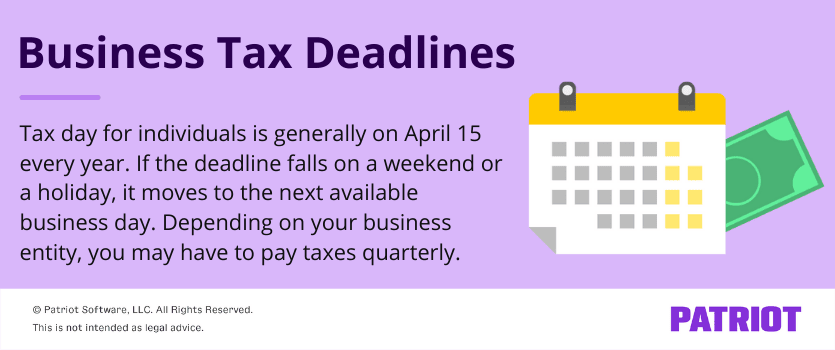
The IRS processed millions of extension requests annually, highlighting the common need for more time. However, financial advisors caution that relying on extensions without proper tax planning can lead to financial strain if the estimated tax due is not remitted on time.
Broader Context and Implications for Small Businesses
Timely and accurate tax compliance is more than just meeting government mandates; it is a cornerstone of sound business management. Non-compliance can lead to a cascade of negative consequences:
- Penalties and Interest: Late filing and late payment penalties can significantly erode a business’s cash flow, often compounded by interest charges.
- Audits: Consistent errors or non-filing can flag a business for an IRS audit, a time-consuming and potentially costly process.
- Financial Health: Poor tax planning and unexpected liabilities can destabilize a business’s financial health, impacting its ability to secure loans, invest in growth, or manage day-to-day operations.
- Reputation: Tax issues can damage a business’s reputation and credibility with suppliers, customers, and investors.
The IRS provides a wealth of resources for small businesses, including publications, online tools, and taxpayer assistance programs. IRS officials consistently remind business owners to utilize these resources and, when in doubt, consult with qualified tax professionals. The complexity of the tax code, especially with continuous updates and evolving regulations, makes expert guidance invaluable for many small businesses.
Historical Perspective and Evolving Tax Landscape
The current system of staggered deadlines for different entity types has evolved to accommodate the flow of information necessary for individuals to file their personal returns. Pass-through entities, which report income that individuals then incorporate into their personal filings, are typically given earlier deadlines to ensure K-1s are distributed in time. This chronological sequencing is fundamental to the efficiency of the overall tax collection process.
The landscape of tax compliance is also continuously shaped by technological advancements. The IRS increasingly encourages and mandates electronic filing for many forms, streamlining processing and reducing errors. This shift underscores the need for businesses to adapt their record-keeping and filing practices to leverage modern tools and software, which can significantly simplify tax preparation.
Conclusion: Proactive Planning is Key
For small businesses, the 2027 tax season (for 2026 taxes) presents a critical window for demonstrating financial diligence and compliance. From the early March deadlines for partnerships and S corporations to the April 15 main Tax Day for individuals and C corporations, and the ongoing quarterly estimated payments, the calendar is packed with crucial dates. Proactive planning, meticulous record-keeping, and, where necessary, professional tax assistance are indispensable tools for navigating these requirements successfully. By understanding and adhering to these deadlines, businesses can safeguard their financial health, maintain compliance, and contribute to a stable economic environment.