admin
As employers navigate the complexities of payroll, one fundamental responsibility involves the calculation and remittance of employment taxes, chief among them the Federal Insurance Contributions Act, or FICA tax. This mandatory payroll tax underpins critical social safety nets in the United States, directly funding Social Security and Medicare programs that provide a lifeline for millions of Americans. Understanding FICA is not merely a compliance task; it is an insight into a cornerstone of the nation’s social and economic infrastructure.
FICA stands as a bipartisan compact, a mechanism through which employers and employees collectively contribute to a system of social insurance. Unlike federal income tax, FICA is applied as a fixed percentage to an employee’s taxable wages, split equally between the worker and their employer. This dual contribution ensures the sustained operation of two vital federal programs: Social Security, which provides old-age, survivors, and disability insurance, and Medicare, which funds hospital insurance for the elderly and disabled. When an employer withholds FICA tax from an employee’s paycheck and matches that contribution, they are directly channeling funds into these programs, which then distribute benefits to eligible individuals who have paid into the system, much like any traditional insurance model.
The Genesis of FICA: A Historical Perspective
The origins of FICA are deeply rooted in the economic turmoil of the 20th century, particularly the Great Depression. Before the Social Security Act of 1935, many elderly Americans faced destitution, and families lacked a safety net in the event of a breadwinner’s death or disability. The Social Security Act was a landmark piece of legislation, signed into law by President Franklin D. Roosevelt, designed to provide a basic level of economic security for retired workers. Initially, the tax rate was modest, starting at just 1% each for employers and employees on wages up to $3,000 annually. Over the decades, as the scope of benefits expanded to include survivors and disability insurance, the FICA tax rates and the wage base subject to the tax steadily increased.
The second pillar of FICA, Medicare, emerged much later, in 1965, under President Lyndon B. Johnson. Before Medicare, many elderly citizens struggled to afford necessary medical care, often facing financial ruin due to illness. The Medicare Act established a federal health insurance program for individuals aged 65 and older, as well as younger people with certain disabilities or end-stage renal disease. Its introduction represented another significant expansion of the nation’s social safety net, providing crucial hospital insurance (Part A) funded directly by a dedicated portion of the FICA tax. The integration of Medicare into the FICA structure solidified its role as a comprehensive mechanism for funding both retirement and healthcare security.
Understanding the Mechanics: FICA Tax Rates and Components
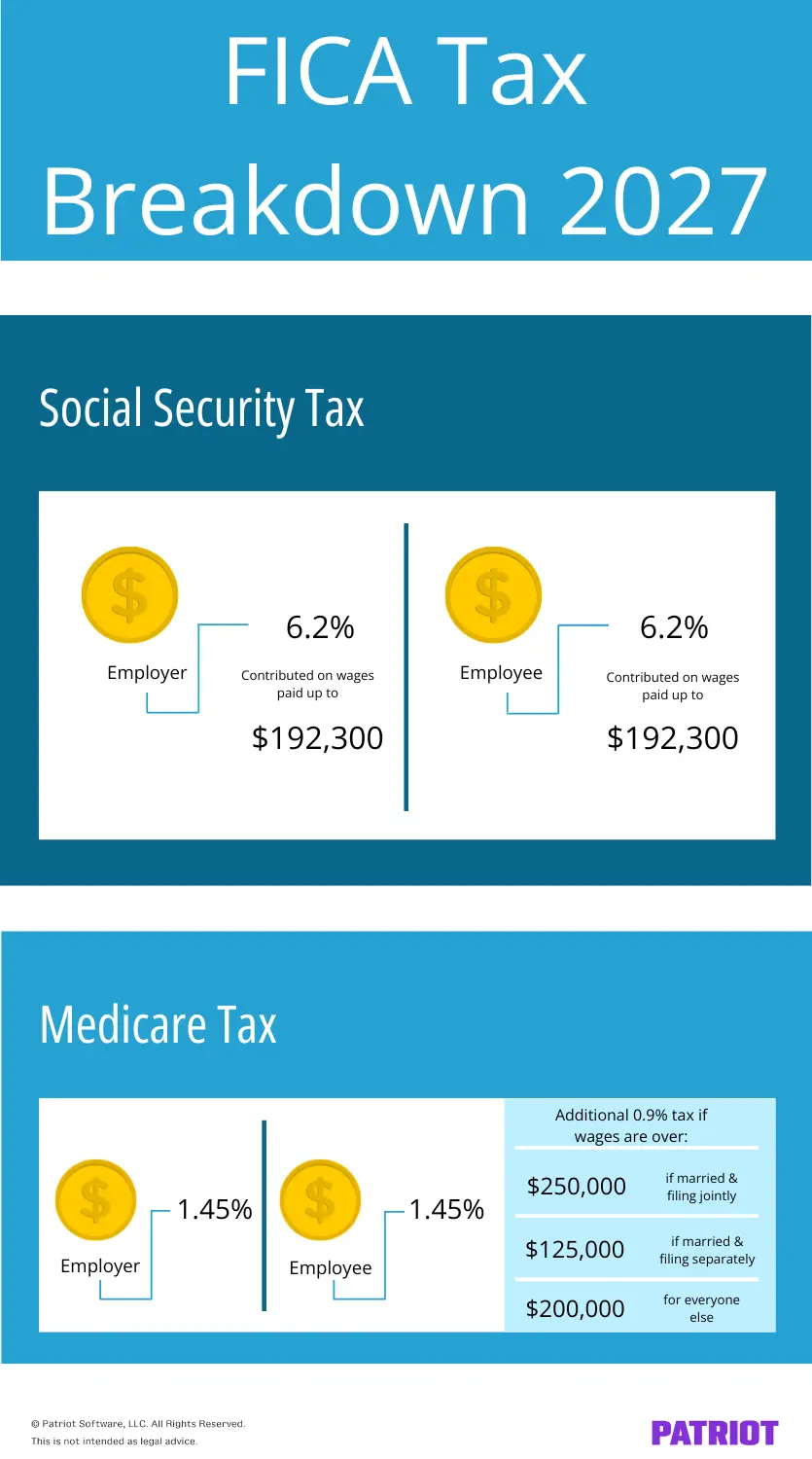
The FICA tax is a mandatory contribution, with a standard combined rate of 15.3% on an employee’s taxable wages. This rate is equally divided, with the employee contributing 7.65% and the employer contributing a matching 7.65%. This means that for every dollar of taxable wages, 15.3 cents are channeled into the Social Security and Medicare trust funds.
This 7.65% employee contribution is further broken down into two distinct components:
- Social Security Tax: 6.2% of an employee’s taxable wages.
- Medicare Tax: 1.45% of an employee’s taxable wages.
For example, if an employee earns $1,000 in a pay period, $62.00 ($1,000 x 0.062) would be withheld for Social Security, and $14.50 ($1,000 x 0.0145) would be withheld for Medicare. The employer would then contribute an additional $62.00 for Social Security and $14.50 for Medicare, totaling $153.00 deposited for FICA taxes for that employee’s wages.
Social Security: The Foundation of Retirement and Disability Support
The 6.2% portion of FICA dedicated to Social Security funds the Old-Age, Survivors, and Disability Insurance (OASDI) program. This program is designed to provide income to retired individuals, beneficiaries of deceased workers, and those who become disabled and unable to work. It represents a vital safety net, with millions of Americans relying on these benefits for their economic well-being. According to the Social Security Administration (SSA), in 2023, over 67 million Americans received Social Security benefits, underscoring its widespread impact.
A key characteristic of the Social Security tax is the Social Security wage base. This is an annual limit on the amount of earnings subject to Social Security tax. Once an employee’s cumulative wages for the year exceed this base, employers must stop withholding and contributing the 6.2% Social Security portion of FICA tax. The wage base is adjusted annually to reflect changes in national average wages. For instance, in 2027, the Social Security wage base is projected to be $192,300, an increase from $184,500 in 2026. This limit exists to prevent higher earners from disproportionately funding the system, as Social Security benefits are designed to replace a higher percentage of income for lower earners. If an employer inadvertently withholds Social Security tax beyond this limit, they are required to refund the excess amount to the employee.
Medicare: Ensuring Healthcare for Seniors and the Disabled
The remaining 1.45% of the FICA tax goes towards Medicare, specifically funding Hospital Insurance (HI), also known as Medicare Part A. This part of Medicare covers inpatient hospital care, skilled nursing facility care, hospice care, and some home health care. Unlike Social Security, there is no wage base limit for Medicare tax. This means that all of an employee’s taxable wages, regardless of how high, are subject to the 1.45% Medicare tax. This distinction reflects the universal nature of healthcare access for eligible beneficiaries, where the cost burden is spread across all earned income.
Furthermore, an Additional Medicare Tax was introduced in 2013 as part of the Affordable Care Act. This supplemental tax applies to high-income earners. Employers are required to withhold an additional 0.9% Medicare tax from employee wages that exceed a certain threshold, which depends on the employee’s filing status:
- $200,000 for single, head of household, or qualifying widow(er)
- $250,000 for married filing jointly
- $125,000 for married filing separately
If an employee’s wages surpass these thresholds, the combined Medicare withholding rate becomes 2.35% (1.45% + 0.9%). It is crucial to note that the employer does not match this additional 0.9% Medicare tax; it is solely an employee contribution. However, employers must continue to pay their matching 1.45% Medicare portion on all wages. This additional tax aims to bolster Medicare’s financial stability by requiring a higher contribution from top earners.

Employer Responsibilities: Withholding, Matching, and Reporting
For employers, managing FICA taxes involves several critical steps to ensure compliance with Internal Revenue Service (IRS) regulations. The process begins with accurately calculating and withholding the employee’s portion of FICA tax from each paycheck. Simultaneously, the employer must account for their matching contribution.
Once these amounts are determined, the employer is responsible for depositing both the withheld employee FICA taxes and their own matching contributions with the IRS. The frequency of these deposits—either monthly or semiweekly—depends on the employer’s total tax liability during a specific "lookback period." This period is typically the four quarters ending on June 30 of the previous year. Employers must determine their depositing schedule annually before the start of each new year. All employment taxes, including FICA and federal income tax, are deposited electronically using the IRS’s Electronic Federal Tax Payment System (EFTPS). Failure to make timely and accurate deposits can result in significant penalties.
Beyond deposits, employers are also required to report FICA taxes to the IRS. Most employers do this quarterly using Form 941, Employer’s QUARTERLY Federal Tax Return. This form details the total wages paid, federal income tax withheld, and both employee and employer portions of Social Security and Medicare taxes for the quarter. Smaller employers, whose annual tax liability is $1,000 or less, may be allowed by the IRS to file Form 944, Employer’s ANNUAL Federal Tax Return, which consolidates the reporting into a single annual submission. Accurate and timely filing of these forms is essential for maintaining compliance and avoiding IRS scrutiny.
FICA Tax Exemptions: Specific Scenarios
While FICA tax is broadly mandatory, there are specific circumstances and types of compensation that are exempt. These exemptions are generally narrowly defined and often reflect unique employment situations or specific policy considerations. Examples of compensation or individuals typically exempt from FICA tax include:
- Certain non-resident aliens: Depending on their visa status and purpose of stay (e.g., some students, teachers, researchers).
- Student workers: Students employed by the school, college, or university where they are enrolled and regularly attending classes, provided their work is incidental to their studies.
- Clergy: Ordained ministers, members of religious orders, and Christian Science practitioners may be exempt from Social Security and Medicare taxes if they apply for an exemption based on religious objections. However, they are generally subject to self-employment tax.
- Certain state and local government employees: Some state and local government employees may be exempt if they are covered by an alternative retirement system that provides comparable benefits.
- Specific types of payments: Certain fringe benefits, reimbursements for business expenses, and some deferred compensation plans may also be exempt from FICA.
For comprehensive and definitive information on FICA tax exemptions, employers and individuals should consult IRS Publication 15, (Circular E), Employer’s Tax Guide, which provides detailed guidance on taxable and non-taxable wages.
FICA vs. Self-Employment Tax: A Distinction for Business Owners
For individuals who are self-employed – such as sole proprietors, partners in a partnership, or independent contractors – the mechanism for contributing to Social Security and Medicare differs from that of traditional employees. Instead of FICA tax, they pay Self-Employment Tax (SE Tax).
The self-employment tax essentially combines both the employee and employer portions of FICA. The rate for self-employment tax is 15.3% of net earnings from self-employment. This rate is composed of:
- 12.4% for Social Security: Applied up to the annual Social Security wage base limit.
- 2.9% for Medicare: Applied to all net earnings, with no wage base limit.
Similar to FICA, the Social Security wage base and the Additional Medicare Tax thresholds apply to self-employment income. Self-employed individuals are responsible for calculating and paying their SE tax, typically through estimated tax payments throughout the year. An important consideration for the self-employed is that they can deduct one-half of their self-employment tax from their gross income when calculating their adjusted gross income. This deduction is intended to offset the employer portion of FICA that a self-employed individual effectively pays.
The Broader Economic and Societal Impact of FICA
Beyond its mechanical aspects, FICA represents a foundational pillar of American economic and social policy, with far-reaching implications:
- Economic Stability: Social Security benefits serve as a critical counter-cyclical stabilizer during economic downturns, providing a steady income stream to millions of retirees, disabled individuals, and survivors. This helps sustain consumer spending and reduces poverty, especially among the elderly. Medicare, by reducing the financial burden of healthcare for seniors, frees up personal savings that might otherwise be depleted by medical costs, contributing to broader economic security.
- Healthcare Access: Medicare ensures that nearly all Americans over 65, and many with disabilities, have access to essential hospital and medical services, regardless of their employment history or pre-existing conditions. This program has profoundly reshaped the landscape of elder care and contributed to longer, healthier lives for seniors.
- Retirement Security: For many Americans, Social Security provides a guaranteed, inflation-adjusted income stream in retirement, serving as a vital supplement to personal savings and pensions. While rarely sufficient on its own, it forms a crucial base layer of financial security that helps prevent widespread poverty among the elderly.
- Intergenerational Compact: FICA embodies an implicit social contract across generations. Current workers contribute to the benefits of current retirees and beneficiaries, with the expectation that future generations will do the same for them. This pay-as-you-go system has fostered a sense of collective responsibility for the nation’s most vulnerable populations.
- Solvency Debates: Despite its successes, the long-term solvency of the Social Security and Medicare trust funds is a subject of ongoing national debate. Demographic shifts, including an aging population, increased life expectancy, and lower birth rates, mean that fewer workers are supporting more beneficiaries. Projections from the Social Security Administration and the Medicare Board of Trustees frequently highlight potential shortfalls in the coming decades if no legislative changes are made. Discussions often center on various reform options, such as adjusting the full retirement age, modifying benefit formulas, increasing the FICA tax rate, raising the Social Security wage base, or a combination of these measures. These debates underscore the dynamic nature of FICA and its programs, which must continually adapt to demographic and economic realities.
Navigating Compliance and Future Outlook
For businesses, navigating FICA compliance requires diligence and accurate record-keeping. The complexity of varying rates, wage bases, and specific exemptions means that many employers, particularly small and medium-sized businesses, often rely on dedicated payroll software or full-service payroll providers to ensure correct calculations, timely deposits, and accurate reporting. Staying informed about annual adjustments to the Social Security wage base and other IRS regulations is paramount to avoiding penalties.
Looking ahead, FICA and the programs it funds will remain central to American public discourse. As the nation continues to grapple with an aging population and evolving healthcare needs, the future of Social Security and Medicare will likely be a recurrent theme in policy discussions. Understanding FICA is thus not merely about tax compliance; it is about grasping a fundamental aspect of the American social contract and its ongoing evolution.
This article is for informational purposes only and is not intended as legal, tax, or financial advice. For specific guidance, consult with a qualified professional.