Lana Rhoades
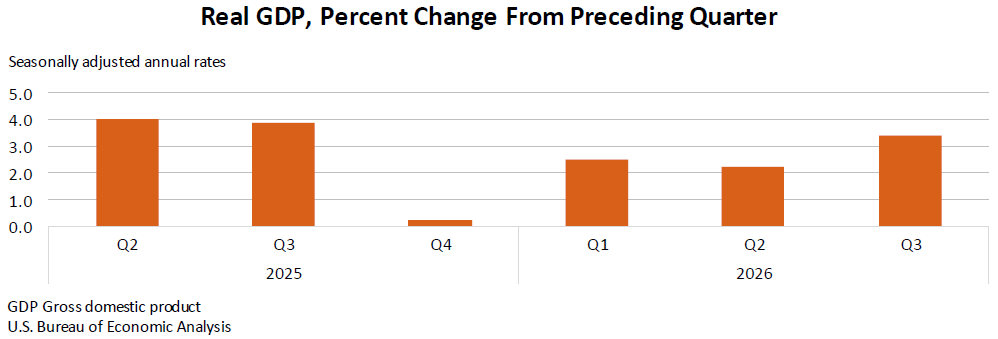
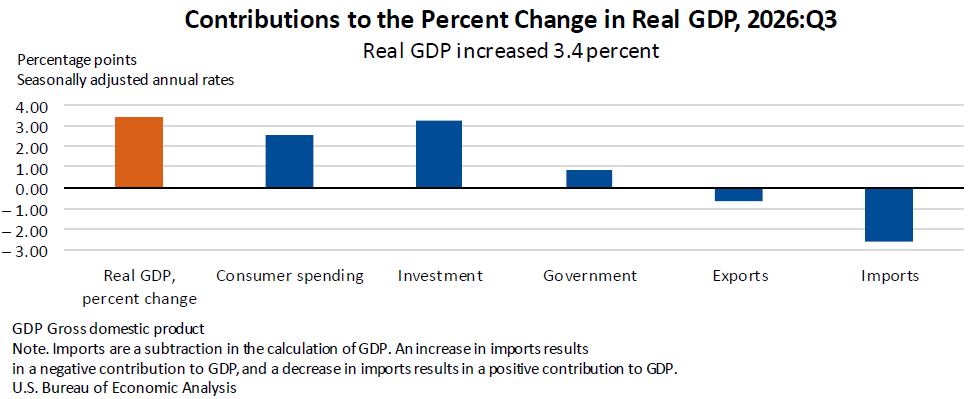
The United States economy demonstrated significant momentum in the third quarter of 2026, with real gross domestic product (GDP) expanding at an annualized rate of 3.4 percent. This marks a notable acceleration from the 2.2 percent growth recorded in the second quarter, signaling a strengthening economic landscape as the year progressed. The advance estimate, released by the U.S. Bureau of Economic Analysis (BEA) today, provides a preliminary snapshot of the nation’s economic output from July through September.
Key Drivers of Economic Expansion
The robust growth in the third quarter was propelled by a confluence of positive economic indicators. Increases in investment, consumer spending, and government expenditures were the primary drivers. These gains were partially tempered by a decline in exports, and a rise in imports, which are subtracted in GDP calculations.
Specifically, investment activity saw a significant uptick, contributing to the overall acceleration. Consumer spending, a perennial engine of the U.S. economy, also continued its upward trajectory, providing a stable foundation for growth. Government spending, which had previously shown a downturn, experienced an upturn in the third quarter, further bolstering economic activity.
The BEA’s data indicates that real final sales to private domestic purchasers – a measure encompassing consumer spending and gross private fixed investment – saw an impressive increase of 4.9 percent. This figure, which excludes changes in private inventories and is often seen as a more precise indicator of underlying demand, also represented an acceleration from the 4.6 percent rise observed in the preceding quarter. This suggests that domestic demand remained strong and resilient.
Inflationary Trends Show Moderation
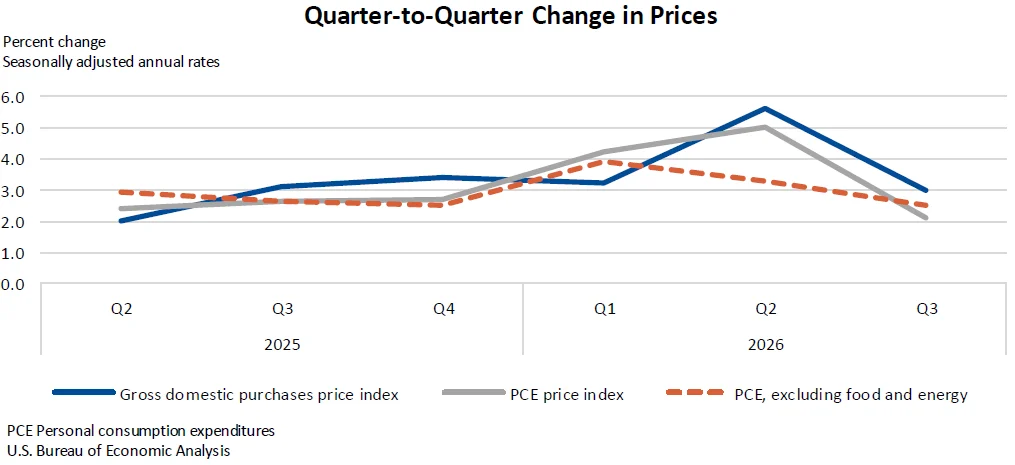
In tandem with the robust GDP growth, inflationary pressures exhibited a noticeable moderation during the third quarter. The price index for gross domestic purchases, a broad measure of inflation for goods and services purchased domestically, increased by 3.0 percent. This stands in stark contrast to the 5.6 percent rise recorded in the second quarter, indicating a significant cooling of price increases.
Further breakdown of inflation data reveals a similar trend in consumer prices. The Personal Consumption Expenditures (PCE) price index, the Federal Reserve’s preferred inflation gauge, rose by 2.1 percent in the third quarter, down from 5.0 percent in the second quarter. Even when excluding the volatile food and energy components, the PCE price index, excluding food and energy, saw its increase slow to 2.5 percent from 3.3 percent in the prior quarter. This deceleration in inflation, while growth accelerated, presents a potentially favorable scenario for policymakers, suggesting that the economy might be achieving a "soft landing" where growth can be sustained without triggering runaway inflation.
A Look at the Contributing Factors
The BEA’s detailed analysis highlights the specific components that influenced the GDP growth rate. The increase in investment was a key factor, reflecting potential upticks in business capital expenditures, residential construction, and changes in private inventories. While the exact composition of this investment growth will be further detailed in subsequent releases, its significant contribution underscores a positive outlook from businesses and a willingness to expand productive capacity.
Consumer spending, which typically accounts for roughly two-thirds of U.S. economic activity, continued to be a bedrock of growth. This sustained consumer confidence and spending power are crucial for maintaining economic momentum. The upturn in government spending, while a smaller component than consumer spending, provided a necessary boost, potentially reflecting increased public investment in infrastructure, defense, or other government programs.
The decline in exports, however, warrants attention. A stronger U.S. dollar, increased global economic uncertainty, or shifts in international demand could all contribute to reduced foreign purchases of U.S. goods and services. Similarly, the increase in imports suggests that domestic consumers and businesses are purchasing more goods and services from abroad, which directly subtracts from the GDP calculation. The net effect of these trade dynamics played a role in moderating the overall GDP growth rate.
Historical Context and Precedent
The economic performance in the third quarter of 2026 can be viewed within the broader context of the post-pandemic recovery and the subsequent efforts to manage inflation. Following a period of significant stimulus and supply chain disruptions that fueled inflation, the economy has been navigating a complex path. The robust GDP growth coupled with moderating inflation suggests that the economic engines are firing effectively, perhaps benefiting from a combination of resilient domestic demand and a gradual easing of global supply chain pressures.
The BEA’s release of advance estimates is the first of three estimations for each quarter’s GDP. The subsequent "second" and "third" estimates incorporate more comprehensive data and are typically released in the subsequent months, offering a more refined picture of economic performance. The next release, scheduled for November 25, 2026, will provide the second estimate for the third quarter of 2026 GDP and also report on corporate profits.
Expert Analysis and Potential Implications
Economists and market analysts will be closely scrutinizing the detailed components of this GDP report in the coming weeks. The sustained strength in domestic demand, particularly consumer spending and investment, is a positive sign for future economic prospects. The moderation in inflation is also a welcome development, potentially giving the Federal Reserve more flexibility in its monetary policy decisions.
If these trends continue, the U.S. economy could be on a path toward sustained, non-inflationary growth. This scenario would be favorable for businesses looking to expand, investors seeking stable returns, and consumers benefiting from a stable price environment. However, persistent challenges such as global geopolitical uncertainties, potential shifts in trade policies, and the ongoing need to address long-term fiscal sustainability remain factors that could influence the economic outlook.
The BEA’s detailed data tables, available through their Interactive Data Application, offer granular insights into these economic movements. For instance, Table 1.1.1 provides the percentage change in real GDP from the preceding period, while Table 1.5.2 breaks down the contributions of various components to that change. Understanding these underlying dynamics is crucial for a comprehensive assessment of the economy’s health.
Looking Ahead
The positive momentum observed in the third quarter of 2026 sets a promising tone for the remainder of the year. However, economic forecasting is inherently complex, and continuous monitoring of key indicators will be essential. The BEA’s commitment to providing timely and detailed economic data remains a critical resource for policymakers, businesses, and the public alike in navigating the evolving economic landscape. The next GDP release will offer further clarity on whether this accelerated growth trajectory is sustainable and how it aligns with broader economic objectives. The resilience shown in the third quarter suggests a robust underlying economic structure, capable of weathering various challenges and continuing its expansionary path.