Candice Horbacz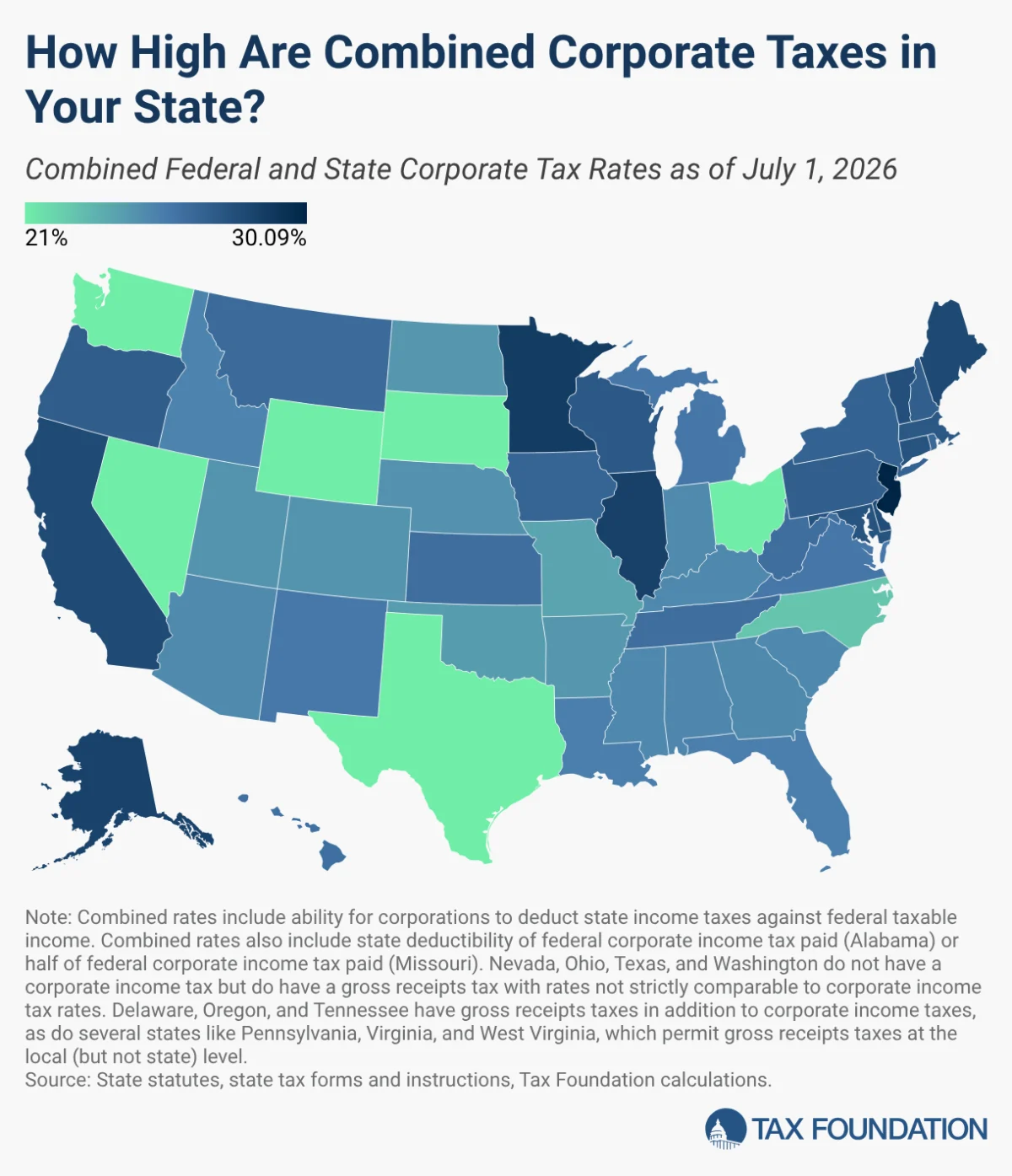
Corporations operating within the United States navigate a complex landscape of taxation, subject to levies at both federal and state levels. The federal corporate income tax, a significant revenue stream for the U.S. Treasury, is currently set at a flat rate of 21 percent. This federal imposition, however, represents only one layer of the fiscal obligations companies face. Complementing this, 44 states and the District of Columbia also impose their own corporate income taxes, creating a diverse and often intricate web of regulations and rates that vary significantly across the nation.
The top marginal corporate income tax rates at the state level exhibit a wide spectrum, ranging from a low of 2.0 percent in North Carolina to a high of 11.5 percent in New Jersey. This disparity is not merely in the rates themselves but also in the structure of these taxes. Thirteen states employ a graduated corporate income tax rate system, meaning the tax rate increases as a company’s taxable income rises, reflecting a progressive approach. In contrast, 31 states and the District of Columbia opt for a flat rate on corporate income, applying a single percentage across all income brackets. This bifurcated approach to rate structures adds another layer of complexity for businesses attempting to understand and comply with their tax obligations. A corporate income tax (CIT) is fundamentally levied by federal and state governments on business profits, calculated after deducting allowable expenses. It is crucial to note, however, that many smaller and medium-sized businesses are structured as pass-through entities (such as S corporations, partnerships, and sole proprietorships) and are therefore not directly subject to the CIT; their income is instead reported and taxed under the individual income tax of their owners.
Beyond Traditional Income Taxes: The Role of Gross Receipts Taxes
The fiscal landscape for corporations extends beyond the conventional corporate income tax in several states, which have adopted alternative or supplementary tax mechanisms. In Nevada, Ohio, Texas, and Washington, corporations are primarily subject to gross receipts taxes instead of a corporate income tax. A gross receipts tax is a levy on a company’s total sales or gross revenue, without deductions for business expenses like employee compensation, the cost of goods sold, or overhead. This differs fundamentally from a corporate income tax, which is applied to net profit. One of the most significant implications of a gross receipts tax is the potential for "tax pyramiding," where the tax is applied at multiple stages of the production process, from raw materials to final retail, leading to embedded taxes that can disproportionately burden businesses with longer supply chains and lower profit margins.
Adding another layer of complexity, states such as Delaware, Oregon, and Tennessee impose a corporate income tax in addition to a separate levy on gross receipts. This dual taxation system can result in a higher overall tax burden for businesses operating within these jurisdictions. Furthermore, some states allow local jurisdictions to impose gross receipts taxes. Pennsylvania, Virginia, and West Virginia, for instance, levy gross receipts taxes at the local level, even if they do not do so at the state level. This patchwork of state and local gross receipts taxes means that businesses often need to navigate a multitude of taxing authorities, each with its own specific rules and rates.
Amidst this varied environment, two states stand out for their unique approach: South Dakota and Wyoming. These two states levy neither a corporate income tax nor a statewide gross receipts tax, offering a potentially more favorable tax environment for certain businesses, particularly those with significant profit margins or extensive supply chains that would otherwise face tax pyramiding. However, businesses in these states still face other state and local taxes, such as property taxes, sales taxes, and potentially industry-specific levies.
Understanding the Combined Tax Burden and Deductibility
When considering the full impact of corporate taxation, it is essential to look at the combined federal and state rates. The state with the highest combined corporate income tax rate is New Jersey, reaching a substantial 30.1 percent. This figure results from the interplay of its high state corporate income tax rate and the federal rate. Other states where corporations face combined rates at or above 28 percent include Alaska, Illinois, Maine, and Minnesota. These higher combined rates can significantly influence business decisions regarding location, expansion, and investment.
Conversely, some states offer a comparatively lower combined tax burden. Six states—Ohio, Nevada, South Dakota, Texas, Washington, and Wyoming—levy no state corporate income tax. Consequently, corporations in these states primarily face only the federal tax rate of 21 percent. However, it is crucial to remember that four of these six states (Ohio, Nevada, Texas, and Washington) do levy statewide gross receipts taxes, meaning businesses there are not entirely free of state-level corporate levies, just free of the corporate income tax. South Dakota and Wyoming remain the true outliers, imposing neither a state corporate income tax nor a statewide gross receipts tax.
A critical aspect of the U.S. corporate tax system that influences the effective tax rate is the concept of deductibility. Corporations are generally permitted to deduct state corporate income taxes paid against their federal taxable income. This deduction effectively lowers the base upon which the federal 21 percent tax is calculated, thereby reducing the effective federal corporate income tax rate. For example, if a corporation in Rhode Island pays its state corporate income tax at a flat rate of 7 percent, it can deduct this amount from its federal taxable income. This deduction reduces its federal rate from 21 percent to an effective 19.53 percent, resulting in a combined federal and state rate of 26.53 percent (7% state + 19.53% effective federal). This mechanism is designed to mitigate the effects of double taxation on corporate profits by both state and federal authorities.
Furthermore, a few states offer reciprocal deductibility. Alabama, for instance, allows corporations to fully deduct their federal corporate income tax liability against their state liability, significantly lowering the effective state corporate income tax rate. Similarly, Missouri permits a 50 percent deduction of federal corporate income tax liability against state liability. These specific state-level deductions further reduce the overall tax burden faced by corporations in these jurisdictions, making them potentially more attractive for businesses seeking to minimize their tax liabilities.
Overall, when considering all states, including those that impose no corporate income taxes, the average combined state and federal corporate tax rate in the U.S. stands at approximately 25.5 percent. This average, however, masks the wide variations and complexities that exist within the system.
A Brief History and Evolution of Corporate Taxation in the U.S.
Corporate taxation in the United States has a rich and evolving history, often reflecting broader economic conditions and policy priorities. The first federal corporate income tax was enacted in 1909 as an excise tax on the privilege of doing business as a corporation, preceding the 16th Amendment that allowed for a direct income tax. The modern federal corporate income tax was formally established after the 16th Amendment’s ratification in 1913. For decades, the federal rate fluctuated, often increasing during times of war or economic expansion and decreasing during periods of recession or tax reform efforts.
A pivotal moment in recent history was the Tax Cuts and Jobs Act (TCJA) of 2017. Prior to the TCJA, the federal corporate income tax rate stood at 35 percent, one of the highest among developed nations. The TCJA dramatically reduced this rate to a flat 21 percent, a move intended to enhance U.S. corporate competitiveness, encourage domestic investment, and prevent companies from relocating profits or operations overseas. This significant federal change had ripple effects across the states, prompting some to re-evaluate their own corporate tax structures and rates to maintain competitiveness or adjust revenue projections. Many states, whose corporate income tax calculations were linked to federal definitions of taxable income, had to enact specific legislation to either conform to the new federal rules or decouple from them to preserve their tax bases.
State-level corporate taxation has also seen dynamic shifts. The adoption of gross receipts taxes by several states, for example, represents a move away from traditional profit-based taxation, often driven by a desire for more stable revenue streams, as gross receipts are less volatile than profits, especially during economic downturns. However, this shift has also sparked considerable debate about the fairness and economic efficiency of such taxes due to their potential for tax pyramiding and disproportionate impact on businesses with lower margins.
Economic Implications and Policy Debates
Corporate taxes are among the most intensely debated topics in economic policy, largely due to their significant implications for investment, employment, and economic growth. Economists generally agree that corporate income taxes are among the most economically damaging ways for governments to raise revenue. This perspective stems from several key economic principles:
-
Tax Incidence: While corporations legally pay the tax, the economic burden of corporate taxes is ultimately borne by individuals. The exact distribution of this burden—known as tax incidence—is a subject of ongoing debate. Depending on market conditions, the tax could be shifted to shareholders (through lower returns on investment), workers (through lower wages or fewer jobs), or consumers (through higher prices). Studies often suggest that a significant portion of the corporate tax burden falls on labor in the long run, making it a less progressive tax than it might appear on the surface.
-
Impact on Investment and Innovation: Higher corporate tax rates can reduce the after-tax return on investment, making capital projects less attractive. This can lead to decreased investment in new plants, equipment, and research and development, which are critical drivers of productivity growth and innovation. Businesses may also choose to invest in jurisdictions with lower tax rates, potentially leading to capital flight.
-
Competitiveness: In a globalized economy, corporate tax rates play a crucial role in a nation’s and a state’s competitiveness. If U.S. or state corporate tax rates are significantly higher than those in competing jurisdictions, it can incentivize businesses to relocate operations, intellectual property, or even their legal domicile, impacting domestic job creation and tax revenue. The TCJA’s reduction of the federal rate was explicitly aimed at addressing this international competitiveness concern.
-
Interstate Tax Competition: At the state level, the wide disparity in corporate tax rates and structures fosters intense interstate tax competition. States often use tax incentives, including lower corporate tax rates or exemptions, to attract businesses, create jobs, and stimulate local economies. This competition can lead to a "race to the bottom" where states feel pressured to lower rates to remain attractive, potentially straining public services if not managed carefully.
-
Revenue Generation vs. Economic Growth: State governments face a perennial challenge in balancing the need for sufficient tax revenue to fund public services (education, infrastructure, healthcare) with the desire to foster a business-friendly environment that promotes economic growth. Corporate income taxes, while a significant revenue source for many states, must be weighed against their potential disincentive effects on economic activity.
The Path Forward: Calls for Reform and Future Outlook
The intricate and varied nature of corporate taxation in the U.S. continues to fuel calls for reform at both federal and state levels. Policy analysts and business advocacy groups frequently highlight corporate taxes as a promising area for reform to increase competitiveness and promote economic growth, ultimately benefiting both companies and workers.
Potential areas of reform could include:
- Simplification: Streamlining tax codes to reduce compliance costs for businesses, particularly for those operating across multiple states.
- Rate Adjustments: Further evaluating whether current federal and state rates are optimally balanced to generate revenue without unduly stifling investment and job creation.
- Base Broadening: Shifting towards a broader tax base with lower rates, which can make the tax system more efficient and less distortive.
- Rethinking Gross Receipts Taxes: A thorough assessment of the economic impacts of gross receipts taxes, considering alternatives that might be less prone to tax pyramiding and more transparent.
- Harmonization: While full harmonization of state tax codes is unlikely due to sovereignty concerns, efforts to standardize definitions and reporting requirements could ease the burden on multi-state businesses.
In an increasingly dynamic global and national economy, continuous evaluation and thoughtful reform of corporate tax policies are essential. Organizations like the Tax Foundation play a crucial role in providing data-driven analysis to inform these debates, offering insights into how different tax structures impact economic outcomes. The ultimate goal is to design a tax system that is fair, efficient, generates sufficient revenue for public services, and fosters a robust environment for business investment, innovation, and job creation across all U.S. states.