Layla Zulfa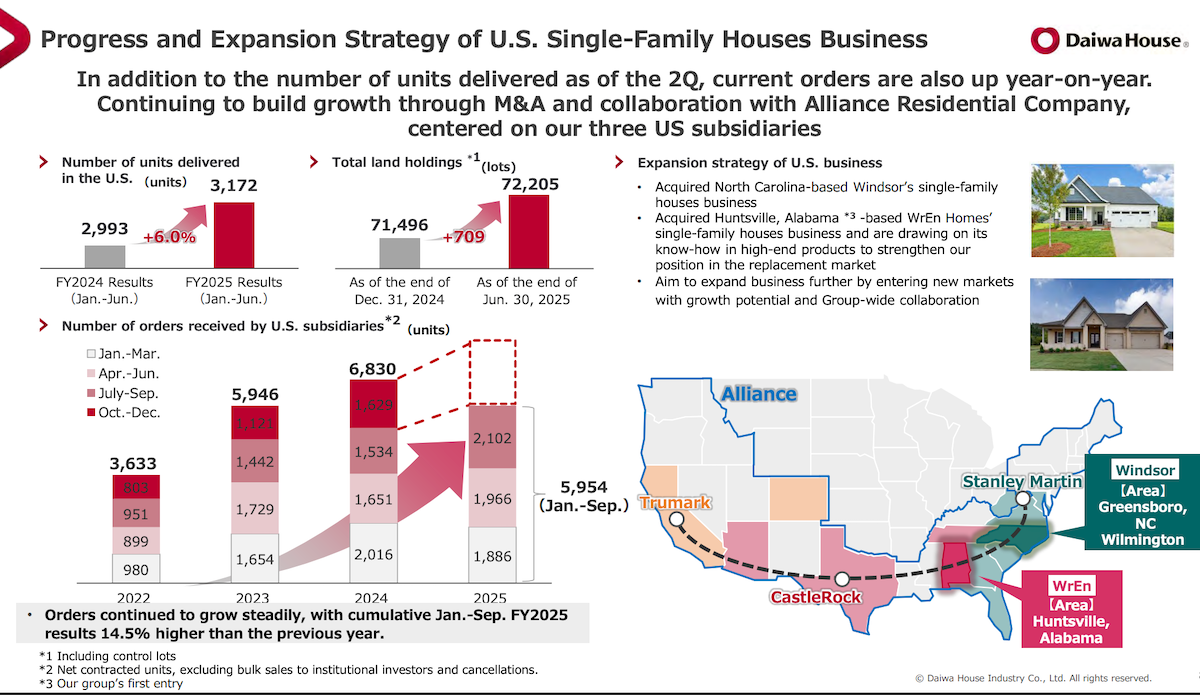
Before Daiwa House Industry unveils its 8th Medium-Term Management Plan this May, the globally integrated real estate giant has not only achieved, but likely surpassed, the ambitious goals of its previous 10-year U.S. expansion strategy. The recent acquisition of Washington-based JK Monarch by Trumark Homes, a key subsidiary of Daiwa House, marks a significant milestone, solidifying Daiwa House’s U.S. homebuilding platform into a cohesive, coast-to-coast network. This strategic move spans the nation’s most active new-home construction corridors, extending from the Mid-Atlantic and Southeast, through Texas, into the Western states, and now definitively reaching the Pacific Northwest.
This acquisition is both a practical culmination and a symbolic beginning. It represents the final geographic link in what has evolved into a three-platform U.S. operating system for Daiwa House. Coincidentally, this final operational step of a decade-long strategic cycle serves as the inaugural major stride into the company’s next planning phase. For Daiwa House, mirroring the strategies of fellow Japan-based global real estate development and construction competitors Sekisui House and Sumitomo Forestry, this consolidation signifies a strategic pivot. The upcoming phase will likely prioritize optimization, integration, and scaling of operations over initial market entry. Geographically, strategically, and metaphorically, the integration of JK Monarch expands the "Smile States" footprint, a concept Daiwa House uses to describe its strategically located, economically robust U.S. markets, thereby broadening the overall positive impact.
A Decade of Strategic Expansion Culminates in Pacific Northwest Entry
The acquisition of JK Monarch by Trumark Homes is the culmination of a long-term vision for Daiwa House’s U.S. homebuilding expansion. Trumark’s entry into Washington state, specifically targeting the Puget Sound and Tri-Cities areas, is facilitated by JK Monarch’s established presence, operational platform, and experienced team. This move strategically positions Trumark to establish a new Washington division, leveraging JK Monarch’s existing infrastructure and market knowledge.
Gregg Nelson, co-founder and co-CEO of Trumark Homes, emphasized the strategic importance of acquisitions over organic growth for rapid market penetration. "Yes, our preference has always been to do an acquisition rather than a de novo, simply because we can get up and running much faster and we have a team," Nelson stated. "However, this means we need to rely on opportunities arising, and this was one of those situations." This preference underscores a growth strategy that prioritizes speed-to-market and immediate alignment with local market dynamics and operational capabilities. Nelson further elaborated on the rationale, "It’s both an opportunity and what we see as an effective combination – meaning their culture and values align with ours, and we believe their team is strong and capable of growth."
The Strategic Rationale Behind the JK Monarch Acquisition
The decision to acquire JK Monarch extends beyond mere geographic expansion. Nelson highlighted JK Monarch’s strong foundational elements: "They have developed strong relationships with land sellers and trade partners, along with a great reputation among their buyers. That was important to us. They have a solid operations team, which was also very attractive." JK Monarch, founded in 2011, emerged from the challenging landscape following the Great Financial Crisis. This origin story shaped its DNA, fostering a culture of disciplined land acquisition, controlled growth, and the cultivation of trusted local relationships. Rather than pursuing aggressive volume, the company focused on precision and differentiated value.
Chris Jasinski, CEO of JTW Advisors, which represented JK Monarch in the sale, provided insight into the seller’s perspective. "He has the desire to see the growth of the business in Seattle. He recognizes there’s a limit to how big or successful they can be with the current ownership’s capital restrictions." This sentiment reflects a common scenario where a successful regional builder, despite strong operational capabilities, encounters capital limitations that hinder further expansion. Jasinski added, "Over the years, he has recruited a very high-caliber team with extensive experience and success in the Seattle market. He realized he couldn’t provide the capital necessary to do what these guys are capable of, and that’s why he sought the right partnership."
This infusion of patient capital from Daiwa House, channeled through Trumark, is poised to unlock JK Monarch’s growth potential. Nelson explained, "Because they are a private company, they’ve been careful with their risk and capital… In previous years, they’ve sold off some of their land. Now, with us bringing the capital to the table, they will be able to develop all their land and increase their land acquisition efforts." The synergy lies in combining JK Monarch’s disciplined operational stewardship with Trumark’s access to substantial capital, a core element of the deal’s strategic logic.

Navigating Complex Markets: The "Hard Market" Edge
The Puget Sound region of Washington state presents one of the most challenging entitlement and development environments in the United States. JK Monarch’s deep-rooted local expertise is therefore a significant asset. Nelson acknowledged the market’s complexities: "Moving into the Seattle metro area presents a very challenging environment for getting projects, finding land, getting approvals, and executing. Fortunately, we’re used to this from our years in California." This shared experience of navigating highly regulated and constrained markets creates a natural operational synergy. Nelson added, "We have a good understanding of the marketplace, and I believe they appreciate our experience in this area. It helps us partner effectively with them and assist in achieving even more than they already have." Consequently, JK Monarch is not merely a gateway to a new market; it represents an acquisition of critical capabilities that bolster Trumark’s proficiency in some of the U.S.’s most difficult, supply-constrained regions.
Product Alignment: The "Middle Lane" Strategy
JK Monarch’s product strategy further solidifies the strategic fit, particularly in the current housing market. While demand for entry-level homes faces affordability challenges, there remains consistent demand from move-up and second-time move-up buyers with significant discretionary spending power. JK Monarch has carved out a niche in this often-difficult-to-master "middle lane," balancing production efficiency with custom-home flexibility. Their homes, typically ranging from 2,100 to over 4,400 square feet and priced from the mid-$700,000s to over $1 million, are designed for versatility. Features often include provisions for multi-generational living, adaptable spaces, and seamless indoor-outdoor connectivity.
This positioning aligns closely with Trumark’s own market approach. Nelson explained, "JK Monarch’s buyers are mainly those looking to move up or make a second move up… people who want larger homes, more options, choices, and better design quality than traditional entry-level production homes. That again aligns with Trumark’s approach to the market." The demographic overlap is also notable. "Their typical buyer profile is quite similar to ours… professionals and families relocating within the greater Seattle area… Many of these are tech workers… much like the Bay Area." In both instances, the strategy centers on delivering design-forward, flexible housing solutions tailored to higher-income, life-stage-driven buyers – a segment that has demonstrated relative resilience amidst broader affordability pressures.
From Regional Builder to a Comprehensive Western Platform
The acquisition of JK Monarch is a pivotal step in Trumark’s evolution from a California-centric builder to a broader, multi-regional Western platform. Bolstered by Daiwa House’s capital, Trumark has experienced significant growth. "Since the merger with Daiwa House in 2020 and through 2025, Trumark has achieved a 50% compounded annual growth rate, which is substantial," Nelson reported. Its current operational footprint now encompasses Northern, Central, and Southern California, Colorado, and Washington, with further Western markets under active consideration. Nelson indicated, "We focus on the Western states… Colorado… and we are also exploring opportunities in Nevada, Utah, Arizona and others." This expansion is creating an increasingly contiguous Western operating geography, enhancing both capital deployment efficiency and operational scalability across multiple states.
The Daiwa House Playbook: Three Platforms, One Integrated System
At the corporate level, this acquisition reinforces Daiwa House’s overarching U.S. strategy, which centers on leveraging its U.S. subsidiaries as distinct vehicles for regional growth. Nelson described this approach: "Their strategy mainly involves using these three sister companies as vehicles for growth within their respective regions." These platforms are now clearly defined:
- Stanley Martin Companies: Primarily focused on the East Coast, with operations in states like Virginia, North Carolina, South Carolina, and Georgia.
- CastleRock Communities: Concentrated in the Southern U.S., particularly Texas.
- Trumark Homes: Strategically positioned on the West Coast, now expanded to include Colorado and Washington, with further Western expansion anticipated.
Collectively, these entities form what can be described as a federated national system. This system is not built upon a singular brand but rather on regionally anchored operators who share capital, strategic direction, and learning loops. This structure allows for localized expertise while benefiting from the collective strength of a global organization.

This expansion mirrors recent industry trends. Less than a month prior to this announcement, Stanley Martin acquired Carolinas-based United Homes Group (UHG) for $221 million, taking UHG private. Daiwa House had previously announced Stanley Martin’s acquisition of Southeast regional builder Windsor Homes in mid-2025. A statement from Daiwa House regarding its U.S. single-family housing business highlighted its strategic acquisitions: "For its U.S. Single-Family Houses business, Daiwa House Group acquired Stanley Martin, a single-family homebuilder on the East Coast, in 2017; Trumark, a builder on the West Coast, in February 2020; and CastleRock, a builder Southern U.S., in September 2021. It has expanded its operations centered on what is sometimes referred to as the ‘Smile Zone,’ a series of metropolitan areas or markets that connect the economically robust East, South, and West regions of the U.S. Currently, the three Daiwa House Group companies (Stanley Martin, CastleRock, and Trumark) aim to increase their annual single-family home deliveries from 7,095 in 2024 to over 10,000 by 2026." The addition of JK Monarch effectively extends this "Smile States" footprint to the Pacific Northwest, completing a coast-to-coast presence.
Leveraging Scale for Enhanced Efficiency and Innovation
With a comprehensive national footprint now established, the focus shifts towards capitalizing on the opportunities that scale provides. "Scale brings the opportunity to refine and increase the efficiency of your operations," Nelson commented. This includes:
- Enhanced Purchasing Power: Negotiating better terms with suppliers and subcontractors due to increased volume.
- Operational Efficiencies: Streamlining processes and implementing best practices across all divisions.
- Talent Development: Investing in broader training and development programs for a larger workforce.
- Technology Adoption: Implementing advanced technologies for design, construction, and customer management across the platform.
Nelson further noted the synergistic benefits: "We have also been able to share information among them and leverage the scale of the combined companies when negotiating… sharing best practices. Adding JK Monarch will allow us to continue this." The flow of value is deliberately multi-directional, fostering a culture of continuous improvement. "There will be things we can learn from them, and we want to bring value to the table for them as well."
A Federated Model Rooted in Local Autonomy
A hallmark of Daiwa House’s U.S. strategy, and a significant contributor to its success, is its operating philosophy. "They genuinely value local and American leadership… and they’ve stayed true to that," Nelson affirmed. Rather than imposing a rigid, centralized control structure, Daiwa House embraces a federated model. This means empowering local leadership: "They are very supportive and trust the leaders of the three companies to do what they do best and operate effectively." This approach resonates with Trumark’s own decentralized management style. "We depend on our division presidents who understand the local markets… and we give them a lot of latitude and flexibility," Nelson added. In an industry where nuanced local knowledge is paramount, this alignment between global financial backing and local operational autonomy represents a distinct competitive advantage.
A Milestone Achieved, A New Gear Engaged
For Trumark Homes, the acquisition of JK Monarch signifies another significant step in its accelerated growth trajectory. "We do envision it as an important milestone for Trumark… another step forward," Nelson stated. For Daiwa House, this achievement represents the successful culmination of a decade-long endeavor to construct a scaled, operationally integrated U.S. homebuilding platform.
The next phase of Daiwa House’s strategy is anticipated to evolve. With the broad geographic framework largely in place, future success will depend on the effective execution across these platforms. Key areas of focus will likely include:
- Synergistic Growth: Driving organic growth within each regional platform while identifying opportunities for cross-platform collaboration.
- Operational Excellence: Continuously refining and optimizing operations to maximize efficiency and profitability.
- Innovation and Technology: Investing in and adopting new technologies to enhance product development, construction methods, and customer experience.
- Market Penetration: Deepening market share within existing regions and strategically expanding into new, complementary markets.
If the past decade was characterized by building the foundational map of its U.S. operations, the coming years will be defined by how effectively Daiwa House and its subsidiaries can win on that map, solidifying their position as a leading force in the American homebuilding landscape.