Julia Chirkova
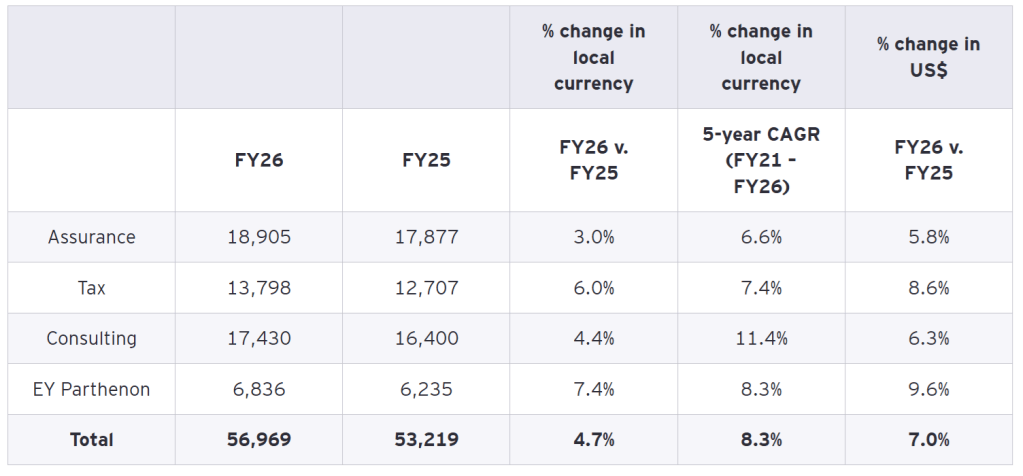
Ernst & Young (EY) announced robust financial results for its fiscal year 2026, which concluded on June 30, reporting a global revenue of $56.969 billion. This figure represents a significant 7% increase in U.S. dollar terms compared to the previous fiscal year, signaling sustained growth and market strength for one of the world’s largest professional services networks. In local currency terms, the growth stood at 4.7%, with the prior year’s revenue recorded at $53.2 billion for FY 2025. This latest performance underscores EY’s ability to navigate a dynamic global economic landscape and capitalize on evolving client needs.
EY’s Financial Performance in FY 2026: A Deeper Dive
The substantial revenue increase highlights EY’s strategic focus and operational execution throughout the fiscal year. The firm’s success can be attributed to a multi-faceted approach that emphasizes collaboration, innovation, and a keen understanding of market trends. EY Global Chair and CEO Janet Truncale emphasized the firm’s strategic direction in a statement, noting, "This fiscal year’s results demonstrate the strength of bringing EY teams and alliance partners together to accelerate value creation and turn disruption into sustained growth." This sentiment points to a deliberate strategy of leveraging a connected global network and strategic partnerships to deliver comprehensive solutions to clients.
Sectoral Performance and Regional Dynamics
EY’s diverse service lines all contributed to the overall revenue growth, with some sectors experiencing particularly impressive gains. The EY-Parthenon division, the firm’s strategy and transactions arm, emerged as a standout performer, achieving a remarkable 9.6% growth in U.S. dollar terms, generating $6.8 billion in revenue. This surge in strategy and transactions likely reflects increased client demand for strategic advisory services amidst ongoing economic shifts and opportunities for mergers, acquisitions, and corporate restructuring.

The Tax practice also demonstrated strong momentum, with revenue increasing by 8.6% to $13.8 billion. This growth in tax services could be indicative of clients seeking more sophisticated advice on navigating complex tax regulations, international tax planning, and the evolving tax implications of new business models and technologies. Consulting services followed with a healthy 6.3% increase, bringing in $17.4 billion, underscoring the continued demand for business transformation, digital enablement, and operational efficiency solutions. Assurance services, the largest revenue-generating segment, grew by 5.8% to $18.9 billion. This steady growth in assurance, which includes audit and related services, highlights the foundational importance of trust and transparency in financial reporting, even as the economic environment presents challenges.
Geographically, the Europe, Middle East, India, and Africa (EMEIA) region led the pack with the most significant year-over-year revenue increase. In U.S. dollar terms, EMEIA saw a 10.1% surge, reaching $23.2 billion. This exceptional performance in a diverse and often complex region suggests that EY’s tailored strategies and deep market understanding are resonating strongly with clients across these varied economies. The Asia-Pacific region also showed robust growth, with a 5.8% increase to just under $7.8 billion, indicating expanding opportunities and a growing client base in this dynamic part of the world. The Americas region, while experiencing a more moderate growth of 4.8%, still contributed significantly to the overall revenue, reaching $25.9 billion, underscoring its substantial market presence.
Strategic Investments in Talent and Technology
A key driver behind EY’s consistent growth is its significant investment in its people and in cutting-edge technologies. During FY 2026, the firm allocated $448 million to training and development initiatives. This investment included the rollout of new learning programs specifically designed to equip employees with skills in artificial intelligence (AI) and other emerging technologies, as well as leadership development and other future-focused competencies.
The firm’s commitment to AI is particularly evident in its employee development programs. EY professionals completed an impressive 5.2 million hours of formal AI-related learning. Furthermore, over 40,000 employees earned AI learning accreditations through EY Badges, the firm’s credentialing and continuous learning platform, with an additional 104,000 accreditations in progress. This proactive approach to upskilling the workforce ensures that EY professionals are at the forefront of technological advancements, enabling them to provide clients with the most relevant and innovative solutions. Across all learning and development areas, EY professionals logged 26.6 million hours of formal learning, a notable increase from the 24.6 million hours recorded in FY 2025, demonstrating a pervasive culture of continuous learning within the organization.

The adoption of AI tools within EY’s own operations is also expanding rapidly. By the close of FY 2026, 203,000 EY employees were equipped with Microsoft Copilot licenses, a number that has since surged to 381,000. This widespread adoption of AI-powered productivity tools signifies EY’s commitment to enhancing efficiency and innovation across its own service delivery.
The Rise of AI Services and Client Transformation
The increased adoption of AI tools within EY and its focus on AI-related training have directly translated into a significant demand for AI services from its clients. Sales from AI services experienced a remarkable 49% growth, indicating that clients are moving beyond initial AI experimentation and are increasingly engaging in enterprise-wide AI transformations.
Janet Truncale elaborated on this trend, stating, "Clients are moving from experimenting with AI to redesigning how their businesses operate. Growth in demand for AI-related services reflects that shift, as organizations increasingly prioritize approaches that combine technology with deep industry knowledge, trusted relationships and human judgment." This observation highlights a critical shift in how businesses are approaching AI implementation. It is no longer viewed as a standalone technological solution but as an integrated component of broader business strategy, requiring a blend of technological expertise, industry acumen, and human insight. EY’s ability to offer this integrated approach, leveraging its global network and alliance partners, positions it as a key enabler of this client transformation. The firm’s EY Value Realized 2026 report, released concurrently with the financial results, further elaborates on this interconnected approach, emphasizing how collaboration across service lines, industries, geographies, and with 119 alliance and ecosystem partners drives value creation and problem-solving for all stakeholders.
Competitive Landscape and Future Outlook
EY’s financial results place it firmly as the third-largest accounting firm globally by revenue. It is the second of the "Big Four" professional services firms to release its FY 2026 global revenue figures. Earlier in October, Deloitte, the world’s largest accounting firm, announced its FY 2026 revenue of $74.5 billion, representing a 3.8% increase in local currency and a 5.7% increase in U.S. dollar terms. This competitive landscape highlights the strong performance across the major players in the industry, suggesting a robust demand for professional services despite ongoing global economic uncertainties.
PricewaterhouseCoopers (PwC) is expected to release its FY 2026 global revenue results later in October, and KPMG typically follows suit in December. The anticipation surrounding these announcements will provide a clearer picture of the overall health and trajectory of the global professional services market.
Workforce Growth and Development
EY’s commitment to growth is also reflected in its expanding workforce. The firm saw a 2.2% increase in global headcount, growing from 406,209 employees in FY 2025 to 415,182 in FY 2026. This modest yet consistent growth in personnel suggests that EY is strategically expanding its capacity to meet client demand and to invest in new service areas, particularly those driven by technological advancements. The emphasis on training and development, coupled with headcount growth, indicates a long-term strategy focused on building a highly skilled and adaptable workforce capable of navigating the complexities of the future business environment.
In conclusion, EY’s strong performance in fiscal year 2026, marked by significant revenue growth and strategic investments in technology and talent, demonstrates its resilience and adaptability in the global professional services market. The firm’s focus on AI, its integrated approach to client solutions, and its strong regional performance position it for continued success in an ever-evolving business landscape. The successful integration of emerging technologies and the development of a skilled workforce are critical elements that will shape EY’s trajectory and its ability to deliver sustained value to its clients and stakeholders in the years to come.