Nila Kartika Wati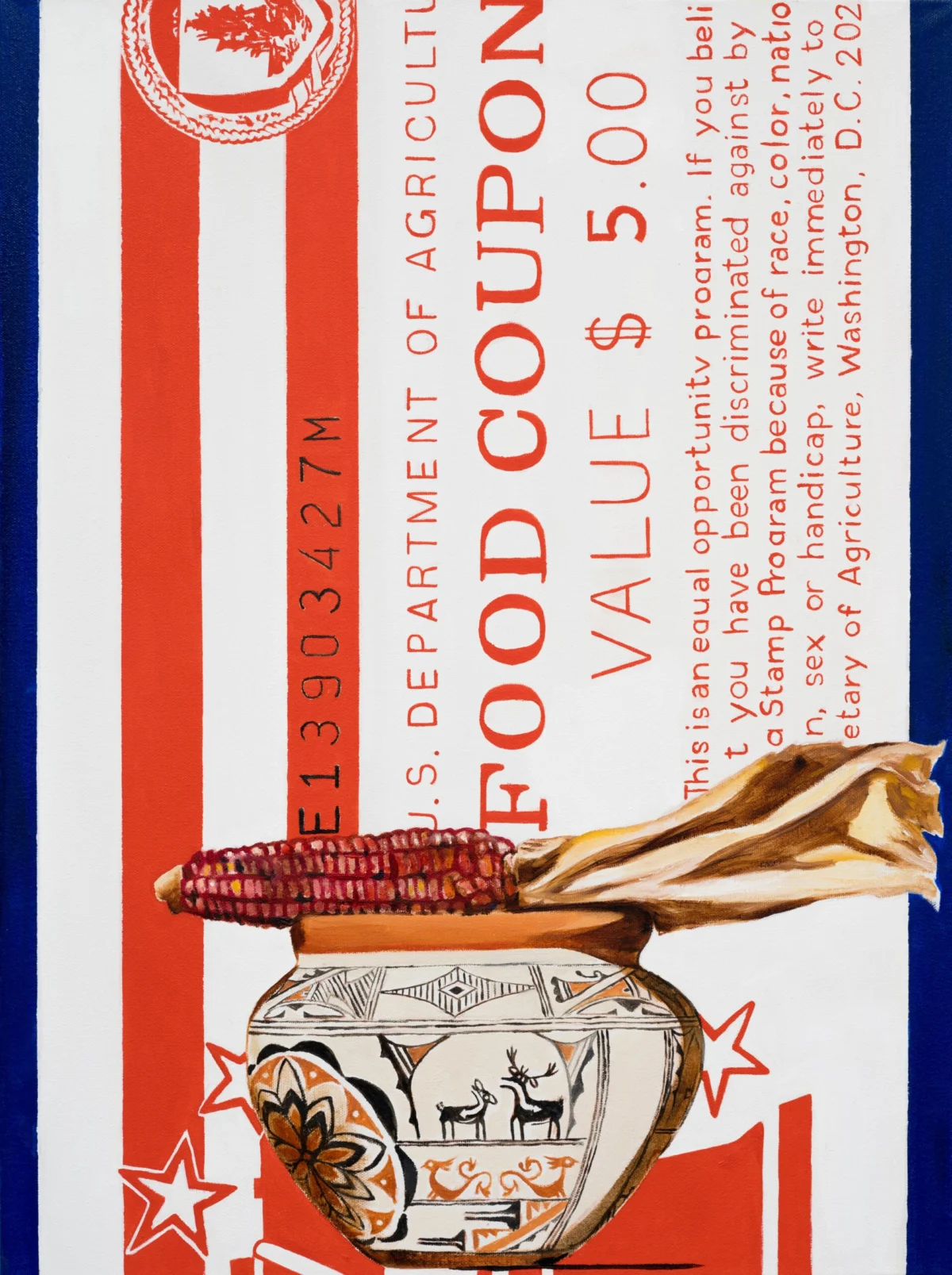
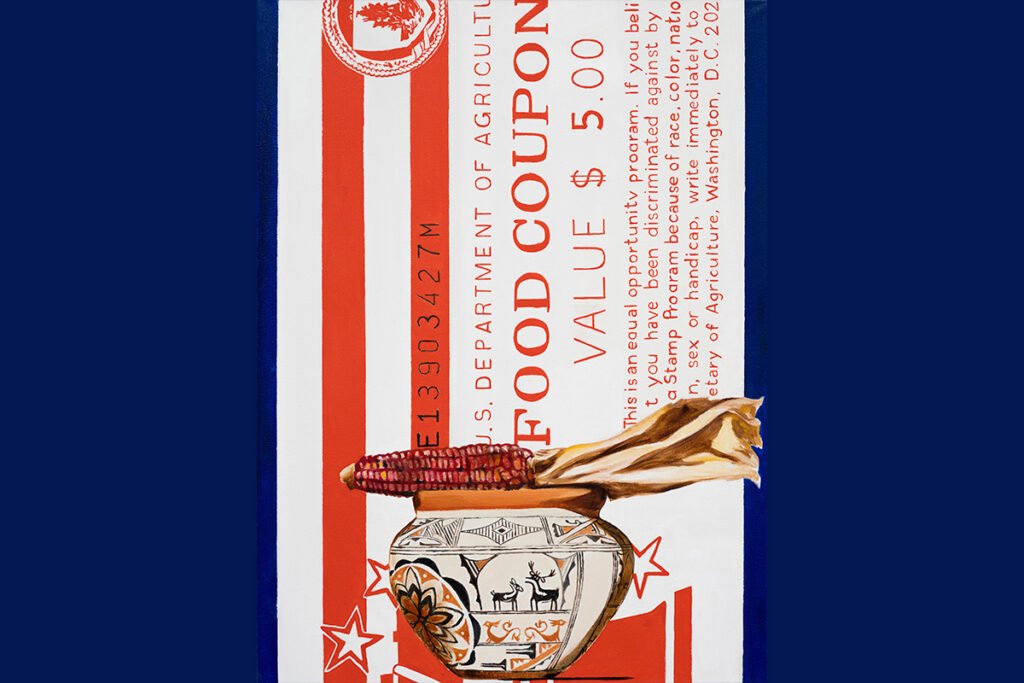
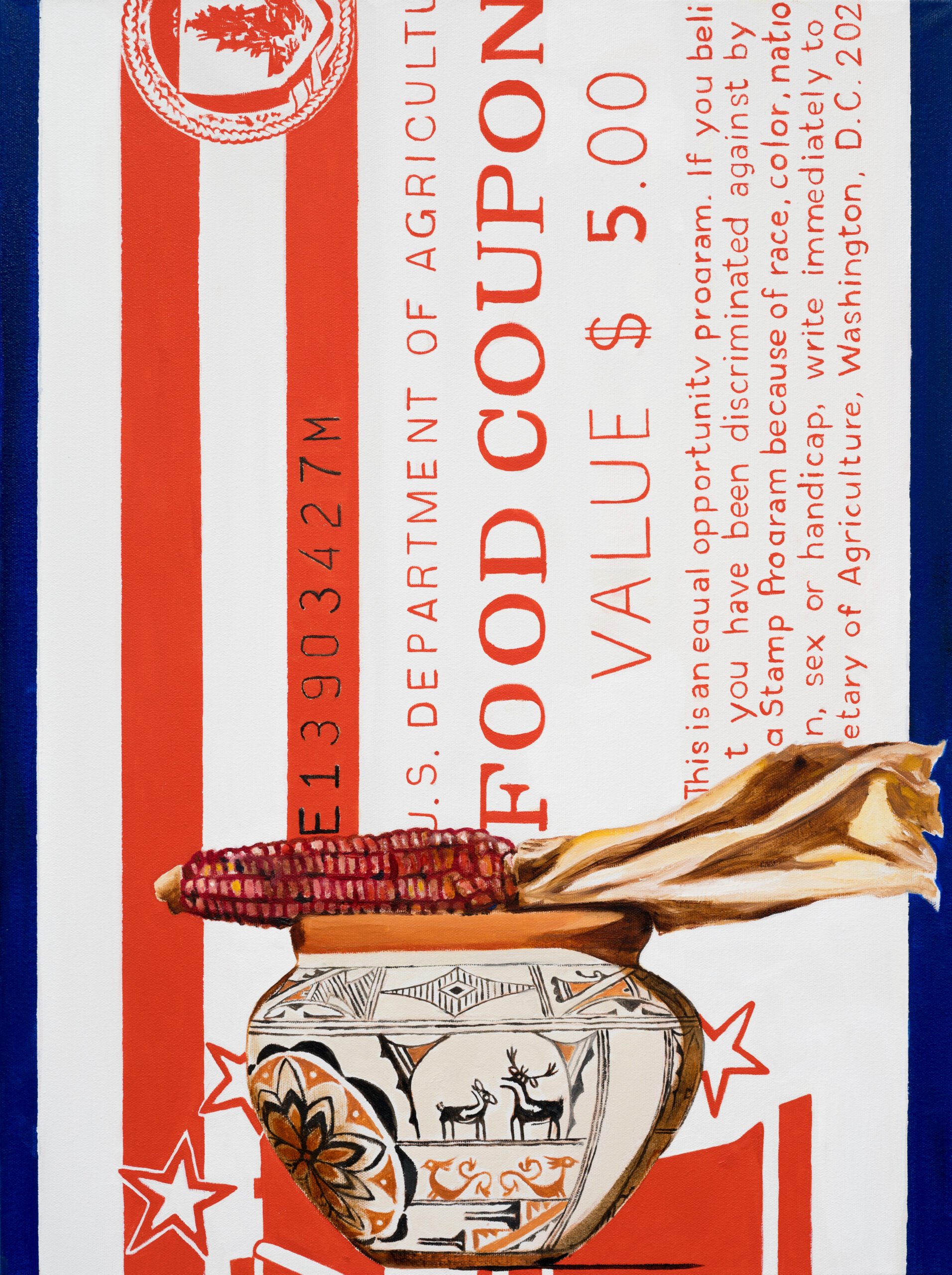
The intersection of contemporary federal assistance and ancestral Indigenous knowledge serves as the focal point for Food Coupons, a significant work by Apsáalooke (Crow) artist D.C. Allen. Through this piece, Allen explores the duality of modern survival and historical abundance, juxtaposing the sterile reality of the United States food assistance program with the rich, regenerative systems of Indigenous agriculture. The artwork is not merely a visual representation of policy but a deeply personal reflection on the artist’s upbringing and a broader critique of the systemic shifts that have altered the health and sovereignty of Native nations. By placing a contemporary food coupon alongside symbols of traditional Zuni and Puebloan foodways, Allen highlights a legacy of resilience and the ongoing movement to reclaim Indigenous food sovereignty.
The Artistic Vision and Personal Narrative of D.C. Allen
Born in 1993 and raised in Montana, D.C. Allen (also known as Del Curfman) is a member of the Crow Tribe of Montana and a graduate of the Institute of American Indian Arts (IAIA). His work frequently centers on Indigenous identity, utilizing large-scale figure painting to elevate contemporary Native voices. Food Coupons emerges from Allen’s personal history, specifically his experience growing up in a household that utilized federal food stamps. This lived experience provides an authentic lens through which he examines the complicated relationship between Native communities and the federal government.
The painting was inspired by Kevin Beltran, a Zuni and El Salvadoran individual who works with Pueblo youth to revive ancestral agricultural practices. In the work, Allen depicts corn harvested by three generations of Beltran’s family and traditional pottery—gifts given to Beltran upon his high school graduation. These elements serve as a counter-narrative to the modern food coupon, representing a time when Indigenous nations possessed sophisticated systems of trade, stewardship, and nutrition that sustained them for millennia prior to European contact.
The Evolution of Food Assistance in Indigenous Communities
To understand the weight of Allen’s critique, one must look at the historical trajectory of food access in Native American communities. For centuries, Indigenous nations across North America maintained complex agricultural and hunter-gatherer systems. In the Southwest, the Zuni and Pueblo peoples developed advanced irrigation and "waffle garden" techniques to thrive in arid climates. In the Northern Plains, the Crow and other nations relied on the buffalo and seasonal harvesting.
The disruption of these systems was a deliberate tool of colonization. The forced relocation of tribes to reservations in the 19th century severed the connection between the people and their traditional food sources. In place of self-sufficiency, the federal government introduced the commodity food system. Originally established through treaties and later formalized through programs like the Food Distribution Program on Indian Reservations (FDPIR), these programs provided rations such as flour, lard, sugar, and canned meats.
While these programs were designed to prevent starvation, they fundamentally altered the Indigenous diet. The transition from nutrient-dense, diverse traditional foods to high-carbohydrate, processed shelf-stable goods created a "nutritional transition" that has had devastating long-term effects. Allen’s work acknowledges that while programs like the Supplemental Nutrition Assistance Program (SNAP)—the modern successor to food stamps—have helped families survive, they often perpetuate a cycle of dependence on low-quality, processed foods.
Statistical Analysis of Health Disparities and Food Insecurity
The contrast Allen draws between "dependence and abundance" is supported by decades of public health data. The reliance on processed foods provided by federal assistance and the lack of access to fresh produce in "food deserts" on reservations have contributed to disproportionately high rates of diet-related illnesses.
According to the Centers for Disease Control and Prevention (CDC), American Indian and Alaska Native (AI/AN) adults are nearly three times more likely to be diagnosed with diabetes than non-Hispanic white adults. Furthermore, data from the Indian Health Service (IHS) indicates that Native American populations experience significantly higher rates of obesity and cardiovascular disease compared to the general U.S. population.
Food insecurity also remains a critical issue. A report by the Feeding America network found that 1 in 4 Native Americans experiences food insecurity, compared to 1 in 8 Americans overall. In many rural reservation communities, the nearest grocery store offering fresh vegetables may be over 50 miles away, leaving residents reliant on local convenience stores or federal commodity programs. These statistics provide the somber background against which Allen’s painting stands, framing the food coupon not just as a tool for survival, but as a symbol of a compromised health system.
The Symbolism of Traditional Foodways and Sovereignty
In Food Coupons, the inclusion of traditional corn and pottery represents the antithesis of the federal coupon. Indigenous agriculture, such as the "Three Sisters" (corn, beans, and squash) method, was built on ecological synergy and nutritional balance. Corn provided a structural trellis for beans, which in turn fixed nitrogen in the soil, while squash provided ground cover to retain moisture and deter weeds.
The pottery depicted in the work signifies more than just a vessel; it represents the trade networks and communal stewardship that once defined Indigenous economies. Before the imposition of modern borders and capitalist structures, Native nations engaged in extensive trade of seeds, dried meats, and agricultural products. This system was rooted in a relationship with the land that was both spiritual and practical.
Allen’s work aligns with the growing "Food Sovereignty" movement, which seeks to return the control of food systems to Indigenous communities. Organizations such as the Intertribal Agriculture Council and the North American Traditional Indigenous Food Systems (NATIFS), founded by Chef Sean Sherman, advocate for the restoration of traditional diets as a means of healing and political empowerment. By reviving ancestral seeds and agricultural techniques, these movements aim to break the cycle of dependence on federal assistance and processed foods.
Chronology of Indigenous Agricultural Reclamation
The context of Allen’s work is further enriched by the timeline of Indigenous agricultural revitalization in the United States:
- 1960s-1970s: The American Indian Movement (AIM) begins to highlight the poor quality of commodity foods and the need for self-determination.
- 1987: The Intertribal Agriculture Council is established to promote the conservation and development of Tribal resources.
- 1990s: Tribal nations begin utilizing the "Self-Governance" act to take more control over federal food distribution programs, allowing for the inclusion of locally grown or traditional foods like bison meat.
- 2010s: A surge in Indigenous culinary arts and agricultural projects, such as the Zuni Youth Enrichment Project (where Kevin Beltran works), focuses on teaching youth traditional farming.
- 2020-Present: The COVID-19 pandemic highlights the fragility of global supply chains, leading many Tribal nations to accelerate their food sovereignty initiatives to ensure community stability.
Broader Implications and the Role of Contemporary Art
Food Coupons serves as a critical bridge between the past and the present, challenging viewers to look beyond narratives of scarcity. By focusing on "innovation, resilience, and knowledge," Allen positions Indigenous people not as passive recipients of aid, but as active agents of their own cultural and physical well-being.
The painting is part of Allen’s broader project, "Faces of Our Land," which utilizes portraiture and documentary practices to represent contemporary Native lives. This project is a direct response to historical misrepresentation and the "vanishing Indian" trope often found in 19th-century American art. Instead, Allen’s practice foregrounds self-representation and sovereignty.
The implications of Allen’s work extend into the realms of policy and social justice. It invites a critique of the modern industrial food system, which prioritizes shelf-life and profit over nutrition and ecological health. For Indigenous communities, the reclamation of traditional food is a form of decolonization—a way to reclaim the body, the land, and the culture simultaneously.
In a museum or public context, Food Coupons acts as an educational tool. It prompts the observer to ask what has been lost through the transition to modern food systems and, more importantly, what remains. The work suggests that while the scars of colonization are evident in the health statistics and the necessity of food coupons, the "sophisticated Indigenous systems" of the past are not entirely gone. They are being revitalized by individuals like Kevin Beltran and depicted by artists like D.C. Allen to ensure that future generations inherit a legacy of abundance rather than dependence.
Through this painting, the food coupon is transformed from a mundane slip of paper into a site of cultural contestation. It stands as a testament to the fact that for many Native American communities, the act of planting a traditional seed or harvesting corn is a profound act of resistance and a step toward a healthier, more sovereign future.