Lana Rhoades
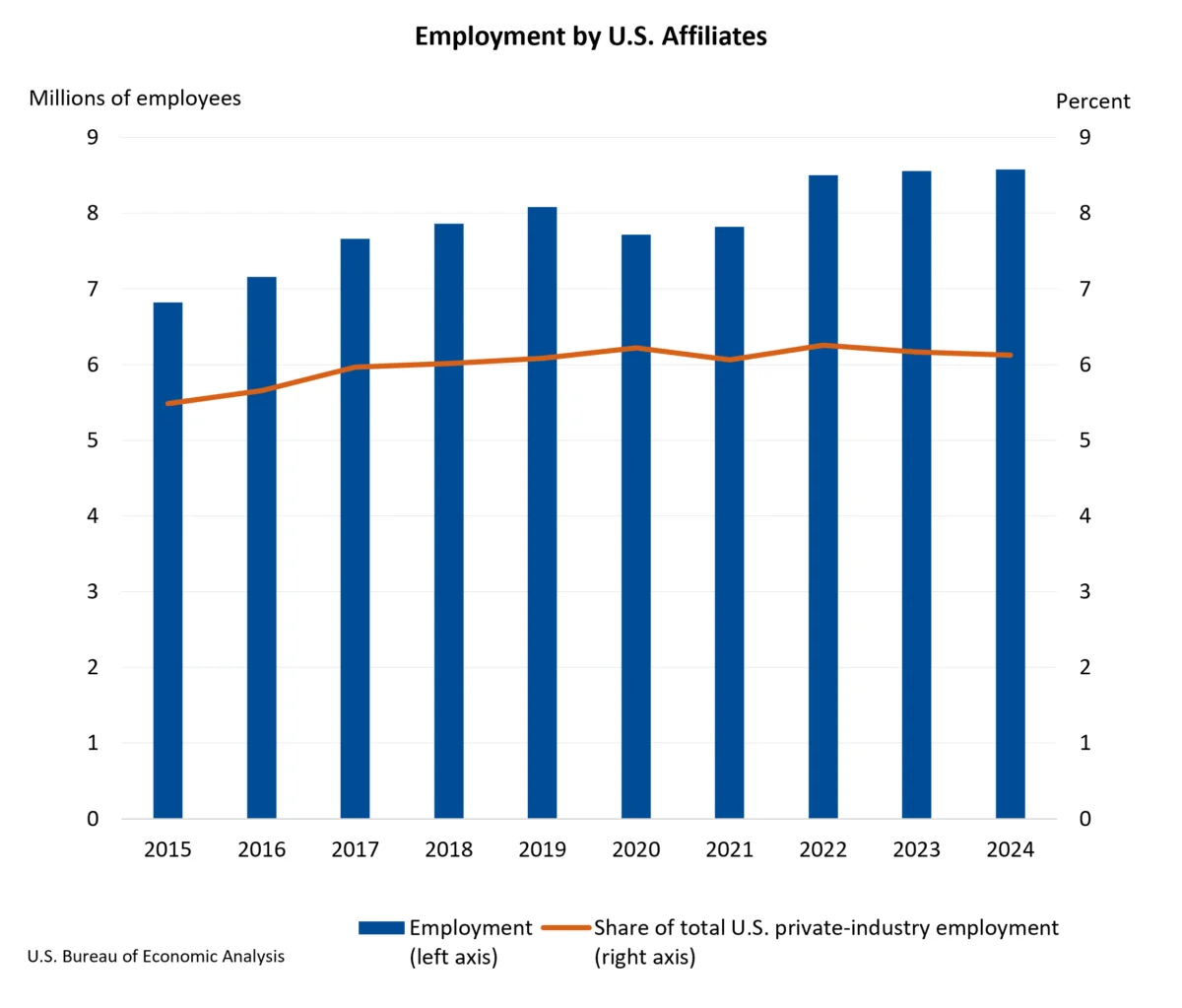
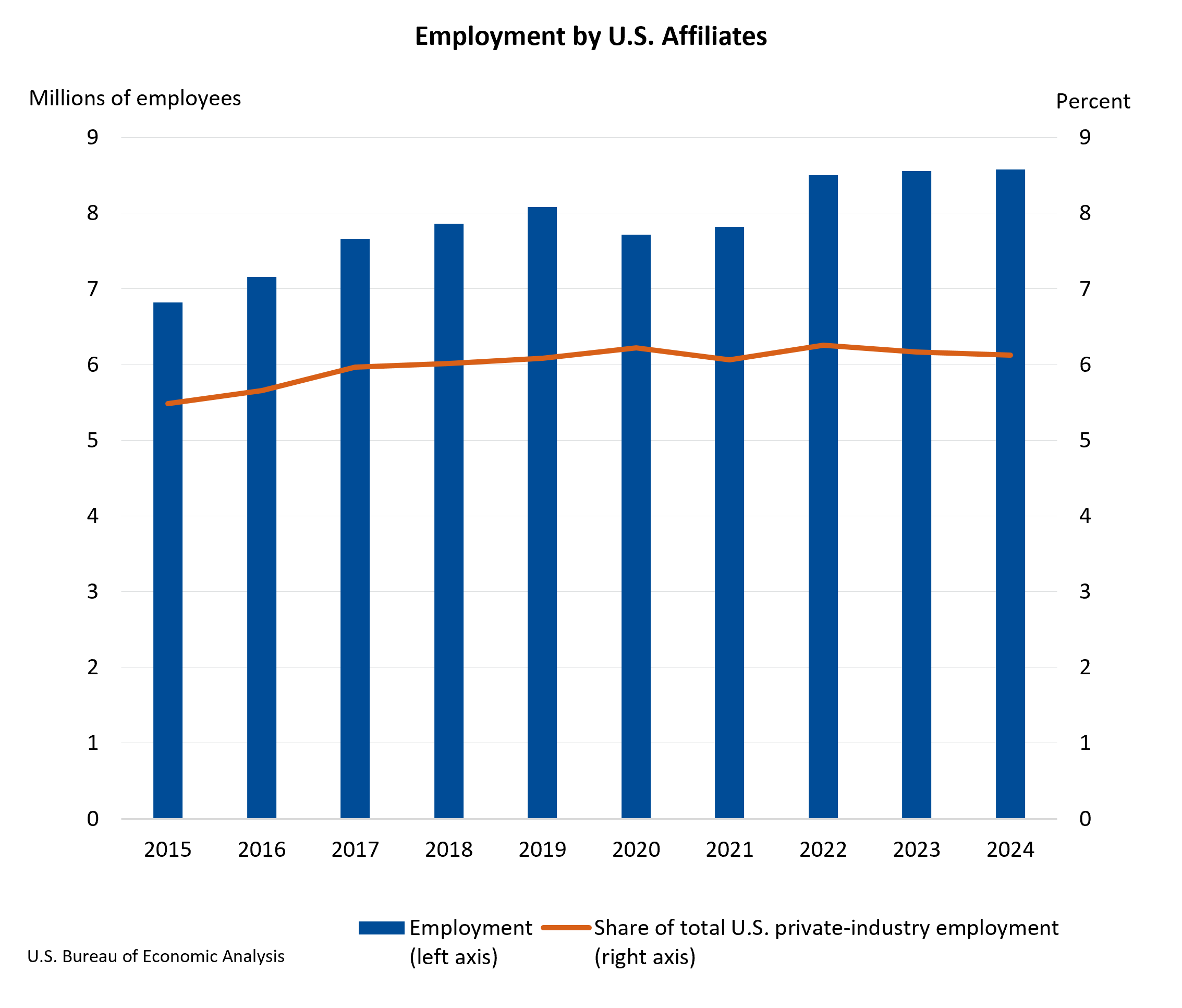
Majority-owned U.S. affiliates of foreign multinational enterprises (MNEs) sustained their significant role in the American economy in 2024, employing 8.57 million workers. This figure represents a modest 0.2 percent increase from the 8.56 million individuals employed in 2023, according to the latest statistics released by the U.S. Bureau of Economic Analysis (BEA). These affiliates, representing foreign companies with a controlling stake in U.S. businesses, continue to be a vital component of the nation’s private-industry employment landscape, accounting for 6.1 percent of all such jobs in 2024, a slight decrease from 6.2 percent in the preceding year.
The BEA’s comprehensive report, detailing the operations and finances of these U.S. affiliates, underscores their enduring impact on job creation and economic output. While the overall percentage of private-industry employment may have seen a fractional dip, the absolute number of jobs maintained by these foreign-owned entities demonstrates resilience and a continued commitment to the U.S. labor market. The sectors most heavily reliant on employment from these affiliates were manufacturing and retail trade, historically significant pillars of the American economy. This indicates that foreign investment continues to flow into foundational industries, contributing to both production and consumption.
Geographically, the United States’ relationship with its key economic partners is reflected in the origins of these investments. Affiliates with ultimate beneficial owners (UBOs) in the United Kingdom, Japan, and Germany emerged as the largest contributors to employment. This long-standing pattern highlights the deep economic ties and trust these nations place in the U.S. market for their overseas operations. The United Kingdom, Japan, and Germany have consistently been major sources of foreign direct investment into the United States, bringing not only capital but also management expertise, technological advancements, and, crucially, jobs.
Beyond employment figures, the economic contribution of these U.S. affiliates to the nation’s gross domestic product (GDP) also saw robust growth. The current-dollar value added by these entities, a key measure of their direct contribution to U.S. economic output, surged by 4.3 percent to reach an impressive $1.52 trillion in 2024. This performance indicates a strong expansion in the productive capacity and economic activity generated by foreign-owned businesses operating within the United States. These affiliates collectively accounted for 6.7 percent of the total U.S. business-sector value added, a slight decrease from 6.8 percent in 2023, reflecting the overall growth of the U.S. economy.
The BEA’s data further illuminates the investment patterns of these foreign-owned enterprises. Expenditures for property, plant, and equipment by U.S. affiliates saw a notable increase of 3.3 percent, reaching $328.0 billion. This upward trend in capital expenditure signifies a commitment to expanding operational capacity, modernizing facilities, and investing in the long-term future of their U.S. operations. Such investments are crucial for enhancing productivity, fostering innovation, and creating a more robust economic infrastructure.
Innovation remains a key area where these affiliates are making substantial contributions. Research and development (R&D) performed by U.S. affiliates experienced a significant increase of 5.3 percent, totaling $95.5 billion. This robust growth in R&D spending underscores the strategic importance these foreign companies place on innovation within the United States. These affiliates accounted for a substantial 12.4 percent of total U.S. business R&D in 2024, highlighting their role as drivers of technological advancement and the development of new products and services. This investment in R&D not only benefits the specific companies but also contributes to the broader scientific and technological ecosystem of the United States, fostering a more competitive and dynamic economy.
Regional economic disparities are also evident in the BEA’s state-level data. California led the nation in employment generated by U.S. affiliates, with 885,200 workers. Texas followed closely with 717,400 employees, and New York secured the third position with 556,700 workers. In all three of these leading states, the manufacturing sector was the largest employer among U.S. affiliates. This concentration of employment in manufacturing in major economic hubs suggests that foreign investment continues to support and revitalize key industrial bases within the United States, contributing to regional economic development and job opportunities.
A Deeper Dive into the Data and Trends
The BEA’s annual release of statistics on U.S. affiliate operations provides a critical lens through which to understand the intricate web of global commerce and investment that underpins the American economy. The data released today, covering the fiscal year 2024, builds upon a legacy of foreign investment that has shaped the U.S. industrial and employment landscape for decades.
Historical Context: The Evolving Role of Foreign Investment
The presence of foreign-owned businesses in the United States is not a new phenomenon. Following World War II, and particularly with the rise of globalization in the latter half of the 20th century, foreign direct investment (FDI) became an increasingly significant factor. Initially, much of this investment was concentrated in established industries like automotive and consumer goods. However, over time, FDI has diversified into sectors such as technology, pharmaceuticals, finance, and services, reflecting the evolving nature of the global economy. The BEA’s statistics serve as a vital barometer of this ongoing trend, tracking the scale and scope of foreign ownership and its impact.
The data for 2024 shows a steady, albeit modest, increase in employment. This follows a period of significant global economic uncertainty, including supply chain disruptions, inflation, and geopolitical tensions. The fact that employment has continued to grow, even by a small margin, suggests a degree of stability and confidence that foreign investors have in the long-term prospects of the U.S. market.
Key Sectors Driving Employment
The prominence of manufacturing and retail trade in employing workers from U.S. affiliates is a consistent theme in BEA reports. In 2024, these sectors continue to be major recipients of foreign capital and operational focus. The manufacturing sector, in particular, has seen a resurgence in attention, with foreign investment playing a role in modernizing factories, introducing advanced production techniques, and creating skilled jobs. Retail trade, on the other hand, reflects the consumer-driven nature of the U.S. economy, with foreign retailers establishing a significant presence to cater to American consumers.
The diversification of employment across various sectors, while not explicitly detailed in the provided summary, is a crucial aspect of understanding the full impact. While manufacturing and retail are dominant, foreign-owned companies also contribute significantly to employment in professional, scientific, and technical services, healthcare, and wholesale trade, among others. These contributions are vital for a well-rounded and dynamic labor market.
The Impact of Major Investing Nations
The continued leadership of the United Kingdom, Japan, and Germany as top sources of employment through their U.S. affiliates is a testament to long-standing bilateral economic relationships. These nations have historically been major players in global trade and investment, and their sustained commitment to the U.S. market underscores the attractiveness of the American economy.
- United Kingdom: Historically, UK companies have invested heavily in various U.S. sectors, including finance, manufacturing, and professional services. Their presence often brings established brands and significant operational footprints.
- Japan: Japanese investment in the U.S. is notable in the automotive sector, where major manufacturing plants have been established, creating thousands of jobs. Beyond automotive, Japan also invests in technology and electronics.
- Germany: German companies, particularly in the automotive and chemical industries, have a strong presence in the U.S. Their investments often focus on high-value manufacturing and advanced technological applications.
The BEA data provides an opportunity to analyze the specific contributions of each of these countries, offering insights into their evolving investment strategies and their impact on different regions and industries within the U.S.
Value Added: A Measure of Economic Contribution
The increase in "value added" is a critical indicator of the economic productivity of these U.S. affiliates. This metric, which measures the difference between the value of an industry’s output and the value of intermediate inputs used in production, provides a direct measure of their contribution to the U.S. GDP. The 4.3 percent growth signifies that these foreign-owned entities are not just employing people but are actively creating wealth and economic value within the United States.
The slight decrease in their share of total U.S. business-sector value added, from 6.8 percent to 6.7 percent, is likely attributable to the overall robust growth of the entire U.S. business sector. In a rapidly expanding economy, the percentage share of any single component may naturally see a fractional decline even as its absolute value increases.
Investment in Infrastructure and Innovation
The substantial increases in expenditures for property, plant, and equipment ($328.0 billion) and R&D ($95.5 billion) are particularly encouraging signals. These figures point to a forward-looking approach by foreign investors, not merely operating existing businesses but actively investing in their future growth and competitiveness within the U.S.
- Capital Expenditures: The investment in physical assets like factories, machinery, and buildings is foundational for economic expansion. It supports job creation in construction and manufacturing, enhances operational efficiency, and increases the productive capacity of the U.S. economy.
- Research and Development: The significant R&D spending highlights the U.S. as a hub for innovation. Foreign companies are leveraging American talent and infrastructure to develop new technologies, products, and processes. This not only benefits the investing companies but also contributes to the U.S. knowledge economy, fostering a competitive advantage in global markets. The 12.4 percent share of total U.S. business R&D performed by these affiliates is a powerful testament to their role in driving innovation.
State-Level Economic Impact
The concentration of employment in California, Texas, and New York underscores the importance of these states as major economic centers and popular destinations for foreign investment. The fact that manufacturing is the leading sector in these states for affiliate employment is noteworthy, suggesting that these economically diverse states continue to maintain a strong industrial base, supported by foreign investment.
- California: With its diverse economy encompassing technology, entertainment, and agriculture, California attracts significant foreign investment across multiple sectors.
- Texas: Known for its energy sector, advanced manufacturing, and growing tech industry, Texas offers a business-friendly environment for foreign companies.
- New York: As a global financial hub and a center for media, fashion, and technology, New York continues to be a prime location for foreign investment.
The BEA’s detailed state-level data allows for a granular understanding of how foreign investment impacts regional economies, job markets, and specific industry clusters across the nation.
Updates and Revisions: Ensuring Data Accuracy
The BEA’s commitment to data accuracy is evident in its practice of revising previously released statistics. The update for 2023 data, which incorporates newly available and revised source data, demonstrates the rigorous process of statistical compilation. Preliminary estimates are subject to refinement as more comprehensive information becomes available. The table provided shows a decrease in the preliminary estimate for employees (from 8,661.8 thousand to 8,556.9 thousand) and value added (from $1,469.1 billion to $1,456.3 billion), while R&D expenditures saw an increase (from $87.8 billion to $90.6 billion). These revisions are a standard part of statistical reporting and are essential for providing the most accurate picture of economic activity.
Broader Implications for the U.S. Economy
The sustained activity of majority-owned U.S. affiliates of foreign MNEs has several key implications for the U.S. economy:
- Job Creation and Stability: These affiliates are significant employers, providing stable jobs and contributing to the overall health of the labor market. Their continued presence offers a buffer against potential economic downturns.
- Economic Growth and GDP Contribution: The substantial value added by these entities directly contributes to U.S. GDP, stimulating economic activity and generating tax revenue.
- Innovation and Technological Advancement: Investment in R&D by foreign-owned companies drives innovation, leading to the development of new technologies, products, and services that benefit consumers and enhance U.S. competitiveness.
- Capital Investment: Expenditures on property, plant, and equipment signal a long-term commitment to the U.S. market, leading to infrastructure development and increased productivity.
- Global Integration: The presence of these affiliates signifies the U.S.’s continued integration into the global economy, attracting international capital and expertise.
- Regional Development: State-level data highlights the impact of foreign investment on specific regions, fostering local economic growth and job opportunities.
Looking Ahead
The BEA’s announcement of the next release in Spring 2027, focusing on 2025 activities, indicates a forward-looking perspective. This ongoing data collection and dissemination process is invaluable for policymakers, businesses, and researchers seeking to understand the dynamics of foreign investment and its contribution to the U.S. economy. As the global economic landscape continues to evolve, the role of these majority-owned U.S. affiliates will remain a critical factor in shaping the nation’s economic trajectory. The BEA’s commitment to providing detailed and up-to-date statistics ensures that this vital aspect of the U.S. economy is well-understood and can be effectively leveraged for future growth and prosperity.
The BEA’s methodology updates, such as the adoption of a coarsening approach to disclosure avoidance, aim to enhance data availability while maintaining respondent confidentiality. This is a crucial step in ensuring that the public has access to more detailed economic insights without compromising the privacy of businesses that contribute to these statistics. The continued refinement of data collection and reporting mechanisms by the BEA underscores its dedication to providing the most accurate and comprehensive economic information possible.
In conclusion, the 2024 data from the Bureau of Economic Analysis paints a picture of sustained engagement and growth for majority-owned U.S. affiliates of foreign multinational enterprises. Despite a slight shift in employment’s percentage share of the private sector, the absolute numbers, coupled with robust growth in value added, capital expenditures, and R&D, affirm the enduring importance of these entities to the American economic fabric. Their contributions to job creation, innovation, and overall economic output underscore the critical role of foreign investment in bolstering the United States’ position on the global economic stage.