Lana Rhoades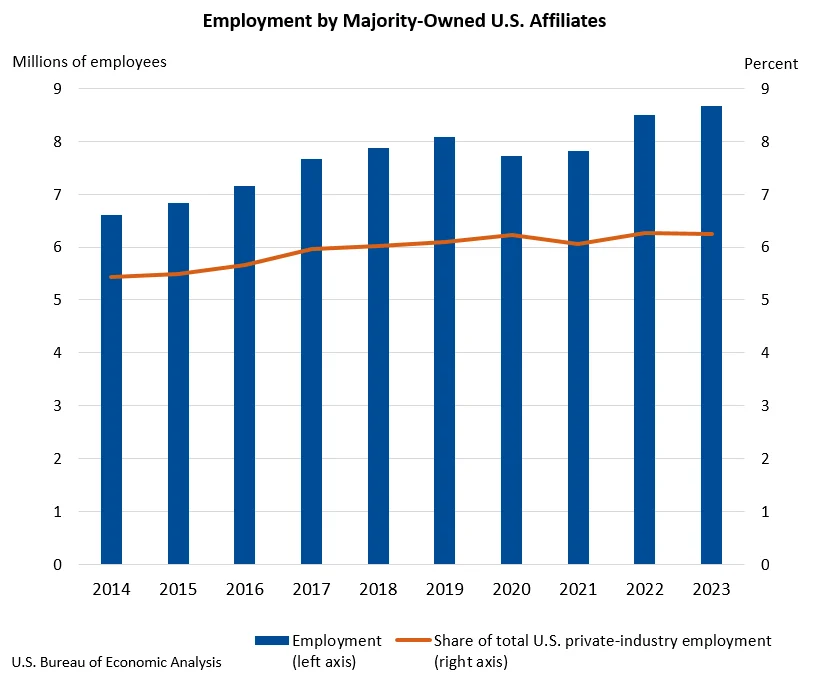
The U.S. economy continued to benefit from the significant presence of foreign multinational enterprises (MNEs) in 2023, as their majority-owned U.S. affiliates employed a record 8.66 million workers. This figure represents a notable increase of 1.9 percent from the 8.5 million jobs recorded in 2022, underscoring the enduring role of international investment in the American labor market. The statistics, released by the U.S. Bureau of Economic Analysis (BEA), provide a comprehensive overview of the financial and operational activities of these foreign-backed entities within the United States.
While the absolute number of jobs grew, the proportion of total private-industry employment held by these majority-owned U.S. affiliates saw a slight dip, moving from 6.3 percent in 2022 to 6.2 percent in 2023. This marginal decrease, however, does not diminish the substantial contribution these companies make to the overall economic landscape. Their aggregate economic output, measured by value added, surged by 6.3 percent to reach $1.47 trillion in 2023. This metric, a key indicator of their direct contribution to the U.S. Gross Domestic Product (GDP), reflects robust growth and increased productivity.
The investment in the future of these U.S. operations is also on the rise. Expenditures for property, plant, and equipment by majority-owned U.S. affiliates climbed by 6.3 percent, reaching $322.7 billion in 2023. This significant capital investment signals confidence in the long-term viability and expansion prospects of these businesses within the United States, paving the way for future job creation and technological advancement. Furthermore, commitment to innovation is evident in the 1.1 percent increase in research and development (R&D) performed by these affiliates, totaling $87.8 billion in 2023. This investment in R&D is crucial for fostering innovation, driving economic competitiveness, and developing cutting-edge products and services.
Historical Context and Trends in Foreign Direct Investment
The presence of foreign multinational enterprises in the U.S. economy is not a new phenomenon. For decades, foreign direct investment (FDI) has played a vital role in shaping the nation’s industrial base, employment figures, and technological capabilities. Historically, the U.S. has been a prime destination for FDI due to its large consumer market, stable economic and political environment, skilled workforce, and robust legal framework.
The BEA’s statistics on U.S. affiliates of foreign MNEs have been a critical tool for understanding the evolving landscape of this investment. These reports track key economic indicators, allowing policymakers, businesses, and researchers to gauge the impact of FDI on employment, output, trade, and innovation. Over the years, trends have shown a consistent growth in the number of jobs created and the value added by these foreign-owned entities, although year-to-year fluctuations are common, influenced by global economic conditions, trade policies, and specific industry trends.
The data released today for 2023 continues this established pattern of significant contribution. The growth in employment, value added, and capital expenditures suggests a resilient and expanding presence of foreign companies in the U.S. market, even amidst a dynamic global economic environment.
Key Performance Indicators for U.S. Affiliates of Foreign MNEs in 2023
The Bureau of Economic Analysis provides a granular look at the economic footprint of these majority-owned U.S. affiliates. The 8.66 million jobs employed in 2023 represent a diverse range of sectors, from manufacturing and services to technology and finance. This broad-based employment contributes to economic stability and provides opportunities for American workers across various skill levels.
Value Added: The $1.47 trillion in value added signifies the direct economic output generated by these firms. This figure is a crucial component of the U.S. GDP, reflecting the contribution of these companies to the nation’s overall economic product. The 6.3 percent increase in value added outpaced the growth in employment, indicating an improvement in productivity and efficiency within these foreign-owned operations.
Capital Expenditures: The $322.7 billion invested in property, plant, and equipment is a strong indicator of future economic activity. These investments can include building new factories, expanding existing facilities, upgrading machinery, and investing in infrastructure. Such capital injections often lead to enhanced production capacity, improved operational efficiency, and, importantly, the creation of new jobs during the construction and operational phases.
Research and Development: The $87.8 billion dedicated to R&D underscores the commitment of foreign MNEs to innovation within the U.S. This investment fuels advancements in various fields, leading to the development of new technologies, products, and processes. R&D activities also contribute to a highly skilled job market and can foster spillover effects, benefiting the broader U.S. innovation ecosystem.
Revisions to 2022 Data Highlight Data Refinement Process
The BEA also released revised statistics for 2022, incorporating newly available and updated source data. These revisions are a standard part of the BEA’s statistical process, ensuring the accuracy and reliability of its economic indicators. The preliminary estimates for 2022, initially released in November 2024, were subject to refinement.
Key revisions for 2022 include:
- Number of Employees: The revised estimate shows 8,503.1 thousand employees, an increase from the preliminary estimate of 8,351.0 thousand.
- Value Added: The revised value added figure stands at $1,382.1 billion, up from the preliminary $1,350.1 billion.
- Expenditures for Property, Plant, and Equipment: These expenditures were revised to $303.5 billion, compared to the preliminary $299.1 billion.
- Research and Development Expenditures: The revised R&D spending reached $86.8 billion, an increase from the preliminary $80.3 billion.
These revisions demonstrate the BEA’s commitment to providing the most accurate economic data possible. The updated 2022 figures provide a more precise baseline for understanding economic trends and for comparing performance across different years.
Broader Economic Implications and Analysis
The consistent growth in employment and economic output from majority-owned U.S. affiliates of foreign MNEs carries significant implications for the U.S. economy.
Job Creation and Economic Stability: The 8.66 million jobs directly supported by these companies represent a substantial portion of the U.S. labor force. These jobs not only provide livelihoods for millions of Americans but also contribute to consumer spending, tax revenues, and the overall economic stability of communities where these businesses operate.
Technological Advancement and Innovation: Investments in R&D by foreign MNEs are critical for maintaining the U.S.’s competitive edge in innovation. These investments can lead to breakthroughs in science and technology, fostering new industries and driving economic growth. Moreover, the transfer of knowledge and expertise associated with R&D activities can benefit domestic companies and research institutions.
Capital Investment and Infrastructure Development: The substantial capital expenditures indicate a strong commitment to expanding operations and improving infrastructure. This not only creates jobs in the short term through construction and manufacturing of equipment but also enhances the productive capacity of the U.S. economy for the long term.
Trade Balance and Global Integration: The activities of these affiliates also influence the U.S. trade balance. Their operations, including imports and exports, are integral to global supply chains and contribute to the interconnectedness of the U.S. economy with the rest of the world.
Future Outlook and Data Availability
The BEA plans to release its next update on the activities of U.S. affiliates of foreign MNEs on July 10, 2026, which will cover data for 2024. This regular release schedule ensures that policymakers and the public have access to timely information for economic analysis and decision-making.
For those seeking more detailed information, the BEA provides extensive data tables through its Interactive Data Application and comprehensive data tables on its website. These resources allow for in-depth exploration of statistics related to sales, balance sheet items, income statements, employee compensation, trade, and more. Industry-, country-, and state-level details are also available, offering a nuanced understanding of the geographical and sectoral distribution of foreign investment.
It is important to note that the BEA has discontinued certain data tables previously produced alongside these news releases, effective December 5, 2025. This includes statistics on U.S. affiliates with 50 percent or less foreign ownership and supplemental industry statistics. While these specific tables are no longer available in their previous format, the BEA continues to provide a wealth of data to support economic research and analysis. The archived tables remain accessible for historical reference.
The continued strength and growth of U.S. affiliates of foreign multinational enterprises are a testament to the enduring appeal of the U.S. market as a destination for global investment. As these companies expand their operations, invest in innovation, and create jobs, they remain a vital engine for U.S. economic prosperity. The BEA’s comprehensive data collection and reporting are instrumental in tracking and understanding this crucial aspect of the American economy.