Lana Rhoades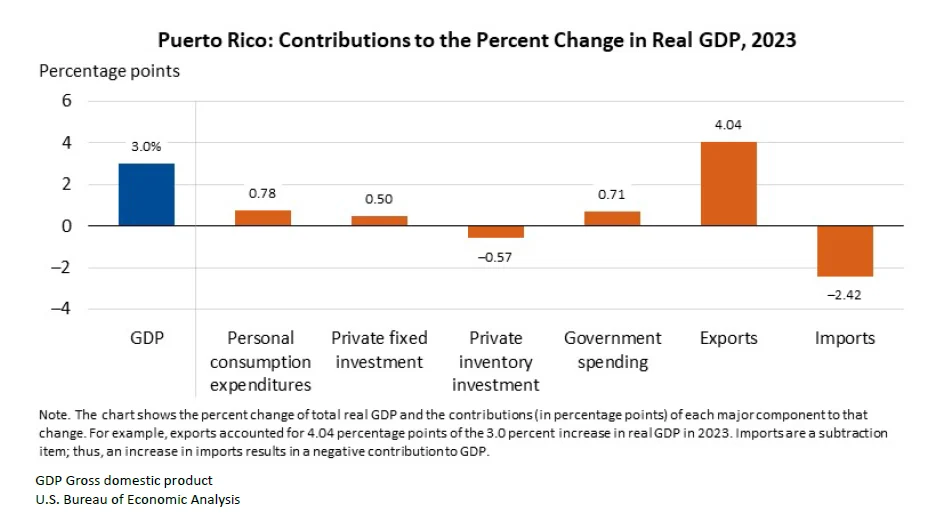
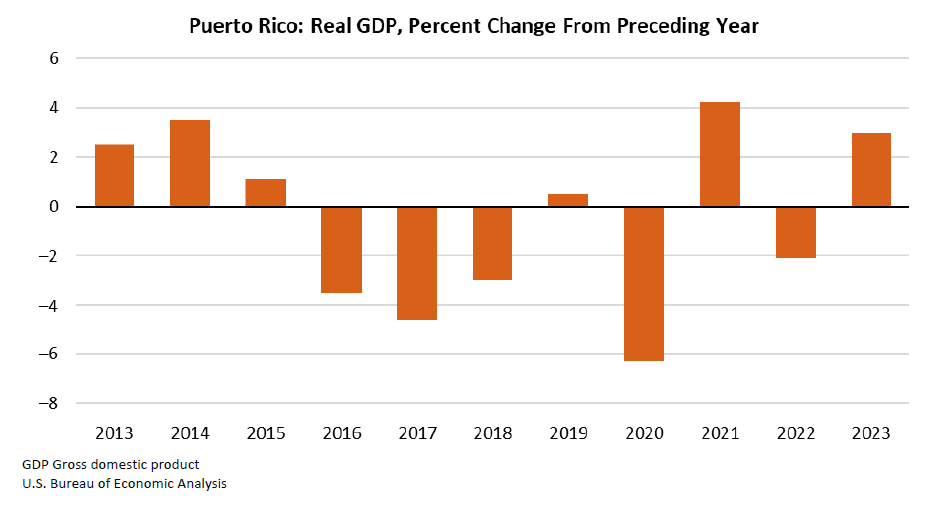
Puerto Rico’s economy demonstrated a notable rebound in 2023, with real gross domestic product (GDP) experiencing a robust increase of 3.0 percent. This marks a significant turnaround from the 2.1 percent contraction recorded in 2022, according to the latest statistics released by the U.S. Bureau of Economic Analysis (BEA). The island’s economic performance in 2023 was largely propelled by a substantial rise in exports, complemented by expansions in personal consumption expenditures, government spending, and private fixed investment. These positive contributions were partially offset by a decline in private inventory investment and an increase in imports, which are subtracted in GDP calculations.
Economic Rebound Driven by Export Strength
The upward trajectory of Puerto Rico’s GDP in 2023 was primarily fueled by a healthy 6.4 percent increase in real exports. This growth encompassed both goods and services, with exports of goods rising by 6.6 percent and exports of services seeing a 5.6 percent increase. This surge in external demand signals a growing appetite for Puerto Rican products and services in the global market, suggesting potential improvements in the competitiveness and appeal of the island’s offerings.
This robust export performance is a critical indicator of economic health, reflecting the ability of local businesses to compete internationally. The diversification of export categories, including both manufactured goods and services, suggests a developing resilience within the Puerto Rican economy. The increase in exports of goods, in particular, may point to a strengthening of the manufacturing sector, a key component of the island’s industrial base. The corresponding rise in services exports could indicate growth in sectors such as professional services, technology, or tourism-related offerings, broadening the base of economic activity.
Key Drivers of GDP Growth
Beyond exports, several other components of aggregate demand contributed to the positive GDP growth in 2023:
- Personal Consumption Expenditures (PCE): Real PCE, a measure of household spending, grew by 1.2 percent. While overall spending on goods within PCE saw a slight decrease of 0.8 percent, this was more than offset by a significant 4.0 percent increase in spending on PCE services. This shift suggests a consumer preference for services, potentially reflecting increased consumer confidence or a reallocation of spending patterns post-pandemic. The growth in services could encompass areas like healthcare, entertainment, transportation, and professional services, indicating a dynamic consumer market.
- Government Spending: Real government spending experienced a substantial increase of 4.8 percent. This growth was observed across all levels of government—federal, central, and municipal—with a notable surge in investment spending. This expansion is largely attributed to the continued disbursement of federal funds allocated for disaster recovery efforts. These funds are being channeled into critical infrastructure projects aimed at rebuilding and modernizing essential services following a series of devastating natural events.
- Private Fixed Investment: Real private fixed investment rose by 3.8 percent, primarily driven by increased investment in equipment. This growth was particularly strong in industrial equipment, indicating businesses are investing in machinery and tools, a positive sign for future productivity and expansion.
Government Investment Fuels Recovery and Modernization
The significant increase in government spending, particularly in investment, underscores the ongoing efforts to reconstruct and enhance Puerto Rico’s infrastructure. The funds are being strategically deployed to address the aftermath of Hurricanes Irma and Maria in 2017, the 2019 and 2020 earthquakes, and Hurricane Fiona in 2022. This sustained investment in rebuilding is not merely about recovery but also about modernization. Key projects include the critical overhaul of the power grid, improvements to the island’s aqueduct system, extensive road and bridge repairs, and upgrades to the National Guard’s Camp Santiago.
This concentrated government investment plays a dual role: it directly contributes to GDP growth and simultaneously lays the foundation for a more resilient and efficient economy. The rebuilding of the power grid, for instance, is crucial for attracting and retaining businesses, ensuring stable operations, and improving the quality of life for residents. Similarly, investments in water systems and transportation networks are fundamental for economic development and public well-being. The continued flow of federal disaster recovery funds highlights a commitment to the island’s long-term recovery and development, providing a significant economic stimulus.
Private Sector Investment Signals Confidence
The 3.8 percent increase in real private fixed investment signals growing confidence among businesses in Puerto Rico’s economic future. The emphasis on equipment investment, particularly industrial machinery, suggests that companies are expanding their operational capacity and investing in technologies that will enhance productivity. This trend is a positive indicator for job creation and economic diversification. The focus on industrial equipment implies a strengthening of the manufacturing and production sectors, which are vital for a robust and diversified economy. Such investments are often precursors to increased output, innovation, and the potential for higher-value economic activities.
Inventory Adjustments and Imports
While most components of GDP showed positive growth, two areas presented a drag on overall expansion:
- Private Inventory Investment: Real private inventory investment experienced a decrease, with the manufacturing sector being the largest contributor to this decline. This could indicate a shift towards more efficient inventory management practices, a response to supply chain uncertainties, or a deliberate effort by manufacturers to reduce stock levels in anticipation of future demand.
- Imports: Real imports increased by 4.4 percent, primarily driven by a rise in imports of goods. The leading categories for this increase were pharmaceuticals and organic chemicals, which saw a 6.0 percent rise. Increased imports, while necessary for certain industries and consumer demand, represent a subtraction in the calculation of GDP, thus moderating the overall growth rate. The rise in pharmaceutical imports could reflect the needs of the island’s significant pharmaceutical manufacturing sector, which often relies on imported raw materials and intermediate goods.
Revisions and Data Integrity
The BEA also announced revisions to Puerto Rico’s real GDP for the period 2018-2022, incorporating updated source data. The largest revision in any single year was a 0.4 percentage point adjustment in 2022. These revisions are a standard part of the statistical process, aiming to ensure the accuracy and reliability of economic indicators. The consistent pattern of inflation-adjusted GDP growth observed in both the previously published and revised estimates suggests the overall economic trends have been accurately captured.
The BEA’s commitment to refining these estimates underscores the complexity of tracking economic activity in Puerto Rico, which is not always fully integrated into standard U.S. economic surveys. The acknowledgment of critical support from the government of Puerto Rico and numerous organizations highlights the collaborative effort required to produce these vital statistics.
A Look at the Broader Economic Landscape
The 2023 GDP figures provide a hopeful outlook for Puerto Rico’s economy. After a challenging period marked by natural disasters and economic downturns, the 3.0 percent growth signifies a period of recovery and expansion. The drivers of this growth—exports, domestic consumption, government investment in infrastructure, and private sector investment—suggest a multi-faceted economic recovery.
However, challenges remain. The decrease in private inventory investment and the rise in imports warrant continued monitoring. The island’s economy is still heavily reliant on external factors, including federal funding and global market conditions. The ongoing rebuilding efforts, while a significant economic driver, also highlight the vulnerability of the island’s infrastructure to climate change and natural disasters.
Future Implications and Outlook
The positive economic momentum in 2023 sets a promising stage for Puerto Rico’s future. The continued investment in infrastructure is likely to enhance the island’s long-term economic competitiveness and resilience. The growth in exports suggests that Puerto Rican businesses are becoming increasingly integrated into global supply chains and are finding success in international markets. The increase in private fixed investment indicates a growing confidence in the island’s economic prospects, which could lead to further job creation and economic diversification.
Nevertheless, sustained efforts will be required to address underlying economic vulnerabilities, such as reliance on federal aid and the need for continuous economic diversification beyond traditional sectors. The BEA’s decision to cease production of Puerto Rico GDP statistics after this release marks the end of an era for this specific data series, though historical data will remain accessible. This transition emphasizes the importance of robust data collection and analysis for informed policymaking and economic development strategies. The island’s economic trajectory will continue to be shaped by its ability to leverage its strengths, attract sustainable investment, and build resilience against future shocks. The 2023 GDP figures offer a strong indication that Puerto Rico is on a path of economic recovery and growth, driven by a combination of external demand, domestic spending, and strategic public and private investment.