Candice Horbacz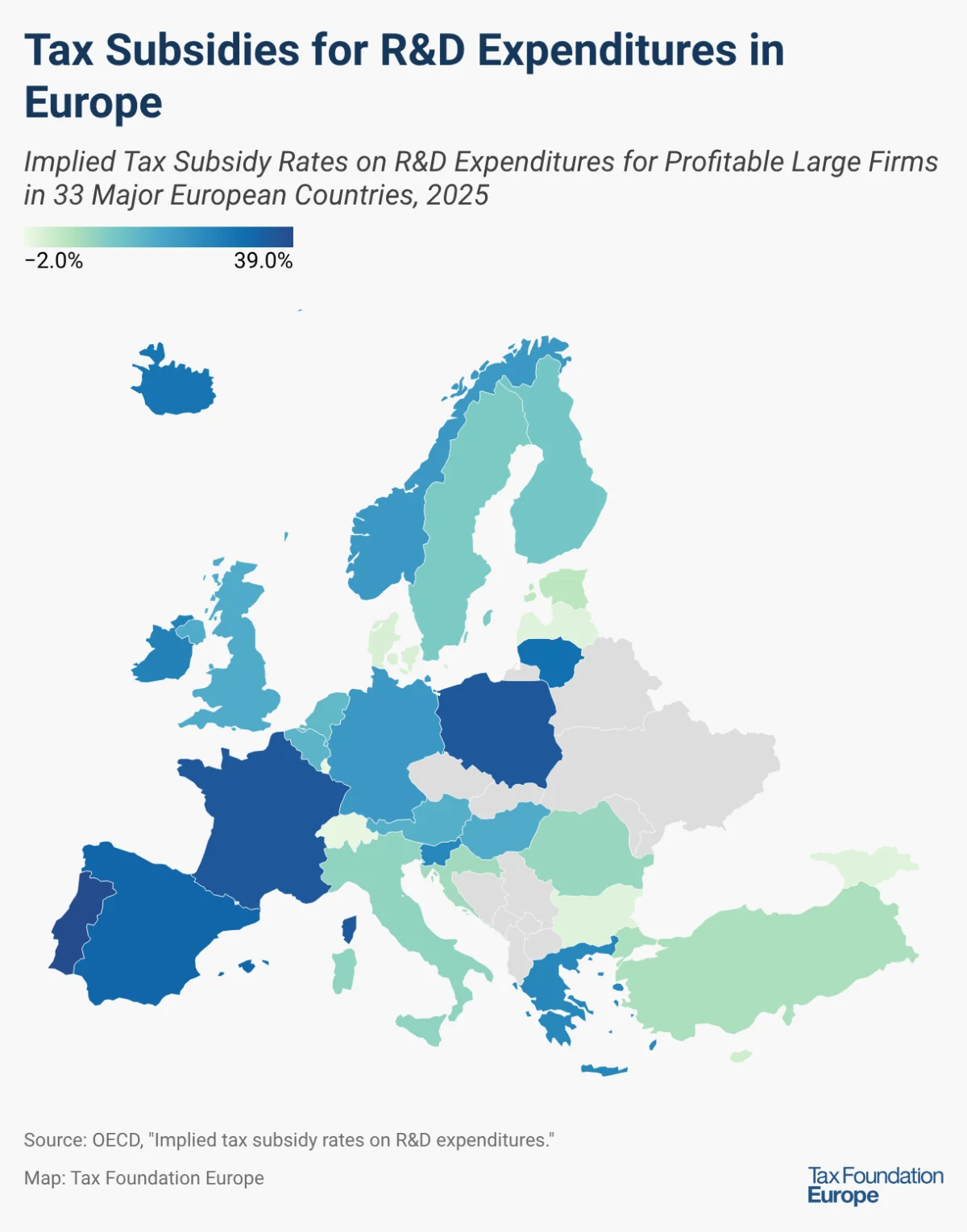
The landscape of research and development (R&D) tax subsidies for large profitable firms reveals a profound divergence among nations, with implied tax subsidy rates oscillating dramatically from a mere 1 percent in Denmark to a substantial 39 percent in Portugal. This significant variation underscores the diverse strategies governments employ to stimulate innovation, reflecting differing economic priorities, industrial structures, and fiscal philosophies across the globe. The latest data, drawing insights from comprehensive analyses, highlights not only the extent of these disparities but also the ongoing policy debate surrounding the most effective and efficient mechanisms to foster a thriving innovation ecosystem.
The Global Spectrum of R&D Tax Relief
At the forefront of generosity, Portugal leads with an implied tax subsidy rate of 39 percent for large profitable firms, making it a highly attractive jurisdiction for R&D investment. Closely following are France and Poland, both offering a robust 36 percent subsidy rate, positioning them as key players in the European innovation landscape. These high rates suggest a deliberate policy choice to incentivize significant corporate investment in cutting-edge research and development, potentially aiming to bolster specific sectors, enhance national competitiveness, or attract foreign direct investment in technology and innovation-intensive industries. The rationale often cited by policymakers in these nations revolves around the belief that substantial tax relief directly translates into increased R&D expenditure, leading to technological advancements, job creation, and long-term economic growth through positive spillover effects to the wider economy.
Conversely, some nations adopt a far more restrained approach to R&D tax incentives. Denmark stands out as the least generous among countries offering notable relief, with an implied subsidy rate of just 1 percent. Cyprus (2 percent) and Estonia (4 percent) also fall into this category of minimal direct R&D tax support. This lower generosity does not necessarily imply a lack of commitment to innovation but rather suggests an alternative strategy. These countries might rely more heavily on direct grants, publicly funded research institutions, or a generally favorable business environment with other competitive advantages, such as highly skilled labor or streamlined regulatory frameworks, to drive innovation. Furthermore, a group of countries including Bulgaria, Georgia, Latvia, Luxembourg, Malta, and Switzerland do not exhibit any significant expenditure-based R&D tax relief in the available data. Switzerland, for instance, known for its high-value manufacturing, pharmaceuticals, and finance sectors, often leverages its stable economic environment, highly educated workforce, and strong intellectual property protections as primary attractants for R&D, rather than relying on broad tax subsidies.
When contextualizing these European figures, the average implied subsidy rate for profitable large firms across 33 major European countries is 16 percent for 2025. This average provides a benchmark against which individual country performances can be measured. However, the global innovation race extends beyond Europe. The United States, a global leader in technological innovation, grants a comparatively modest subsidy rate of 7 percent to large profitable firms, a figure that has seen recent adjustments reflecting policy shifts. In stark contrast, China offers a substantial subsidy rate of 32 percent, signaling its aggressive push to become a global leader in science and technology. These international comparisons highlight the varying levels of state intervention and fiscal support in the global competition for innovation leadership, with significant implications for the location of R&D activities and the competitiveness of national economies.
Understanding the Economic Rationale and Challenges of R&D Incentives
The fundamental economic rationale behind R&D tax incentives is rooted in the concept of market failure. Research and development activities often generate "positive externalities" or "spillover effects," meaning the benefits extend beyond the innovating firm to society at large. For example, a new drug developed by a pharmaceutical company benefits not just the company but also patients globally. Because firms cannot fully capture all the societal benefits of their R&D, they may underinvest in innovation from a societal perspective. Tax incentives are designed to bridge this gap, encouraging firms to undertake more R&D than they otherwise would by reducing the effective cost of these investments.
However, the implementation of such incentives is fraught with challenges. One of the primary difficulties lies in accurately defining and targeting "genuine innovation." Distinguishing between routine product improvements or adaptations and truly novel research that yields significant societal spillovers can be complex. This definitional challenge often leads to increased administrative burdens for both businesses, which must meticulously document their expenditures to qualify, and tax authorities, which must verify these claims. The costs associated with compliance and administration can, in some cases, erode the net benefit of the subsidy. Moreover, there is a risk of "deadweight loss," where subsidies are granted for R&D that firms would have undertaken anyway, resulting in an inefficient use of public funds. Policymakers constantly grapple with striking a balance between encouraging desirable R&D and preventing fiscal losses due to misdirected or unnecessary subsidies.
Differentiated Support: SMEs, Loss-Making Firms, and Policy Nuances
The application of R&D tax relief often extends beyond large, profitable corporations to encompass small and medium-sized enterprises (SMEs) and loss-making firms, recognizing their distinct financial circumstances and their crucial role in innovation. The Organisation for Economic Co-operation and Development (OECD) provides implied tax subsidy rates for these categories, revealing further layers of policy sophistication.
Most countries covered in the analysis apply the same expenditure-based R&D tax relief to both large firms and SMEs. This uniform approach simplifies administration but may not fully address the unique challenges faced by smaller businesses. SMEs typically have less access to capital, face higher perceived risks, and may have limited in-house expertise to navigate complex tax regulations. Therefore, some countries adopt a more nuanced approach. France, notably, provides more generous relief for loss-making firms, which are often startups or young innovative companies in their early, pre-profit stages. Germany, Iceland, and the Netherlands also demonstrate greater generosity towards SMEs than to large firms, reflecting an understanding that targeted support can be particularly impactful for these growth engines. For instance, enhanced tax credit rates or more accessible refund mechanisms for SMEs can significantly de-risk their innovative ventures. Conversely, Croatia offers slightly higher relief to large firms than to SMEs, a policy choice that might be driven by a focus on established industrial players or specific strategic sectors where large corporations dominate R&D investment.
The treatment of loss-making firms is a critical aspect of R&D tax policy. Innovative companies, especially in biotech or high-tech sectors, often incur substantial R&D costs for years before generating revenue or profit. To address this, some countries incorporate refunds and carryover provisions within their R&D tax incentive schemes. Refunds allow loss-making firms to receive a cash payment for their R&D tax credits, providing immediate liquidity. Carryover provisions permit firms to utilize their R&D losses or credits against future taxable income. While these mechanisms are designed to support nascent innovators, the analysis indicates that they have generally resulted in lower average implied tax subsidy rates for loss-making firms relative to profitable firms, both for SMEs and large firms. This counterintuitive outcome suggests that while the intent is supportive, the actual financial benefit realized by loss-making firms might be less substantial or more delayed compared to the immediate advantages enjoyed by profitable entities. This could be due to limitations on refundability, caps on carryover periods, or the inherent difficulty for firms to accurately forecast future profits against which to offset losses.
A Broader Perspective: General Tax Treatment vs. Specific Incentives
A growing body of economic research and policy advocacy suggests an alternative, or complementary, approach to R&D-specific tax incentives: improving the general tax treatment of risky investment. This perspective argues that policymakers can often support innovation at a lower revenue cost and with less administrative complexity by creating a tax environment that is broadly neutral towards investment.
Key components of this "horizontal" approach include:
- Full Capital Cost Recovery: Allowing businesses to immediately and fully deduct the cost of capital investments (including R&D assets, machinery, and intellectual property) in the year they are incurred, rather than depreciating them over several years. This is known as "full expensing." When firms can expense their capital costs, it reduces the after-tax cost of investment and encourages greater capital formation, which is fundamental to innovation. The current system in many countries, which requires amortization or depreciation, effectively taxes investment by delaying the recovery of costs.
- Offsetting Operating Losses: Permitting businesses to fully offset their operating losses against past or future taxable income. This is crucial for innovative firms, particularly startups, which often incur losses in their initial years. The ability to carry back or carry forward losses provides a vital financial buffer, reducing the risk associated with new ventures and encouraging entrepreneurship. Without robust loss offset provisions, the tax system can disproportionately penalize risky, long-term investments.
Proponents of this general approach argue that it reduces distortions in the economy, is simpler to administer, and provides broader support for all forms of productive investment, not just those narrowly defined as R&D. While R&D-specific preferences can be effective, they often come with high compliance costs, create opportunities for tax planning arbitrage, and can lead to arbitrary distinctions between "qualified" and "non-qualified" innovation. A neutral tax system, by contrast, empowers businesses to make investment decisions based on economic merit rather than tax considerations, potentially leading to more efficient allocation of capital and more sustainable innovation.
Recent Shifts in Policy and Their Impact
The past year has seen several notable policy adjustments across Europe and in the United States, reflecting an ongoing re-evaluation of R&D tax strategies in response to economic pressures and the global innovation race.
In Europe, several countries have moved to enhance their R&D tax subsidies:
- Lithuania and the Slovak Republic: Both nations raised their corporate tax rates starting in 2025. While seemingly counterintuitive, an increase in the corporate rate can paradoxically increase the value of certain preferential R&D deductions, as the deduction reduces a larger tax liability. This led to an increase in Lithuania’s implied subsidy rate for large profitable firms from 31 percent to 34 percent, and in the Slovak Republic, from 28 percent to 33 percent. These adjustments demonstrate how changes in the broader corporate tax framework can inadvertently or intentionally amplify the impact of specific R&D incentives.
- The Netherlands: Taking a more direct approach, the Netherlands explicitly raised tax credit rates for in-scope R&D activities. This direct policy intervention boosted its implied subsidy rate from 31 percent in 2024 to 35 percent in 2025. This move underscores a clear commitment to strengthening the country’s position as an innovation hub, likely targeting high-tech and knowledge-intensive industries.
Across the Atlantic, a significant policy reversal in the United States has reshaped its R&D tax landscape:
- United States: The U.S. had, since 2022, required businesses to amortize (deduct over five years) their R&D expenses rather than immediately expensing them, a change mandated by the 2017 Tax Cuts and Jobs Act (TCJA) that took effect in January 2022. This policy was widely criticized by businesses and economists for significantly increasing the upfront cost of R&D, hindering investment, and putting U.S. companies at a disadvantage compared to international competitors who allowed immediate expensing. After extensive advocacy and legislative efforts, the U.S. scrapped these temporary R&D amortization requirements and restored its pre-2022 expensing regime. This restoration, combined with existing R&D tax credits, dramatically raised the implied subsidy rate for large profitable firms from a meager 3 percent to a more competitive 7 percent. This policy shift is expected to have a substantial positive impact on domestic R&D investment, particularly for startups and high-growth technology firms that rely heavily on immediate cost recovery. It signifies a renewed commitment to fostering innovation by reducing the tax burden on R&D, aligning the U.S. more closely with global best practices in capital cost recovery for R&D.
Implications for the Global Innovation Ecosystem
These divergent and evolving R&D tax policies carry profound implications for the global innovation ecosystem. The wide range of subsidy rates creates a competitive environment where nations vie for R&D investment, potentially influencing where multinational corporations choose to locate their research facilities and intellectual property. Countries offering generous incentives may attract more R&D-intensive industries, leading to economic growth and the development of specialized clusters. Conversely, those with less attractive regimes might struggle to retain or attract innovative firms, potentially impacting their long-term economic prospects.
The ongoing debate about the efficacy of targeted R&D tax credits versus broader, neutral tax treatments for investment is likely to continue shaping policy decisions. As economies grapple with challenges such as technological disruption, climate change, and global health crises, the need for robust innovation is more pressing than ever. Policymakers face the delicate task of designing tax systems that not only stimulate R&D effectively but also do so in a fiscally responsible manner, minimizing administrative burdens and avoiding unintended consequences. The insights provided by international comparisons and detailed analyses, such as those from the OECD, serve as crucial tools for governments as they navigate this complex terrain, striving to build competitive, resilient, and innovation-driven economies for the future.