Nila Kartika Wati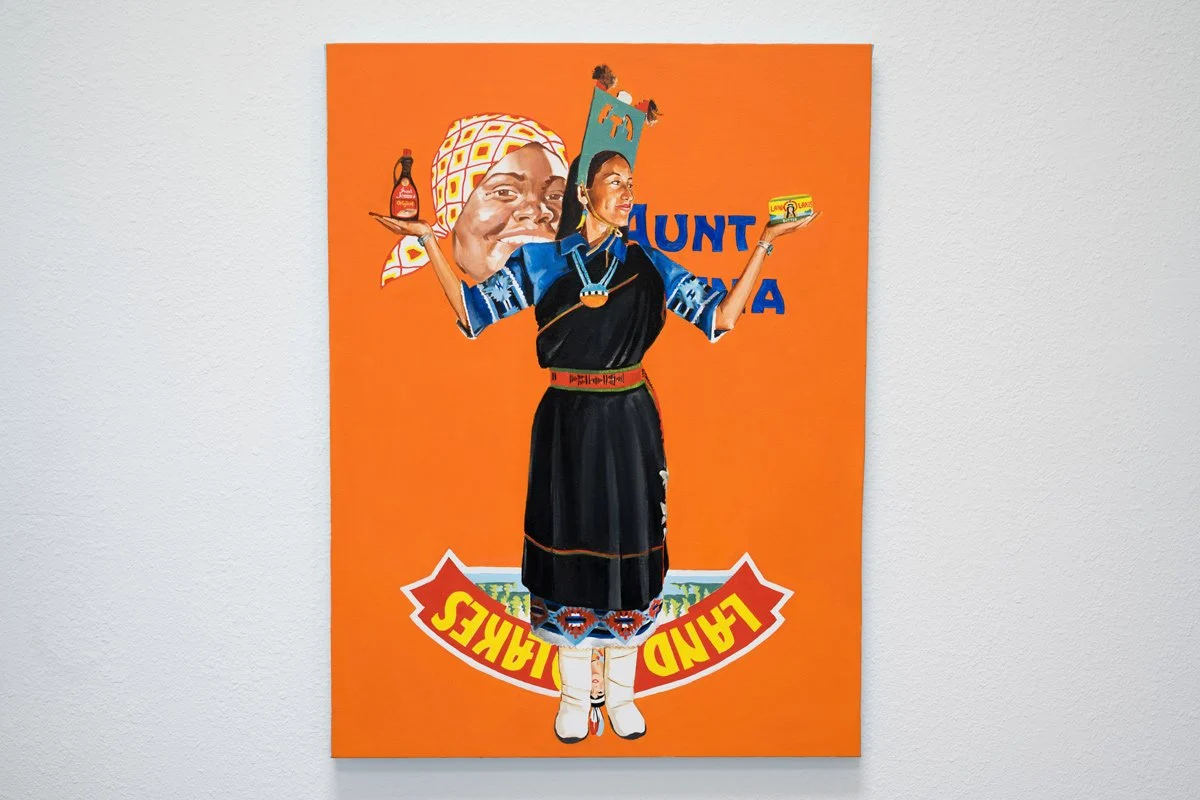
The Convergence of Art and Identity
D.C. Allen, also known as Del Curfman, is a contemporary Native American artist whose work is deeply rooted in the preservation and assertion of Indigenous presence. Born in 1993 and raised in Montana, Allen is a member of the Crow Tribe of Montana. His artistic practice, now based in Santa Fe, New Mexico, centers on large-scale figure painting that challenges the static, romanticized tropes often associated with Native American art. Allen’s background is academically rigorous; he earned a Bachelor of Fine Arts in Studio Arts and a second BFA in Museum Studies from the Institute of American Indian Arts (IAIA) in 2017. This dual focus allows him to critique the way Indigenous bodies are displayed in institutional settings while simultaneously creating new narratives through the lens of self-representation.
The subject of the painting, Juanita Toledo, represents a multifaceted identity that defies the simplistic categories often imposed by colonial structures. As a Native youth advocate, fashion model, and community leader, Toledo embodies the contemporary reality of Indigenous life—one that is grounded in cultural continuity while actively participating in modern social and political spheres. By placing the "Handheld Tropes" of corporate branding in her hands, Allen highlights the physical and psychological weight of representation. Toledo does not merely hold these items; she confronts them, asserting her agency over images that were designed to silence and simplify people like her.
A Chronology of Corporate Caricature and Rebranding
To understand the weight of the symbols depicted in Allen’s work, one must examine the history of the brands themselves. The Aunt Jemima brand, established in 1889, was built upon the "mammy" archetype—a racist caricature of a devoted, submissive Black domestic servant. The character was originally inspired by a minstrel show song and was brought to life by Nancy Green, a woman born into slavery, who was hired to portray Aunt Jemima at the 1893 World’s Columbian Exposition in Chicago. For over 130 years, the image persisted, undergoing various "modernizations" that failed to strip away its origins in white supremacist nostalgia for the antebellum South.
Similarly, the Land O’Lakes "Butter Maiden," known as Mia, was introduced in 1928. Created by illustrator Arthur C. Hanson, the image featured a stylized Native American woman in a pastoral setting. While the brand claimed the image honored Indigenous heritage, critics and activists long argued that it perpetuated the "Indian Princess" trope—an objectified and romanticized version of Indigenous womanhood that exists primarily for the consumption of a non-Native audience.
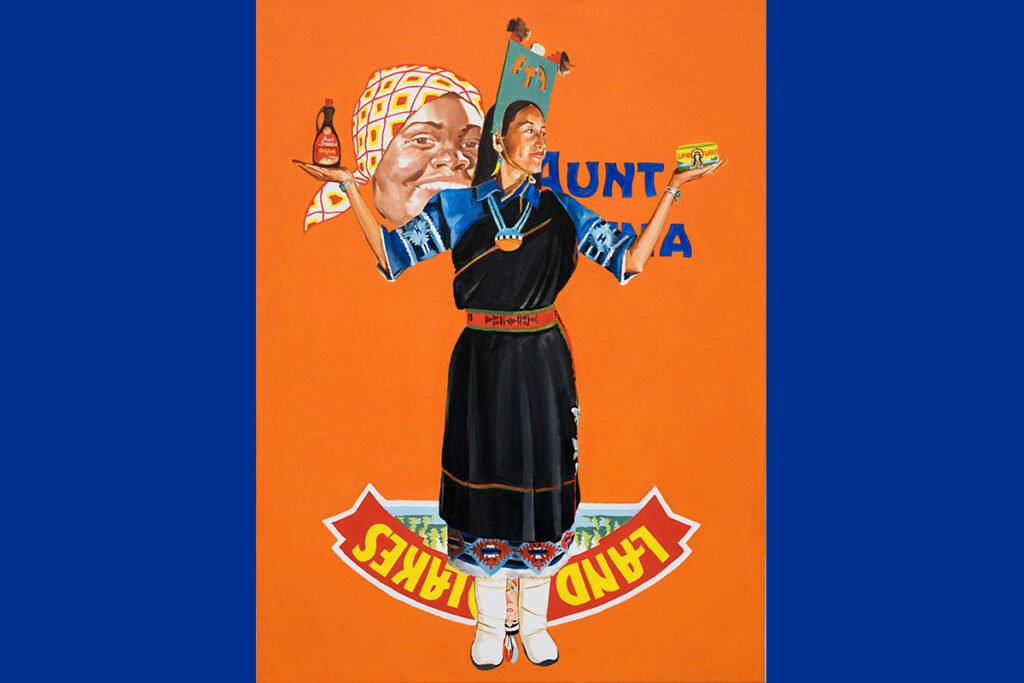
The chronology of these brands reached a turning point in 2020. Following the global protests for racial justice sparked by the death of George Floyd, both Quaker Oats (the parent company of Aunt Jemima) and Land O’Lakes announced significant changes. Land O’Lakes removed the image of Mia from its packaging in early 2020, transitioning to a logo that focused on the cooperative’s farmers. In June 2020, Quaker Oats announced it would retire the Aunt Jemima name and image entirely, eventually rebranding as the Pearl Milling Company. These corporate shifts provide the immediate historical context for Allen’s painting, which captures these symbols not as active marketing tools, but as artifacts of a psychological burden that Indigenous and Black people are still processing.
Supporting Data on Media Representation and Psychological Impact
The themes explored in Allen’s work are supported by a significant body of research regarding the impact of racialized mascots and imagery. According to a 2014 report by the American Psychological Association (APA), the use of Native American mascots and stereotypical imagery in schools and media creates a hostile environment for Indigenous youth. The report noted that such imagery undermines the self-esteem of Native children and reinforces biased perceptions among non-Native populations.
Furthermore, a study conducted by Reclaiming Native Truth, a multi-year national research initiative, found that 78 percent of Americans living outside of Indian Country admitted they knew little to nothing about Native Americans. This "visibility gap" is often filled by the very tropes Allen critiques: the "noble savage," the "Indian princess," or the "impoverished victim." When corporate brands like Land O’Lakes use these images, they contribute to a "frozen-in-time" narrative that suggests Indigenous people only exist in the past. Allen’s depiction of Toledo—vibrant, contemporary, and empowered—directly counters this data by providing a visual record of Indigenous modernity.
The Intersection of Food Systems and Sovereignty
The choice of food brands in "Handheld Tropes" is not accidental. The history of Indigenous people in the United States is inextricably linked to the disruption of traditional food systems. Through forced relocation and the destruction of ancestral lands, the U.S. government replaced Indigenous self-sufficiency with a dependence on government-issued commodities. This "commodity food" system, which often included flour, lard, and sugar, has had long-term health implications for Native communities, contributing to high rates of diabetes and heart disease.
By featuring brands like Aunt Jemima and Land O’Lakes—products that are staples of the very Western diet imposed upon Indigenous people—Allen connects the commodification of identity to the commodification of nutrition. The painting asks the viewer to consider the irony of using Indigenous and Black faces to sell products that have, in many ways, been detrimental to those same communities. This critique aligns with the growing Food Sovereignty movement within Indian Country, which seeks to reclaim traditional foodways and reduce reliance on corporate food systems.

The Faces of Our Land Project
"Handheld Tropes" is a vital component of Allen’s broader initiative, "Faces of Our Land." This ongoing, community-centered project combines portraiture with interviews and documentary practices to create a collaborative representation of contemporary Native lives. Unlike traditional portraiture, where the artist maintains total control over the subject’s image, Allen works closely with his participants to ensure their personal narratives and cultural identities are at the forefront.
This collaborative approach is a form of "sovereign aesthetics"—a term used by scholars like Jolene Rickard (Tuscarora) to describe art that asserts Indigenous political and cultural autonomy. By involving Toledo in the process, Allen ensures that the painting is not just an observation of her, but a statement made by her. This methodology is particularly significant given Allen’s training in Museum Studies; he is acutely aware of the historical tendency of museums to treat Indigenous people as objects of study rather than authors of their own stories.
Broader Impact and Implications for the Art World
The significance of D.C. Allen’s work extends beyond the canvas, influencing how contemporary Native art is curated and perceived in public and institutional spaces. As museums across the United States undergo a period of "decolonization," works like "Handheld Tropes" provide a roadmap for how to engage with difficult histories without centering the trauma of the past. Instead, Allen centers the agency of the present.
The painting serves as a visual manifesto for a new generation of Native artists who are no longer content to work within the boundaries of "traditional" Indian art. By incorporating elements of pop culture, corporate critique, and social advocacy, Allen expands the definition of what Native art can be. His work challenges the art market’s demand for "authenticity"—a concept often defined by non-Native collectors—and replaces it with "integrity," defined by the artist’s relationship to their community and their lived experience.
In conclusion, Handheld Tropes is more than a critique of outdated branding; it is a celebration of the enduring power of Indigenous and Black self-definition. Through the image of Juanita Toledo, D.C. Allen reminds the viewer that while tropes may be handheld, the power to define one’s identity remains firmly in the hands of the people themselves. As the conversation around representation continues to evolve, Allen’s work stands as a testament to the resilience of those who refuse to be reduced to a caricature, asserting instead a contemporary identity that is as complex, beautiful, and unyielding as the people it represents.