Nila Kartika Wati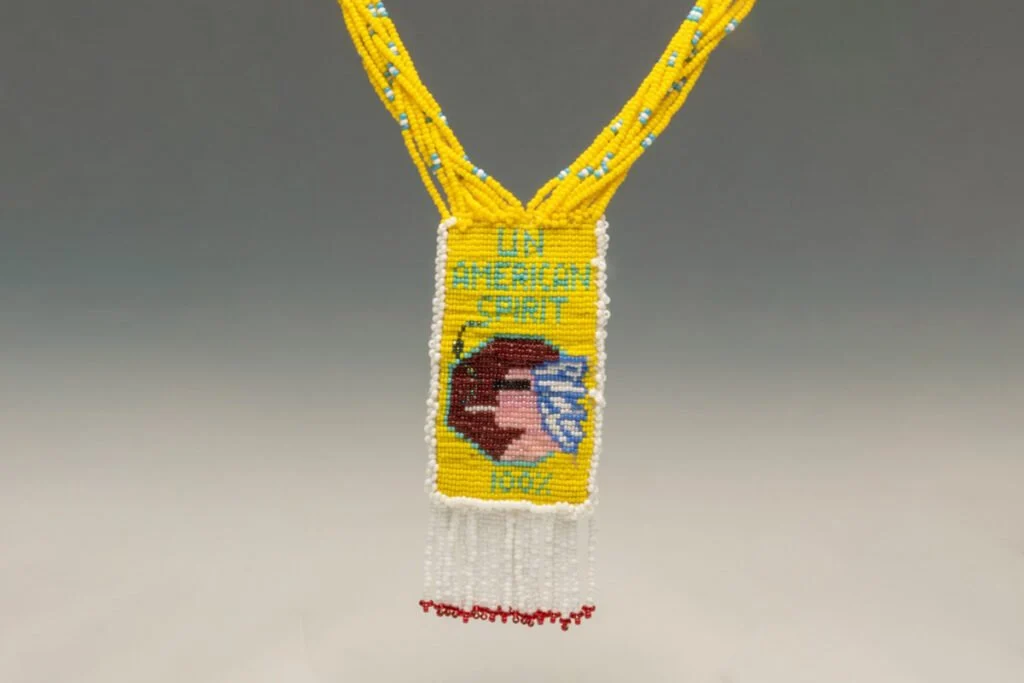
The intersection of contemporary art, public health advocacy, and Indigenous sovereignty finds a powerful voice in the work of Karen Sixkiller, a Cherokee Nation citizen and sculptor whose latest piece, "Un American Spirit," serves as a scathing critique of corporate cultural appropriation and the commercial tobacco industry. By deconstructing the visual language of the "American Spirit" cigarette brand, Sixkiller utilizes her background in social psychology and public health to expose the disconnect between stereotypical Native American imagery and the reality of commercial tobacco’s impact on Indigenous communities. Her work highlights a broader movement among Native artists to reclaim traditional narratives from commercial entities that have long profited from the romanticization of Indigenous cultures while contributing to systemic health disparities.
The Genesis of Un American Spirit
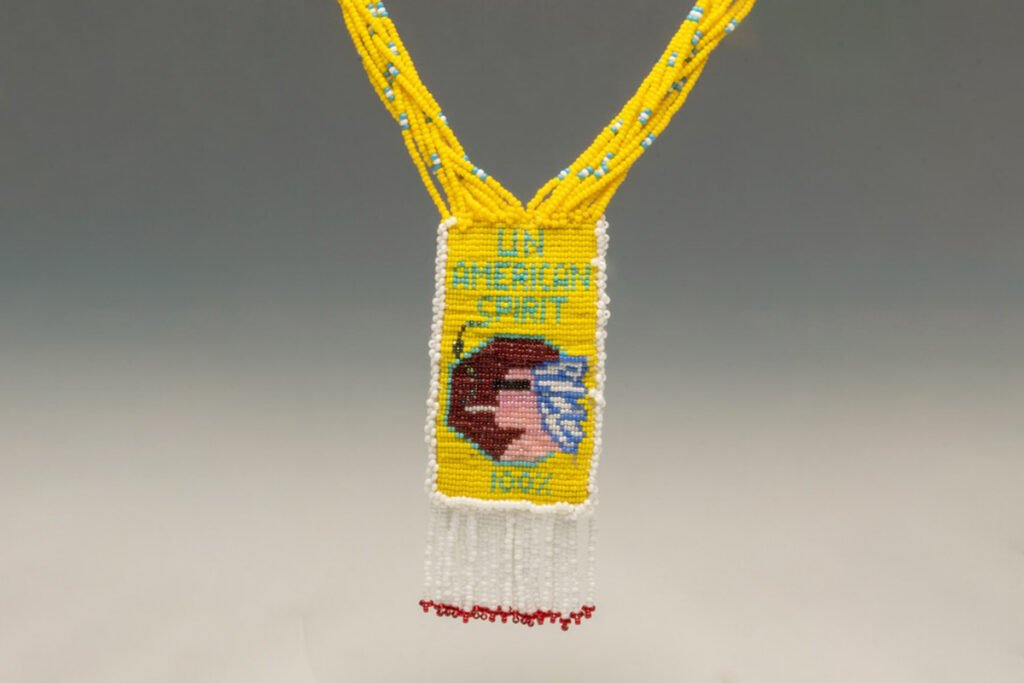
"Un American Spirit" is a meticulously crafted necklace and pendant designed as a parody of the Natural American Spirit cigarette brand, which is owned by Santa Fe Natural Tobacco Company, a subsidiary of Reynolds American. The original branding features a stylized silhouette of a Native American figure wearing a warbonnet and smoking a pipe, an image that has long been criticized for its reductionist and stereotypical portrayal of Indigenous traditions. Sixkiller’s sculpture subverts this imagery by replacing the iconic figure with a "pink-skinned" man donning a warbonnet, his eyes obscured by a black line, actively smoking a commercial cigarette.
The artist’s choice of materials—including metal, ceramic, glass beads, and leather—reflects her multidisciplinary approach to sculpture. The pendant features twenty fringes hanging from the bottom, each meticulously designed to resemble a lit cigarette, corresponding to the number of cigarettes found in a standard commercial pack. Perhaps the most poignant detail is found on the reverse side of the pendant, which is covered in beaded "cancerous growths." This hidden detail serves as a visceral reminder of the biological consequences of tobacco use, mirroring the way malignant cells develop unseen within the human body.
A Biography Informed by Science and Service
Karen Sixkiller’s artistic perspective is deeply rooted in her academic and professional background. A Washington state native currently residing on the Olympic Peninsula, Sixkiller’s path to becoming a professional sculptor was non-linear. She pursued graduate studies in social psychology, a field that emphasizes the discipline of scientific research and the analysis of human behavior. This analytical framework remains a cornerstone of her creative process, allowing her to research the historical and sociological contexts of her subjects before translating them into physical form.
Sixkiller’s commitment to community well-being led her to New Mexico, where she served with the Indian Health Service (IHS). Her tenure with the IHS, combined with her work at a tribally owned residential school, provided her with first-hand insight into the public health challenges facing Indigenous populations, particularly those related to substance use and the commercialization of sacred traditions. These experiences coalesced into a passion for using art as a medium for social commentary. Today, her work is recognized by the Cherokee Nation, which has purchased numerous pieces for display in official government buildings, and her public art installations are located across Oklahoma, North Carolina, Idaho, and Washington.
The Context of Cultural Appropriation in the Tobacco Industry
The "American Spirit" brand has been a focal point of controversy for decades. Founded in 1982, the Santa Fe Natural Tobacco Company marketed its products as "natural" and "additive-free," often using Indigenous imagery to imply a sense of purity or traditional authenticity. However, public health experts and Indigenous advocates note that there is nothing "natural" about the mass production of commercial tobacco, nor is the recreational use of cigarettes a traditional Native American practice.
In traditional Indigenous contexts, tobacco—specifically Nicotiana rustica—is often considered a sacred medicine used in prayer, ceremony, and diplomacy. It is typically not inhaled into the lungs and is used in limited quantities. In contrast, commercial cigarettes contain Nicotiana tabacum and are designed for frequent, recreational inhalation. Sixkiller’s "Un American Spirit" directly addresses this distinction, asserting that "there is nothing Native about cigarettes, inhaling tobacco or using tobacco recreationally."
The use of Native imagery by non-Native corporations is a phenomenon often referred to as "commodity shamanism," where Indigenous symbols are co-opted to imbue consumer goods with a sense of spiritual or environmental value. The Santa Fe Natural Tobacco Company has historically faced legal challenges regarding its marketing. In 2017, the company reached an agreement with the U.S. Food and Drug Administration (FDA) to remove the terms "additive-free" and "natural" from its labels and advertising, as these terms could mislead consumers into believing the cigarettes were less harmful than other brands.
Supporting Data: Tobacco Use and Indigenous Health
The implications of Sixkiller’s work are underscored by stark public health data. According to the Centers for Disease Control and Prevention (CDC), American Indian and Alaska Native (AI/AN) adults have the highest prevalence of current cigarette smoking among all racial and ethnic groups in the United States. As of 2021, approximately 22.6 percent of AI/AN adults reported smoking cigarettes, compared to 11.5 percent of white adults and 5.4 percent of Asian adults.
These high rates of commercial tobacco use contribute significantly to the leading causes of death in Indigenous communities, including cardiovascular disease, lung cancer, and diabetes. The CDC further notes that AI/AN populations are disproportionately targeted by tobacco industry marketing, which often utilizes cultural symbols and sponsors tribal events to build brand loyalty. Sixkiller’s critique of the "American Spirit" brand highlights how this marketing strategy not only exploits Indigenous culture but also exacerbates a public health crisis.
Artistic Symbolism and the "Un-American" Narrative
By naming her piece "Un American Spirit," Sixkiller performs a dual linguistic and cultural inversion. The term "American Spirit" usually evokes patriotism and resilience. By prefixing it with "Un," Sixkiller suggests that the exploitation of Indigenous identity for corporate profit is fundamentally at odds with the values of a just society. The "pink-skinned" figure in the warbonnet is a direct reference to "pretendians" or non-Native individuals who appropriate Indigenous regalia—a practice often seen in sports mascots and fashion—which Sixkiller views as a form of erasure.
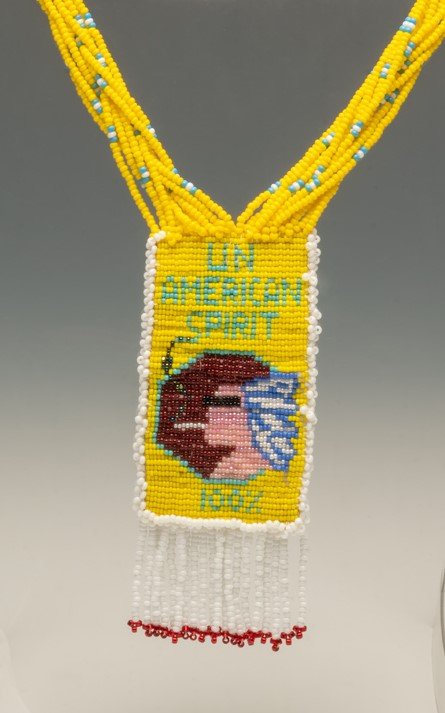
The "cancerous growths" on the back of the pendant represent the hidden costs of this appropriation. While the front of the brand (and the pendant) presents a stylized, aestheticized image, the reality is one of disease and mortality. This duality is central to Sixkiller’s work, which often uses beauty and craftsmanship to draw viewers into a deeper, often uncomfortable, conversation about social and health issues.
Broader Impact and Official Recognition
The significance of Sixkiller’s work extends beyond the gallery space. Her sculptures are part of a growing movement of "artivicm," where creative expression is used to drive social and political change. The Cherokee Nation’s acquisition of her work for permanent display in Tahlequah, Oklahoma, signals a formal endorsement of her message by tribal leadership. Furthermore, her public installations in cities like Asheville, NC, and Port Angeles, WA, bring these Indigenous perspectives to a broader, non-Native audience.
In recent years, there has been an increased focus on the Indian Arts and Crafts Act of 1990, a truth-in-advertising law that prohibits misrepresentation in the marketing of Indian arts and crafts products within the United States. While this law primarily applies to handmade goods, the spirit of the legislation—protecting Indigenous intellectual and cultural property—is central to the critique leveled by artists like Sixkiller against major corporations.
Conclusion: Art as a Tool for Multiracial Democracy
The work of Karen Sixkiller, as highlighted by the Nonprofit Quarterly, reflects the vital role of Indigenous voices in a multiracial democracy. By challenging the narratives of powerful corporations and reclaiming the imagery of her heritage, Sixkiller contributes to a more accurate and equitable cultural landscape. "Un American Spirit" is more than a sculpture; it is a clinical and cultural autopsy of a brand that has long profited from a distorted version of Native American identity.
As journalism and nonprofit sectors continue to navigate a landscape where truth and representation are frequently contested, the insights of artist-researchers like Sixkiller provide essential clarity. Her ability to synthesize social psychology, public health, and traditional Cherokee storytelling into a single piece of jewelry demonstrates the profound power of art to expose systemic issues and advocate for the health and dignity of Indigenous peoples. Through her work, the "Un American Spirit" becomes a call for accountability, authenticity, and a healthier future for all communities.