Layla Zulfa
The mortgage industry is navigating a turbulent period, marked by persistent interest rate uncertainty and a widening gap between high-performing and struggling lenders. This postscript to the Into the Crucible series, penned between two major mortgage conferences, reflects a palpable tension between executive outlooks and the evolving landscape of mortgage technology and operations. A live survey conducted at the HousingWire Mortgage Banking Summit on October 1 revealed that a significant 70% of participating executives anticipated mortgage rates of 7.5% or higher within the next six months. This sentiment was further underscored two weeks later at the MBA Annual Convention, where MBA Chief Economist Mike Fratantoni presented a somber two-year forecast, predicting flat production and minimal expectation of substantial rate relief, leaving many in attendance with a sense of disquiet.
Amidst this cautious economic outlook, the exhibit halls of these industry gatherings presented a starkly different narrative. A surge of technology companies, reminiscent of the pre-2008 financial crisis era, showcased solutions promising to revolutionize mortgage operations. Artificial intelligence (AI) was a pervasive theme, with vendors touting its potential to drastically reduce origination costs and enhance productivity. The allure of an AI-powered "promised land" for mortgage lenders is undeniable, offering a vision of streamlined efficiency and profitability.
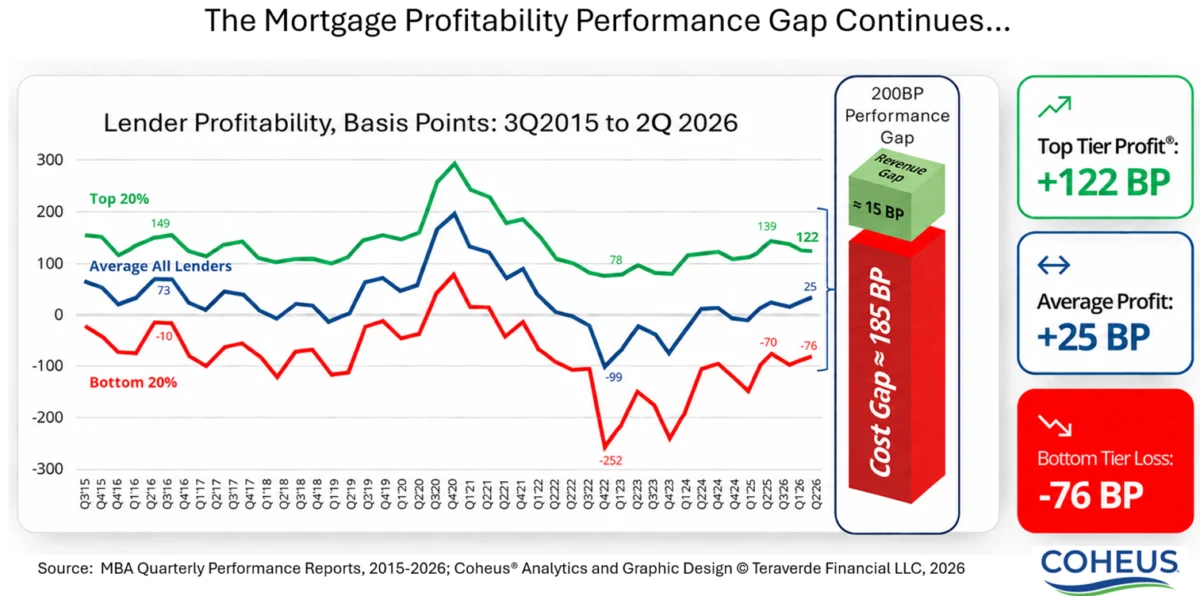
However, a critical examination of these promises reveals a persistent disconnect. If the cumulative return on investment (ROI) and cost-saving projections from technology vendors over the years were to be believed, the cost to originate a mortgage would theoretically be near zero by now. Yet, for many lenders, origination costs remain stubbornly elevated. The industry continues to grapple with a significant performance gap, a chasm that, as of the current quarter, remains stubbornly wide at approximately 200 basis points.
This 200-basis point performance gap, as observed in the second quarter of 2026, translates to a substantial net production income deficit exceeding $7,000 per loan. A closer analysis suggests that the primary drivers of this disparity are not necessarily a lack of technological innovation, but rather critical deficiencies in measurable results and accountability across the mortgage origination process. Issues such as price exceptions and revenue leakage are identified as significant contributors to this performance gap.
The Mortgage Industry’s Core Challenge: Measurable Results and Accountability
The overarching thesis emerging from industry observations is that the mortgage sector does not suffer from a shortage of technology; rather, it faces a deficit in its ability to generate and track measurable results and to enforce robust accountability for those results. The true challenge lies in comprehensively measuring the economics of the entire business process. This involves dissecting what activities effectively generate cash and, conversely, which ones consume it, at granular levels including product, pricing, process, and individual employee performance. Technology investments, therefore, must be rigorously evaluated against their demonstrable financial impact, not solely on vendor assurances.
For Chief Executive Officers (CEOs) and senior leadership, the imperative is to establish clear financial objectives, assign executive accountability for achieving these objectives, and demand demonstrable improvements in cash flow, productivity, and profitability. Investments that cannot substantiate their economic contribution warrant serious reconsideration and potential divestment.
Rates Remain Volatile; Strategic Decisions Cannot Wait
The mortgage market is characterized by its inherent volatility, with interest rates capable of fluctuating by 50 basis points or more within weeks. Factors such as inflation, employment figures, geopolitical events, Federal Reserve policy shifts, and Treasury yields will continue to exert influence on rate movements. However, the pursuit of predicting mortgage rates should not supersede the development of a sound business strategy.
The substantial existing inventory of mortgages carrying rates below 6% significantly curtails the potential for a refinancing wave comparable to those that have historically buoyed lenders during economic downturns. Consequently, even a meaningful decline in interest rates may not generate the transaction volume necessary to support the current cost structure of the industry.
CEOs are powerless to control interest rate movements. However, they possess direct control over critical strategic levers such as pricing discipline, operating capacity, employee productivity, capital allocation, and overall strategic direction. For a considerable number of lenders, two primary strategic pathways are emerging: either a fundamental transformation of the existing business into a significantly more efficient enterprise or the pursuit of a strategic combination with a financially stronger partner.
Crucially, the selection between these two alternatives is not the initial step. The foundational requirement is to first undertake a comprehensive "triage" of the business. This involves maximizing current cash flow and establishing a sufficient financial runway to enable informed strategic decision-making.
Triage: The Foundation of Financial Stability
When financial performance deteriorates, the immediate inclination is often to implement cost-cutting measures. While necessary in certain contexts, indiscriminate expense reduction can inadvertently harm the very capabilities that generate positive cash flow. A more effective approach commences with a deep understanding of the business’s underlying economics.
Key questions must be addressed: Which products consistently generate positive contribution margins? Which branches and individual producers are demonstrably creating economic value? Which operational processes are consuming excessive cash? Where are pricing decisions actively eroding profit margins? Perhaps most critically, does management possess the capability to accurately measure these activities to inform decisive action?
Traditionally, mortgage banking executives have relied on aggregate metrics such as production volume, gain-on-sale margins, and company-wide cost-to-originate ratios. While these metrics remain important, relying solely on averages can mask substantial variations in profitability and productivity at more granular levels. A lender might report acceptable overall company performance while individual branches, product lines, or operational processes are actively draining cash reserves. Enhanced visibility into these nuanced differences is essential for effective leadership.
The ultimate objective of a triage strategy is not merely to shrink the company. It is to identify and cease activities that unnecessarily consume cash, to strengthen those that demonstrably generate positive contributions, and to cultivate the financial flexibility necessary to pursue a sustainable long-term strategy.
Stemming Revenue Leakage and Enforcing Accountability
Revenue leakage represents one of the most immediate and impactful opportunities for financial improvement, achievable without the need to originate a single additional loan. Pervasive issues such as unwarranted pricing concessions, extended rate lock periods, costly disclosure corrections, uncollected fees, excessive rework, and preventable loan fallout can collectively siphon off a significant portion of a lender’s profit margins.
Consider a lender originating $1 billion in mortgages annually. A mere 25 basis points of avoidable revenue leakage equates to $2.5 million in lost revenue. Recovering even half of this amount would improve the lender’s financial results by $1.25 million, without any increase in production volume.
To effectively combat revenue leakage, it must be meticulously measured across product types, individual producers, branches, and specific processes. Each material source of leakage should be assigned to an accountable manager, with clearly defined financial improvement objectives and established timelines. Importantly, the emphasis in assigning accountability should be on coaching and process improvement, rather than on assigning blame.

Employees generally aspire to perform well. Providing them with clear visibility into the financial ramifications of their decisions, equipping them with the necessary tools for improvement, and setting unambiguous expectations for results can foster a culture of performance. When leakage stems from poorly designed workflows, the focus should be on rectifying the underlying process rather than repeatedly expecting employees to circumvent its inherent inefficiencies. CEOs must possess a clear understanding of the extent of revenue leakage, the strategies being implemented to address it, and the tangible progress being made in recovering lost revenue.
Aligning Capacity with Realistic Production Forecasts
The second critical priority within a triage strategy involves the judicious adjustment of excess operating capacity. Historically, many lenders retained infrastructure during periods of market contraction, anticipating a resurgence in refinancing activity. While this strategy sometimes proved successful in the past, the current mortgage market presents a different set of challenges. Instead of staffing for hoped-for volume, lenders must now align their processing, underwriting, closing, post-closing, management, and corporate infrastructure with realistic and attainable production expectations.
A crucial distinction exists between mere excess capacity and valuable core capability. High-performing employees, with their inherent productivity, mortgage expertise, and ability to serve borrowers effectively, represent invaluable assets regardless of a company’s future strategic direction. The objective, therefore, must be to preserve these essential capabilities while systematically eliminating unnecessary expenses.
Establishing clear productivity expectations, informed by metrics such as funded units, loan complexity, quality standards, turn times, and direct labor costs, is paramount. Opportunities for redeploying employees, automating repetitive tasks, and refining existing processes should be thoroughly explored before any staffing decisions are made. Where operating capacity materially and persistently exceeds demand, management must take decisive action. Maintaining excess capacity for production that is unlikely to materialize is not a viable strategy; it represents a continuous drain on financial resources.
Identifying Cash Generators and Consumers
Perhaps one of the most revealing exercises for mortgage banking executives is the granular measurement of contribution margin at the individual producer, branch, channel, and product level. A loan officer originating $50 million in annual volume, for instance, might contribute less to overall company profitability than a producer originating $25 million, depending on various influencing factors.
Compensation structures, pricing concessions, the mix of products offered, loan quality, and borrower fallout rates can all contribute to dramatically different financial outcomes. The same analytical rigor must be applied to evaluating branches and product lines. Production volume alone is an insufficient determinant of economic value.
A comprehensive assessment requires measuring revenue against directly attributable costs to establish a clear contribution margin. Separately, corporate overhead, capital requirements, and the timing of cash receipts and disbursements must be evaluated. These distinctions are critical, as accounting profitability does not always equate to actual cash flow, particularly when servicing rights, secondary marketing activities, and settlement timelines are factored into the equation.
Identifying the individuals and activities that consistently produce strong contribution margins is essential. The focus should then shift to understanding how to further empower and support these high performers. For those consistently performing below expectations, the approach should involve providing targeted coaching, setting clear financial objectives, and establishing reasonable timelines for improvement. Certain activities may warrant continued investment due to their strategic importance. However, such investments must be deliberate, measurable, and explicitly approved by management, rather than remaining as unacknowledged subsidies embedded within overall company financial results.
Creating Runway: The Prerequisite for Strategic Direction
Effective triage accomplishes a fundamental objective that extends beyond the immediate improvement of the quarterly income statement: it creates time. Consider the stark difference between a lender that is consuming $500,000 monthly and one that is generating $250,000. Over a twelve-month period, this differential represents a $9 million improvement in the company’s liquidity position. This enhanced financial flexibility can significantly influence management’s ability to fund a comprehensive business transformation, pursue a strategic acquisition, or negotiate a strategic combination from a position of strength.
CEOs must maintain realistic cash-flow forecasts, incorporating downside scenarios to anticipate potential challenges. A clear understanding of the capital required to support ongoing operations, servicing assets, and planned investments is also critical. Once the business is stabilized through effective triage, the two primary strategic choices become more clearly defined.
Option One: Transforming the Operating Model
For lenders possessing sufficient capital, a competitive distribution network, and robust management capabilities, the first strategic option involves a fundamental rebuilding of the operating model. Technology, including advanced agentic AI, offers substantial opportunities to automate routine activities, optimize workflows, reduce operational defects, and significantly enhance employee productivity.
However, the success of such a transformation cannot be measured by the mere number of technology applications installed. True success must be quantified by demonstrable improvements in financial outcomes. Every initiative undertaken within this transformation must be supported by a clear business case, a specific financial target, a defined implementation timetable, and an executive assigned direct accountability for results. The overarching objective is to establish a sustainably lower cost structure, deliver a superior customer experience, and achieve improved profitability across all market cycles. This endeavor is fundamentally an operating strategy, not merely an IT project.
Option Two: Pursuing a Strategic Combination
The second strategic option involves pursuing a combination with another lender that possesses complementary strengths. These strengths might lie in manufacturing efficiency, capital reserves, servicing capabilities, distribution channels, or specialized product offerings. A strategic combination should not be perceived as an admission of failure. When executed effectively, it can preserve valuable customer relationships, provide employees with enhanced career opportunities, and allow shareholders to participate in the economic benefits of a stronger, more resilient enterprise.
The timing of such a combination is of paramount importance. A company that maintains positive cash flow, employs a productive workforce, and possesses differentiated capabilities will invariably possess significantly greater negotiating leverage than one facing a liquidity crisis. The triage process, by enhancing the business’s value and stability, empowers management to clearly understand and articulate the unique strengths it brings to any potential combination.
C-Suite Decisions: Unwavering Accountability
The next mortgage cycle will undoubtedly reward those companies that possess a profound understanding of their underlying economics and are willing to act decisively. Interest rates will continue their volatile trajectory. Technological advancements will persist. Origination forecasts will undoubtedly fluctuate. None of these uncertainties absolve CEOs of their fundamental responsibility to make critical strategic decisions.
The C-suite must meticulously determine where cash is generated within the organization, where it is being consumed, which investments are yielding acceptable returns, and which strategic alternative offers the greatest potential for long-term value creation. While consultants can provide valuable analysis, technology can offer critical insights, and managers can effectively execute strategies, the ultimate ownership of financial outcomes rests with the CEO and the broader leadership team.
Execution can be delegated; accountability cannot. The path forward for mortgage lenders begins with three critical initiatives: a rigorous assessment of cash flow generation and consumption, a decisive program to halt revenue leakage and assign accountability, and a strategic alignment of operating capacity with realistic production expectations.
Waiting for lower mortgage rates is a forecast, not a strategy. The time for decisive action is now.
This article concludes the seven-part Into the Crucible series examining the strategic challenges facing mortgage banking executives. Jim Deitch is CEO and founder of Teraverde. Rick Roque is senior vice president of Strategic Growth and M&A at NFM Lending and founder and managing director of Menlo Company.