Lana Rhoades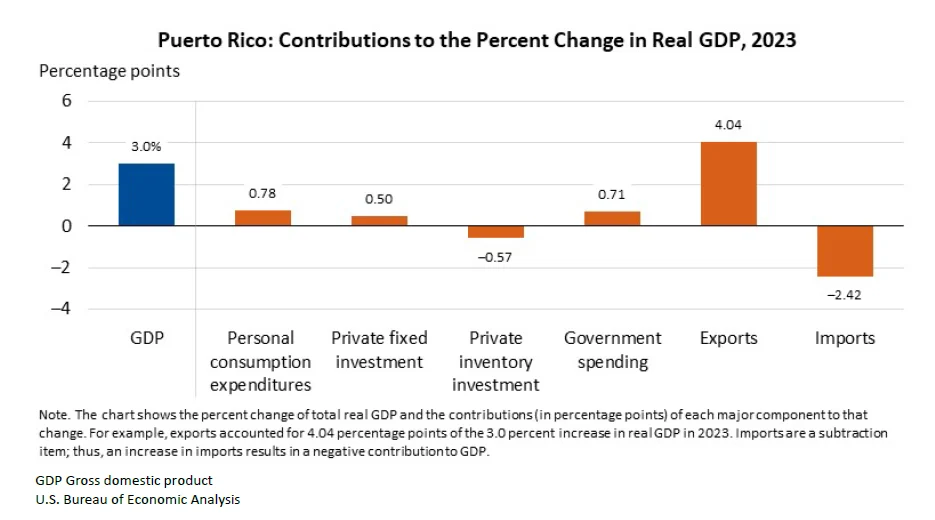
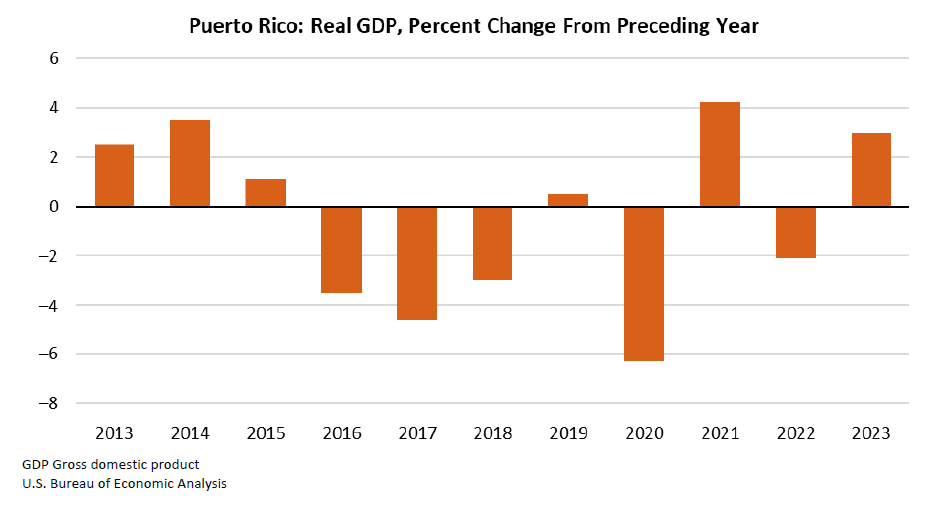
Puerto Rico’s economy experienced a significant turnaround in 2023, with real gross domestic product (GDP) increasing by 3.0 percent. This marks a strong recovery from a 2.1 percent contraction in 2022, according to the latest statistics released by the U.S. Bureau of Economic Analysis (BEA). The rebound was propelled by a robust surge in exports, complemented by growth in personal consumption expenditures, government spending, and private fixed investment. While imports also rose, the net effect was a positive trajectory for the island’s economic output.
Economic Recovery Fueled by External Demand and Domestic Investment
The upward trend in Puerto Rico’s real GDP in 2023 was primarily attributed to a substantial increase in exports, which grew by 6.4 percent. This growth encompassed both goods and services, with exports of goods rising by 6.6 percent and exports of services by 5.6 percent. This heightened external demand signals a strengthening of international trade relationships and a growing global appetite for Puerto Rican products and services.
Beyond exports, several key components of domestic demand also contributed positively. Personal consumption expenditures (PCE) saw an increase of 1.2 percent, indicating a rise in consumer spending. Within PCE, spending on services grew by a notable 4.0 percent, while spending on goods experienced a slight decrease of 0.8 percent. This shift suggests a potential move towards greater expenditure on services, such as tourism, healthcare, or professional services, as the economy recovers.
Government spending also played a crucial role, increasing by 4.8 percent. This expansion was observed across all levels of government and was particularly driven by significant increases in investment spending by federal, central, and municipal authorities. A substantial portion of this government investment is linked to the ongoing disbursement of federal funds allocated for disaster recovery efforts. These funds are being channeled into critical infrastructure projects aimed at rebuilding and enhancing the island’s resilience following a series of natural disasters.
Private fixed investment also demonstrated healthy growth, rising by 3.8 percent. This increase was largely fueled by investments in equipment, with a notable surge in industrial equipment purchases by businesses. This suggests a renewed confidence in the business environment and a commitment to upgrading operational capabilities.
However, the overall picture was tempered by a decrease in private inventory investment, primarily concentrated in the manufacturing sector. This reduction could indicate a strategic adjustment by manufacturers to optimize stock levels or a response to shifting production demands.
Imports, which are subtracted in the calculation of GDP, also increased by 4.4 percent, driven predominantly by imports of goods. Specifically, pharmaceuticals and organic chemicals saw a significant 6.0 percent rise in imports, pointing to the importance of these sectors in the island’s supply chain.
Historical Context: Navigating Economic Challenges
Puerto Rico’s economic landscape has been shaped by a complex interplay of factors, including its political status, historical economic policies, and vulnerability to natural disasters. For years leading up to 2023, the island grappled with a prolonged economic recession, exacerbated by its debt crisis, a shrinking population, and the devastating impacts of Hurricanes Irma and Maria in 2017, followed by earthquakes in 2019 and 2020, and Hurricane Fiona in 2022. The previous year’s GDP contraction of 2.1 percent in 2022 reflected these ongoing challenges.
The 2023 rebound is therefore a significant development, offering a much-needed signal of economic revitalization. The BEA’s revised estimates for GDP from 2018 to 2022, which incorporated updated source data, showed that the largest revision in any single year was 0.4 percentage point in 2022. This suggests that the underlying economic trends, while subject to minor adjustments, have been broadly consistent.
Drivers of Growth: A Deeper Dive
Exports: The Engine of Recovery
The 6.4 percent surge in real exports is a critical indicator of Puerto Rico’s integration into the global economy. The increase in both goods and services exports suggests a diversified export base. The growth in goods exports could be linked to manufacturing sectors that have historically been a cornerstone of Puerto Rico’s economy, while the rise in services exports might reflect a burgeoning tourism sector or an expansion of professional services offered remotely. The BEA’s detailed breakdown highlights that exports of goods increased by 6.6 percent and services by 5.6 percent, demonstrating a broad-based strength in external trade.
Personal Consumption Expenditures: Consumer Confidence on the Rise
The 1.2 percent increase in real personal consumption expenditures signifies a return of consumer confidence and spending power. The divergence between spending on services (up 4.0 percent) and goods (down 0.8 percent) is noteworthy. This pattern could indicate a post-pandemic shift in consumer behavior, with a greater emphasis on experiences and services over material goods. This trend, if sustained, could lead to further growth in sectors like hospitality, entertainment, and personal care.
Government Spending: Rebuilding and Resilience
The substantial 4.8 percent increase in real government spending underscores the critical role of public investment in the island’s recovery. The widespread increases in investment spending across federal, central, and municipal governments are directly tied to the ongoing efforts to repair and upgrade infrastructure damaged by past natural disasters. Projects focused on rebuilding and improving the power grid, the aqueduct system, roads and bridges, and military installations like Camp Santiago are crucial for long-term economic stability and resilience. These investments not only create jobs in the short term but also lay the foundation for future economic activity by enhancing the island’s basic infrastructure.
Private Fixed Investment: Business Confidence Rekindled
The 3.8 percent rise in real private fixed investment signals renewed optimism among businesses. The primary driver of this growth was investment in equipment, particularly industrial equipment. This indicates that businesses are not only maintaining their current operations but are actively investing in machinery and technology to enhance productivity and expand capacity. The BEA’s data points to increases in equipment purchases by businesses, which is a positive sign for future economic output and competitiveness.
Inventory Adjustments and Import Dynamics
The decrease in real private inventory investment, with the manufacturing sector being the largest contributor, suggests a strategic move by businesses to manage their stock levels more efficiently. This could be a sign of a maturing economy where just-in-time inventory management is becoming more prevalent, or it could reflect specific challenges within the manufacturing sector.
The 4.4 percent increase in real imports, led by pharmaceuticals and organic chemicals, highlights the continued reliance on imported goods for certain key industries. While imports are a subtraction in GDP calculations, their increase in this context may reflect the needs of growing export-oriented industries or essential consumer goods, indicating a level of economic activity that requires external sourcing.
Acknowledging Collaboration and Future Outlook
The U.S. Bureau of Economic Analysis specifically acknowledged the critical role of the government of Puerto Rico and numerous organizations and individuals on the island in the successful production of these GDP estimates. This collaborative effort is essential given that Puerto Rico is not typically included in the major surveys used by the BEA to estimate U.S. GDP. This highlights the unique statistical challenges and the importance of local cooperation in providing accurate economic data for the territory.
Important Note on Data Availability:
It is crucial to note that the BEA has announced that it will no longer produce Puerto Rico GDP statistics after this 2023 release. Previously published data will remain accessible in the BEA’s Data Archive. This marks the end of an era for detailed, regular GDP reporting for Puerto Rico by the BEA, necessitating a greater reliance on other data sources and methodologies for future economic analysis of the island.
Broader Implications and Analysis
The strong GDP growth in 2023 offers a much-needed positive narrative for Puerto Rico’s economic future. The recovery driven by exports and investment suggests a potential shift towards a more diversified and resilient economy. The significant government spending on infrastructure, fueled by federal disaster recovery funds, is not only addressing immediate needs but also building a more robust foundation for long-term growth.
The increase in private fixed investment, particularly in industrial equipment, is a promising sign of business confidence and a commitment to modernization. This could lead to increased productivity, job creation, and enhanced competitiveness in the global market.
However, the decrease in private inventory investment warrants further monitoring. While it could reflect efficient inventory management, it could also signal underlying concerns about future demand or production challenges within certain sectors.
The shift in personal consumption expenditures towards services could present new opportunities for businesses in those sectors, but it also highlights a potential decline in spending on tangible goods, which could impact manufacturing and retail sectors focused on goods.
The continued reliance on imports for key sectors like pharmaceuticals and chemicals underscores the importance of supply chain stability and the need for strategies to foster greater local production where feasible.
The end of BEA’s regular GDP reporting for Puerto Rico presents a significant challenge for consistent economic monitoring. Future analyses will likely need to draw upon a broader range of data sources and potentially rely on different analytical frameworks to track the island’s economic performance.
Conclusion
Puerto Rico’s 3.0 percent real GDP growth in 2023 represents a significant economic rebound, driven by strong export performance, increased government investment in infrastructure, and a resurgence in private fixed investment. This positive momentum offers hope for continued economic recovery and development on the island. While challenges remain, particularly in managing inventory levels and navigating the cessation of BEA’s regular GDP reporting, the overall economic picture for 2023 is one of progress and renewed vitality. The ongoing efforts in infrastructure development and the strengthening of export markets are critical pillars for building a more resilient and prosperous future for Puerto Rico.