Candice Horbacz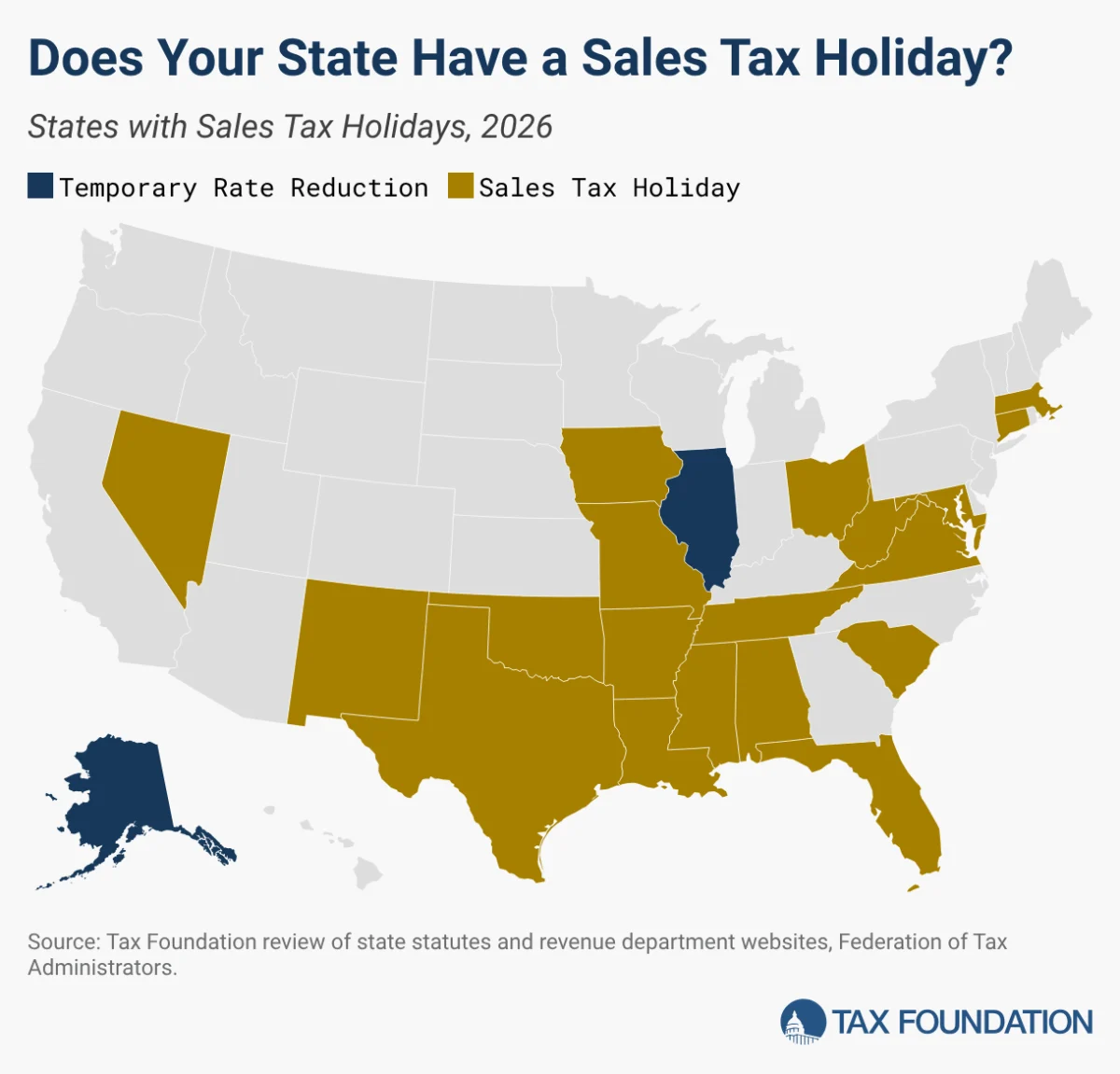
Sales tax holidays, those eagerly anticipated periods when states temporarily waive sales taxes on specific goods and services, continue to thrive as a popular political instrument across the United States. For 2026, a total of 20 states have either implemented or announced plans to hold such holidays, marking an increase from 19 states in the preceding year. This uptick underscores the enduring appeal of these targeted tax breaks, even as economists and tax policy experts frequently highlight their significant economic inefficiencies and often regressive impacts. The recent additions of Illinois, which reinstated a holiday previously active in 2010 and 2022, and Alabama, which introduced a new sales tax holiday for SNAP-eligible food items alongside its existing severe weather preparedness and back-to-school exemptions, exemplify this trend.
This tally of 20 states focuses exclusively on state-level initiatives and does not encompass localized sales tax holidays, such as one offered by a municipality in Alaska, nor does it include the various state gas tax holidays implemented in 2026 in response to fluctuating fuel prices. The widespread adoption of these holidays paints a complex picture of political expediency meeting consumer demand, often at the expense of sound fiscal policy and long-term economic health.
The Enduring Allure and Historical Context of Sales Tax Holidays
The concept of a sales tax holiday first emerged in the late 1990s and gained significant traction in the early 2000s, often championed as a means to stimulate retail activity, provide relief to consumers, and offer a visible demonstration of governmental responsiveness. Initially, these holidays were often introduced during economic downturns, framed as a form of short-term economic stimulus. Their appeal is multi-faceted: for policymakers, they represent a tangible, easily understood tax break that can be announced with fanfare and is generally well-received by the public. For consumers, the perception of immediate savings on essential or desirable goods makes these periods highly attractive, fostering a sense of financial relief, however fleeting.
Politicians often claim that these holidays spur economic growth by encouraging increased retail spending within their designated timeframes. This narrative resonates with voters, particularly during periods of economic uncertainty or rising living costs, making sales tax holidays a recurrent feature in legislative calendars despite consistent warnings from fiscal watchdogs and academic studies about their limited actual benefits.
A Snapshot of 2026: Scope and Variety of Exemptions
The sales tax holidays scheduled for 2026 exhibit a broad spectrum of targeted goods and services, reflecting diverse policy priorities and consumer needs across states. The most common exemptions revolve around "back-to-school" essentials, typically including clothing, footwear, school supplies, and sometimes computers or other electronic devices. States like Maryland, Missouri, Texas, and Virginia have expanded their offerings to include energy-efficient appliances, aiming to promote environmental consciousness and reduce household utility costs. Alabama’s new holiday for SNAP-eligible food items is a notable addition, seeking to provide direct relief to low-income families on essential groceries, complementing its existing exemptions for severe weather preparedness items.
These holidays usually last for a few days, typically a weekend or a week, strategically timed to coincide with periods of high demand. Back-to-school holidays, for instance, are almost universally scheduled in late July or August, just before the academic year commences. Hurricane preparedness holidays are often set in late spring or early summer, ahead of peak storm seasons. This strategic timing, while seemingly beneficial for consumers, paradoxically undermines the economic rationale often cited by proponents.
The Economic Debate: Shifting Demand vs. Generating Growth
While proponents often laud sales tax holidays as engines for economic growth, numerous studies, including research from the National Bureau of Economic Research, paint a less optimistic picture. The prevailing academic consensus suggests that much of the increased shopping activity observed during these holidays is not new economic growth but rather a temporal shift in consumer behavior. Shoppers, aware of the upcoming tax-free periods, simply postpone purchases they would have made anyway, consolidating them into the holiday timeframe to capitalize on the discounts.
This "pulling forward" of demand means that sales tax holidays primarily redistribute sales activity rather than generate a net increase in overall consumption. While some consumers may make incidental "impulse" purchases during these periods, the additional revenue generated from such spontaneous buying is generally insufficient to offset the significant revenue losses incurred by state and local governments. By effectively reducing the tax base for a short period, sales tax holidays deplete public coffers without delivering a commensurate boost to the economy. This results in reduced state and local tax collections for minimal, if any, genuine economic benefit. Moreover, by scheduling these exemptions during periods of naturally high demand (e.g., back-to-school, pre-storm season), states forgo revenue on transactions that would have occurred irrespective of the tax holiday, further exacerbating the fiscal impact.
Unintended Consequences and Hidden Costs for Consumers
Despite their populist appeal, sales tax holidays can inadvertently harm the very consumers they aim to help, particularly those with lower incomes. One critical, albeit difficult to quantify, consequence is the potential for retailers to subtly increase prices during tax holidays. With an induced surge in demand for specific, narrow sets of goods, businesses may raise prices to manage inventory or maximize profits, effectively absorbing a portion of the tax savings. Some research suggests that companies can absorb up to 20 percent of the benefit through price adjustments, blunting the intended relief for consumers. This practice disproportionately affects lower-income shoppers, who are often less flexible in their purchasing timelines and may lack the financial reserves to plan ahead and capitalize on the sales.
Furthermore, the timing of these holidays can create challenges. A lower-income family might delay purchasing school supplies until the tax holiday, only to find that popular items are out of stock or that choices are limited, as many other families who could afford to shop earlier have already completed their purchases. This forces them to either buy less desirable items or purchase them at full price after the holiday. Price caps on qualifying items, a common feature of many sales tax holidays, can also distort consumer choices, subtly nudging shoppers toward less expensive, potentially lower-quality products when they might otherwise have opted for more durable or higher-quality goods exceeding the price threshold.
The claim that sales tax holidays encourage out-of-state consumers to travel for discounts also holds little weight. With so many states now offering similar holidays, and given that the exemptions often apply to lower-cost items, the incentive for significant cross-border shopping trips is negligible. Any consumer making an out-of-state, tax-free purchase for consumption in their home state is, in principle, legally obligated to pay a "use tax" on that item, though compliance for such small-scale purchases is notoriously low.
Disproportionate Burdens on Businesses: Compliance and Operational Challenges
While consumers grapple with potential price hikes and stock issues, businesses, particularly small and independent retailers, face a different set of challenges. Sales tax holidays impose significant administrative and compliance burdens. Retailers must reconfigure their point-of-sale systems to accurately apply exemptions to a specific, often lengthy, list of qualifying products within a limited timeframe. This process is complicated by varying rules across states regarding product eligibility, price caps, and the treatment of shipping, handling, layaway sales, and "rain check" purchases.
The short notice often provided for these legislative changes further exacerbates the problem. For instance, Illinois’s Public Act 104-0468, which reinstated a back-to-school sales tax holiday from August 7 to August 16, 2026, was signed into law on June 16, 2026. This tight turnaround of less than two months leaves businesses scrambling to update systems, train staff, and manage inventory for the sudden shift in tax policy. Small businesses, lacking dedicated legal compliance teams, find this particularly onerous. They may also struggle to absorb the induced spikes in demand, often requiring additional short-term staffing, and then contend with the spending slowdowns that typically precede and follow the holiday period. Consistent revenue streams are crucial for businesses with thin margins, and these timing distortions can be painful.
For online retailers, the complexity is magnified exponentially. Selling into multiple states, they must navigate a patchwork of sales tax holiday rules, making real-time adjustments to their e-commerce platforms. The legal consequences of over-collecting sales tax from consumers mean that any error can be costly, forcing sellers to make meticulous, product-by-product eligibility judgments on an evolving range of items, often with ambiguous definitions.
Nevada offers a distinct approach with its National Guard sales tax holiday, which shifts the compliance burden from retailers to consumers. Eligible Guard members and their families must apply for the exemption 45 days in advance, pay the tax upfront during the holiday, and then request a refund from the Department of Taxation with supporting documentation. While simplifying matters for businesses, this cumbersome refund process can deter participation, especially for smaller purchases where the administrative effort outweighs the potential savings.
Structural Flaws and Political Expediency
The very existence of sales tax holidays points to deeper structural weaknesses within state tax codes. If policymakers genuinely believe that temporarily suspending sales tax can stimulate economic activity, they implicitly acknowledge that the sales tax, as currently structured, acts as a drag on growth for the other 51 weeks of the year. Rather than providing genuine, sustainable tax relief, these holidays are often criticized as political "gimmicks" that sidestep the more challenging, but ultimately more beneficial, work of comprehensive, permanent tax reform.
States that consistently generate surplus revenues sufficient to cover the costs of these holidays could, from an economic standpoint, better utilize those funds for more efficient, permanent tax reforms, such as broad-based rate reductions. Such reforms would offer year-round relief, reduce distortions, and foster a more predictable and stable economic environment for businesses and consumers alike. Sales tax holidays, by picking specific winners and losers (certain products, certain retailers, certain consumers), introduce distortions into the market without offsetting meaningful economic benefits. They create space for political lobbying and favoritism in the selection of eligible goods, leading to an inherently discriminatory process that favors some consumers and businesses over others.
Conclusion: A Persistent Practice Despite Persistent Problems
Ultimately, sales tax holidays are an inefficient and often counterproductive mechanism for achieving either tax relief or economic stimulation. They inject unnecessary instability into government and business revenue streams, creating administrative and compliance costs for all stakeholders. They fail to promote long-term economic growth and, in many instances, inadvertently harm the very taxpayers they are intended to assist, particularly those with lower incomes.
Indeed, several states have recognized these inherent downfalls and have accordingly abandoned their sales tax holidays in recent years. However, their potent electoral utility—the immediate, visible, and politically advantageous perception of tax relief—continues to be a powerful incentive for policymakers. With 20 states offering these holidays in 2026, the trend suggests that despite the mounting economic scrutiny and the clear structural flaws, sales tax holidays are unlikely to disappear from the American fiscal landscape anytime soon. This perpetuation underscores a recurring tension in public policy: the conflict between short-term political gains and long-term economic prudence. For a more detailed analysis of the arguments surrounding sales tax holidays, comprehensive reports from organizations like the Tax Foundation offer deeper insights into this complex policy debate.