Candice Horbacz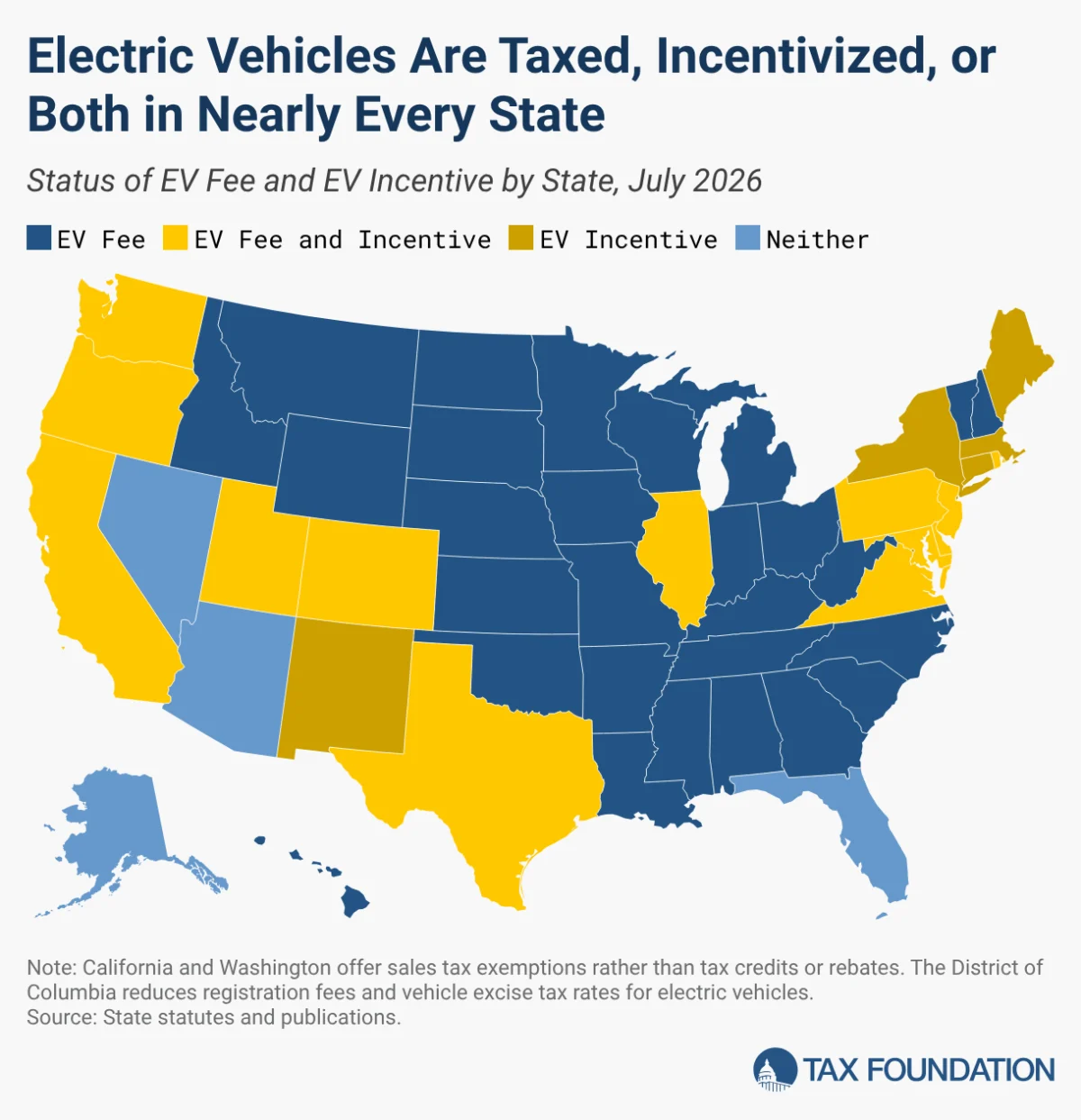
As of July 2026, a comprehensive review of state-level policies reveals a highly varied landscape of tax treatments and incentives for electric vehicles (EVs) and plug-in hybrid electric vehicles (PHEVs) across the United States. This complex patchwork of regulations reflects a dynamic tension between the need for states to maintain revenue streams for road infrastructure, traditionally funded by gasoline taxes, and the desire to accelerate the adoption of cleaner transportation technologies to meet environmental goals. From substantial annual fees to generous purchase rebates and tax credits, the financial implications of owning an EV or PHEV differ significantly depending on where one resides.
The divergence in state approaches is immediately apparent when examining annual fees levied on electric vehicles. These fees, often termed "road usage fees" or "EV surcharges," are designed to compensate for the reduced gasoline tax revenue generated by vehicles that consume little to no fossil fuel. States like Georgia, for instance, impose one of the highest annual fees at $273.59 for both EVs and PHEVs, alongside an initial $25 Alternative Fuel Vehicle (AFV) license plate manufacturing fee. Similarly, Alabama charges $203 for EVs and $103 for PHEVs, while Indiana levies $242 for EVs and $81 for PHEVs. These figures underscore a clear policy direction aimed at ensuring that EV owners contribute to the maintenance of public roads, a responsibility historically borne by gasoline consumers through fuel excise taxes. Other states with notable annual fees include New Jersey ($270 for both EV/PHEV), Michigan ($267 EV, $113 PHEV), and Pennsylvania ($250 EV, $63 PHEV). The logic behind these fees is rooted in the "user pays" principle, where those who utilize public infrastructure contribute to its upkeep, regardless of their fuel source.
Conversely, a significant number of states have opted not to impose any specific annual fees on EVs or PHEVs. Alaska, Arizona, California, Connecticut, Florida, Massachusetts, Nevada, New Mexico, and New York stand out in this category. Their decision to forgo such fees often aligns with a stronger emphasis on promoting EV adoption without creating additional financial barriers. This approach suggests a policy priority where the environmental and public health benefits of electric transportation are deemed to outweigh the immediate need to recoup lost fuel tax revenue through direct fees on EV owners.
The spectrum of fees also includes nuanced variations. Some states, such as Hawaii, Oregon, Utah, and Virginia, offer drivers the option to enroll in a vehicle-miles-traveled (VMT) tax program, allowing them to pay a per-mile rate instead of a flat annual fee. This innovative approach aims to more accurately align road usage with contributions, potentially offering a more equitable system as the automotive landscape shifts. Other states, like Kansas, integrate the EV/PHEV charge into an increased registration fee rather than a separate surcharge, with the fee shown representing the additional amount compared to internal combustion engine vehicles. Delaware, Iowa, Kentucky, Oklahoma, Wisconsin, and Wyoming also apply excise taxes to electricity used for EV charging, further diversifying revenue collection methods. Several states, including Michigan, Minnesota, Montana, and Oklahoma, indicate that the fee shown is a standard or minimum rate, with the actual charge potentially varying based on factors like vehicle weight, MPG, age, or MSRP, reflecting an effort to tailor fees to specific vehicle characteristics.
Beyond annual fees, states employ a diverse array of purchase incentives designed to encourage the transition to electric vehicles. These incentives aim to mitigate the higher upfront cost often associated with EVs and PHEVs, making them more financially accessible to consumers. Rebates are the most common form of incentive, with amounts varying widely based on vehicle type, price, and applicant income.
Maine leads with some of the most generous rebates, offering qualifying purchasers up to $6,000 for a new EV priced at $55,000 or less, or $3,000 for a used EV under $40,000. Low-income applicants in Maine can receive an additional rebate, pushing the total to $8,000 for new EVs or $4,000 for used EVs, including a $1,000 bonus set to expire in September 2026. This comprehensive program highlights a strong commitment to broad EV adoption across different income brackets.
Massachusetts also offers substantial rebates, with up to $3,500 for new or used Zero Emission Vehicles (ZEVs) with an MSRP of $55,000 or less. Low-income applicants can receive an additional $1,500, and a $1,000 trade-in bonus is available, culminating in a maximum rebate of $6,000 for most drivers. Specialized incentives are also available for taxi, livery, or rideshare drivers, ranging from $6,500 to $17,500, underscoring a strategic effort to electrify commercial fleets.
Other states with significant rebate programs include Oregon, offering up to $2,500 for new EVs/PHEVs, with low-income applicants eligible for an increased rebate of $5,000 for used vehicles or $7,500 for new ones. Rhode Island provides up to $3,000 for new EVs and $1,750 for used PHEVs, with an additional $1,500 for low-income applicants, reaching a maximum of $4,500. New Jersey’s program offers up to $1,500 for EVs under $55,000 MSRP, with an additional rebate up to $4,000 for lower-income applicants. New York provides rebates ranging from $500 to $2,000, depending on vehicle range and MSRP.
Tax credits represent another form of incentive. Colorado offers a $750 income tax credit for EVs or PHEVs with an MSRP of $80,000 or less, increasing to $3,250 for vehicles under $35,000. Maryland provides a $3,000 credit against the state’s 6.5% tax on vehicle fair market value. New Mexico offers income tax credits ranging from $2,000 to $3,000, tailored to new or used EVs and PHEVs.
Sales tax exemptions are a simpler, yet effective, incentive, employed by California and Washington. In these states, the purchase of an EV may qualify for an exemption from the state sales tax, directly reducing the upfront cost for consumers. This approach benefits all eligible purchasers equally, regardless of income level.
A unique approach is seen in Utah, where the Electric Vehicle Replacement Assistance Program provides grants ranging from $4,000 to $10,000 for low-income applicants. These grants are specifically for replacing older, less efficient gasoline or diesel vehicles with new or used EVs, aiming to address both environmental concerns and vehicle accessibility for vulnerable populations.
Despite the proliferation of incentive programs, some states face challenges with funding. Maryland, Oregon, Texas, and Virginia, for example, have incentive programs that are operational but currently lack funds, thus not accepting new applicants. This highlights the inherent difficulty in maintaining consistent funding for such programs, often subject to legislative appropriations and budget cycles.
The chronological development of these policies often mirrors the broader evolution of the EV market. In the early 2010s, as EVs began to enter the mainstream, most state policies focused predominantly on incentives to jumpstart adoption, often without corresponding fees. Federal tax credits, such as the $7,500 federal credit, also played a crucial role. As EV sales gained momentum in the mid-to-late 2010s and early 2020s, and gasoline tax revenues began to show a noticeable decline, more states started considering and implementing annual EV fees. The period leading up to July 2026 has seen a further refinement of these policies, with many states introducing tiered fees, income-based incentives, and VMT options, signaling a maturing approach to EV taxation and promotion. The infrastructure bill passed at the federal level has also spurred states to consider how they will fund and maintain charging infrastructure alongside traditional road networks.
From a broader impact perspective, this disparate policy landscape has several implications. For consumers, the total cost of EV ownership is highly state-dependent. A buyer in Massachusetts, for example, could receive a significant rebate and pay no annual EV fee, making their EV purchase considerably more affordable than a buyer in Georgia, who would pay a high annual fee and receive no state incentive. This creates uneven playing fields for EV adoption and could influence consumer migration patterns or vehicle purchasing decisions.
For state budgets, the balance between generating revenue from EV fees and spending on incentives is a delicate act. States that impose high fees without incentives may risk slowing down EV adoption, potentially delaying their environmental goals. Conversely, states with generous incentives and no fees might face long-term challenges in funding road infrastructure as their EV fleet grows. The "no funds remaining" status of some incentive programs underscores the need for sustainable funding mechanisms. Inferred statements from state treasury officials might highlight the constant re-evaluation of revenue projections and spending allocations in response to evolving vehicle demographics and fuel consumption patterns.
Environmental advocacy groups and EV manufacturers often voice concerns about the inconsistencies. While applauding states with robust incentive programs, they frequently advocate for more uniform and stable policies that can provide long-term certainty for consumers and the industry. They might argue that a patchwork of regulations creates market inefficiencies and complicates nationwide efforts to reduce carbon emissions from the transportation sector. Automotive industry representatives, for their part, seek clarity and predictability in state policies to inform their investment decisions in manufacturing, distribution, and charging infrastructure. They might emphasize that consistent support from state governments is crucial for meeting ambitious electrification targets.
Looking ahead, the policy landscape is expected to continue evolving. As EV technology advances, battery ranges increase, and charging infrastructure becomes more ubiquitous, some states may reassess their incentive structures, potentially phasing out certain rebates as the market matures. Concurrently, more states might explore VMT programs as a long-term solution for road funding, moving away from flat annual fees that may not accurately reflect road usage. The ongoing dialogue between state legislatures, environmental agencies, consumer advocates, and the automotive industry will undoubtedly shape the future of EV taxation and incentives, striving for a balance that supports fiscal responsibility, equitable access, and environmental sustainability in the era of electric mobility. The current snapshot from July 2026 clearly illustrates that while the destination is a fully electrified transportation system, the paths states are taking to get there are as diverse as the nation itself.