Pevita Pearce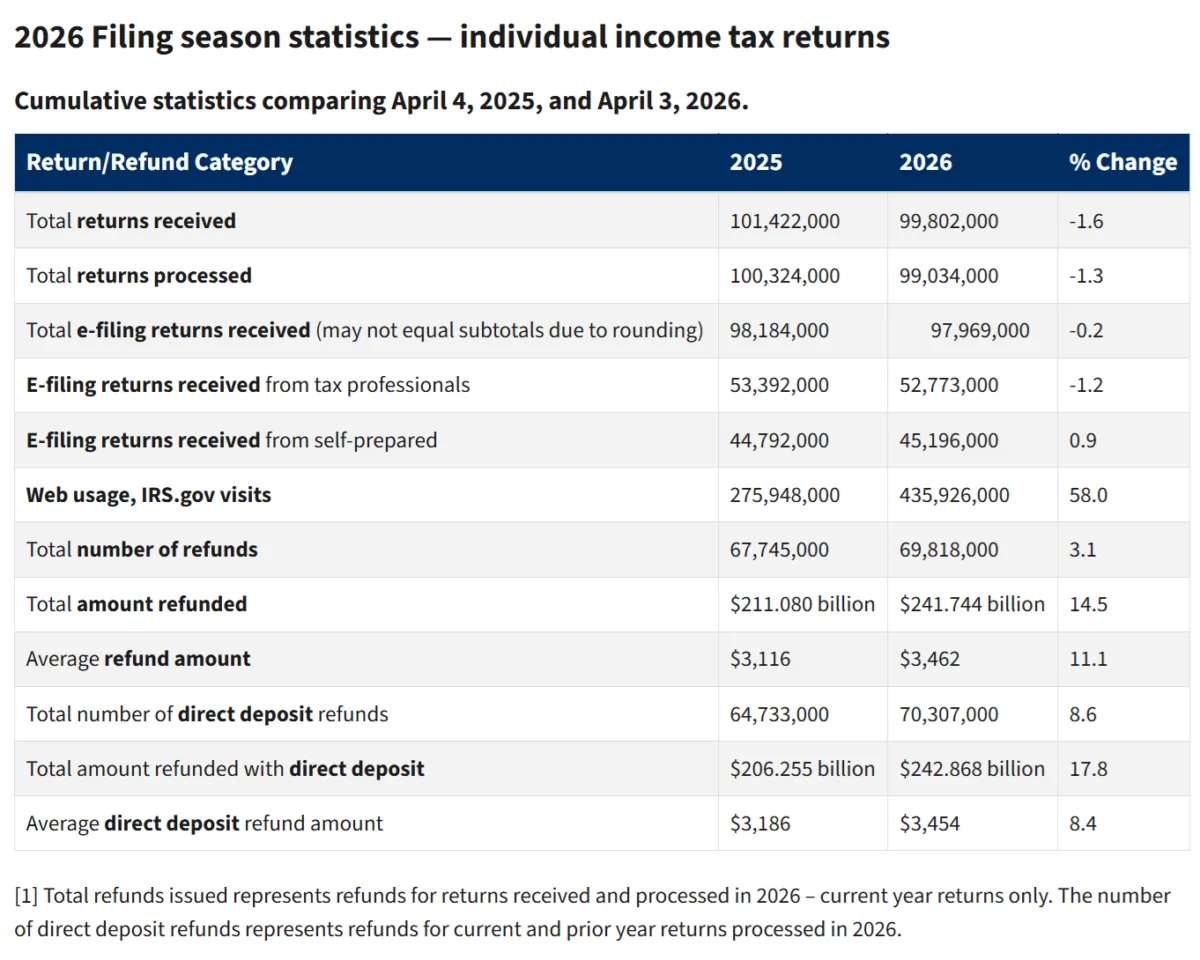
By Matt Durr
mlive.com
(TNS)
The 2026 tax season is revealing a notable, yet somewhat tempered, increase in average tax refunds for American taxpayers, according to newly released Internal Revenue Service (IRS) data. While President Donald Trump has consistently projected a substantial boost in refund amounts, the latest figures indicate that while refunds are indeed growing, they are not reaching the ambitious targets previously set forth by the White House. This discrepancy raises questions about the full impact of recent tax legislation and the expectations surrounding its benefits for the average American household.
IRS Data Reveals Modest Refund Growth
Data from the IRS, covering the filing period up to April 3, 2026, shows that the average tax refund issued so far this year stands at $3,462. This represents an increase from the $3,116 average observed during the same period in 2025, marking an overall rise of approximately 11.1%. For taxpayers who opt for direct deposit, a common and often faster method of receiving refunds, the average amount is $3,454. This figure is up from an average of $3,186 in 2025, indicating an 8.6% increase for this segment of filers.
While these increases are statistically significant and represent a welcome financial boost for millions of Americans, they fall considerably short of the projections championed by the Trump administration. In a press release issued on January 26, 2026, the White House had optimistically projected that the average tax refund would increase by $1,000 or more. This ambitious forecast was also echoed by the House Ways and Means Committee in November 2025, which similarly anticipated the largest tax refund season in U.S. history. The current data suggests that the actual increase, while positive, is closer to a $300 to $400 rise for the average filer, rather than the $1,000 benchmark.
The "One Big Beautiful Bill Act" and its Impact
The uptick in average refunds, even if below expectations, can be partly attributed to significant changes enacted through the "One Big Beautiful Bill Act," passed by Congress in the previous year. This landmark legislation introduced several key provisions aimed at stimulating the economy and providing direct financial relief to taxpayers. Among the most impactful changes were the elimination of federal income tax on overtime pay and tips, a measure designed to reward longer working hours and service industry workers.
Furthermore, the act introduced new deductions for auto loan interest specifically for vehicles manufactured in America, a provision intended to bolster domestic automotive production. Increases to the standard deduction also contribute to higher refund amounts by allowing more individuals to reduce their taxable income. These measures were widely expected to translate into more substantial financial returns for a broad spectrum of taxpayers.
Discrepancy Between Projections and Reality
The disparity between the administration’s pronouncements and the IRS’s current figures raises important questions about the effectiveness and scope of the tax reforms. While the legislation has clearly influenced refund amounts, the projected magnitude of the increase appears to have been overstated. Analysts suggest several potential reasons for this gap. It is possible that the economic conditions impacting individual tax liabilities did not align perfectly with the models used for forecasting. Additionally, the complexity of tax law means that the benefits of legislative changes can manifest differently for various income brackets and household structures.
It is crucial to note that the IRS data is a snapshot as of April 3, 2026. The tax filing season is an extended period, with millions of Americans still in the process of submitting their returns. This means that the average refund amount could still fluctuate as more data becomes available. Historically, a significant portion of tax returns are filed closer to the deadline, and the composition of these late filings could potentially alter the overall average.

Filing Season Dynamics and Trends
The 2026 tax season is following a pattern similar to previous years, with the IRS providing weekly updates on return and refund statistics. As of the April 3rd reporting period, approximately 99.8 million tax returns had been received by the IRS. This is a decrease in the number of returns filed compared to the same period in 2025, when over 163.5 million returns had been processed. However, despite the lower volume of returns, the number of refunds issued has seen a marginal increase of 3.1%, with 69.8 million refunds already disbursed. This suggests that while fewer people may have filed so far, those who have are generally receiving a refund, and at a higher average amount than last year.
The IRS typically advises taxpayers who file electronically and opt for direct deposit to expect their refunds within 21 days of their return being accepted. For those who prefer to track their refund status, the IRS offers a convenient online tool, "Where’s My Refund?" This tool provides real-time updates on the status of a taxpayer’s refund, typically showing a status within 24 hours of an electronic filing, three to four days after an e-filed prior-year return, or approximately four weeks after a paper return has been filed.
Approaching the Filing Deadline
Taxpayers still have a critical window to submit their 2025 tax returns. The official deadline for filing is April 15, 2026. Failure to meet this deadline without an approved extension can result in significant penalties and interest charges from the IRS. This looming deadline means that the final numbers for the 2026 tax season are still being shaped, and the ultimate average refund amount may see further adjustments.
Expert Analysis and Broader Implications
Financial analysts are closely observing these developments. The current data suggests that while the "One Big Beautiful Bill Act" has had a discernible positive impact on tax refunds, the extent of this impact may be less dramatic than initially portrayed by the administration. This could have implications for how the public perceives the effectiveness of the tax reforms and the overall economic benefits being delivered.
Dr. Eleanor Vance, a tax policy expert at the National Taxpayers Union, commented on the situation: "The increase in refunds is certainly welcome news for American households. However, it’s important for taxpayers to have realistic expectations. The figures from the IRS provide a more grounded perspective compared to the ambitious projections. The key takeaway is that tax policy changes do have tangible effects, but the magnitude and distribution of those effects require careful and ongoing scrutiny."
The discrepancy also highlights the challenges inherent in forecasting the economic impact of complex legislation. Numerous variables, including taxpayer behavior, economic fluctuations, and the intricate nature of tax code interactions, can influence the final outcomes. As the filing season progresses, further analysis will be needed to fully understand the nuances of the 2026 tax refund trends and their relationship to the broader economic landscape. The IRS will continue to release weekly updates, providing a more comprehensive picture as more Americans complete their tax obligations.
The data presented by the IRS serves as a crucial reality check against the optimistic narratives often surrounding tax policy. While the goal of the "One Big Beautiful Bill Act" was to provide significant relief, the current refund figures suggest a more measured, though still positive, outcome for the average American taxpayer. The coming weeks will be pivotal in determining the final average refund amount for the 2026 tax season.
©2026 Advance Local Media LLC. Visit mlive.com. Distributed by Tribune Content Agency LLC.