Julia Chirkova
As the calendar pages flip towards December, a familiar question echoes in the boardrooms of accounting firms: "What are we doing for marketing next year?" This annual introspection often sparks a flurry of ideas, but the true challenge for firms in 2027 lies not in generating a plethora of novel concepts, but in implementing a select few with strategic precision. The objective for any robust marketing plan in the coming year is refreshingly straightforward: to ensure the right clients discover the firm, comprehend its value proposition, and feel confident initiating contact. This requires a focused approach, prioritizing effectiveness and efficiency over sheer volume or exorbitant expenditure.
This article outlines seven practical and actionable strategies designed to equip accounting firms with a potent marketing framework for 2027. These imperatives are grounded in understanding client needs, optimizing digital presence, and fostering meaningful engagement, all while emphasizing measurable outcomes.
H2: Understanding the Target Audience: The Cornerstone of Effective Marketing
Before embarking on any marketing initiative, the fundamental question that must be addressed is: "Who are our ideal clients for 2027?" This introspection requires a deliberate narrowing of focus to two or three distinct client segments. For each segment, a deep dive into their prevalent concerns, recurring questions, and preferred channels for seeking professional guidance is paramount. The creation of detailed buyer personas, a practice increasingly recognized for its efficacy, will accelerate the identification of these critical client inquiries.
Empathy Mapping for Buyer Persona Development
To illustrate this critical step, consider the process of developing buyer personas for accounting firms. This involves a detailed empathy mapping exercise to define three core buyer personas representing the ideal target customer for a specific industry or job title within a defined geographic area and revenue bracket, particularly those who file tax returns.
For example, let’s construct a persona for a Construction Company President, Owner, CFO, or Controller in the New Haven and North Haven, Connecticut area, with annual revenues ranging from $5 million to $20 million, who regularly files tax returns.
Persona 1: "Robert ‘Bob’ Miller"
- Gender: Male
- Age: 52
- Location: North Haven, Connecticut
- Work: President and Owner of a mid-sized construction firm, responsible for overall business strategy, project acquisition, and financial oversight. Works long hours, often on-site and in the office.
- Search Terms: "construction company tax strategies," "cash flow management for contractors," "CFO services for construction," "mitigate tax liabilities construction," "best accounting firms for builders CT."
- Pain Points: Cash flow volatility, managing project budgets effectively, understanding complex tax regulations specific to the construction industry, ensuring compliance, finding reliable financial partners who understand the cyclical nature of construction projects.
- Goals: Increase profitability, secure larger and more profitable contracts, improve operational efficiency, build a strong financial foundation for future growth and potential sale, achieve greater work-life balance.
- How We Can Help: Provide specialized tax planning and compliance services tailored to the construction sector, offer strategic financial advisory to optimize cash flow and project profitability, assist with budgeting and forecasting, ensure adherence to industry-specific regulations.
Robert’s Concerns When Considering Hiring Us (Emotional, First-Person Perspective):
- "I’m worried that I’m leaving money on the table with my taxes. Are these guys really going to understand the unique deductions I’m entitled to as a builder?"
- "My cash flow is so unpredictable. I need someone who can help me manage those ups and downs without me having to constantly micromanage it."
- "Will they speak my language? I don’t want to waste time explaining construction project nuances to someone who doesn’t get it."
- "I’ve had advisors in the past who were too generic. I need a firm that truly specializes in construction and understands the risks and opportunities we face."
- "Is this going to be another expensive engagement where I don’t see a clear return on investment? I need to feel confident this is a wise financial decision."
Top 10 Frequently Asked Questions Robert Might Have About Advisory Services:
- What specific tax strategies do you employ for construction businesses to minimize liabilities?
- How can you help me improve my company’s cash flow management and forecasting?
- Can you provide insights into job costing and project profitability analysis?
- What are the key financial metrics I should be tracking for my construction business?
- How do you stay current with tax laws affecting the construction industry?
- What is your experience working with construction firms of my size and revenue?
- Can you assist with bonding and insurance requirements from a financial perspective?
- What are the typical fee structures for your advisory services for construction companies?
- How do you integrate with our existing accounting software and systems?
- What is the process for onboarding a new construction client?
Persona 2: "Maria Rodriguez"
- Gender: Female
- Age: 38
- Location: New Haven, Connecticut
- Work: Founder and CEO of a growing tech startup, focusing on software development. Manages a team of engineers and product managers.
- Search Terms: "startup tax advice," "angel investor tax implications," "R&D tax credits for software," "venture capital accounting," "scalable accounting solutions for tech."
- Pain Points: Understanding R&D tax credits, managing burn rate, preparing for future funding rounds, navigating stock options and equity compensation, ensuring compliance with evolving tech regulations.
- Goals: Secure Series A funding, scale the business rapidly, optimize for long-term profitability, build a strong financial infrastructure that supports growth, attract and retain top talent.
- How We Can Help: Offer specialized tax advisory for startups, including R&D credits and equity compensation planning, provide financial modeling and forecasting to support fundraising efforts, assist with robust accounting systems to handle rapid growth.
Maria’s Concerns When Considering Hiring Us:
- "I’m completely overwhelmed by the tax implications of our R&D. Are you sure you can help me maximize those credits?"
- "My burn rate is a constant concern. I need someone who can help me make smart financial decisions to extend our runway."
- "Will you understand the fast-paced, agile nature of a tech startup? I can’t afford slow processes."
- "How do you handle the complexities of stock options and founder equity? This is critical for attracting talent."
- "I need a partner who can grow with me, not just someone for basic bookkeeping. Can you offer strategic financial guidance as we scale?"
Top 10 Frequently Asked Questions Maria Might Have About Advisory Services:
- How can you help us identify and claim R&D tax credits for our software development?
- What are the key financial milestones and metrics for startups seeking venture capital?
- Can you assist with financial modeling and projections for fundraising rounds?
- What is your expertise in managing stock options and employee equity compensation?
- How do you advise on structuring debt and equity financing for startups?
- What are the typical accounting and tax challenges faced by SaaS companies?
- Can you help us implement scalable accounting systems to support rapid growth?
- What are the tax implications of international expansion for a tech startup?
- How do you ensure compliance with evolving data privacy regulations from a financial standpoint?
- What is your experience working with startups at our current stage of development?
Persona 3: "Sarah Chen"
- Gender: Female
- Age: 45
- Location: New Haven, Connecticut
- Work: Owner of a small, established professional services firm (e.g., marketing agency, consulting practice), with a loyal client base.
- Search Terms: "small business tax planning," "profitability analysis for service firms," "succession planning for small businesses," "outsourced accounting services," "streamlining business operations."
- Pain Points: Maximizing profitability from existing clients, understanding the true cost of services, developing a clear succession plan, finding efficient ways to manage administrative tasks, ensuring personal financial security.
- Goals: Increase profit margins, reduce personal involvement in day-to-day operations, ensure a smooth transition of ownership or leadership, achieve greater financial freedom.
- How We Can Help: Provide in-depth financial analysis to identify profit drivers, offer tax planning strategies to reduce personal and business tax burdens, assist with succession planning and exit strategies, implement efficient accounting and operational processes.
Sarah’s Concerns When Considering Hiring Us:
- "I feel like I’m working harder than ever but not seeing a proportional increase in profit. Can you help me figure out where the money is going?"
- "I’m starting to think about what happens to my business when I’m ready to step back. Do you have experience with succession planning for owners like me?"
- "I’m tired of drowning in paperwork. Can you help me streamline our financial operations so I can focus on my clients?"
- "Will your advice be practical and actionable for a business of my size? I don’t need overly complex corporate strategies."
- "How can you help me ensure my own personal financial future is secure, not just the business’s?"
Top 10 Frequently Asked Questions Sarah Might Have About Advisory Services:
- How can you help me understand the true profitability of each of my service offerings?
- What tax strategies can I implement to reduce my personal income tax burden as a business owner?
- Can you assist in developing a clear and achievable succession plan for my business?
- What are the best practices for streamlining invoicing, collections, and accounts payable for service firms?
- How do you approach budgeting and forecasting for small professional service businesses?
- What are the key performance indicators (KPIs) a firm owner like me should be monitoring?
- Can you help me evaluate potential exit strategies for my business?
- What are the tax implications of selling my business?
- How can outsourced accounting services benefit a firm of my size?
- What is your process for educating clients on financial best practices?
By investing time in these persona-driven insights, firms can tailor their marketing messages and activities to resonate deeply with their target audiences, fostering a more authentic and effective connection.

H2: Revitalizing Digital Presence: The Website as a Virtual Front Door
The firm’s website serves as its digital storefront, and its responsiveness and clarity are paramount. A critical self-assessment involves viewing the website through the lens of a potential client, particularly on mobile devices. Given that over half of all web traffic originates from mobile devices, a slow, confusing, or outdated website can significantly deter prospects.
While a complete overhaul may not be necessary, focusing on the core pages—services, team biographies, and contact information—is essential. Services should be articulated with utmost clarity, team bios should be current and engaging, and contact options must be immediately accessible and user-friendly. Addressing any outdated design elements or usability issues will enhance the user experience and convey a professional, modern image. Data from the Pew Research Center consistently shows that website design and user experience are critical factors in building trust and credibility for online businesses. A study by Adobe found that 38% of people will stop engaging with a website if the content or layout is unattractive.
H3: Enhancing Online Discoverability in an AI-Driven Search Landscape
The search landscape is rapidly evolving, with AI-powered search engines becoming increasingly prevalent. Queries like, "Who helps small businesses with cash flow planning near me?" are now commonplace. For accounting firms, the question becomes: "Would our firm be a strong match for such queries, and do we provide enough comprehensive information for AI and search engines to recognize our expertise?"
Optimizing for this new paradigm requires a multi-faceted approach. Clear, detailed service pages are foundational. Providing helpful, informative answers to common client questions within website content, such as through an FAQ section or blog posts, is crucial. Maintaining accurate and up-to-date business information across all online platforms, including Google Business Profile, is non-negotiable. Furthermore, showcasing real-world examples of the firm’s expertise through case studies and client testimonials can significantly bolster online visibility and credibility. A recent report by Search Engine Journal indicated that AI-powered search is projected to grow exponentially, underscoring the importance of structured data and content quality.
H3: Crafting Emails That Command Attention
In an era of information overload, the inbox is a fiercely contested space. For accounting firms, the challenge lies in creating email communications that clients genuinely want to open. Generic, lengthy newsletters filled with dry tax updates are increasingly being bypassed. A more effective strategy involves focusing on a single, valuable topic per email.
For instance, instead of a bland "December Firm Newsletter," consider a more compelling subject line such as "Three Year-End Tax Questions Your Business Needs to Ask Now." This targeted approach respects the recipient’s time and offers immediate, actionable value. Research by Campaign Monitor indicates that personalized emails deliver 6x higher transaction rates, highlighting the impact of tailored content. The key is to shift from broadcasting information to providing specific, relevant solutions to client challenges.
H2: Strategic Social Media Engagement: Quality Over Quantity
For most accounting firms, maintaining a presence on every social media platform is an inefficient use of resources. The focus should be on identifying one or two platforms where prospective clients and referral partners are most active and engaging strategically. For many firms, LinkedIn remains a prime candidate due to its professional networking focus.
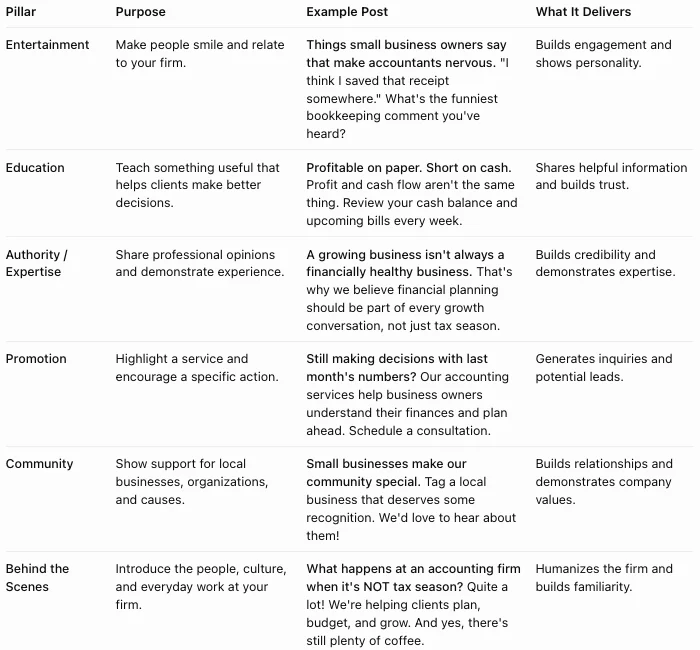
Content on these platforms should aim to provide practical advice, address common client queries, and offer insightful perspectives on industry trends. Crucially, the content should avoid being overtly promotional. A balanced content strategy, often referred to as "social media pillars," can ensure a diverse and engaging feed.
Six Social Media Content Pillars for Accounting Firms:
- Educational Content: This pillar focuses on providing valuable information that helps clients understand complex financial topics, tax laws, or business strategies. Examples include "Understanding R&D Tax Credits for Tech Startups," or "Key Financial Ratios for Construction Companies."
- Authority/Expertise: This pillar showcases the firm’s deep knowledge and experience. This could involve sharing insights on new legislation, offering commentary on economic trends, or presenting case studies (anonymized, of course) that highlight successful client outcomes.
- Client Success Stories/Testimonials: Sharing positive feedback and demonstrating how the firm has helped clients achieve their goals builds trust and social proof. This can be done through short video testimonials or written quotes.
- Behind-the-Scenes/Firm Culture: Humanizing the firm by sharing glimpses into its culture, team achievements, or community involvement can foster a stronger connection with followers.
- Interactive Content: Engaging the audience through polls, Q&A sessions, or "ask me anything" opportunities can drive interaction and provide valuable insights into client needs.
- Industry News and Trends: Curating and commenting on relevant industry news demonstrates that the firm is informed and a valuable resource for staying up-to-date.
Planning Tip: A sustainable approach involves selecting two educational posts, one authority post, and one post from another pillar each month. Rotating the remaining pillars ensures content remains fresh and engaging over time. The overarching goal is to cultivate a balanced mix of content that educates, builds trust, sparks conversations, and ultimately, encourages prospective clients to take action.
H3: Transforming Client Questions into High-Value Content
Every client interaction presents an opportunity for content creation. The common questions fielded by the team can be transformed into valuable marketing assets, ranging from short articles and checklists to videos and social media posts. For instance, the question, "How much cash should my business keep in reserve?" can be repurposed into a blog post, an email newsletter segment, and several concise social media updates.
A proactive approach involves tasking team members to collect a list of the top five to ten frequently asked client questions. These questions can then be systematically addressed across various content channels over a period of weeks or months. This strategy not only provides valuable information to a broader audience but also reinforces the firm’s expertise and demonstrates its commitment to client success. According to HubSpot, businesses that blog consistently are 13 times more likely to see positive ROI.
H3: Measuring Marketing Success: Beyond Clicks and Likes
While website traffic and social media engagement metrics are indicators of reach, they do not inherently measure the success of marketing efforts in terms of client acquisition or bottom-line impact. For accounting firms, it is imperative to track metrics that directly correlate with business growth.
Key Performance Indicators (KPIs) for Marketing Success:
- Number of Qualified Leads Generated: This tracks the volume of potential clients who meet the firm’s ideal client criteria.
- Conversion Rate of Leads to Clients: This measures the effectiveness of the sales process in turning interested prospects into paying clients.
- Client Acquisition Cost (CAC): This calculates the average cost incurred to acquire a new client, allowing for optimization of marketing spend.
- Client Lifetime Value (CLTV): This estimates the total revenue a firm can expect from a single client over the duration of their relationship, providing a long-term perspective on marketing ROI.
- Referral Rate: Tracking the number of new clients acquired through existing client referrals highlights the power of client satisfaction and advocacy.
The practice of reviewing three to five of these critical numbers monthly allows for data-driven decision-making, enabling firms to identify which marketing activities are yielding the best results and which require adjustment or discontinuation. A study by Bain & Company found that companies that excel at measuring and analyzing marketing ROI are significantly more likely to outperform their peers financially.
H2: The 2027 Marketing Plan: A Decision-Driven Approach
The development of a comprehensive marketing plan for 2027 does not necessitate an immediate overhaul of all seven strategies. Instead, the most impactful approach involves selecting two to three initiatives that promise the greatest return for the firm. Assigning clear ownership for each chosen task, establishing definitive deadlines, and implementing a 90-day progress review mechanism will foster accountability and ensure momentum.
For firms seeking a structured guide, a downloadable "2027 Accounting Firm Marketing Checklist" can serve as an invaluable tool. This resource facilitates the review of current marketing efforts, aids in prioritizing key initiatives, and supports the creation of a practical, actionable 90-day plan. Consistent, regular marketing efforts, integrated into the firm’s operational rhythm, are far more effective than sporadic campaigns initiated only during periods of business slowdown. Marketing, when approached strategically and consistently, becomes a continuous engine for growth, not a reactive measure.