Candice Horbacz
Legal sports betting has undergone a dramatic transformation across the United States since the landmark 2018 Supreme Court decision in Murphy v. NCAA. This pivotal ruling recognized the federal prohibition on sports wagering as unconstitutional, effectively dismantling the Professional and Amateur Sports Protection Act (PASPA) and empowering individual states to establish their own legal markets. Prior to this decision, consumers could legally place sports bets in only a handful of states, primarily Nevada. Today, the landscape is vastly different, with some form of legal sports betting now active in 40 states and the District of Columbia, ushering in a new era for the multi-billion dollar industry.
Historical Context: The Genesis of a New Market
For decades, sports betting in most of the U.S. was confined to the shadows of illegal bookmakers or the regulated confines of Nevada casinos. The 1992 PASPA law, championed by sports leagues, prohibited states from authorizing sports betting. However, New Jersey, a persistent challenger, sought to legalize sports wagering, arguing that PASPA unfairly prevented states from making their own policy decisions. This legal battle culminated in Murphy v. NCAA. On May 14, 2018, the Supreme Court, in a 7-2 decision, struck down PASPA, ruling it violated the Tenth Amendment’s anti-commandeering doctrine, which prevents the federal government from compelling states to enforce federal law. This decision did not legalize sports betting nationwide, but rather cleared the path for individual states to do so, igniting a rapid legislative flurry across the country. States, eyeing significant new revenue streams and an opportunity to regulate an existing black market, quickly moved to pass enabling legislation. Delaware was among the first, launching single-game sports betting just weeks after the ruling, followed swiftly by New Jersey and others.
The Rapid Expansion of Legalized Wagering
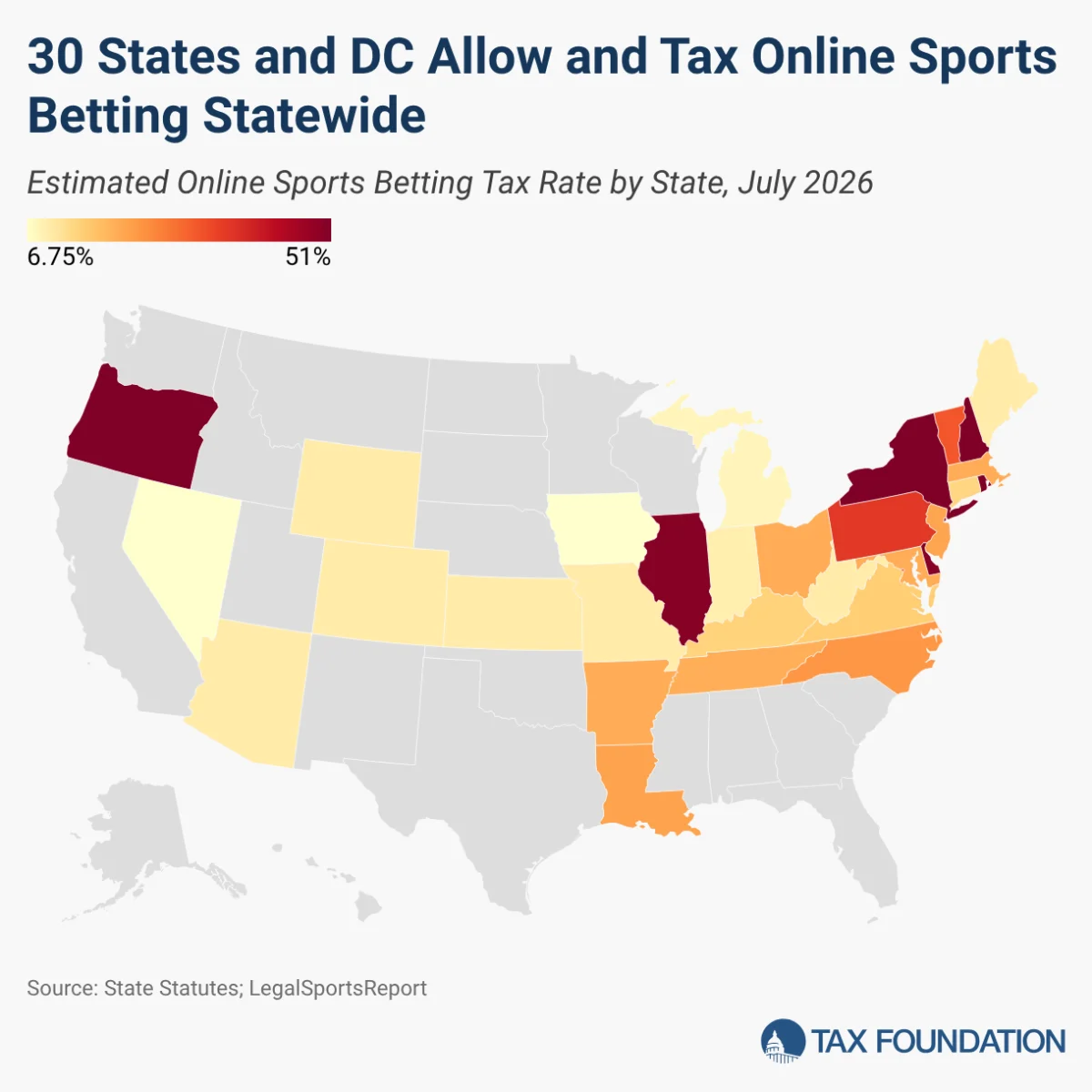
The post-PASPA era has seen an unprecedented expansion of sports betting access. From a mere handful of states, the number of jurisdictions offering legal sports wagering has swelled to 40 states and the District of Columbia. This represents a significant shift, bringing a substantial portion of the American population into regulated markets. However, the form and accessibility of this betting vary considerably. While 40 jurisdictions permit some form of sports wagering, statewide access to online sports betting platforms, which represent the lion’s share of activity, is available in only 30 states and the District of Columbia. The remaining states often restrict wagers to those placed within brick-and-mortar casinos, on tribal lands, or other physical locations, even if the actual transaction is digital. This disparity highlights the patchwork nature of state-level regulation.
Divergent State Tax Regimes and Revenue Generation
The economic models adopted by states to capitalize on legalized sports betting are diverse, reflecting varying policy objectives and market philosophies. Most states primarily levy an ad valorem tax on the revenues of sportsbook operators, typically targeting Gross Gaming Revenues (GGR). GGR is generally defined as the total amount wagered minus payouts to bettors, representing a sportsbook’s estimated profitability before operational expenses. The treatment of promotional wagers, such as free bets or bonuses offered to attract new customers, remains a contentious policy focus, as different states decide whether these should be deducted from GGR before taxation.
Tax rates on GGR vary dramatically across the country. At the higher end, New Hampshire, New York, Oregon, and Rhode Island impose a substantial 51 percent tax rate on sportsbook revenues. This aggressive taxation is often driven by states seeking to maximize immediate revenue, though critics argue such high rates can stifle market growth and operator profitability. Conversely, Nevada and Iowa levy some of the lowest tax rates, at 6.75 percent, reflecting established gaming markets with different policy priorities, often prioritizing a competitive landscape and broader economic impact.
A few states have experimented with alternative taxation approaches. Tennessee, for instance, levies a tax directly on the sports betting handle – the total amount wagered – rather than on GGR. Illinois recently introduced an additional ad quantum fee of $0.50 per wager, adding a flat charge on each transaction. Some states, like Oregon, have opted for a state-controlled monopoly on online sports betting, establishing revenue-sharing agreements with operators. For comparability across states, these alternative tax structures are typically converted to their approximate GGR equivalents to allow for a standardized analysis of the tax burden.
The financial rewards for states have been substantial. In 2025, sports betting taxes generated over $3.7 billion for state treasuries nationwide. New York emerged as the clear leader, collecting more than $1.3 billion, largely due to its high tax rate and massive population. Illinois followed, bringing in over $495 million. These figures underscore the powerful fiscal incentive driving continued legalization and expansion efforts.
Beyond Taxation: Barriers to Entry and Market Access
While taxes are a primary mechanism for states to generate revenue, they are not the only burdens placed on the sports betting ecosystem. Significant non-tax regulatory hurdles impact both sportsbook operators and consumers, shaping the competitiveness and accessibility of legal markets.
Operator Licensing and Partnership Mandates: State laws and regulations often create high barriers to entry for sports betting operators. These typically come in the form of exorbitant licensing fees or requirements for online sportsbooks to partner with existing in-state brick-and-mortar casinos or racetracks. For example, Massachusetts demands a substantial $5 million licensing fee, renewable every five years. Pennsylvania imposes an even steeper initial fee of $10 million, with a $250,000 renewal fee every five years. These high costs can deter smaller operators and limit market competition.
Several states mandate specific partnership structures. New Jersey requires online sportsbook operators to affiliate with a licensed brick-and-mortar racetrack or casino within the state. Ohio offers a similar model, allowing online sportsbooks to partner with professional sports organizations approved by the Casino Control Commission. Other states grant control of online sports betting to their state lottery commissions, either directly or through exclusive contracts. Connecticut, for instance, requires online gaming operators to partner with an approved "master gaming operator." Montana has monopolized all sports betting under its Lottery Commission, effectively creating a single-provider market. Similarly, Florida allows online sports betting exclusively through the Seminole Tribe’s single operator. New Hampshire also operates under an exclusive contract with a single private operator.
The Impact of Monopolies: States that grant a monopoly to a single provider of sports betting services, whether through direct control or an exclusive contract, establish an insurmountable barrier to entry for other potential operators. While this might simplify oversight for the state, it often leads to limited consumer choice, less competitive odds, and potentially reduced innovation. The District of Columbia provides a compelling case study: it established a monopolized sports betting market in 2019 but ended the arrangement in 2024 following widespread problems related to customer satisfaction, poor performance, and fraud. The shift to a more competitive market had a dramatic effect: GGR per adult in the population nearly tripled, from approximately $83 in 2024 to about $240 in 2025, demonstrating the economic benefits of fostering competition.
Geographic Restrictions on Wagering: Even in states where sports betting is legal, consumers often face geographical restrictions on where they can place bets. In New Mexico, North Dakota, and Wisconsin, for example, wagers are strictly limited to tribal casinos. South Dakota permits betting within tribal casinos or licensed establishments in the city of Deadwood. Mississippi and Montana only allow consumers to place bets when physically present at retail casinos or state-operated facilities. These limitations, while intended to support existing land-based gaming industries, restrict consumer convenience and can inadvertently push potential bettors toward unregulated online platforms.
Furthermore, some states differentiate between online and retail wagers for tax purposes, often taxing online bets more heavily. Arizona, Kentucky, Louisiana, Massachusetts, New Jersey, New York, and the District of Columbia are among the jurisdictions that apply higher tax rates to online wagers compared to in-person bets.
The Evolving Landscape of Prediction Markets
Beyond traditional sports betting, a newer form of wagering known as prediction markets is emerging, presenting a fresh set of regulatory and taxation challenges. Prediction markets allow participants to bet on the outcome of future events, such as political elections, economic indicators, or celebrity contests, with "shares" in an outcome trading like stocks. Legally and economically, these are distinct from sports betting.
However, efforts are underway in several states to integrate prediction markets into the existing tax and regulatory frameworks that govern sports betting or other forms of gambling. North Carolina, for instance, recently passed a budget bill that not only increased taxes on sportsbooks but also established a 6 percent tax on operators of prediction markets, set to begin in 2027. Kentucky has also legislated a broader 14.25 percent tax on prediction markets.
The legal environment surrounding prediction markets is rapidly developing and fraught with uncertainty. Federal courts are currently considering whether states possess the authority to regulate these entities as gambling, or if authority rests solely with the federal Commodity Futures Trading Commission (CFTC), which oversees financial products. Different courts have reached conflicting conclusions, leading to a fragmented legal landscape. This suggests that either definitive input from the Supreme Court or comprehensive congressional legislation will likely be required to provide clarity on whether, and how, states can regulate and tax prediction markets. Until then, the treatment of these markets at the state level remains largely ambiguous.
Implications for Consumers and the Industry
The various burdens imposed by states—high tax rates, exorbitant licensing fees, restrictive partnership requirements, and geographic limitations—translate into tangible disadvantages for bettors and operators alike. For consumers, these often result in worse odds and a less favorable betting experience within the legal market. For operators, the high cost of doing business can stifle competition and innovation.
Crucially, these barriers and costs can push consumers toward illicit, unregulated black markets. Such markets typically offer no consumer protections, lack responsible gambling safeguards, and operate outside the purview of state tax authorities. This undermines the very public health and revenue-generation goals that often motivate legalization efforts. The recent change to the federal income tax treatment of gambling losses, allowing only a portion of losses to be deductible, further complicates matters. This unequal tax treatment could also incentivize gambling activity to shift to offshore or illicit markets that are not subjected to such burdens.
The Path Forward: Optimizing Regulatory Frameworks
The market for legal sports betting is projected to continue its substantial growth as more states allow operations or expand existing services to include online platforms. State governments, consistently enticed by the potential for new tax revenues, will remain key drivers of this expansion. As the tax base grows and matures, the design of tax policy becomes increasingly critical.
An optimal sports betting policy design would prioritize several key objectives:
- Competitive Rates: Tax rates should be low enough to allow operators to offer competitive odds and promotions, thereby drawing consumers away from illicit markets.
- Broad Access: Minimize restrictions on where consumers are allowed to gamble and ensure easy access to online platforms.
- Fair Market Entry: Reduce exorbitant licensure fees and eliminate monopoly grants or overly restrictive partnership requirements to foster a competitive marketplace.
- Consumer Protection: Implement robust responsible gambling measures and consumer safeguards within a well-regulated environment.
Achieving these goals aligns not only with maximizing state tax revenues but also with broader public health objectives by providing a safer, more transparent environment for gambling. A well-designed regulatory framework ensures that the economic benefits of legal sports betting are realized while mitigating the risks associated with unchecked illicit activity. The ongoing evolution of this market demands continuous evaluation and adaptation of state policies to ensure they remain effective, fair, and beneficial for all stakeholders.