Lana Rhoades
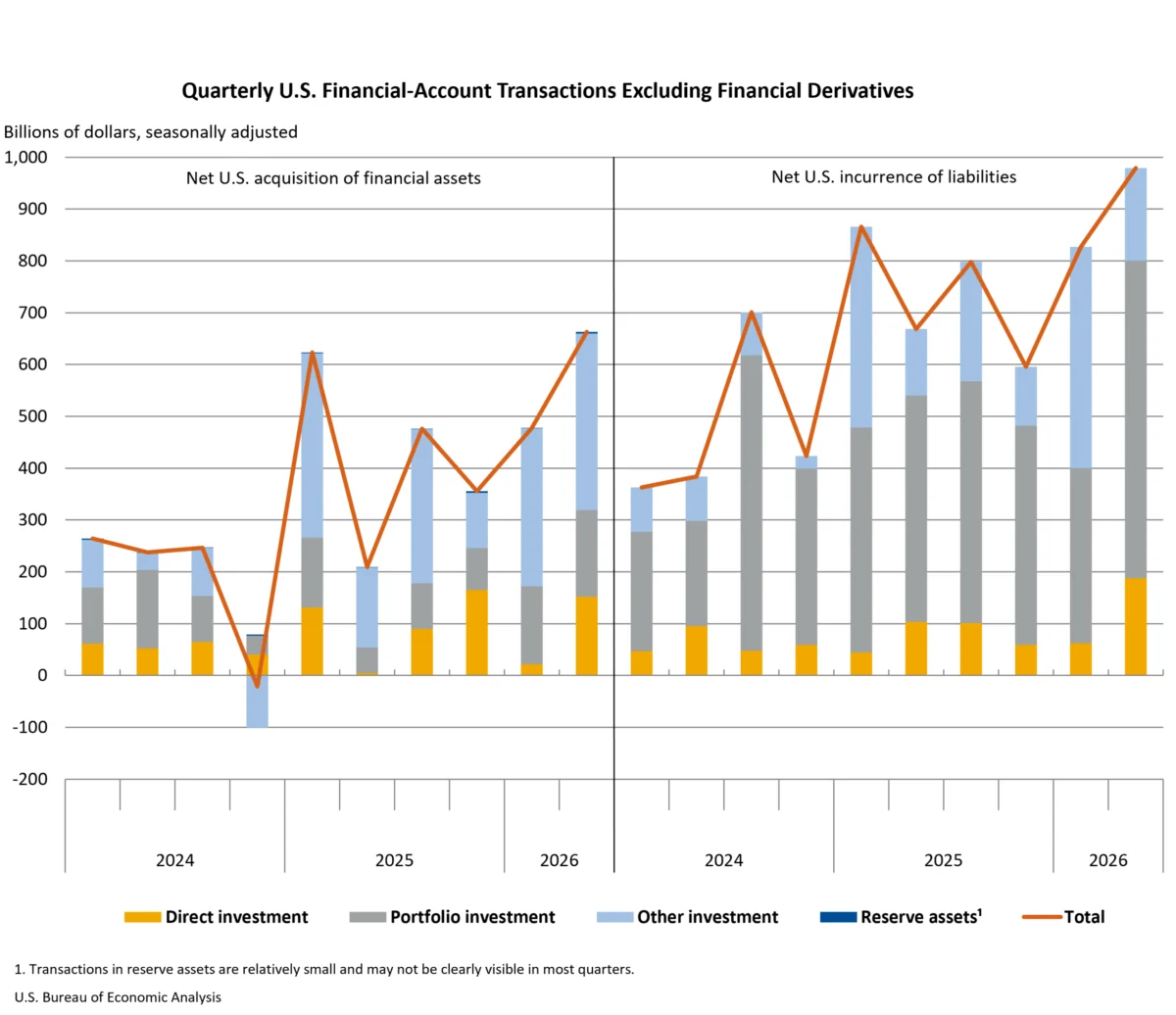
The U.S. current-account deficit, a broad measure of a nation’s international economic transactions, expanded by $33.4 billion, or 15.7 percent, to reach $246.0 billion in the second quarter of 2026. This widening, as reported by the U.S. Bureau of Economic Analysis (BEA), signals a growing imbalance in the nation’s trade and investment relationships with the rest of the world. The revised deficit for the first quarter of 2026 stood at $212.6 billion.
As a proportion of the U.S. economy, the current-account deficit grew to 3.0 percent of current-dollar gross domestic product (GDP) in the second quarter, an increase from 2.7 percent recorded in the preceding quarter. This trend indicates that a larger share of the nation’s economic output is being financed by foreign capital.
Deep Dive into the Components of the Widening Deficit
The substantial $33.4 billion expansion of the current-account deficit was primarily fueled by a deterioration in the balance of trade in goods. This negative trend was partially counteracted by a reduction in deficits related to primary income, which encompasses earnings on investments, and secondary income, which includes current transfers.
Goods Trade: The Primary Driver
The deficit in goods trade, a persistent concern for U.S. economic policymakers, saw a significant escalation. While the BEA report does not provide specific figures for the goods deficit alone in the initial summary, the overall increase in imports of goods and services, coupled with an increase in goods exports, points to a widening gap. This suggests that the value of goods imported into the United States outpaced the value of goods exported, a common pattern that has characterized U.S. trade for many years. Factors such as consumer demand for imported products, global supply chain dynamics, and the competitiveness of U.S. manufactured goods likely played a role in this widening imbalance.
Income Accounts Show Mixed Movements
On the income front, the situation presented a more nuanced picture. The deficit on primary income narrowed. This category includes income earned by U.S. residents from their foreign investments (receipts) and income paid to foreign residents on their U.S. investments (payments). A reduction in the primary income deficit suggests that either U.S. earnings from overseas investments grew faster than payments to foreign investors in the U.S., or payments to foreign investors decreased while U.S. earnings remained stable or increased.
Conversely, the deficit on secondary income, which consists of unilateral transfers like foreign aid, remittances, and certain government grants, also decreased. This implies a reduction in net outflows of these current transfers from the U.S. to other countries.
Trade in Goods and Services: An Expanding Exchange
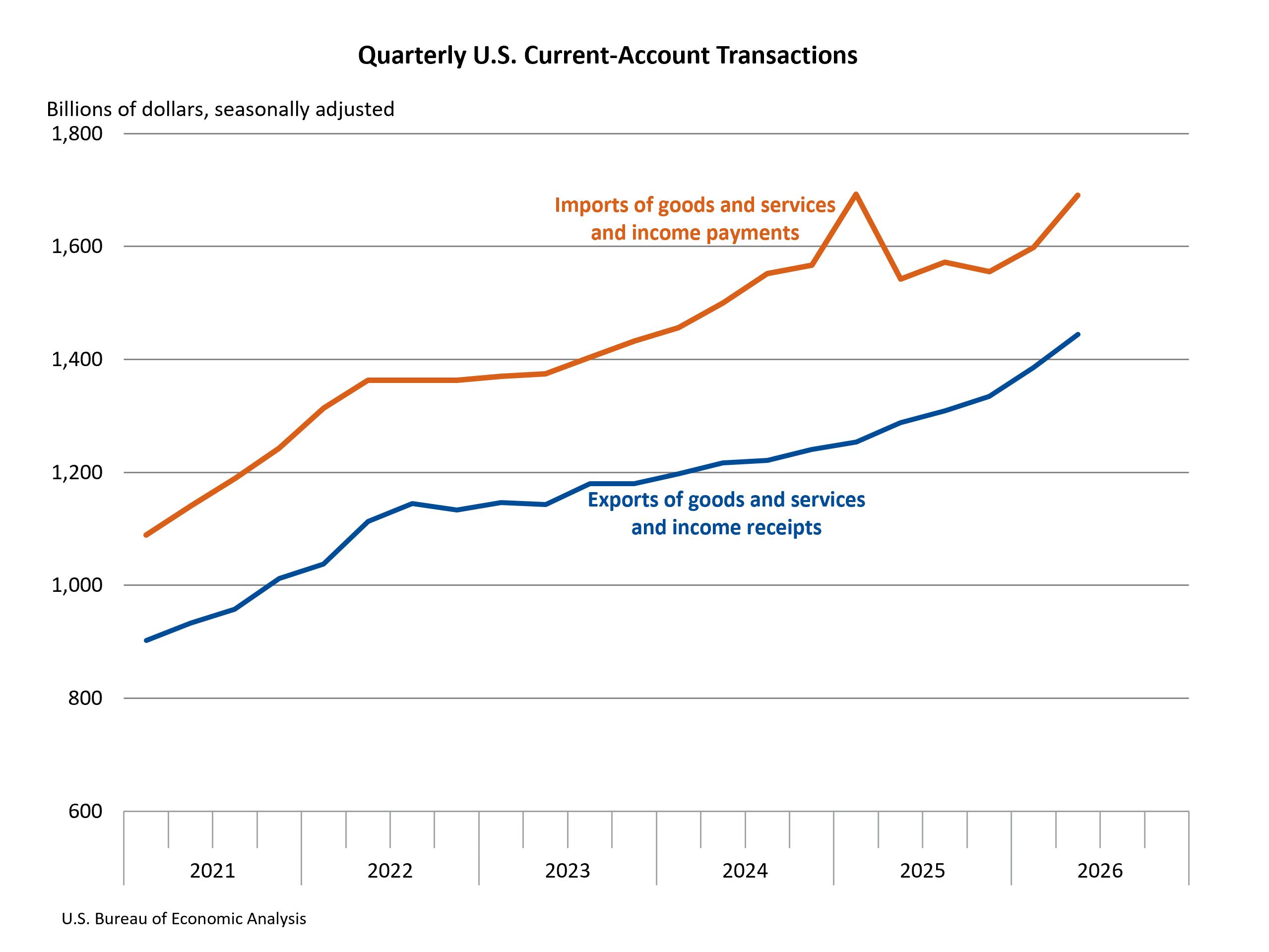
The overall volume of international transactions saw a notable increase. Exports of U.S. goods and services to foreign residents, along with income received from these foreign entities, rose by $58.8 billion to a total of $1.44 trillion in the second quarter. This growth was attributed to increases in both goods exports and primary income receipts. This indicates a healthy demand for U.S. products and services on the global market.
On the import side, the picture was even more pronounced. Imports of goods and services from foreign residents, along with income paid to these foreign entities, surged by $92.2 billion, reaching $1.69 trillion. This substantial increase reflects higher imports of goods and increased primary income payments. The larger jump in imports compared to exports directly contributed to the widening of the current-account deficit.
Capital and Financial Flows: A Complex Interplay
Beyond the current account, the BEA report also detailed capital and financial account transactions. Capital-transfer receipts, which involve the transfer of ownership of fixed assets or the forgiveness of liabilities without any consideration, decreased by $1.1 billion to $2.3 billion. Similarly, capital-transfer payments saw a reduction of $0.9 billion, settling at $1.0 billion. These movements represent relatively minor components of the overall international economic picture.
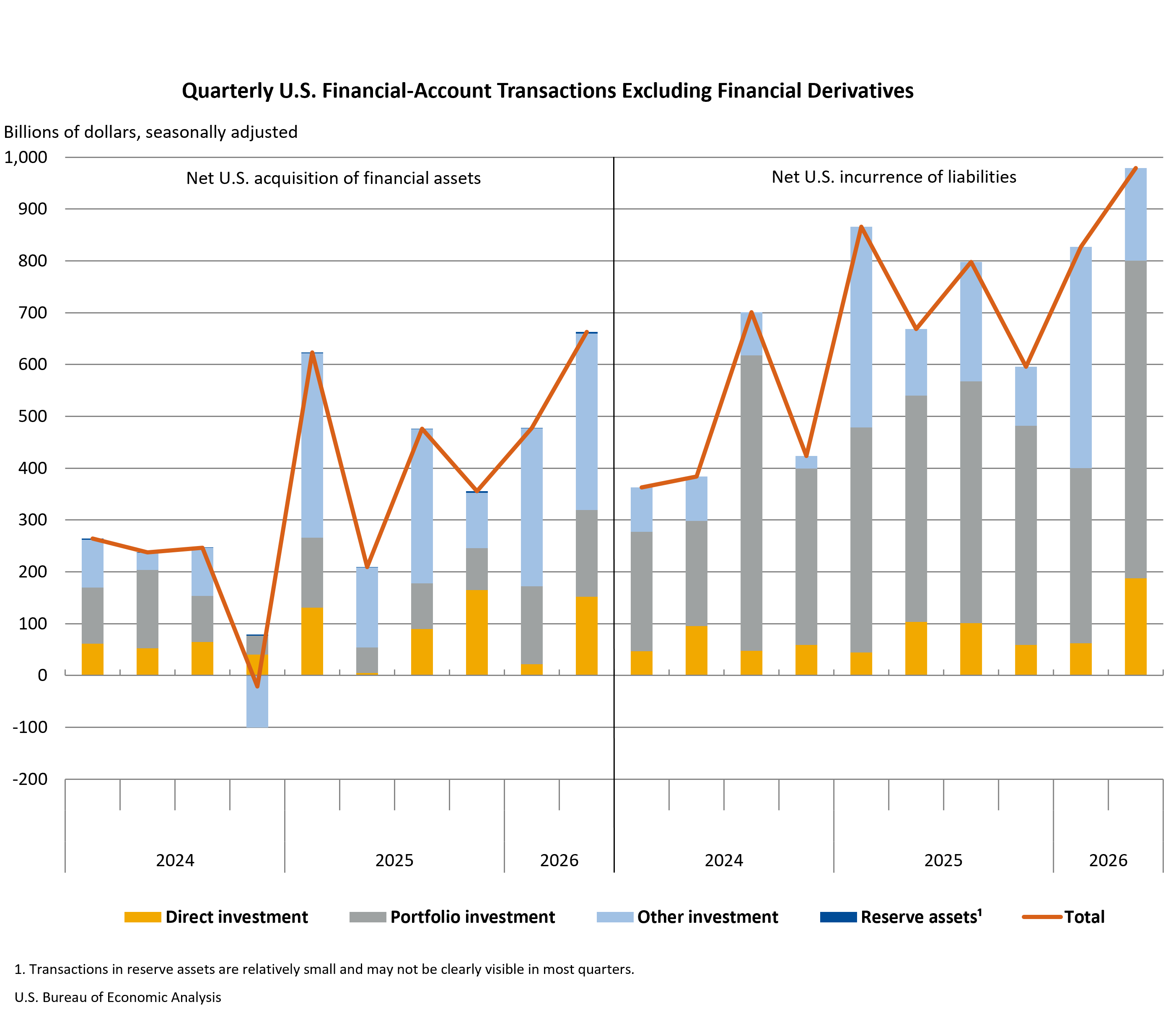
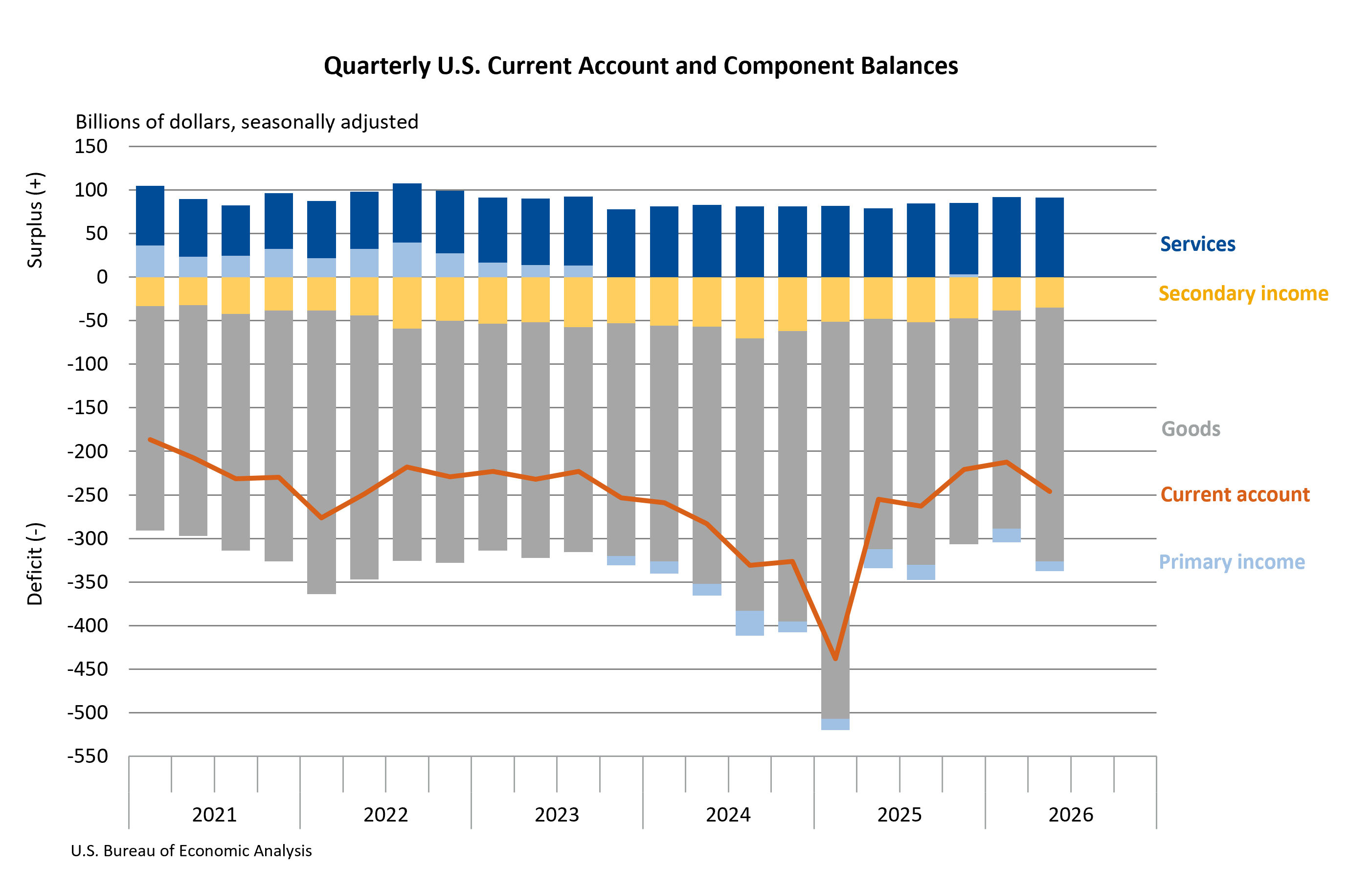
The financial account, which records transactions involving financial assets and liabilities, showed a net outflow of capital from the U.S. Net financial-account transactions were negative $369.7 billion in the second quarter, indicating that the U.S. economy borrowed more from foreign residents than it lent to them. This was driven by an increase in U.S. residents’ foreign financial assets by $663.3 billion, alongside a larger increase in U.S. liabilities to foreign residents by $978.9 billion. This net borrowing from abroad is a direct counterpart to the current-account deficit.
U.S. Net International Investment Position: A Deepening Debt
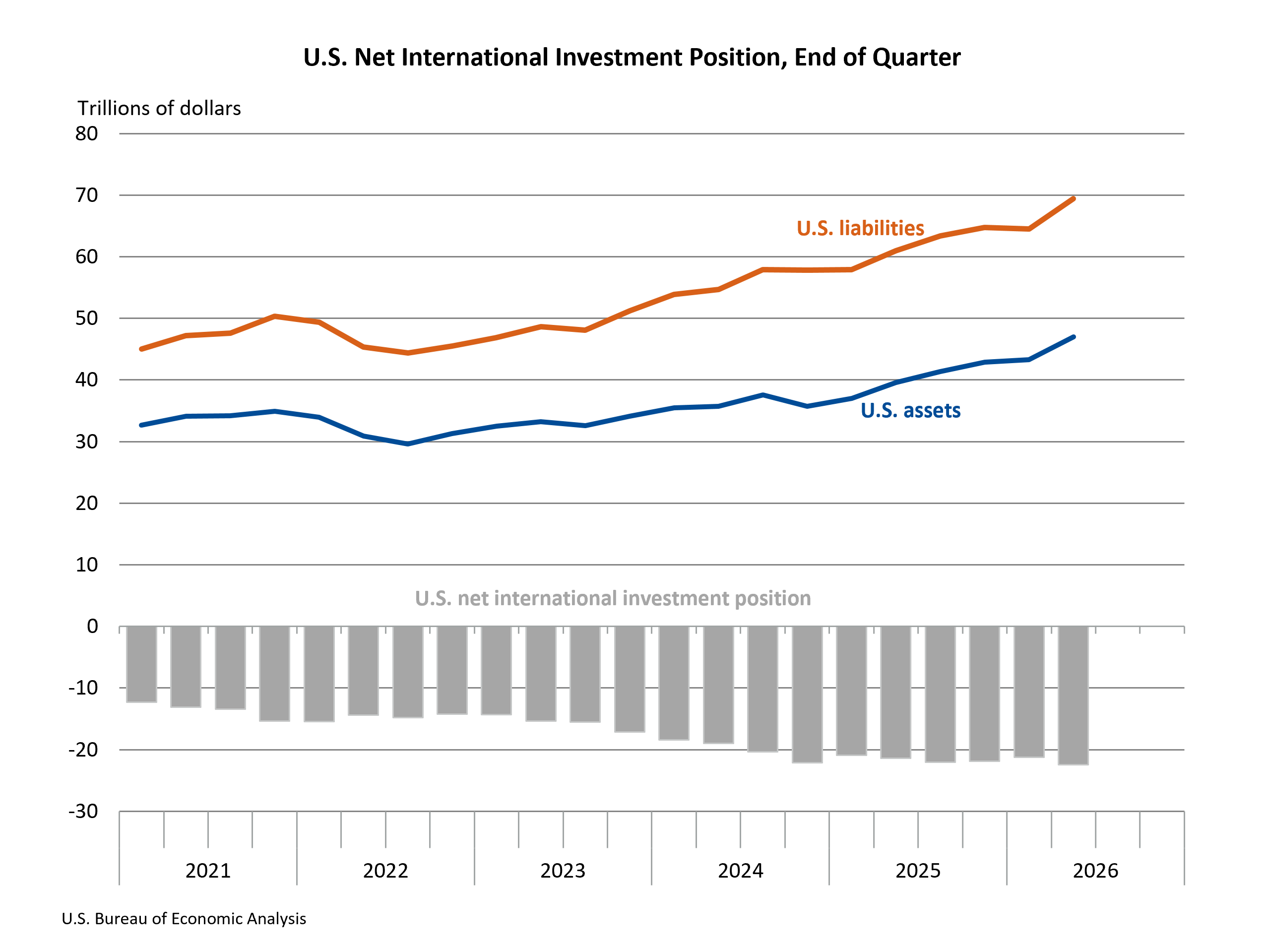
The nation’s net international investment position, which represents the difference between U.S. residents’ foreign financial assets and liabilities, remained significantly negative. At the end of the second quarter of 2026, the net position was negative $22.42 trillion. U.S. assets abroad totaled $46.97 trillion, while liabilities to foreign residents stood at $69.39 trillion. This represents a substantial net foreign debt.
Comparing this to the end of the first quarter of 2026, where the net investment position was a revised negative $21.27 trillion, the U.S. has seen its net foreign liabilities increase. This deepening net debt position underscores the cumulative effect of persistent current-account deficits.
Dynamics of Asset and Liability Changes
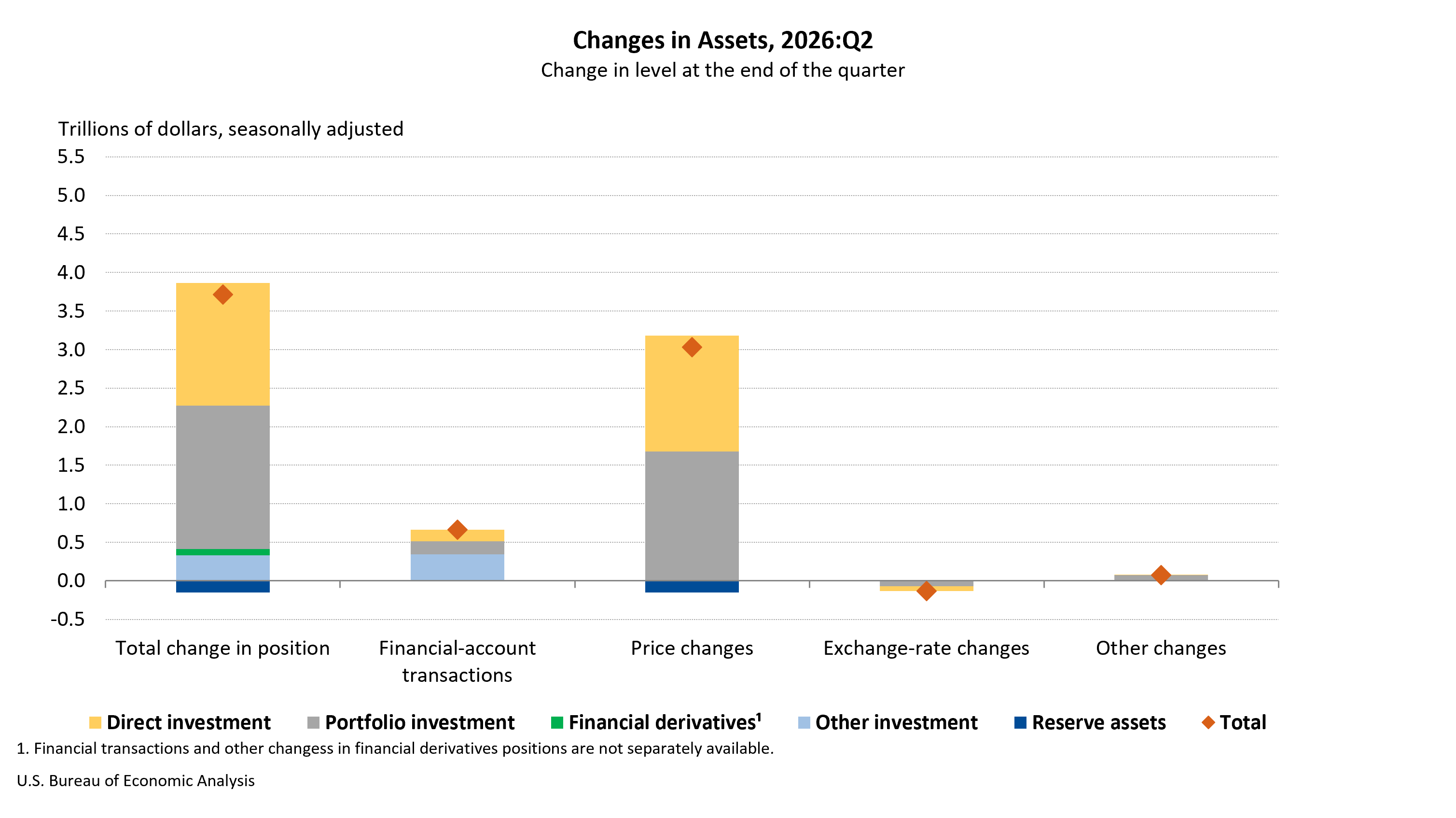
The increase in U.S. assets abroad during the second quarter amounted to $3.72 trillion. This growth was broadly distributed across major investment categories, with the exception of reserve assets. The primary drivers of this increase were price changes, which contributed $3.03 trillion, and financial transactions, accounting for the remaining $663.3 billion. This indicates that while the value of existing foreign holdings increased due to market appreciation, there was also a significant net acquisition of foreign assets by U.S. entities.
U.S. liabilities to foreign residents also experienced a substantial increase, rising by $4.87 trillion in the second quarter. This growth was observed across all major investment categories, with portfolio investment being particularly significant. Similar to assets, price changes played a dominant role, contributing $3.95 trillion to the increase in liabilities, while financial transactions accounted for $978.9 billion. This suggests that foreign investors increased their holdings of U.S. assets, both through new investments and through appreciation of their existing holdings.
Revisions to First-Quarter Data
The BEA also provided revised estimates for the first quarter of 2026, offering a clearer picture of the preceding period. The current-account balance was revised from a preliminary estimate of negative $226.8 billion to a revised negative $212.6 billion. This upward revision of $14.2 billion was influenced by several components:
- Goods Balance: The preliminary estimate of negative $250.9 billion remained unchanged in the revised figures.
- Services Balance: This saw a significant upward revision from $85.1 billion to $92.1 billion, indicating stronger net exports of services than initially reported.
- Primary Income Balance: The preliminary estimate of negative $13.3 billion was revised to negative $15.8 billion, suggesting a larger deficit in primary income than first thought.
- Secondary Income Balance: This category experienced a notable improvement, revised from negative $47.8 billion to negative $38.0 billion, indicating a smaller net outflow of current transfers.
The net financial-account transactions for the first quarter were also revised upwards significantly, from a preliminary estimate of negative $209.0 billion to negative $295.2 billion. This substantial revision suggests that U.S. borrowing from foreign residents in the first quarter was considerably larger than initially reported.
The U.S. net international investment position at the end of the first quarter remained unchanged at a revised negative $21.27 trillion. However, revisions were made to the underlying components: U.S. assets were revised down slightly from $43.37 trillion to $43.25 trillion, and U.S. liabilities were also revised down from $64.64 trillion to $64.52 trillion.
Broader Economic Implications and Potential Outlook
The widening current-account deficit in the second quarter of 2026 is a significant economic indicator that warrants careful monitoring. A persistent and growing current-account deficit can have several implications for the U.S. economy:
- Increased Reliance on Foreign Capital: A larger deficit means the U.S. is becoming more reliant on foreign investment to finance its domestic spending and investment. This can make the U.S. economy more vulnerable to shifts in global capital flows and foreign investor sentiment.
- Potential for Currency Depreciation: Over the long term, a persistent current-account deficit can put downward pressure on the U.S. dollar. If foreign demand for U.S. assets weakens, or if the U.S. continues to run large deficits, the dollar could depreciate, making imports more expensive and potentially contributing to inflation.
- Impact on Future Income: The growing net international investment position, characterized by a larger net debt, means that a greater portion of future U.S. income will be directed towards servicing foreign claims, potentially reducing the amount available for domestic consumption and investment.
- Trade Policy Considerations: The widening deficit, particularly driven by goods trade, may intensify discussions around trade policy. Policymakers may face increased pressure to address trade imbalances through various means, including negotiations, tariffs, or incentives to boost domestic production.
While the BEA data provides a snapshot of these international transactions, understanding the underlying causes and future trajectory requires ongoing analysis of global economic conditions, U.S. domestic economic policies, and the behavior of international investors. The next release of U.S. International Transactions and Investment Position data for the third quarter of 2026, scheduled for December 18, 2026, will provide further insights into the continuation of these trends.
The BEA’s commitment to providing timely and comprehensive data through its Interactive Data Application and Data Archive ensures that researchers, policymakers, and the public have access to the information necessary to understand the complex dynamics of the U.S. economy in its global context.