Lana Rhoades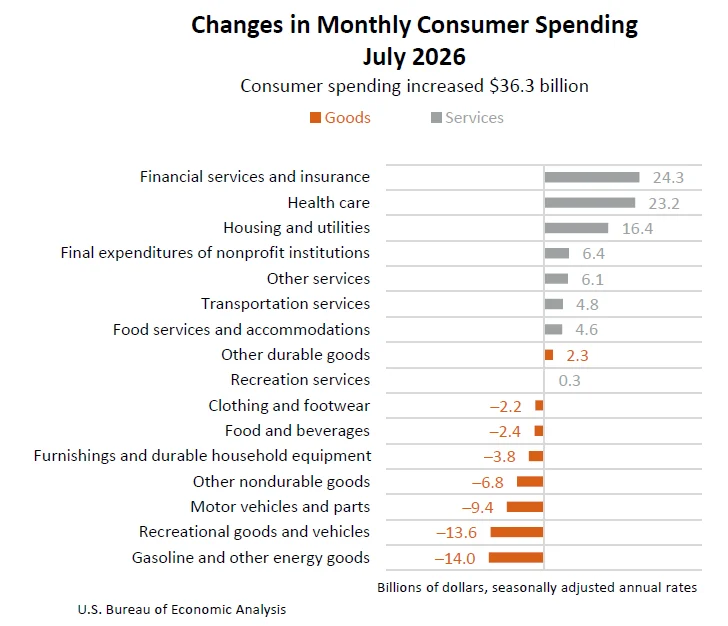
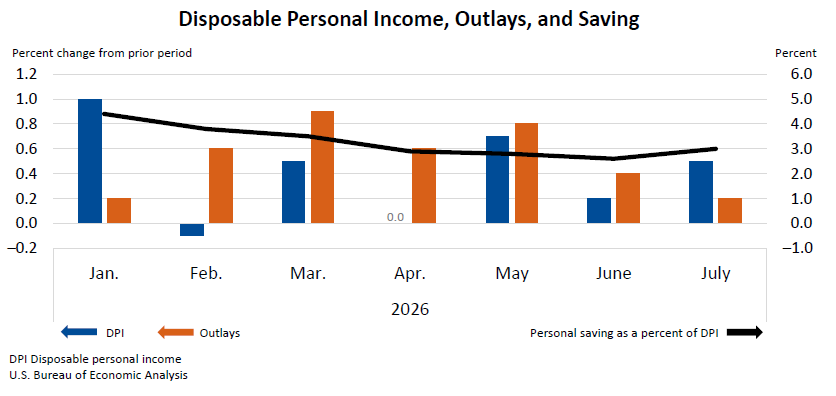
Washington D.C. – Personal income in the United States experienced a moderate increase of $115.1 billion, or 0.4 percent on a monthly basis, in July, according to the latest estimates from the U.S. Bureau of Economic Analysis (BEA). This growth, while positive, was accompanied by a notable deceleration in personal consumption expenditures (PCE), indicating a more cautious consumer spending environment. Disposable personal income (DPI), the amount of income left after taxes, saw a more robust rise of $125.9 billion, or 0.5 percent, suggesting that consumers had more funds available, though their spending did not keep pace with income growth.
The divergence between income and spending in July is a key takeaway from the BEA’s report, released today. While Americans earned more, their overall expenditure on goods and services grew at a slower rate. Personal outlays, which encompass PCE, personal interest payments, and personal current transfer payments, rose by $36.6 billion. This limited increase in outlays, relative to the income gains, contributed to a personal saving of $712.0 billion in July, maintaining a personal saving rate of 3.0 percent of disposable personal income.
Key Drivers of Income Growth
The upward trajectory of current-dollar personal income in July was primarily fueled by increases in several key components. Compensation, which includes wages and salaries, employer contributions for social insurance, and other labor income, played a significant role. This suggests a healthy labor market where earnings are continuing to climb. Furthermore, government social benefits contributed to the overall income rise. These benefits can encompass a range of programs, including social security, unemployment insurance, and other forms of public assistance, providing a crucial safety net and bolstering household finances for many. Finally, personal income receipts on assets, such as dividends, interest, and rental income, also saw an uptick, indicating a positive performance in investment and asset-related earnings for individuals.
Consumer Spending Shows Signs of Slowdown
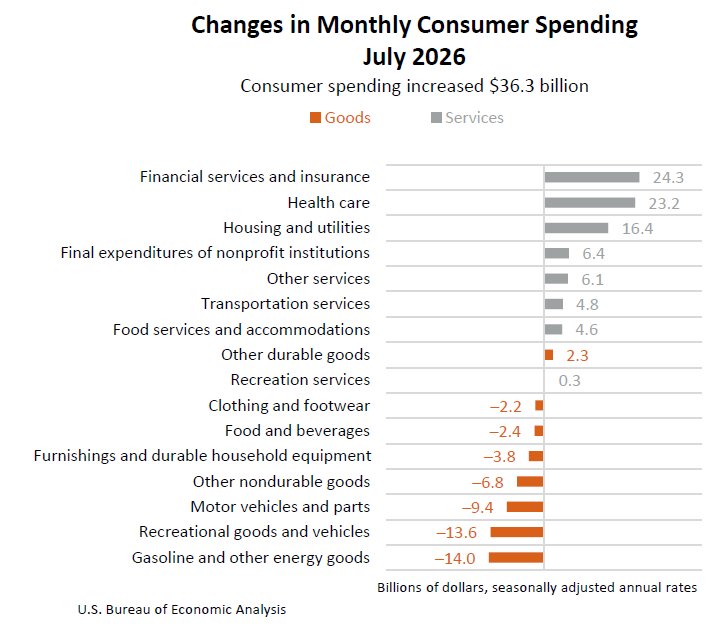
In contrast to the income gains, personal consumption expenditures (PCE) registered a more subdued increase of $36.3 billion, or 0.2 percent, in current dollars. This slowdown in spending was driven by a significant decrease in expenditures on goods, which fell by $49.9 billion. This decline in spending on physical products was partially offset by a substantial increase of $86.2 billion in spending on services. This shift in consumer behavior, from goods to services, has been a recurring theme in recent economic data, reflecting changing consumer priorities and potentially the ongoing normalization of service-sector activities post-pandemic.
The implications of this shift are multifaceted. A decrease in spending on goods could signal a reduction in demand for manufactured products, potentially impacting industries reliant on their production and sale. Conversely, the robust growth in services spending indicates continued consumer appetite for experiences, travel, healthcare, and other service-oriented activities.
Real Consumption and Inflationary Pressures
When adjusted for inflation, real personal consumption expenditures (PCE) saw a marginal increase of $1.3 billion, representing less than 0.1 percent growth on a monthly rate. This minimal real increase underscores that much of the nominal growth in spending was attributable to rising prices rather than an actual expansion in the volume of goods and services consumed.
The persistence of inflationary pressures is further evidenced by the PCE price index. For July, the PCE price index rose by 0.2 percent from the preceding month. This inflation rate was consistent even when excluding volatile food and energy components, with the core PCE price index also increasing by 0.2 percent. This suggests that broader price pressures are embedded within the economy, affecting a wide range of goods and services.
On an annual basis, the PCE price index showed a more significant increase, climbing 3.7 percent compared to July of the previous year. The core PCE price index also saw a substantial year-over-year rise of 3.3 percent, indicating that underlying inflation trends remain elevated. These figures are closely watched by policymakers, particularly the Federal Reserve, as they provide insights into the overall inflationary environment and inform decisions on monetary policy.
Historical Context and Economic Landscape
The July data arrives within a broader economic context characterized by ongoing adjustments following a period of rapid post-pandemic recovery. In the preceding months, personal income had shown more consistent growth, with a 0.2 percent increase in June. Disposable personal income also grew by 0.2 percent in June, and real disposable income saw a 0.3 percent rise. Consumer spending, as measured by current-dollar PCE, had increased by 0.3 percent in June, while real PCE had expanded by 0.4 percent. The July report thus marks a noticeable deceleration in the pace of consumer spending growth, particularly in real terms.
The trend of rising wages and salaries has been a positive indicator for the labor market, with employment figures generally remaining strong throughout much of the recovery period. Government social benefits have also played a crucial role in supporting household incomes, especially for those who may have experienced job disruptions or who rely on these programs for essential needs. However, the moderation in spending growth, especially when real consumption barely budged, raises questions about the sustainability of demand in the face of persistent inflation and potentially shifting consumer confidence.
Analysis of Implications
The BEA’s July report offers several key insights for economic analysts and policymakers. Firstly, the continued rise in personal income, particularly driven by compensation, suggests underlying strength in the labor market. This is a positive sign, as robust wage growth is a fundamental component of economic expansion.
Secondly, the widening gap between income growth and spending growth, especially in real terms, points to potential headwinds for economic activity. Consumers may be becoming more discerning with their spending due to the erosion of purchasing power caused by inflation. This could lead to a slowdown in economic growth if consumers significantly pull back on their expenditures.
Thirdly, the persistent inflation, as indicated by the PCE price index, remains a significant concern. While the monthly increases are moderate, the year-over-year figures highlight the ongoing challenge of bringing inflation back to the Federal Reserve’s target. The core PCE price index, which excludes food and energy, is particularly scrutinized as it provides a clearer picture of underlying inflationary trends. The fact that it also rose by 0.2 percent monthly and 3.3 percent annually suggests that inflationary pressures are broad-based.
The BEA’s annual update of national and regional economic accounts, scheduled for September 30, 2026, will incorporate revised data and potentially offer a more comprehensive view of economic trends. This update will encompass GDP, gross domestic income, and monthly personal income and outlays, among other statistics.
Official Commentary and Expert Reactions (Inferred)
While the BEA report itself is a factual release, economic analysts would typically look to statements from Federal Reserve officials for insights into how these figures might influence monetary policy. Given the mixed signals of rising income but slowing real consumption alongside persistent inflation, the Federal Reserve faces a delicate balancing act. The central bank aims to curb inflation without triggering a significant economic downturn.
Economists might interpret the July data as a sign that the economy is gradually cooling, which could be a desired outcome for the Fed. However, the continued inflationary pressures mean that interest rate decisions will likely remain data-dependent, with a close eye on both employment and inflation indicators.
Some analysts may also point to the increase in personal saving as a potential buffer against future economic shocks, providing households with greater financial resilience. Others might express concern that a sustained slowdown in consumer spending could lead to reduced business investment and a broader economic deceleration.
Broader Economic Impact and Future Outlook
The trends observed in July’s personal income and outlays report have implications for various sectors of the economy. A slowdown in spending on goods could impact manufacturing, retail, and logistics industries. Conversely, continued strength in services could benefit sectors like travel, hospitality, and professional services.
The persistence of inflation remains a key factor shaping consumer behavior and business decision-making. If inflation continues to outpace wage growth significantly, it could lead to further erosion of purchasing power and a more pronounced slowdown in consumer demand.
Looking ahead, the next release of Personal Income and Outlays data for August 2026, scheduled for September 30, will be crucial in determining whether the trends observed in July represent a temporary blip or the beginning of a more sustained shift in economic activity. Investors, policymakers, and businesses will be closely monitoring these releases for further clarity on the direction of the U.S. economy. The interplay between income growth, consumer spending patterns, and inflationary pressures will be central to navigating the economic landscape in the coming months. The upcoming annual updates to national economic accounts will also provide a more refined understanding of the broader economic picture.