Lana Rhoades
Personal income in the United States saw a modest increase of $86.2 billion, or 0.3 percent, in December, according to revised estimates released by the U.S. Bureau of Economic Analysis (BEA). This growth, while positive, occurred against a backdrop of economic adjustments and a notable delay in the report’s original release schedule, which was attributed to the protracted government shutdown spanning October and November. Disposable personal income (DPI), representing income after taxes, also climbed by $75.7 billion, a 0.3 percent rise, while personal consumption expenditures (PCE), a key measure of consumer spending, expanded by $91.0 billion, marking a 0.4 percent increase.
The delayed release of the December Personal Income and Outlays (PIO) report, originally slated for January 29, 2026, underscores the tangible impact of federal government disruptions on the dissemination of vital economic data. The shutdown, which extended through the autumn months of 2025, created a backlog of statistical reporting, necessitating a rescheduling of this crucial economic indicator. This occurrence serves as a stark reminder of the interconnectedness between government operations and the timely flow of information essential for businesses, policymakers, and the public to make informed decisions. The rescheduling pushed the release to a later date, impacting the usual cadence of economic analysis and forecasting.
December Economic Snapshot: Income, Spending, and Savings Trends
In December, the rise in current-dollar personal income was primarily propelled by gains in personal current transfer receipts and compensation. These categories reflect the income individuals received from government programs, such as social security and unemployment benefits, alongside wages and salaries. The increase in compensation, often a direct indicator of labor market health, suggests a continued, albeit measured, expansion in employment and earnings.
Disposable personal income, the amount households have available for spending or saving after taxes, also demonstrated a steady upward trend. The 0.3 percent increase in DPI indicates that, on average, Americans had slightly more income at their disposal. This is a critical metric as it directly influences consumer purchasing power.
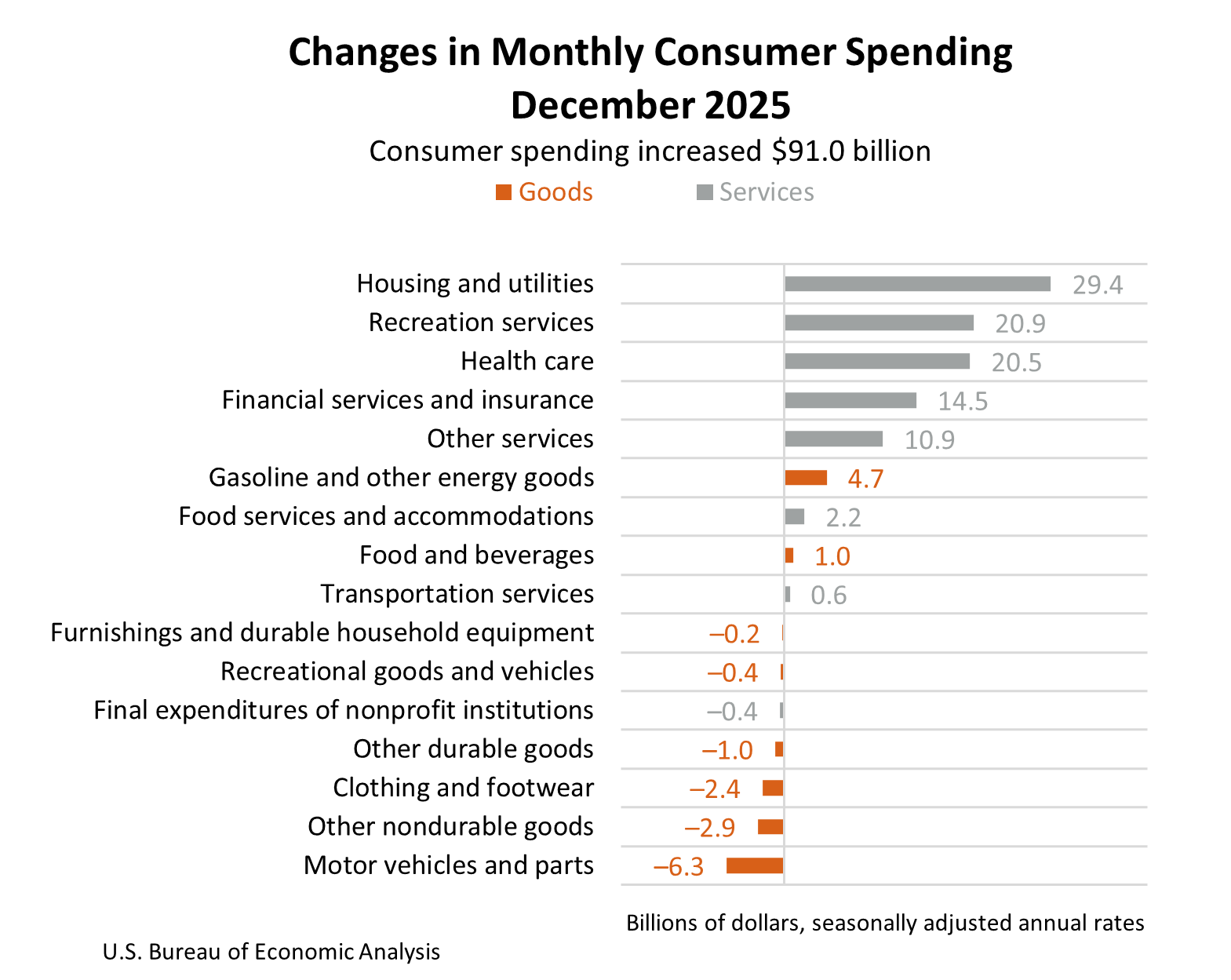
Personal consumption expenditures (PCE), a significant component of Gross Domestic Product (GDP), registered a notable increase of $91.0 billion, or 0.4 percent. This growth was largely driven by a substantial $98.5 billion surge in spending on services, which more than offset a $7.5 billion decline in spending on goods. The shift towards services spending is a recurring theme in recent economic data, suggesting a sustained consumer preference for experiences, travel, and other service-oriented consumption patterns. This trend has been observed as economies continue to recover and adapt post-pandemic, with consumers allocating a greater portion of their budgets to activities and amenities.
Personal outlays, encompassing PCE along with personal interest payments and personal current transfer payments, collectively rose by $90.2 billion in December. This figure closely mirrors the increase in PCE, highlighting the dominant role of consumer spending in overall personal outlays.
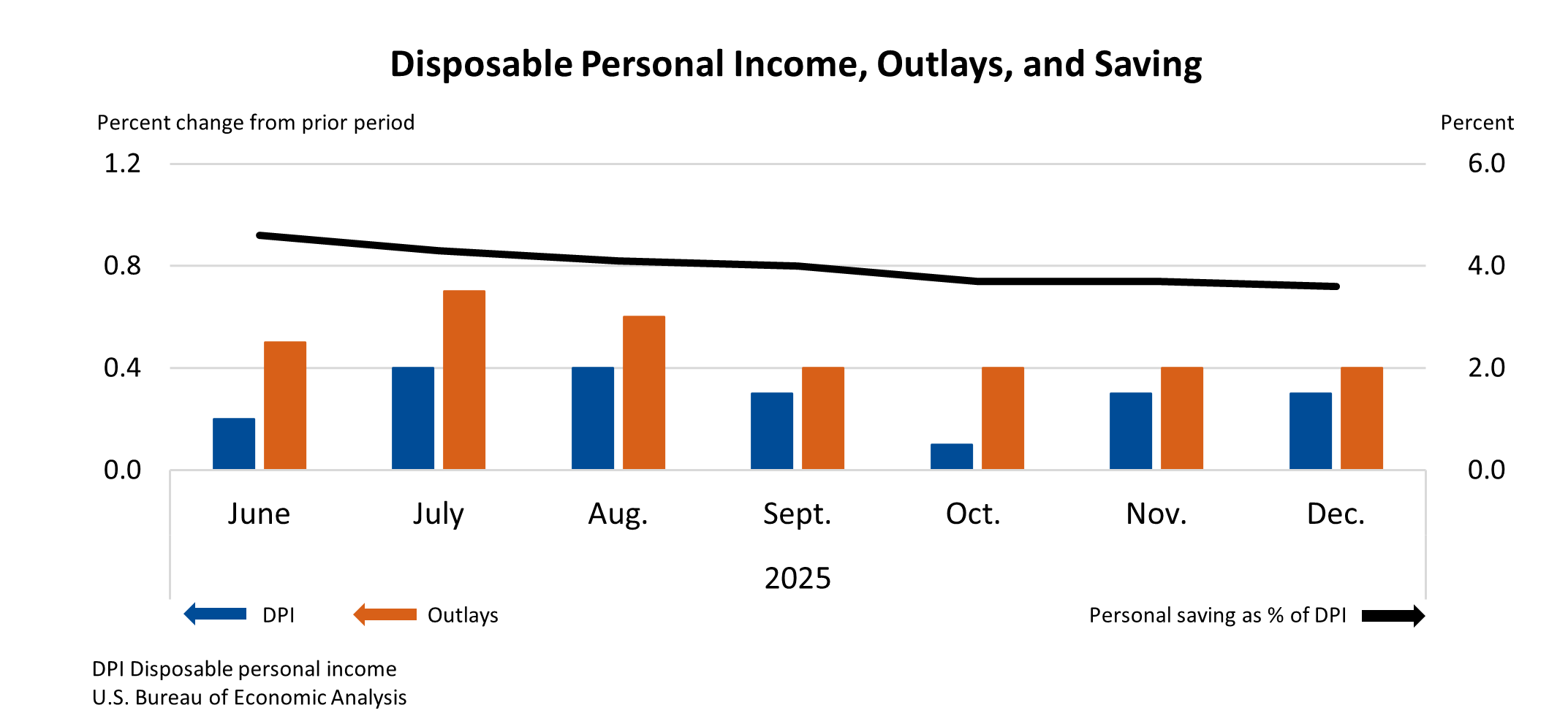
The personal saving rate, a measure of how much of disposable personal income is saved, stood at 3.6 percent in December. This rate indicates that for every dollar of disposable income, 3.6 cents were saved. While a 3.6 percent saving rate is not exceptionally high, it reflects a balanced approach by consumers, who are spending a significant portion of their income while still setting aside a portion for future needs. Personal saving itself amounted to $830.8 billion for the month.
Real Consumption and Inflationary Pressures
Beyond nominal figures, the BEA also reported on real PCE, which accounts for inflation. Real PCE increased by $11.5 billion, or 0.1 percent, in December. This indicates that while nominal spending grew, the actual volume of goods and services consumed saw a more subdued increase, a direct consequence of inflationary pressures. The difference between nominal and real PCE growth highlights the extent to which rising prices are impacting consumer purchasing power.
The Personal Consumption Expenditures (PCE) price index, a key inflation gauge closely watched by the Federal Reserve, increased by 0.4 percent in December compared to the previous month. This monthly rise suggests a persistent inflationary trend. Furthermore, when excluding the volatile categories of food and energy, the core PCE price index also rose by 0.4 percent, indicating that underlying inflationary pressures remain broad-based across the economy.
On an annual basis, the PCE price index for December showed a 2.9 percent increase from the same month a year prior. The core PCE price index, excluding food and energy, rose by 3.0 percent year-over-year. These figures indicate that while inflation may have moderated from its peak levels, it remains elevated and above the Federal Reserve’s target of 2 percent. The persistence of inflation continues to be a significant factor influencing monetary policy decisions and consumer confidence.
Context of the Delay: The October-November 2025 Government Shutdown
The delay in the release of the December PIO report is directly linked to the government shutdown that impacted federal agencies during October and November of 2025. Such shutdowns, stemming from failures to pass appropriations bills, can have far-reaching consequences, including the suspension of non-essential government services and the curtailment of data collection and reporting activities.
During a shutdown, many federal employees are furloughed, and agencies operate with essential personnel only. This disruption directly affects the timely compilation and release of critical economic statistics by bodies like the BEA. The backlog created by such an event means that economic data, which is time-sensitive and crucial for market participants and policymakers, becomes available with a significant lag. This can complicate economic analysis, making it harder to assess current economic conditions and forecast future trends accurately.
The October-November 2025 shutdown was particularly impactful due to its duration, creating a substantial data processing and release bottleneck. The rescheduling of the PIO report is just one example of how such political impasses can have tangible, albeit often indirect, economic ramifications by impeding the flow of information.
Broader Economic Implications and Analysis
The modest growth in personal income and the continued expansion of consumer spending in December suggest an economy that is moving forward, albeit at a measured pace. The increase in compensation points to a resilient labor market, a crucial pillar of consumer confidence and spending. However, the fact that real PCE growth lagged behind nominal PCE growth underscores the persistent challenge of inflation. Consumers are spending more, but a larger portion of that spending is attributable to higher prices rather than increased consumption volume.
The personal saving rate of 3.6 percent, while not alarmingly low, suggests that many households may be operating with less financial cushion than in prior periods. This could make them more vulnerable to unexpected expenses or economic downturns. The ability of households to maintain or increase their savings rate is a key indicator of financial stability and resilience.
The implications of the PCE price index figures, particularly the sustained increase in the core index, will be closely scrutinized by the Federal Reserve. Persistent inflation, even if it shows signs of gradual moderation, often necessitates a tighter monetary policy stance. This could involve maintaining higher interest rates for longer, which can slow down economic growth by increasing borrowing costs for businesses and consumers.
The trend of increasing spending on services over goods also has broader implications for different sectors of the economy. Businesses reliant on goods production may face ongoing challenges, while those in the service sector, such as hospitality, travel, and entertainment, may continue to see robust demand.
Official Responses and Future Outlook
While the original report did not include direct quotes from officials, the BEA’s role is to provide objective economic data. The agency’s commitment to releasing these figures, even with delays, is crucial for maintaining transparency and providing the necessary information for economic decision-making. The technical notes accompanying the release, which detail revisions and methodological improvements, are standard practice for ensuring data accuracy and user understanding.
The BEA’s announcement of improvements to its PIO news release, including the integration of links to its online Interactive Data Tables, signals a move towards greater digital accessibility and efficiency. The discontinuation of PDF and Excel tables for news releases, beginning in February 2026, is part of a broader effort to streamline data dissemination and reduce redundancy, directing users to more dynamic and comprehensive data resources.
Looking ahead, the economic trajectory will likely be influenced by several key factors. The continued path of inflation will be paramount, dictating the Federal Reserve’s monetary policy decisions. The strength and resilience of the labor market will be crucial for sustaining consumer spending. Global economic developments, geopolitical events, and domestic policy decisions will also play significant roles in shaping the economic landscape in the coming months. The next PIO release, scheduled for March 13, 2026, will provide further insights into the January economic performance, offering an updated view of these evolving trends. The BEA’s commitment to timely and accurate data, despite operational challenges, remains a cornerstone of informed economic discourse.