Lana Rhoades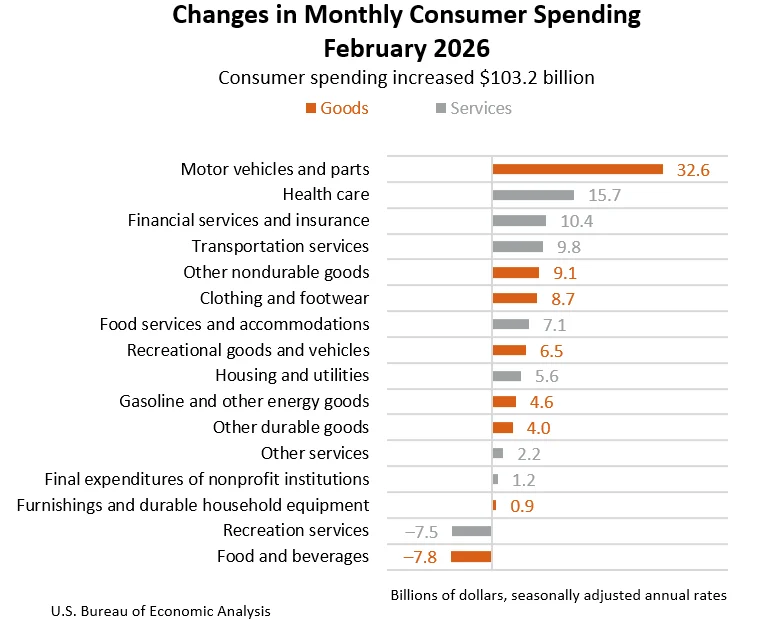
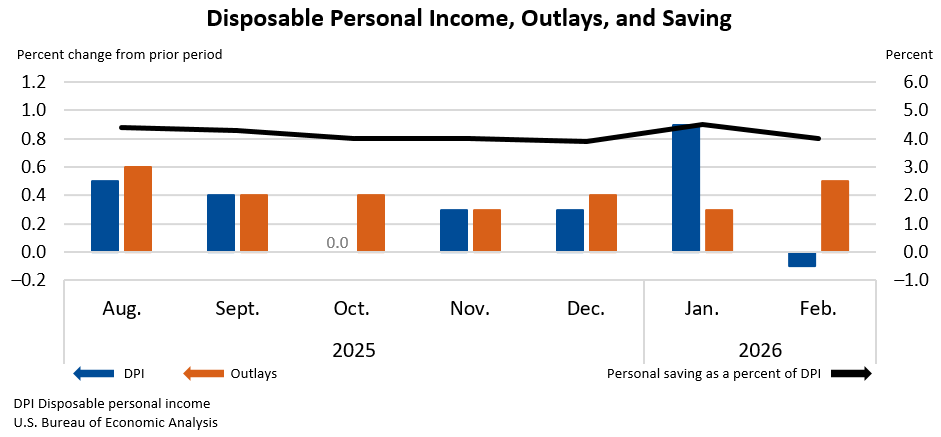
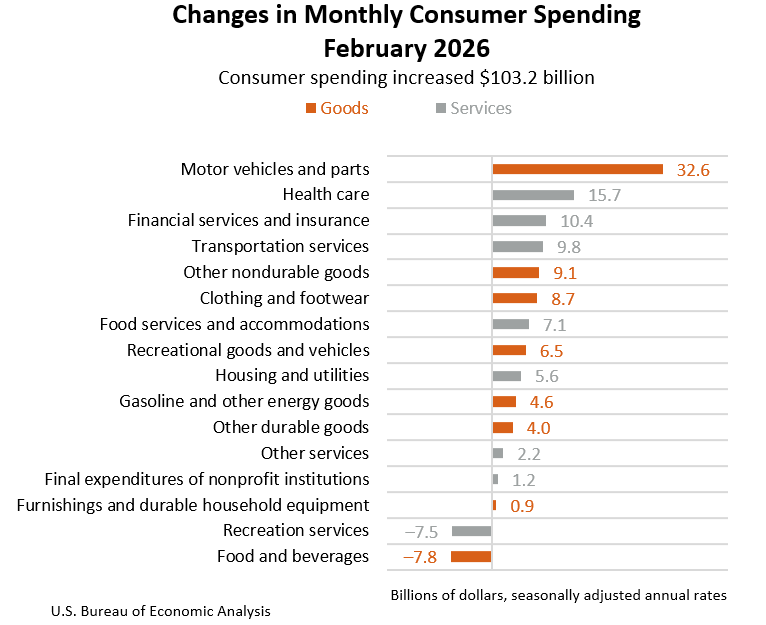
Personal income experienced a marginal decrease of $18.2 billion, or 0.1 percent, in February, according to newly released data from the U.S. Bureau of Economic Analysis (BEA). This slight contraction in overall income was accompanied by a parallel dip in disposable personal income (DPI), which fell by $18.3 billion, also marking a 0.1 percent decline. DPI, representing personal income after taxes, is a key indicator of consumers’ ability to spend. However, despite the slight reduction in income available to households, personal consumption expenditures (PCE) demonstrated resilience, rising by $103.2 billion, or 0.5 percent. This divergence suggests that consumers, while facing a marginal dip in their net income, continued to prioritize spending.
The report, originally slated for release on March 27, 2026, experienced a delay and was rescheduled to its current release date due to the protracted October-November 2025 government shutdown. This shutdown, which impacted federal agencies and their data collection and reporting schedules, underscores the fragility of governmental operations and their potential to disrupt the timely dissemination of critical economic information. The extended period of government inactivity likely contributed to the revised release schedule for this significant economic indicator.
Divergent Trends: Income Recedes, Spending Persists
The February data reveals a nuanced economic picture. While headline personal income edged downward, driven primarily by a decline in personal dividend income and personal current transfer receipts, consumer spending on goods and services continued to expand. Personal outlays, which encompass personal consumption expenditures, personal interest payments, and personal current transfer payments, collectively increased by $106.5 billion. This robust growth in outlays, even as income saw a minor retreat, points to a continued demand-side momentum in the economy.
The personal saving rate, a crucial metric reflecting the proportion of disposable income that households save, stood at 4.0 percent in February, translating to $931.5 billion in personal saving. While this rate indicates a continued savings cushion, the interplay between declining income and rising expenditures may put pressure on this rate in the coming months if the trend persists. The personal saving rate has been a subject of considerable economic scrutiny, particularly in the wake of the COVID-19 pandemic, which saw unprecedented shifts in household savings patterns due to stimulus measures and altered consumption habits.
Consumer Spending on an Upward Trajectory
The $103.2 billion increase in current-dollar personal consumption expenditures (PCE) in February was a significant driver of economic activity. This growth was broadly distributed, with spending on goods rising by $58.7 billion and spending on services increasing by $44.5 billion. This balanced expansion suggests a healthy demand across various sectors of the economy, from durable and non-durable goods to a wide array of services.
In real terms, adjusted for inflation, PCE rose by $17.3 billion, or 0.1 percent, in February. This modest real increase indicates that while consumers are spending more, the bulk of the increase in dollar terms is attributable to higher prices rather than a significant expansion in the volume of goods and services purchased. This observation aligns with the inflation data also released today.
Inflationary Pressures Continue to Influence Spending
The Personal Consumption Expenditures (PCE) price index, a key inflation gauge closely watched by the Federal Reserve, saw a notable increase of 0.4 percent in February compared to the preceding month. This acceleration in price growth indicates that inflationary pressures remain a persistent feature of the economic landscape. The core PCE price index, which excludes the volatile categories of food and energy, also increased by 0.4 percent, suggesting that inflation is broad-based and not solely driven by commodity price shocks.
Looking at the year-over-year trend, the PCE price index climbed by 2.8 percent in February. The core PCE price index, excluding food and energy, rose by a more pronounced 3.0 percent over the same period. These figures suggest that while there might be some moderation from peak inflation rates seen in prior periods, the underlying inflationary trend remains elevated, posing a challenge for policymakers aiming to achieve price stability. The sustained increase in the core PCE price index, in particular, signals that businesses are continuing to pass on higher costs to consumers, impacting purchasing power.
Economic Context and Historical Perspective
The February economic data emerges against a backdrop of evolving economic conditions. Following a period of robust recovery and significant fiscal stimulus in the aftermath of the COVID-19 pandemic, the U.S. economy has been navigating a complex transition. Inflationary pressures, supply chain disruptions, and shifts in consumer behavior have all contributed to a dynamic and at times unpredictable economic environment.
The slight decline in personal income could be attributed to several factors. A decrease in dividend income might reflect a more cautious approach by corporations in distributing profits, potentially in anticipation of slower economic growth or increased investment needs. Reductions in personal current transfer receipts could indicate a tapering off of certain government support programs or a normalization of post-pandemic aid. Conversely, the continued increase in compensation and proprietors’ income, as noted in the technical notes, suggests underlying strength in the labor market and business activity.
The resilience of consumer spending, even with a marginal dip in disposable income, can be viewed through several lenses. Households may be drawing down savings accumulated during the pandemic, utilizing credit more readily, or prioritizing essential purchases and services amidst persistent inflation. The increase in spending on services, in particular, could reflect a continued normalization of consumer behavior as pandemic-related restrictions have eased, with individuals increasingly engaging in activities like travel, dining, and entertainment.
Government Shutdown’s Lingering Impact
The delay in the release of the February Personal Income and Outlays report due to the government shutdown serves as a stark reminder of the operational dependencies of economic data collection and dissemination on federal government functioning. Such shutdowns can create uncertainty for businesses, investors, and policymakers who rely on timely and accurate economic indicators to make informed decisions. The extended duration of the October-November 2025 shutdown likely created a backlog of reports and required significant effort to re-establish normal reporting cycles. This event underscores the importance of consistent and uninterrupted government operations for maintaining economic transparency and stability.
Analysis of Implications
The combination of slightly declining income and robust consumer spending presents a complex scenario for economic forecasting. The sustained strength in PCE suggests that the economy may possess a degree of underlying resilience. However, the persistent inflationary pressures indicated by the PCE price index raise concerns about the future purchasing power of households and the potential for a slowdown in real consumption growth if wages do not keep pace.
For the Federal Reserve, these data points present a mixed signal. While the moderation in real income growth might suggest a cooling of demand, the persistent inflation, particularly in core categories, reinforces the need for vigilance in its monetary policy stance. The central bank will likely continue to monitor inflation data closely and assess whether current policy measures are sufficiently calibrated to bring inflation back to its target rate without triggering a significant economic downturn.
The personal saving rate of 4.0 percent, while not alarmingly low, indicates that households are not building their savings at a rapid pace. If income growth remains subdued and spending continues at its current pace, this saving rate could come under further pressure, potentially leading to increased reliance on debt. This would warrant close monitoring for signs of financial strain on households.
Looking Ahead: Future Data and Policy Considerations
The next release of Personal Income and Outlays data, scheduled for April 30, 2026, will provide crucial insights into the economic trajectory for March. Analysts and policymakers will be keenly observing whether the trends of declining income and rising spending persist, and how inflation evolves. Any significant shifts in these patterns could necessitate adjustments in economic strategy and policy responses.
The BEA’s ongoing modernization of its news releases, including the integration of direct links to its Interactive Data Tables, aims to enhance user access and efficiency. The discontinuation of PDF and Excel tables for news releases reflects a broader trend towards digital dissemination of data, allowing for more dynamic and interactive exploration of economic statistics.
The technical notes accompanying the report highlight important details, such as the adjustment to the PCE price index for legal services in January and its absence in February, indicating the dynamic nature of data adjustments and the BEA’s commitment to methodological rigor. Revisions to estimates for prior months, reflecting updated Bureau of Labor Statistics (BLS) data, underscore the iterative process of economic data compilation.
In conclusion, the February Personal Income and Outlays report paints a picture of an economy grappling with competing forces. While consumer spending demonstrates notable resilience, a slight dip in personal income and persistent inflation present ongoing challenges. The delayed release due to the government shutdown serves as a reminder of the critical role of stable governance in the functioning of economic data infrastructure. As the economy moves forward, continued vigilance and careful analysis of incoming data will be paramount for navigating the complex economic landscape.