Lana Rhoades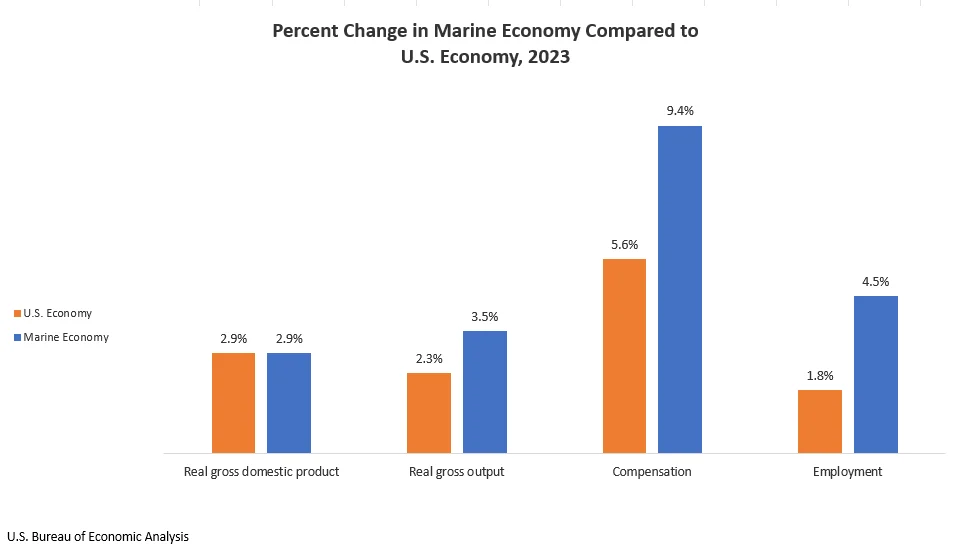
The U.S. marine economy played a significant role in the nation’s economic landscape in 2023, contributing $511.0 billion, or 1.8 percent, to the current-dollar U.S. gross domestic product (GDP). This figure represents a notable increase from the $482.4 billion recorded in 2022, signaling a healthy expansion in this vital sector. Furthermore, the marine economy generated a total gross output of $826.6 billion in 2023, accounting for 1.7 percent of the nation’s total gross output. These statistics, released today by the U.S. Bureau of Economic Analysis (BEA) as part of its Marine Economy Satellite Account (MESA), provide a comprehensive overview of the economic activity tied to the nation’s oceans, coasts, and Great Lakes.
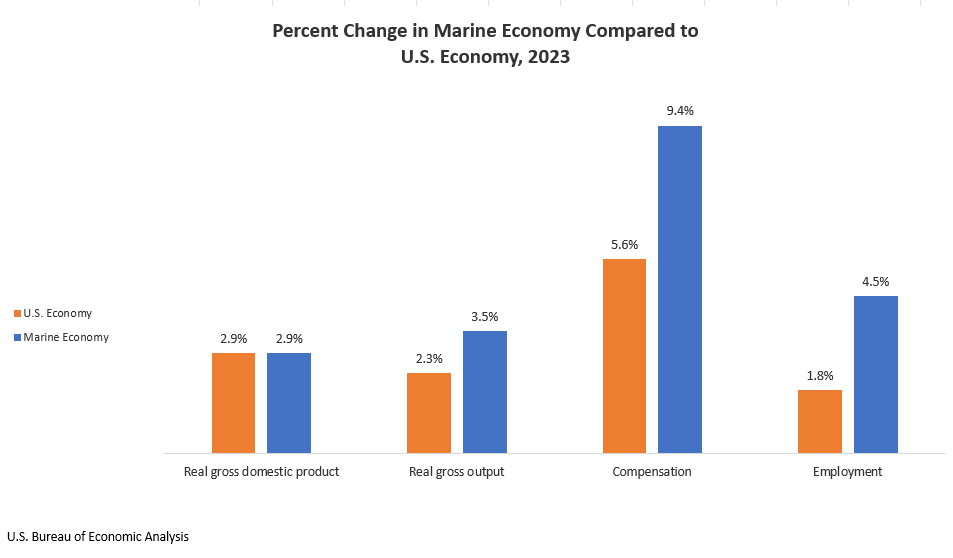
The robust growth trajectory of the marine economy is further underscored by its real (inflation-adjusted) GDP, which saw an increase of 2.9 percent from 2022 to 2023. This growth rate mirrors the overall U.S. economy’s performance during the same period, indicating that the marine sector is keeping pace with broader national economic trends. Beyond GDP, the MESA data reveals a substantial surge in compensation within the marine economy, which rose by an impressive 9.4 percent, or $19.1 billion. This significant uptick in compensation is accompanied by a corresponding increase in employment, with 111,000 full- and part-time jobs added to the sector, reflecting a 4.5 percent rise in workforce participation.
A Deeper Dive into Marine Economy Performance: 2023 Highlights
The release not only presents the latest annual figures but also incorporates updated statistics for the period spanning 2014 to 2022. These revisions are a result of the BEA’s comprehensive update of the National Economic Accounts, including the Industry Economic Accounts, which ensures that the data reflects the most current and accurate source information. This meticulous process allows for a more precise understanding of the marine economy’s performance over time.
Marine Economy by Activity: Unpacking the Drivers of Growth
To provide a granular view of the marine economy’s contributions, the MESA categorizes economic activities into ten distinct areas. This framework allows for a deeper analysis of how different facets of the marine economy contribute to the overall economic output. In 2023, the real gross output of the marine economy, a measure of inflation-adjusted sales and receipts that includes sales to final users (GDP) and sales to other industries (intermediate inputs), experienced a significant increase of 3.5 percent, amounting to $22.7 billion. This growth across various marine-related activities highlights the sector’s broad-based economic impact.
The MESA’s innovative approach of reorganizing industry value-added and gross output statistics into a framework that specifically isolates marine-related activities is crucial. This methodology allows for a more focused analysis of sectors that might otherwise be obscured within broader industry classifications. For instance, activities that span multiple industries but are intrinsically linked to the marine environment can be accurately measured and understood. This satellite account approach is a key feature of BEA’s methodology, enabling a more nuanced understanding of specialized economic domains.
Industry Contributions to the Marine Economy: A Sectoral Analysis
Beyond categorizing by activity, the MESA also details the contributions of specific industries to the marine economy. This industry-level data illuminates which sectors are driving growth and employment within the marine realm, offering insights into the interconnectedness of various industries that rely on or contribute to marine resources and activities. The statistics encompass value added (GDP by industry), gross output, employment, and compensation, providing a comprehensive financial and labor market snapshot.
Methodology and Scope: Defining the Boundaries of the Marine Economy
The Marine Economy Satellite Account is a sophisticated tool designed to measure the economic activity associated with the marine environment. Its estimation methods are built upon the BEA’s established supply and use framework, which meticulously tracks the relationships among industries and their contributions to GDP. The MESA essentially rearranges these data to specifically isolate marine-related spending and production, utilizing a wide array of private and public data sources to achieve this.
A critical aspect of the MESA is its presentation of estimates by both marine economic activity and by industry. This dual perspective is invaluable for analyzing economic activity that might occur across a diverse range of industries but is fundamentally tied to the marine environment. Such a comprehensive approach is essential for understanding the full economic footprint of the nation’s oceans and coastal areas.
The geographic scope of the MESA is extensive, encompassing the Atlantic, Pacific, and Arctic Oceans within the U.S. Exclusive Economic Zone (approximately 200 nautical miles offshore). It also includes marginal seas such as the Chesapeake Bay, Puget Sound, Long Island Sound, and San Francisco Bay, along with the U.S. shoreline directly adjacent to these waters. Furthermore, the Great Lakes are incorporated into the MESA’s purview, extending up to the international boundary with Canada. This broad geographic coverage ensures that the economic activities linked to these vital water bodies are comprehensively captured.
The development of the MESA is a collaborative effort, undertaken in partnership with the National Oceanic and Atmospheric Administration (NOAA), a key federal agency dedicated to understanding and managing the nation’s oceanic and atmospheric resources. This partnership underscores the interagency commitment to accurately measuring and understanding the economic significance of the marine environment.
Historical Context and Data Evolution
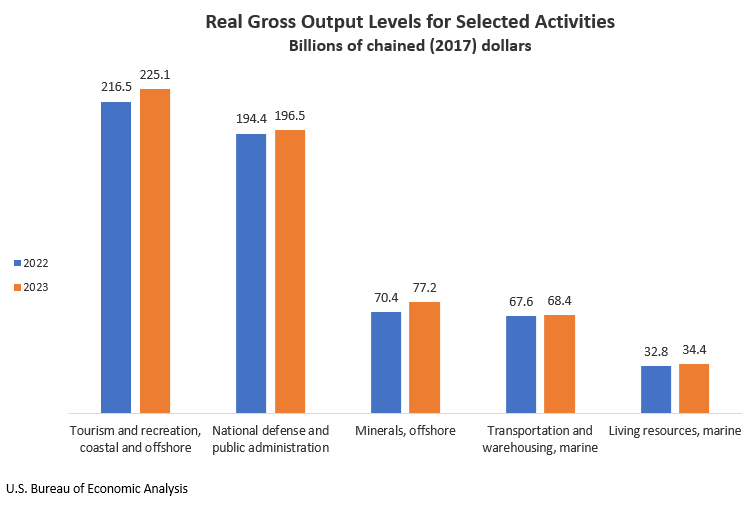
The release of the 2023 statistics marks the latest iteration of a valuable data series. The BEA has been diligently updating these figures, with the current release incorporating enhancements from the 2023 comprehensive update and the 2024 annual update of the National Economic Accounts. These updates are crucial for maintaining the accuracy and relevance of the data, ensuring that policymakers, researchers, and industry stakeholders have access to the most reliable economic indicators.
The evolution of the Marine Economy Satellite Account can be traced back to the foundational work aimed at "Defining and Measuring the U.S. Ocean Economy." This initial research laid the groundwork for the systematic collection and analysis of data pertaining to marine-related economic activities. The subsequent development of the MESA has allowed for a more sophisticated and detailed quantification of this sector’s economic impact.
Broader Economic Implications and Future Outlook
The consistent growth and substantial contribution of the marine economy to the U.S. GDP highlight its importance as a driver of national economic prosperity. The sector’s ability to keep pace with overall economic growth, coupled with significant increases in compensation and employment, suggests a healthy and expanding job market within marine-related industries. This trend is likely to have positive ripple effects across various communities, particularly those situated along the nation’s coastlines and Great Lakes regions.
The robust performance of marine economy GDP and gross output suggests a strong demand for goods and services produced within this sector. This could translate into increased investment in infrastructure, technology, and human capital, further stimulating economic activity. The rise in compensation also indicates a potential for improved livelihoods for those employed in the marine economy, contributing to broader economic well-being.
Looking ahead, the continued growth of the marine economy is likely to be influenced by a range of factors, including technological advancements, evolving consumer demands, and environmental stewardship initiatives. As the world increasingly recognizes the importance of sustainable resource management and the economic potential of ocean-based industries, sectors such as renewable energy, sustainable fisheries, and marine biotechnology are poised for further expansion.
The BEA’s commitment to regularly updating and enhancing the MESA provides a crucial foundation for understanding these evolving trends. The data available on the BEA’s website, offering detailed annual statistics from 2014 to 2023, serves as an invaluable resource for in-depth analysis and informed decision-making.
The next release of the Marine Economy Satellite Account is anticipated in the Spring of 2026, which will cover data for 2024. This ongoing data collection and dissemination effort by the BEA is essential for tracking the dynamic nature of the marine economy and its continued contribution to the U.S. economic landscape. The consistent reporting and detailed breakdown by activity and industry provide a clear picture of a sector that is not only vital to specific coastal and Great Lakes communities but also contributes significantly to the nation’s overall economic health and resilience. The insights gleaned from these statistics will be instrumental in shaping future policies and investments aimed at harnessing the full potential of America’s marine resources.