Lana Rhoades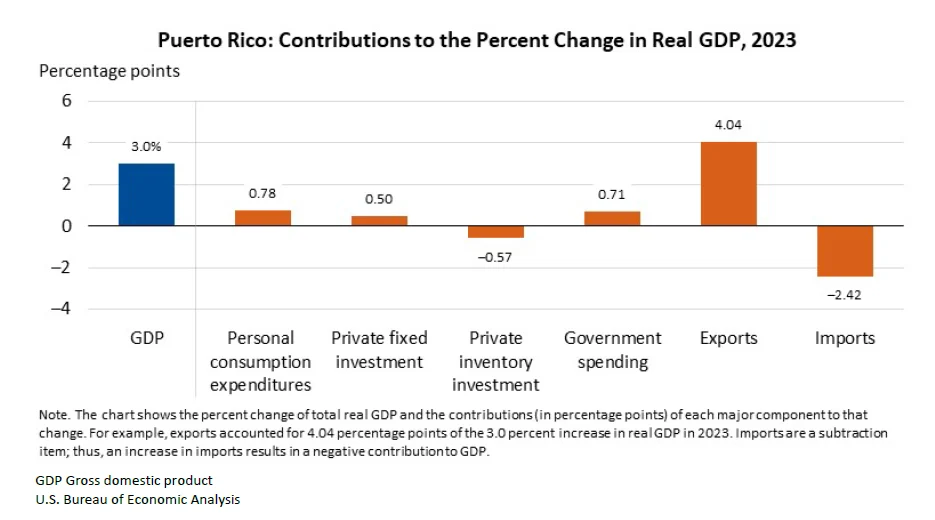
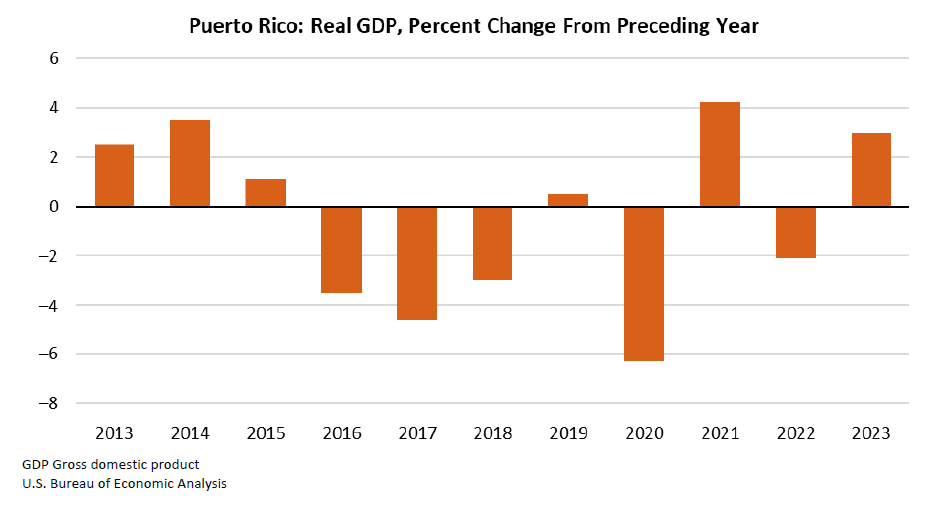
Puerto Rico’s economy experienced a notable rebound in 2023, with real gross domestic product (GDP) increasing by 3.0 percent. This marks a significant turnaround from the 2.1 percent decrease recorded in 2022, according to the latest statistics released by the U.S. Bureau of Economic Analysis (BEA). This positive growth trajectory signals a period of economic recovery and expansion for the island, driven by several key sectors.
Economic Rebound Fueled by Robust Exports and Investment
The upswing in Puerto Rico’s real GDP in 2023 was primarily propelled by a substantial increase in exports. This sector, crucial for the island’s economic health, saw a 6.4 percent rise, encompassing both goods and services. Exports of goods grew by 6.6 percent, while exports of services demonstrated a healthy 5.6 percent increase. This surge in international trade indicates growing demand for Puerto Rican products and services in global markets, a vital indicator of economic vitality.
Beyond exports, several other components of GDP contributed positively to the island’s economic performance. Personal consumption expenditures (PCE) rose by 1.2 percent, reflecting increased spending by households. Government spending also saw a significant increase of 4.8 percent across all levels of government, highlighting a concerted effort to bolster public services and infrastructure. Furthermore, real private fixed investment grew by 3.8 percent, signaling confidence from businesses and a commitment to expanding productive capacity.
These positive contributions were partially offset by a decrease in private inventory investment, which saw a decline, with the manufacturing sector being the largest contributor to this reduction. Additionally, real imports increased by 4.4 percent, primarily driven by a rise in imported goods, particularly pharmaceuticals and organic chemicals, which saw a 6.0 percent increase. While imports represent a subtraction in the calculation of GDP, their rise can also indicate increased domestic demand and economic activity.
Key Drivers of Growth: A Deeper Dive
Surge in Exports: The robust performance of Puerto Rico’s export sector is a cornerstone of its 2023 economic success. The increase in both goods and services exports suggests a diversifying and strengthening of trade relationships. The rise in goods exports could be attributed to sectors such as pharmaceuticals and medical devices, which have historically been significant contributors to Puerto Rico’s export economy. The growth in services exports points to the increasing importance of sectors like business services, technology, and potentially tourism-related services, reflecting a broader economic base.
Government Spending and Infrastructure Investment: The substantial 4.8 percent increase in real government spending underscores a strategic focus on public investment and recovery efforts. This growth was observed across federal, central, and municipal government levels, with a notable emphasis on investment spending. A significant portion of this investment is directly linked to the disbursement of federal funds for disaster recovery initiatives. These funds are crucial for rebuilding and enhancing critical infrastructure damaged by past natural disasters, including Hurricanes Irma and Maria in 2017, earthquakes in 2019 and 2020, and Hurricane Fiona in 2022.
Specific projects receiving substantial investment include the ongoing efforts to modernize and fortify the island’s power grid, a critical component for economic stability and resilience. Investments in the aqueduct system are also underway, addressing essential water supply and sanitation needs. Furthermore, significant resources are being allocated to the repair and improvement of roads and bridges, facilitating transportation and commerce. The National Guard’s Camp Santiago is also undergoing reconstruction and upgrades, demonstrating a commitment to national security and readiness. These infrastructure investments not only create jobs in the short term but also lay the foundation for long-term economic growth and improved quality of life.
Private Fixed Investment: The 3.8 percent increase in real private fixed investment indicates a growing confidence in Puerto Rico’s economic future among private sector entities. This rise was predominantly driven by increased investment in equipment, particularly industrial equipment. This includes substantial purchases of engines, turbines, and electrical equipment by businesses, suggesting an expansion of manufacturing capabilities and a commitment to technological upgrades. Such investments are vital for enhancing productivity, fostering innovation, and maintaining competitiveness in the global market.
Personal Consumption Expenditures: A Mixed Picture
While overall personal consumption expenditures (PCE) saw a modest increase of 1.2 percent, there was a divergence in spending patterns between goods and services. Spending on PCE services grew by a healthy 4.0 percent, indicating increased demand for services such as healthcare, education, entertainment, and transportation. Conversely, spending on PCE goods experienced a decrease of 0.8 percent. This shift might suggest a recalibration of consumer spending habits, with a greater emphasis on services over tangible goods, or it could reflect inflationary pressures impacting the affordability of certain goods.
Context and Historical Perspective
The 2023 economic performance for Puerto Rico follows a period of significant challenges. The island has grappled with a prolonged economic recession, the devastating impacts of natural disasters, and ongoing fiscal austerity measures. The 2.1 percent contraction in real GDP in 2022, while a setback, was preceded by periods of modest growth and contraction in the years prior. The BEA’s data revisions for the period 2018-2022, incorporating updated source data, show that the largest revision in any single year was a 0.4 percentage point adjustment in 2022. This indicates that the overall economic trends, while subject to minor adjustments, have been relatively consistent.
The BEA’s commitment to providing these statistics, despite the inherent complexities of measuring the economic activity of Puerto Rico, has been invaluable. The agency has acknowledged the critical support and assistance provided by the government of Puerto Rico and numerous organizations and individuals on the island, which have been instrumental in the production of these estimates.
Implications and Future Outlook
The positive GDP growth in 2023 offers a much-needed boost to Puerto Rico’s economic outlook. The strong performance in exports and government-led infrastructure projects are particularly encouraging signs. These developments suggest that the island’s economy is not only recovering but also laying the groundwork for more sustainable and resilient growth. The increased private fixed investment signals a growing business confidence, which is crucial for job creation and long-term economic development.
However, challenges remain. The decrease in private inventory investment in the manufacturing sector warrants attention, as it could indicate potential headwinds or adjustments within that industry. The shift in consumer spending patterns, with a decline in goods expenditure, may also require further analysis to understand its underlying causes and potential impact on retail sectors.
The ongoing implementation of federal funds for disaster recovery is a critical lifeline, but its effective and efficient utilization is paramount to achieving the desired long-term impact on infrastructure and economic stability. The successful completion of these projects will not only improve the island’s resilience to future natural events but also create a more favorable environment for business investment and tourism.
The BEA’s decision to cease producing Puerto Rico GDP statistics after this release marks the end of an era for detailed economic tracking by the agency. While this transition is noted, the previously published data remains accessible in BEA’s Data Archive, providing a valuable historical record. The ongoing efforts of local economic development agencies and academic institutions will be vital in continuing to monitor and analyze Puerto Rico’s economic trajectory.
A Note on Data and Revisions
The U.S. Bureau of Economic Analysis regularly revises its GDP estimates to incorporate updated source data, ensuring the most accurate representation of economic activity. For the period 2018-2022, these revisions were incorporated, with the largest revision to real GDP growth being 0.4 percentage points in 2022. This meticulous process of revision underscores the commitment to data integrity. The BEA’s methodology for estimating Puerto Rico’s GDP is detailed in their "Summary of Methodologies: Puerto Rico Gross Domestic Product," providing transparency into the data collection and analysis process.
Acknowledgements and Data Resources
The production of these economic statistics for Puerto Rico is a collaborative effort. The BEA extends its gratitude to the government of Puerto Rico and numerous organizations and individuals for their essential support and assistance. These contributions are vital for the accurate estimation of Puerto Rico’s GDP.
For those seeking more in-depth data and historical information, the BEA provides a comprehensive suite of interactive data tables accessible through their application. These tables cover various aspects of Puerto Rico’s GDP, including overall GDP figures, real GDP, percent changes, contributions to GDP growth, personal consumption expenditures, exports and imports, and gross domestic investment. These resources are invaluable for researchers, policymakers, and the public interested in the intricacies of Puerto Rico’s economy.
The discontinuation of BEA’s Puerto Rico GDP statistics signifies a shift in data reporting. However, the legacy of these reports, coupled with the continued efforts of other institutions, will ensure that the economic narrative of Puerto Rico remains accessible and understood. The 2023 figures represent a significant milestone, offering a positive outlook as Puerto Rico continues its journey of economic rebuilding and development.