Lana Rhoades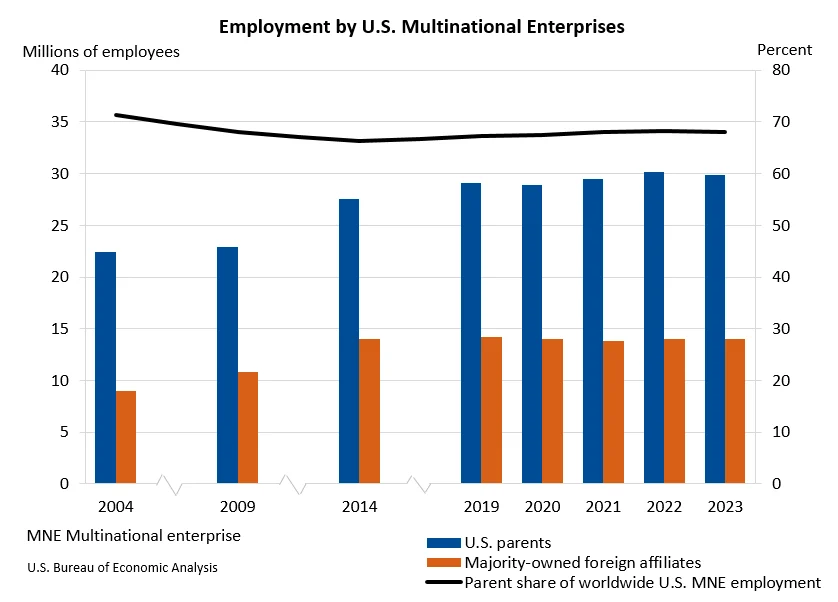
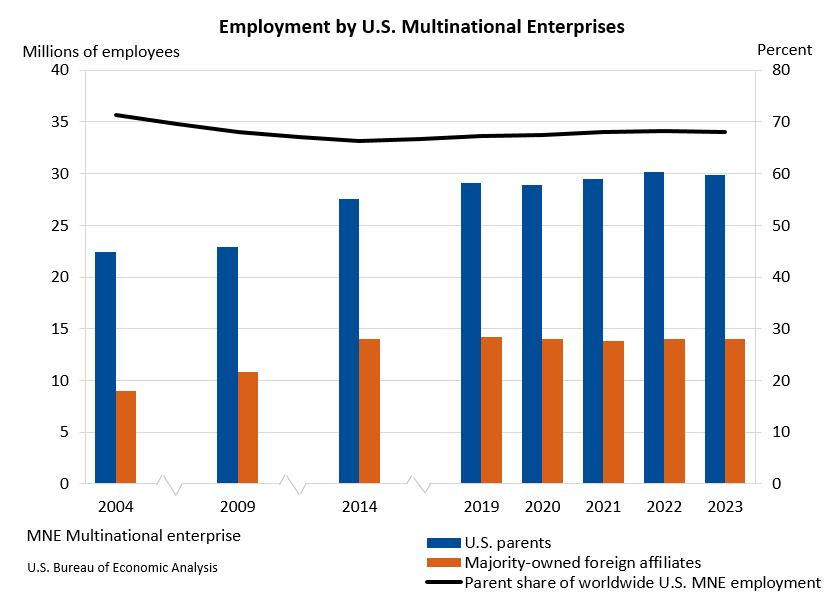
Washington D.C. – In 2023, U.S. multinational enterprises (MNEs) experienced a marginal decline in their global workforce, employing 43.9 million individuals, a 0.4 percent decrease from the revised 44.1 million workers recorded in 2022. This preliminary data, released by the U.S. Bureau of Economic Analysis (BEA), offers a snapshot of the operational and financial landscape of American parent companies and their foreign affiliates, highlighting subtle shifts in global employment patterns and economic contributions.
The slight contraction in overall employment belies a more nuanced picture when examining domestic and international operations separately. While the total number of workers employed by U.S. MNEs saw a modest dip, the distribution of this workforce experienced a more significant recalibration. Employment within the United States by U.S. parent companies decreased by 0.8 percent, bringing the total down to 29.9 million workers. This segment, representing the core domestic operations of these enterprises, accounted for 68.1 percent of worldwide employment by U.S. MNEs in 2023, a fractional decrease from 68.3 percent in the preceding year.
Conversely, employment abroad by the foreign affiliates of U.S. MNEs registered a modest increase of 0.2 percent, reaching 14.0 million workers. This international workforce now constitutes 31.9 percent of the total global employment footprint of U.S. multinational enterprises. This divergence suggests a gradual, albeit small, shift in the geographic distribution of labor, with a slightly greater proportion of jobs being generated or maintained outside the United States by these globally integrated corporations.
Domestic Employment Trends and Sectoral Distribution
The decrease in domestic employment by U.S. parents had a tangible impact on their overall share of the U.S. private industry labor market. In 2023, U.S. parents accounted for 21.9 percent of total private industry employment in the United States, down from 22.5 percent in 2022. This indicates that while U.S. MNEs remain significant employers domestically, their relative contribution to the broader U.S. job market experienced a slight erosion.
Analysis of the sectoral distribution of employment within U.S. parent companies reveals key areas of focus. Manufacturing continued to be the largest sector for domestic employment by U.S. parents. Following closely were "other industries," a broad category significantly bolstered by the transportation and warehousing sector, and retail trade. These sectors likely represent areas where U.S. MNEs maintain substantial operational bases and workforces. The BEA’s detailed data tables provide further granularity, allowing for a deeper understanding of employment trends within specific manufacturing sub-sectors and other industry classifications.
Global Employment Hotspots
The data also sheds light on the primary destinations for U.S. MNEs’ international employment. Majority-owned foreign affiliates reported their largest employment figures in India, Mexico, and the United Kingdom. These countries have historically been significant hubs for foreign direct investment and manufacturing for U.S. companies, and the continued concentration of employment in these regions underscores their ongoing importance in the global operational strategies of American corporations. The BEA’s comprehensive data tables offer detailed breakdowns of foreign affiliate employment by country and industry, providing valuable insights for understanding global supply chains and labor markets.
Economic Value Added: A Mixed Picture
Beyond employment figures, the BEA’s report also tracks the economic contribution of U.S. MNEs through their value added, a measure of their direct contribution to gross domestic product. Worldwide current-dollar value added by U.S. MNEs saw a slight decrease of 0.6 percent, totaling $6.9 trillion in 2023.
Domestically, the value added by U.S. parents declined by 1.0 percent to $5.3 trillion. This metric represents the direct contribution of U.S. parent companies to the U.S. gross domestic product. Similar to employment trends, this also translated to a reduced share of the total U.S. private-industry value added, falling from 23.1 percent in 2022 to 21.4 percent in 2023. This decline suggests a softening of the domestic economic output generated directly by the U.S.-based operations of these multinational corporations.
In contrast, the value added by majority-owned foreign affiliates experienced an increase of 0.8 percent, reaching $1.6 trillion. This growth in international economic contribution by foreign affiliates, despite the overall slight decrease in worldwide value added, further emphasizes the dynamic nature of global business operations. The primary contributors to this foreign value added were affiliates located in the United Kingdom, Canada, and Ireland. These figures highlight the significant economic impact U.S. MNEs have in their host countries, with specific nations acting as major engines of their global economic output.
Capital Investments and Innovation Drive Growth
Despite the marginal contractions in employment and domestic value added, U.S. multinational enterprises demonstrated a robust commitment to future growth and innovation, as evidenced by their substantial investments in property, plant, and equipment, as well as research and development.
Worldwide expenditures for property, plant, and equipment by U.S. MNEs surged by 7.5 percent to $1.1 trillion in 2023. This significant increase in capital expenditure underscores a strategic focus on expanding operational capacity, upgrading infrastructure, and potentially investing in new facilities or technologies. Of this total, U.S. parents accounted for $886.1 billion, indicating substantial domestic investment. Foreign affiliates contributed the remaining $216.2 billion, reflecting continued global investment in physical assets. These capital expenditures are critical indicators of future economic activity and job creation potential.
The commitment to innovation was equally pronounced, with worldwide research and development (R&D) expenditures by U.S. MNEs also increasing by 7.5 percent, reaching $558.3 billion. This significant investment in R&D signals a strong emphasis on developing new products, services, and technologies, which is crucial for maintaining competitiveness in the global marketplace. U.S. parents were the primary drivers of this R&D spending, accounting for $476.6 billion, while majority-owned foreign affiliates contributed $81.7 billion. The substantial domestic R&D investment by U.S. parents is particularly noteworthy, suggesting a continued focus on innovation originating within the United States.
Context and Historical Perspective
The data released by the BEA provides an annual overview of the complex operations of U.S. multinational enterprises, a segment of the economy that plays a pivotal role in international trade, investment, and employment. The BEA has been collecting and disseminating statistics on the activities of U.S. MNEs for decades, providing a vital historical record of globalization’s impact on American businesses and the global economy.

The release of preliminary 2023 data follows the revision of 2022 statistics, a standard practice by the BEA to incorporate newly available and revised source data. The revised 2022 figures, initially released in August 2024, were highlighted in the September 2024 issue of the Survey of Current Business in an article titled "Activities of U.S. Multinational Enterprises in 2022." This iterative process ensures the accuracy and reliability of the reported statistics.
Updates and Revisions to 2022 Data
The detailed revisions for 2022 data offer a clearer picture of the previous year’s performance. For instance, the number of employees for U.S. parents was revised to 30,120.1 thousand from a preliminary estimate of 30,240.8 thousand. Similarly, value added for U.S. parents was slightly adjusted to $5,321.2 billion from $5,308.0 billion. These revisions, though minor, underscore the dynamic nature of economic data collection and the BEA’s commitment to providing the most accurate figures possible. Expenditures for property, plant, and equipment and R&D also saw adjustments, reflecting the ongoing refinement of these critical economic indicators.
Broader Implications and Analysis
The slight decline in overall employment and domestic value added by U.S. MNEs in 2023, coupled with a modest increase in foreign affiliate employment and value added, could be interpreted in several ways. It may reflect ongoing global economic trends, such as shifting comparative advantages in labor costs or market access, which encourage the relocation or expansion of certain operational functions abroad. Furthermore, global economic uncertainties, geopolitical factors, or evolving trade policies could also influence investment decisions and employment strategies of multinational corporations.
The sustained and significant investment in capital expenditures and R&D, however, paints a picture of companies actively positioning themselves for future growth and technological advancement. This suggests that while short-term employment figures might fluctuate, the underlying strategic direction for many U.S. MNEs involves continued expansion and innovation, albeit with a potentially evolving geographic distribution of their operational footprint. The resilience and adaptability of these enterprises will be key factors in navigating the complexities of the global economic landscape in the years ahead.
The BEA’s comprehensive data tables provide an invaluable resource for economists, policymakers, businesses, and researchers seeking to understand the intricate global operations of U.S. multinational enterprises. These detailed datasets allow for in-depth analysis of industry-specific trends, country-level impacts, and the evolving nature of international business. The availability of this data is crucial for informed decision-making and for comprehending the significant role U.S. MNEs play in both the domestic and global economies. The BEA’s commitment to providing regular updates and detailed statistical information ensures that stakeholders have access to the most current and relevant economic intelligence.