Lana Rhoades
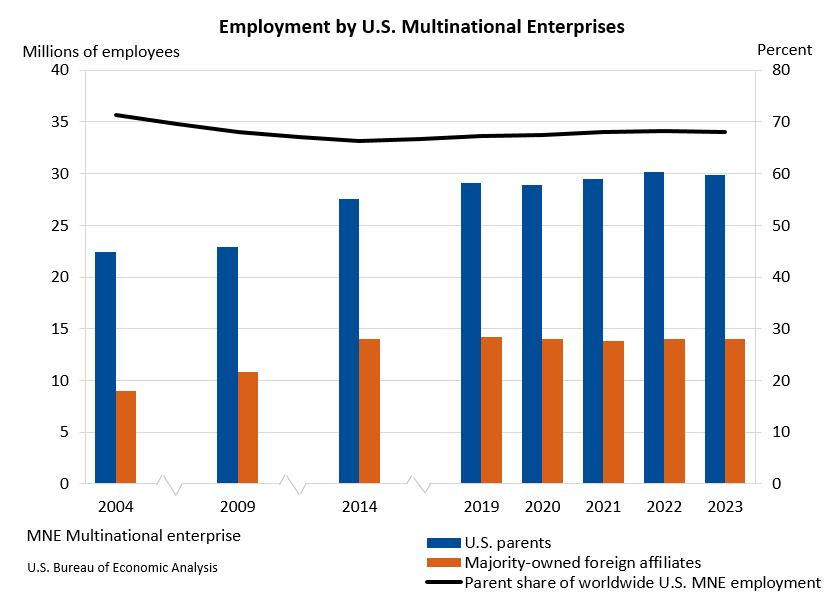
Washington D.C. – August 22, 2025 – The U.S. Bureau of Economic Analysis (BEA) today released preliminary statistics indicating a slight contraction in the global workforce employed by U.S. multinational enterprises (MNEs) for 2023. Worldwide employment by these entities dipped by 0.4 percent, falling to 43.9 million workers from a revised 44.1 million in 2022. This marks a notable shift following a period of growth and offers insights into the evolving operational landscape of American businesses operating on an international scale.
The data, derived from comprehensive surveys of U.S. parent companies and their foreign affiliates, reveals a nuanced picture of employment trends. While overall global employment decreased, the composition of this workforce saw a divergence between domestic and international operations.
Domestic Employment Sees a Modest Decline
Within the United States, employment by U.S. parent companies experienced a more pronounced decrease of 0.8 percent, bringing the total to 29.9 million workers in 2023. Despite this reduction, U.S. parent companies still constituted the significant majority of worldwide employment by U.S. MNEs, accounting for 68.1 percent of the total. This figure represents a marginal decrease from 68.3 percent in the preceding year, underscoring a continued, albeit slightly diminished, reliance on domestic labor.
The manufacturing sector, along with "other industries" – notably transportation and warehousing – and retail trade, remained the largest employers for U.S. parent companies. These sectors have historically formed the backbone of employment for American multinational corporations. The BEA’s detailed data indicates that U.S. parents accounted for 21.9 percent of the total private industry employment in the United States in 2023, a slight decrease from 22.5 percent in 2022. This suggests a modest erosion of their share in the overall U.S. labor market, potentially influenced by a variety of economic factors including automation, shifts in consumer demand, and global supply chain dynamics.
International Employment Shows Resilience
In contrast to domestic trends, employment abroad by foreign affiliates of U.S. MNEs demonstrated a modest increase of 0.2 percent, reaching 14.0 million workers in 2023. This segment now represents 31.9 percent of the total global employment by U.S. MNEs. This resilience in international employment suggests that despite potential global economic headwinds, U.S. companies are maintaining or even expanding their workforces in foreign markets.
The leading destinations for employment by majority-owned foreign affiliates of U.S. MNEs were India, Mexico, and the United Kingdom. These countries have long been strategic hubs for American businesses due to factors such as skilled labor availability, market access, and established trade relationships. The growth in foreign affiliate employment could be attributed to several factors, including increased foreign direct investment, the expansion of existing operations, and a strategic diversification of manufacturing and service operations to optimize costs and market reach.
Economic Output and Investment Trends
Beyond employment figures, the BEA report also sheds light on the economic contributions and investment activities of U.S. MNEs. The worldwide current-dollar value added by these enterprises saw a slight decrease of 0.6 percent, totaling $6.9 trillion in 2023. Value added, a measure of an enterprise’s direct contribution to the gross domestic product (GDP), declined by 1.0 percent for U.S. parents, reaching $5.3 trillion. This represented 21.4 percent of total U.S. private-industry value added, down from 23.1 percent in 2022.
Conversely, the value added by majority-owned foreign affiliates experienced an increase of 0.8 percent, reaching $1.6 trillion. The primary contributors to this foreign value added were affiliates located in the United Kingdom, Canada, and Ireland. This divergence in value-added trends – a decrease domestically and an increase internationally – further illustrates a shifting economic contribution from U.S. parent operations to their foreign subsidiaries.
Capital Expenditures and R&D Investments Signal Future Growth
Despite the mixed employment and value-added figures, indications of future growth and innovation are present in the investment data. Worldwide expenditures for property, plant, and equipment (capital expenditures) by U.S. MNEs surged by a robust 7.5 percent to $1.1 trillion in 2023. U.S. parents allocated $886.1 billion to these investments, while majority-owned foreign affiliates invested $216.2 billion. This substantial increase in capital spending suggests a strategic outlook focused on enhancing operational capacity, modernizing facilities, and potentially expanding production capabilities both domestically and abroad.
Furthermore, worldwide research and development (R&D) expenditures by U.S. MNEs also saw a significant increase of 7.5 percent, reaching $558.3 billion. U.S. parents were responsible for the lion’s share of this investment, with $476.6 billion, while majority-owned foreign affiliates contributed $81.7 billion. This strong emphasis on R&D underscores a commitment to innovation and the development of new products and technologies, which is crucial for maintaining a competitive edge in the global marketplace. The substantial R&D investment by U.S. parent companies, in particular, signals a continued focus on domestic innovation as a driver of future growth.
Context and Timeline of the Data
The statistics released today represent preliminary data for 2023, with the Bureau of Economic Analysis continuously refining its figures as more comprehensive source data becomes available. The BEA has a well-established practice of releasing these detailed statistics annually, providing a critical snapshot of the economic activities and global footprint of U.S. multinational enterprises.
The revision process ensures accuracy and comparability over time. For instance, the BEA notes that statistics for 2022 were revised to incorporate newly available and revised source data. Preliminary estimates for 2022 were initially released in August 2024 and further detailed in the September 2024 issue of the Survey of Current Business under the title "Activities of U.S. Multinational Enterprises in 2022." This iterative approach to data collection and dissemination allows for a more accurate understanding of economic trends.
The data collection for these reports is a complex undertaking, involving the aggregation of information from a vast network of U.S. parent companies and their foreign affiliates. These entities are required to report detailed financial and operational data, including employment figures, value added, capital expenditures, and R&D outlays. The BEA then compiles, analyzes, and publishes this information, making it accessible to policymakers, businesses, and the public.
Broader Economic Implications and Analysis
The observed trends in employment and economic activity for U.S. MNEs in 2023 offer several points for consideration. The decrease in domestic employment by U.S. parents, while modest in percentage terms, contributes to ongoing discussions about job creation and economic growth within the United States. Factors such as the ongoing impact of automation, the reshoring or near-shoring of certain manufacturing activities, and the continued growth of the services sector all play a role in shaping these employment figures.
The growth in employment by foreign affiliates suggests that U.S. companies are continuing to leverage global opportunities. This can lead to increased exports of U.S.-made goods and services to support these foreign operations, as well as the transfer of capital and technology. However, it also raises questions about the balance of economic activity between the U.S. and its global partners.

The significant increase in capital expenditures and R&D spending by U.S. MNEs is a positive indicator for future economic performance. These investments are crucial for enhancing productivity, fostering innovation, and ensuring long-term competitiveness. The strong emphasis on R&D, particularly by U.S. parent companies, suggests a strategic focus on developing proprietary technologies and intellectual property that can drive future revenue streams and market leadership.
The BEA’s release of this data is a critical component of understanding the complex web of international economic relations. It provides a factual basis for analyzing the global reach of American businesses and their impact on both the U.S. economy and the economies of other nations. The BEA also makes a wide array of supplementary data tables available, offering deeper dives into specific industries, countries, and financial items, empowering researchers and analysts to conduct more granular examinations.
Official Statements and Future Outlook
While specific official statements directly responding to these 2023 preliminary figures were not provided at the time of this report, the U.S. Department of Commerce, under which the BEA operates, consistently emphasizes the importance of international trade and investment for U.S. economic prosperity. The administration’s policies often aim to foster an environment conducive to both domestic investment and the global competitiveness of U.S. businesses.
The BEA itself, as a statistical agency, focuses on the objective reporting of economic data. The accompanying notes in their releases highlight the importance of these statistics for understanding the U.S. position in the global economy and for informing economic policy.
Looking ahead, the BEA’s schedule indicates that the next comprehensive release on the activities of U.S. multinational enterprises, covering 2024 data, is anticipated in November 2026. This upcoming release will supersede the preliminary 2023 data, offering further insights into evolving global economic trends and the strategic adjustments made by U.S. multinational enterprises. The BEA also notes that certain historical data tables have been discontinued or archived, reflecting an ongoing effort to streamline data presentation and adapt to evolving analytical needs.
The BEA’s commitment to providing detailed, regularly updated statistics on U.S. multinational enterprises is invaluable for comprehending the dynamics of globalization and the role of American companies within it. The interplay between domestic and international operations, as reflected in these employment, value added, and investment figures, will continue to be a key area of economic observation.