Lana Rhoades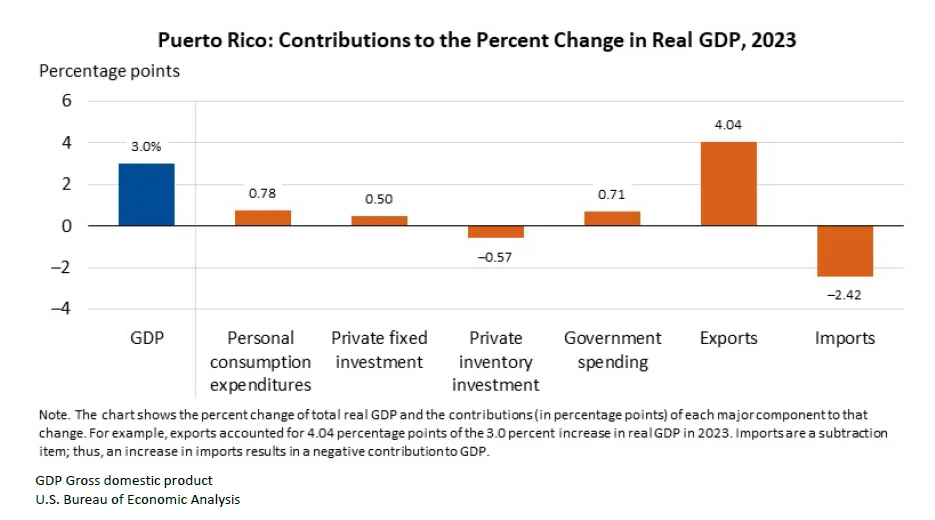
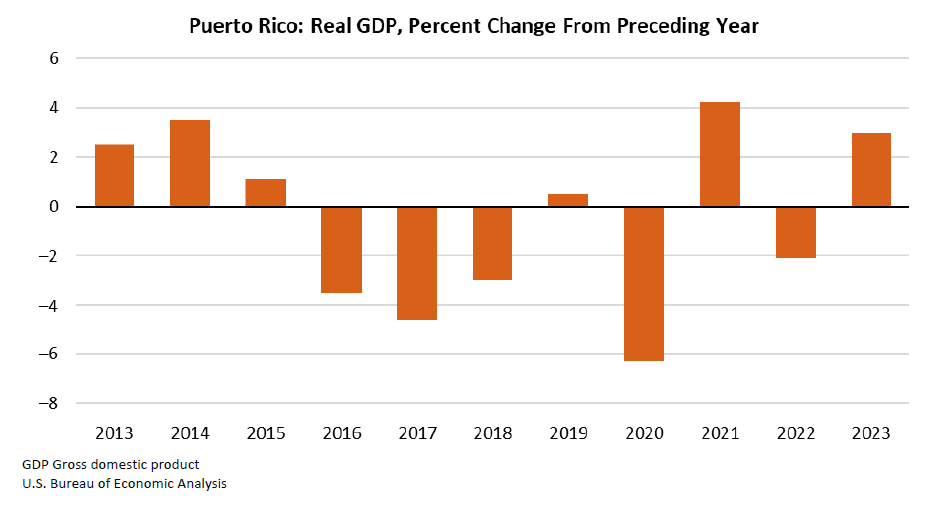
The economy of Puerto Rico experienced a significant turnaround in 2023, with real gross domestic product (GDP) surging by 3.0 percent. This robust growth marks a notable recovery from the 2.1 percent contraction observed in 2022, according to the latest statistics released by the U.S. Bureau of Economic Analysis (BEA). The rebound was primarily propelled by a strong performance in exports, coupled with gains in personal consumption expenditures, government spending, and private fixed investment, partially counterbalanced by a decrease in private inventory investment. Imports also saw an increase, which is a subtraction in GDP calculations.
Economic Recovery Driven by Export Surge
The key driver behind Puerto Rico’s impressive economic resurgence in 2023 was a substantial increase in real exports, which grew by 6.4 percent. This broad-based growth encompassed both goods and services, with exports of goods rising by 6.6 percent and exports of services by 5.6 percent. This surge in external demand highlights the island’s increasing integration into global supply chains and the competitive edge of its exported products and services. The pharmaceutical and chemical sectors, which are significant components of Puerto Rico’s export economy, likely played a crucial role in this expansion.
This upward trend in exports is a positive indicator for the island’s economic health, suggesting a growing demand for goods and services produced in Puerto Rico by international markets. Such a development can lead to increased production, job creation, and greater foreign exchange earnings, contributing to overall economic stability and prosperity.
Consumer Spending and Government Investment Bolster Growth
Beyond exports, domestic demand also contributed positively to the GDP growth. Real personal consumption expenditures (PCE) saw an increase of 1.2 percent. While spending on goods within PCE experienced a slight decrease of 0.8 percent, this was more than offset by a substantial 4.0 percent rise in PCE services. This shift indicates a growing consumer appetite for services, potentially reflecting increased confidence and disposable income among residents.
Government spending also emerged as a significant contributor to economic expansion, with real government spending increasing by 4.8 percent. This growth was observed across all levels of government and was particularly driven by widespread increases in investment spending. This surge in public investment is largely attributable to the continued disbursement of federal funds allocated for disaster recovery efforts. These funds are being channeled into critical infrastructure projects aimed at rebuilding and enhancing the island’s resilience following major natural disasters.
Infrastructure Rebuilding and Federal Funding Fueling Investment
The substantial increase in government investment spending is a direct consequence of ongoing reconstruction and improvement initiatives following a series of devastating events. These include the impacts of Hurricanes Irma and Maria in 2017, earthquakes in 2019 and 2020, and Hurricane Fiona in 2022. Federal funds are being strategically deployed to revitalize key sectors of the island’s infrastructure. Notable projects include significant work to modernize and fortify the power grid, enhance the aqueduct system, repair and upgrade roads and bridges, and rebuild facilities such as the National Guard’s Camp Santiago.
This sustained investment in infrastructure not only addresses immediate recovery needs but also lays the groundwork for long-term economic growth and improved quality of life for Puerto Rico’s residents. Enhanced infrastructure can attract further private investment, improve the efficiency of businesses, and create a more stable environment for economic activity.
Private Sector Investment Shows Momentum
The private sector also demonstrated a healthy expansion, with real private fixed investment increasing by 3.8 percent. This growth was primarily driven by increased investment in equipment, with a notable lead in industrial equipment. This includes heightened business expenditures on engines, turbines, and electrical equipment. Such investments are often indicative of businesses expanding their operational capacity, upgrading technology, and preparing for future growth.
However, real private inventory investment experienced a decrease, with the manufacturing sector being the largest contributor to this decline. This could suggest a strategic adjustment by manufacturers to optimize inventory levels in response to changing market demands or supply chain dynamics.
Imports Increase Amidst Economic Activity
Real imports also rose by 4.4 percent in 2023, primarily reflecting an increase in the import of goods. This rise was particularly influenced by pharmaceuticals and organic chemicals, which saw a 6.0 percent increase. An increase in imports, while a deduction in GDP calculation, can also signify robust domestic demand and economic activity, as businesses and consumers acquire a greater volume of goods from external sources.
Revisions and Data Context
The BEA’s release also included revisions to real GDP for Puerto Rico for the years 2018 through 2022, incorporating updated source data. The largest revision to any single year within this period was a 0.4 percentage point adjustment in 2022. These revisions are a standard part of the BEA’s statistical process, aimed at ensuring the accuracy and reliability of economic indicators.
The production of GDP statistics for Puerto Rico is a collaborative effort. The BEA acknowledges the critical support and assistance provided by the government of Puerto Rico, as well as numerous organizations and individuals on the island. This partnership is essential because Puerto Rico is not typically included in the major surveys used to estimate U.S. GDP, making tailored data collection and analysis vital.
Broader Economic Implications and Future Outlook
The 2023 rebound in Puerto Rico’s GDP signifies a positive shift in the island’s economic trajectory. The strong performance in exports suggests a growing international competitiveness, while the increases in domestic consumption and investment point towards a strengthening internal economy. The continued federal investment in infrastructure is a crucial element in building a more resilient and modern economy, capable of withstanding future shocks and fostering sustainable growth.
The diverse nature of the growth drivers – exports, consumption, government investment, and private investment – indicates a more balanced economic recovery. However, the decrease in private inventory investment warrants continued monitoring to understand its underlying causes and potential implications for manufacturing output.
A Timeline of Economic Events and Recovery Efforts
The recent economic performance of Puerto Rico is best understood within the context of its recent history, marked by significant challenges and concerted recovery efforts.
- 2017: Hurricanes Irma and Maria cause widespread devastation across the island, leading to extensive damage to infrastructure, housing, and businesses. This event severely impacted the island’s economic output and initiated a period of reconstruction and recovery.
- 2019-2020: A series of earthquakes strike the southern region of Puerto Rico, causing further damage and disrupting economic activity, particularly in an already fragile recovery phase.
- 2020-2021: The global COVID-19 pandemic presents new economic challenges, affecting supply chains, tourism, and overall economic activity worldwide, including in Puerto Rico. Despite these challenges, the island began to see a slight recovery in its GDP in 2021.
- 2022: Puerto Rico experiences a contraction in its real GDP by 2.1 percent, reflecting ongoing economic adjustments and the lingering effects of past disasters and the pandemic.
- 2023: The island witnesses a significant economic rebound, with real GDP increasing by 3.0 percent. This growth is driven by a strong export performance, increased consumer spending, and substantial government investment in infrastructure, largely funded by federal disaster recovery allocations.
This timeline highlights the persistent challenges Puerto Rico has faced, but also underscores its resilience and the impact of strategic investments in rebuilding and economic development. The 2023 figures represent a crucial milestone in this ongoing recovery process.
Key Components of GDP Growth in 2023
Real Exports: Increased by 6.4 percent, comprising both goods (6.6 percent) and services (5.6 percent). This sector has been a primary engine of growth.
Real Personal Consumption Expenditures (PCE): Grew by 1.2 percent, with services consumption rising by 4.0 percent, indicating increased demand for services, while goods consumption saw a slight dip of 0.8 percent.
Real Government Spending: Expanded by 4.8 percent, fueled by federal disaster recovery funds being channeled into infrastructure projects across all levels of government.
Real Private Fixed Investment: Rose by 3.8 percent, driven by increased spending on equipment, particularly industrial machinery.
Real Private Inventory Investment: Decreased, with the manufacturing sector showing the largest decline in inventory levels.
Real Imports: Increased by 4.4 percent, primarily in goods, suggesting robust domestic economic activity.
Acknowledging Data Production and Future Outlook
The U.S. Bureau of Economic Analysis has expressed its appreciation for the collaboration with the government of Puerto Rico and various local entities, which has been instrumental in producing these vital economic estimates. The BEA has also noted that it will cease producing Puerto Rico GDP statistics after this 2023 release. Previously published data will remain accessible through the BEA’s Data Archive. This marks a significant shift in the availability of detailed economic data for the island.
The performance in 2023 offers a promising outlook for Puerto Rico, demonstrating its capacity for economic recovery and growth. Continued strategic investment, a focus on export competitiveness, and the effective utilization of federal aid will be crucial in sustaining this positive momentum and building a more prosperous and resilient future for the island. The detailed data released by the BEA provides valuable insights for policymakers, businesses, and researchers to understand the dynamics of Puerto Rico’s economy and to inform future economic strategies.