Lana Rhoades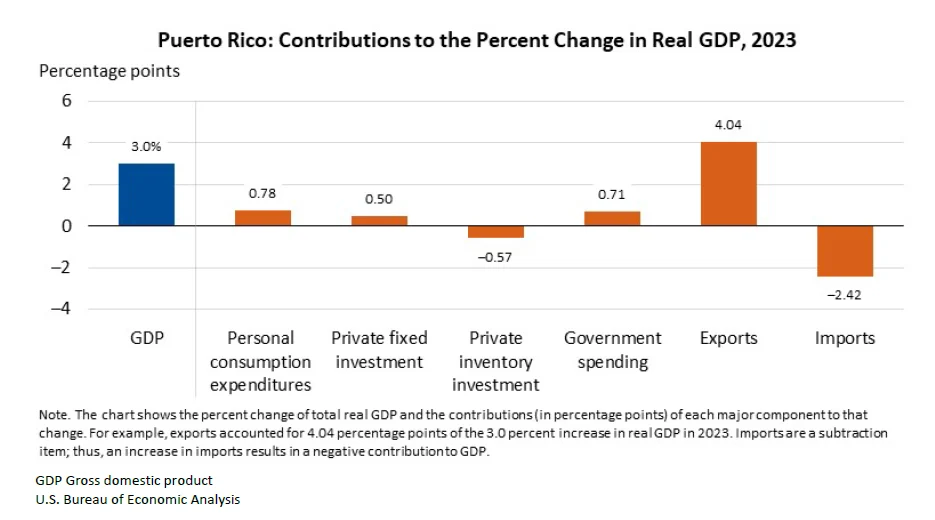
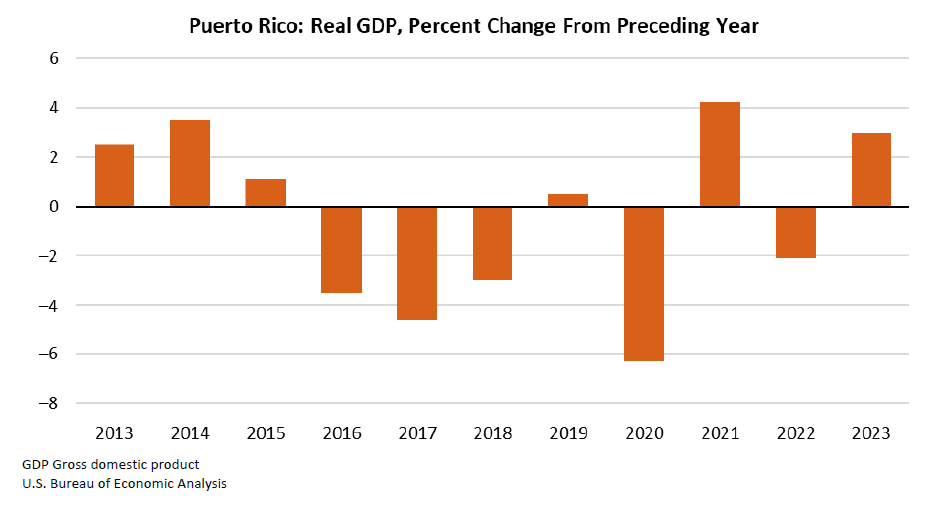
Puerto Rico experienced a significant economic rebound in 2023, with its real gross domestic product (GDP) growing by 3.0 percent, a notable turnaround from the 2.1 percent contraction recorded in 2022. This positive shift in economic performance, as detailed by statistics released today by the U.S. Bureau of Economic Analysis (BEA), was primarily driven by a robust increase in exports, signaling a strengthening of external demand for the island’s goods and services.
The turnaround in Puerto Rico’s economic trajectory in 2023 marks a critical juncture following a period of challenges. The 2.1 percent decrease in real GDP in 2022 reflected a complex economic environment, potentially influenced by lingering effects of past natural disasters, global supply chain disruptions, and evolving domestic economic conditions. The rebound in 2023, however, suggests a growing resilience and a positive response to various economic stimuli and policy initiatives.
Key Drivers of Economic Growth in 2023
The BEA’s analysis highlights that the 3.0 percent increase in real GDP for Puerto Rico in 2023 was not attributable to a single factor but rather a confluence of positive developments. The most significant contributor was a substantial surge in exports, which saw a real increase of 6.4 percent. This growth was broad-based, encompassing both goods and services. Exports of goods rose by 6.6 percent, while exports of services experienced a 5.6 percent uplift. This expansion in export markets indicates an increased demand for Puerto Rican products and services, potentially reflecting improved competitiveness, diversified product offerings, or favorable international market conditions.
Beyond exports, several other components of GDP also demonstrated positive growth, further bolstering the island’s economic expansion. Personal consumption expenditures (PCE), a key indicator of household spending, increased by 1.2 percent. This growth was primarily fueled by a 4.0 percent rise in PCE services, suggesting that consumers were spending more on services, while spending on goods saw a slight decrease of 0.8 percent. This shift towards services spending is a common trend observed in economies as they mature and household incomes rise.
Government spending also played a crucial role in the economic uplift, with real government spending increasing by a notable 4.8 percent. This expansion was observed across all levels of government—federal, central, and municipal. A significant driver within government spending was investment, particularly by federal, central, and municipal governments. This investment surge is directly linked to the ongoing disbursement of federal funds for disaster recovery efforts. These funds are being channeled into critical infrastructure projects aimed at rebuilding and enhancing the island’s resilience. Notable projects include the extensive work to rebuild and improve the power grid, the aqueduct system, roads and bridges, and the National Guard’s Camp Santiago. The sustained investment in infrastructure is vital for long-term economic stability and growth, addressing long-standing vulnerabilities and creating jobs.
Private fixed investment also contributed positively to GDP growth, with a 3.8 percent increase. This rise was primarily driven by increased investment in equipment, with industrial equipment, including purchases of engines, turbines, and electrical equipment by businesses, leading the way. This suggests a renewed confidence among businesses to invest in their operations and expand their productive capacity.
However, the overall GDP growth was partially tempered by a decrease in private inventory investment, with the manufacturing sector being the largest contributor to this decline. Additionally, real imports increased by 4.4 percent, largely due to a rise in imports of goods, particularly pharmaceuticals and organic chemicals, which saw a 6.0 percent increase. While increased imports can reflect growing domestic demand and economic activity, they are subtracted in the calculation of GDP, thus having a dampening effect on the overall growth figure.
Context and Historical Perspective
The economic landscape of Puerto Rico has been shaped by a series of significant events in recent years. The island faced a prolonged economic recession prior to 2017, exacerbated by its debt crisis. The devastating impacts of Hurricanes Irma and Maria in 2017, followed by earthquakes in 2019 and 2020, and Hurricane Fiona in 2022, inflicted severe damage on infrastructure and disrupted economic activity. These events necessitated substantial federal aid and a concerted effort towards rebuilding and modernization.
The BEA’s GDP estimates for Puerto Rico serve as a critical barometer of the island’s economic health, providing policymakers, businesses, and the public with essential data for decision-making. The BEA’s methodology for estimating Puerto Rico’s GDP is distinct from that of the U.S. mainland, given that Puerto Rico is not included in most of the major surveys used for U.S. GDP estimation. The production of these estimates relies heavily on the support and assistance provided by the government of Puerto Rico and numerous other organizations and individuals on the island, highlighting a collaborative approach to economic data collection.
The BEA has also undertaken revisions to its previously published GDP estimates for Puerto Rico for the years 2018-2022. These revisions incorporate updated source data and, in most cases, exhibit a pattern of inflation-adjusted GDP growth similar to the previously published figures. The largest revision in any single year was a 0.4 percentage point adjustment in 2022, indicating a generally stable trend in the underlying economic data.
Detailed Analysis of Economic Components
Exports: The Engine of Growth
The substantial 6.4 percent increase in real exports in 2023 stands out as the primary engine of Puerto Rico’s GDP growth. This broad-based rise in both goods and services exports suggests a healthy demand from external markets. The specific breakdown reveals a robust performance in the export of goods (6.6% increase) and a commendable rise in services exports (5.6% increase). This expansion could be attributed to various factors, including the island’s manufacturing sector’s ability to meet international demand, its growing tourism sector, or an increase in service-based exports such as professional or technical services. Understanding the specific sectors driving this export growth will be crucial for sustained economic development.
Personal Consumption Expenditures (PCE): A Modest but Positive Contribution
Real personal consumption expenditures, representing household spending, saw a 1.2 percent increase in 2023. This growth was driven by a significant 4.0 percent rise in spending on PCE services, while spending on PCE goods declined by 0.8 percent. This divergence suggests a consumer preference shift towards services, such as entertainment, healthcare, or personal care, potentially indicating increased disposable income or a post-pandemic normalization of spending patterns. The slight dip in goods spending could be influenced by various factors, including inflation on certain goods or a shift in consumer priorities.
Government Spending: Rebuilding and Investment
The 4.8 percent increase in real government spending underscores the significant role of public sector investment in the island’s economy. This growth was broad-based across federal, central, and municipal levels, with a particular emphasis on investment spending. The BEA explicitly links this increase to the continued disbursement of federal funds for disaster recovery, addressing the lingering impacts of Hurricanes Irma and Maria, the 2019-2020 earthquakes, and Hurricane Fiona. The ongoing investments in critical infrastructure—the power grid, aqueduct system, roads, bridges, and military facilities like Camp Santiago—are not only vital for immediate recovery but also lay the groundwork for future economic stability and resilience. This sustained public investment acts as a significant economic stimulus, creating jobs and fostering an environment conducive to private sector activity.
Private Fixed Investment: Business Confidence on the Rise
Real private fixed investment, a measure of spending by businesses on capital goods, increased by 3.8 percent in 2023. This growth was largely characterized by increased investment in equipment, with industrial equipment purchases by businesses leading the surge. This indicates a growing confidence among businesses in the economic outlook of Puerto Rico, prompting them to invest in expanding their operational capabilities and productivity. Such investments are crucial for long-term economic growth, innovation, and job creation.
Inventory Investment and Imports: Offsetting Factors
While several components of GDP showed positive growth, the decrease in real private inventory investment acted as a partial offset. The manufacturing sector was identified as the largest contributor to this decline, suggesting potential adjustments in production or inventory management strategies within the sector.
Simultaneously, real imports increased by 4.4 percent, driven primarily by imports of goods, particularly pharmaceuticals and organic chemicals. While increased imports can signal robust domestic economic activity and consumer demand, they represent a subtraction in the calculation of GDP. This means that while the underlying economic activity might be strong, the net effect on GDP is reduced. The significant increase in pharmaceutical and chemical imports could reflect the needs of the island’s manufacturing sector or a rise in domestic healthcare demands.
Broader Implications and Future Outlook
The 3.0 percent GDP growth in 2023 is a positive signal for Puerto Rico’s economic future. It suggests that the island is not only recovering from past disruptions but is also building a more robust and diversified economy. The strong performance in exports and the sustained government investment in infrastructure are particularly encouraging.
However, the reliance on federal disaster recovery funds for a significant portion of government investment highlights a continuing dependence on external aid. While crucial for rebuilding, a sustainable long-term economic strategy will require fostering domestic revenue generation and attracting sustained private sector investment beyond infrastructure projects.
The BEA’s decision to cease production of Puerto Rico GDP statistics after the 2023 release marks the end of an era for comprehensive economic tracking by the agency. While acknowledging the critical role of local collaboration, the discontinuation of these reports means that future detailed economic analysis will likely depend on alternative data sources and methodologies. This transition underscores the importance of robust local data collection and analytical capabilities within Puerto Rico itself.
The shift in consumer spending towards services and the increased business investment in equipment suggest evolving economic patterns. Continued monitoring of these trends will be essential for policymakers to adapt and develop targeted strategies. The island’s ability to leverage its export potential, attract diversified foreign and domestic investment, and continue its infrastructure development will be key determinants of its long-term economic prosperity. The positive momentum in 2023 provides a solid foundation, but sustained effort and strategic planning will be necessary to navigate future economic challenges and opportunities.
The BEA’s detailed data tables, accessible through their Interactive Data Application, offer a deeper dive into the specifics of these economic trends, allowing for a more granular understanding of each component’s contribution to Puerto Rico’s GDP. These resources remain invaluable for researchers, policymakers, and stakeholders interested in the economic development of the island.