Lana Rhoades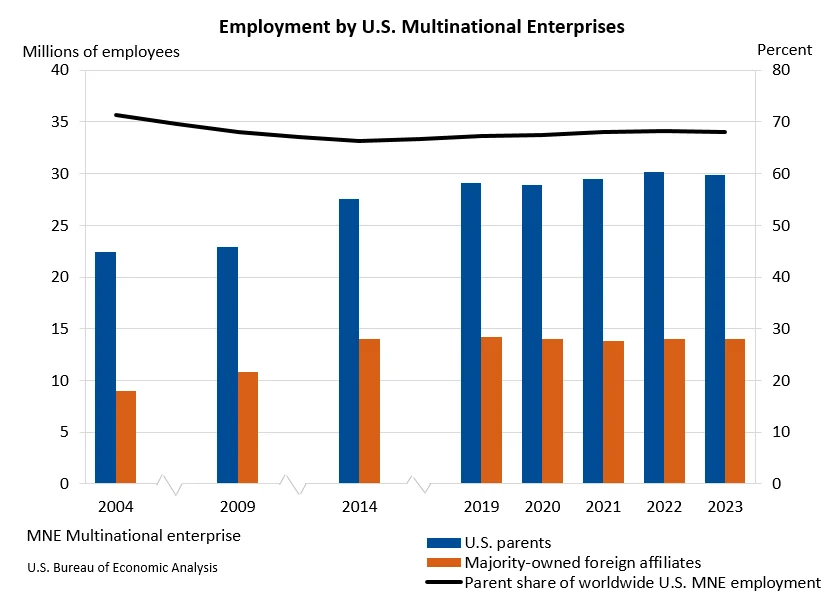
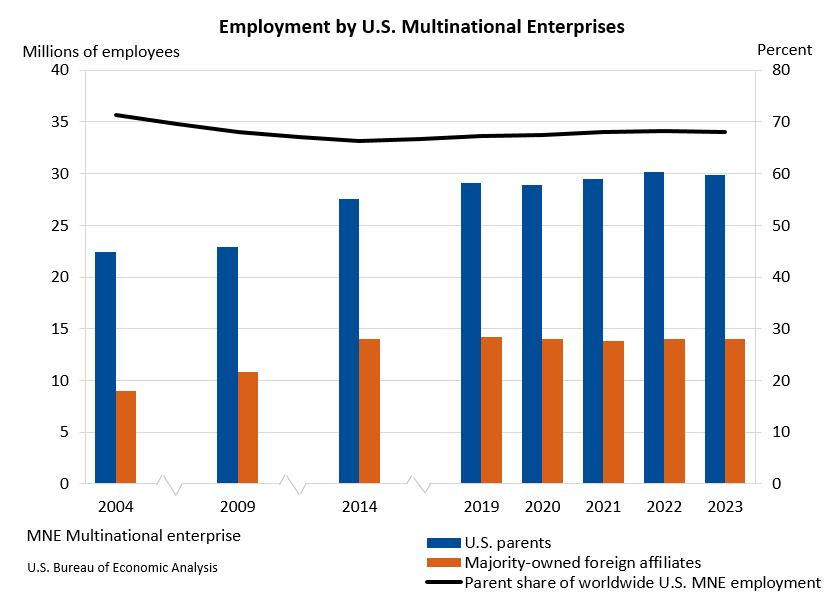
Worldwide employment by U.S. multinational enterprises (MNEs) experienced a marginal decrease of 0.4 percent in 2023, settling at 43.9 million workers. This figure, based on preliminary data released by the U.S. Bureau of Economic Analysis (BEA), represents a slight dip from the revised 44.1 million workers recorded in 2022. The statistics offer a comprehensive look into the operational and financial activities of U.S. parent companies and their foreign affiliates, providing critical insights into the global reach and economic impact of American corporations.
The slight contraction in overall employment reflects a nuanced picture within U.S. multinational operations. While global employment saw a minor decline, the internal distribution of this workforce reveals a more significant shift. Employment within the United States by U.S. parent companies experienced a more pronounced decrease of 0.8 percent, falling to 29.9 million workers in 2023. Despite this decline, U.S. parents still constituted the vast majority of the MNE workforce, accounting for 68.1 percent of worldwide employment. This figure, however, marks a slight reduction from 68.3 percent in the previous year, indicating a subtle but observable trend towards a relatively larger proportion of the workforce being situated abroad.
Conversely, employment abroad by foreign affiliates of U.S. MNEs saw a modest increase of 0.2 percent, reaching 14.0 million workers. This growth, though small, signifies a growing reliance on international labor markets by U.S. corporations. Consequently, employment outside the United States now represents 31.9 percent of the total global employment by U.S. MNEs, a slight uptick from the prior year. This development suggests a strategic recalibration by some U.S. multinational firms, potentially driven by factors such as labor costs, market access, or the need for specialized skills in specific foreign locales.
U.S. Parent Company Employment Dynamics
The data further elaborates on the significance of U.S. parent companies within the domestic economic landscape. In 2023, U.S. parents accounted for 21.9 percent of the total private industry employment in the United States. This proportion, while still substantial, represents a decrease from 22.5 percent in 2022. This marginal decline underscores the increasing global footprint of U.S. corporations, where a larger share of their workforce is now employed outside the nation’s borders.
The primary sectors contributing to U.S. parent company employment remain consistent, with manufacturing leading the charge. Following manufacturing, "other industries" emerged as a significant employer, notably bolstered by the transportation and warehousing sectors. Retail trade also maintained its position as a key employment generator for U.S. parent firms. This sectoral concentration highlights the enduring importance of these industries to the operational base of American multinational enterprises within the United States.
Global Expansion and Top Host Countries for Employment
The trend of increasing employment abroad, albeit at a modest pace, is further illuminated by examining the geographic distribution of foreign affiliate employment. The largest concentrations of employees working for majority-owned foreign affiliates of U.S. MNEs were reported in India, Mexico, and the United Kingdom. These countries have historically been significant destinations for foreign direct investment and operations by U.S. companies, offering a combination of market potential, skilled labor, and established business infrastructure. The continued growth in these regions suggests ongoing strategic investments and operational expansions by U.S. firms in these key global markets.
Economic Output and Value Added: A Shifting Landscape
Beyond employment figures, the BEA’s report also sheds light on the economic output, measured by value added, generated by U.S. MNEs. Worldwide current-dollar value added by these enterprises saw a slight decrease of 0.6 percent in 2023, reaching $6.9 trillion. This overall contraction mirrors the marginal dip in global employment.
Within this global figure, the contribution of U.S. parents to the U.S. gross domestic product (GDP) also experienced a decline. Value added by U.S. parents decreased by 1.0 percent to $5.3 trillion. This represents 21.4 percent of the total U.S. private-industry value added, down from 23.1 percent in 2022. This reduction in the domestic share of value added further supports the observation of a relatively growing proportion of MNE activity occurring abroad.
In contrast, the value added by majority-owned foreign affiliates of U.S. MNEs demonstrated resilience, increasing by 0.8 percent to $1.6 trillion. This growth in foreign affiliate value added contributed to their increasing share of the overall MNE economic output. The countries that generated the largest value added from majority-owned foreign affiliates were the United Kingdom, Canada, and Ireland. These nations continue to be significant hubs for U.S. corporate operations and economic contributions outside the United States.
Investment in Future Growth: Capital Expenditures and R&D
The data also provides insights into the investment strategies of U.S. MNEs, focusing on expenditures for property, plant, and equipment (capital expenditures) and research and development (R&D). Worldwide expenditures for property, plant, and equipment by U.S. MNEs saw a notable increase of 7.5 percent, reaching $1.1 trillion in 2023. This robust growth in capital investment signals a commitment to expanding productive capacity and infrastructure.
Of this total, U.S. parents accounted for $886.1 billion in capital expenditures, indicating significant ongoing investment within the United States. Foreign affiliates also contributed substantially, with expenditures totaling $216.2 billion. This dual investment pattern suggests that U.S. MNEs are simultaneously strengthening their domestic operational base and expanding their global infrastructure.
A similar upward trend was observed in worldwide research and development (R&D) expenditures, which also increased by 7.5 percent to $558.3 billion. This substantial investment in innovation underscores the importance of R&D for maintaining competitiveness and driving future growth in the global marketplace. U.S. parents were the primary drivers of R&D spending, accounting for $476.6 billion. Foreign affiliates contributed $81.7 billion to global R&D efforts. This indicates a continued strong focus on innovation originating from the United States, while also recognizing the value of R&D activities conducted by their international subsidiaries.
Revisions and Data Updates
The Bureau of Economic Analysis periodically revises its statistical data to incorporate newly available and updated source information. The statistics for 2022, released as preliminary estimates in August 2024, underwent revisions for this latest release. These revisions, highlighted in the September 2024 issue of the Survey of Current Business in an article titled "Activities of U.S. Multinational Enterprises in 2022," provide a more accurate picture of the economic landscape in that year.

Key revisions for 2022 data include adjustments to employment figures, value added, capital expenditures, and R&D expenditures for both U.S. parents and their majority-owned foreign affiliates. For instance, the preliminary estimate for U.S. parent employment in 2022 was 30.2 million, which was revised to 30.1 million. Similarly, value added for U.S. parents was revised slightly upwards from $5,308.0 billion to $5,321.2 billion. These revisions, while often minor, are crucial for maintaining the integrity and accuracy of economic analysis.
Broader Implications and Future Outlook
The data released by the BEA offers a multifaceted view of the operations of U.S. multinational enterprises. The slight contraction in global employment, coupled with a more significant decline in domestic employment by U.S. parents, suggests a continuing trend of globalization in workforce distribution. While U.S. parent companies remain the dominant employer, the growing proportion of employment abroad indicates a strategic diversification of labor resources by American corporations.
The increase in capital expenditures and R&D spending globally, however, points towards a forward-looking strategy. Despite shifts in employment, U.S. MNEs are demonstrating a commitment to investing in future growth, innovation, and productive capacity, both domestically and internationally. This suggests that the observed employment shifts may be part of a larger strategy to optimize global operations and maintain a competitive edge in an increasingly interconnected world economy.
The BEA’s release also signifies a shift in its data presentation, with a move away from including detailed tables directly within the news release. Instead, users are directed to BEA’s Interactive Data Application and comprehensive data tables for more in-depth analysis. This change aims to streamline reporting and provide users with more dynamic and accessible data exploration tools.
The next release concerning the activities of U.S. Multinational Enterprises, covering data for 2024, is anticipated in November 2026. This forthcoming release will supersede the current 2023 statistics, allowing for further analysis of evolving trends in global business operations. The BEA also noted the discontinuation of certain data tables, a common practice as data collection and reporting methodologies evolve. These archived tables, particularly those concerning foreign affiliates with less than 50 percent U.S. ownership and supplemental industry statistics, will remain accessible through BEA’s Data Archive.
In conclusion, the 2023 statistics from the U.S. Bureau of Economic Analysis paint a picture of subtle contraction in global employment for U.S. multinational enterprises, with a more pronounced decrease in domestic employment by U.S. parents. However, this is counterbalanced by robust investments in capital expenditures and research and development, indicating a continued commitment to global growth and innovation. The ongoing shifts in employment distribution underscore the dynamic nature of international business and the strategic decisions U.S. corporations are making to navigate the global economic landscape.