Lana Rhoades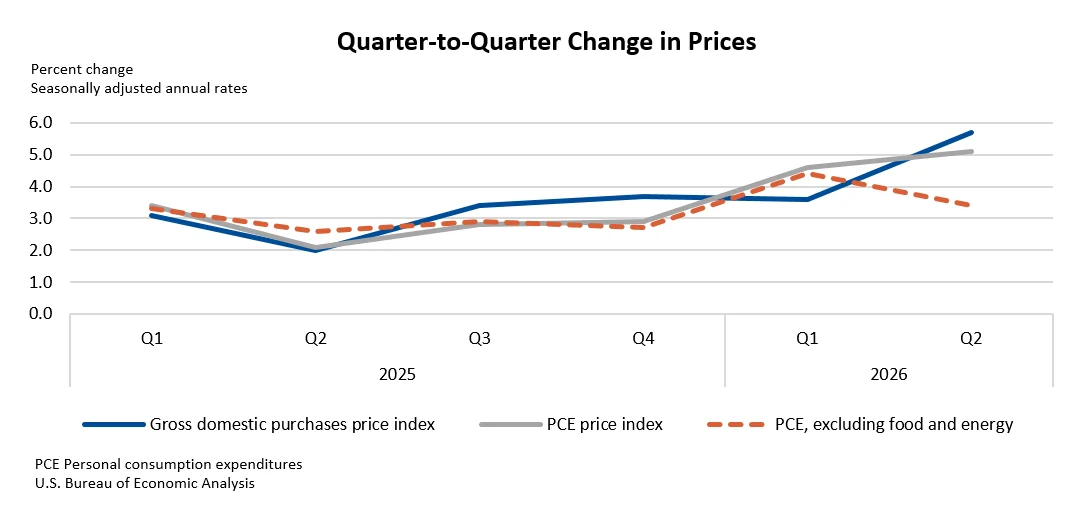
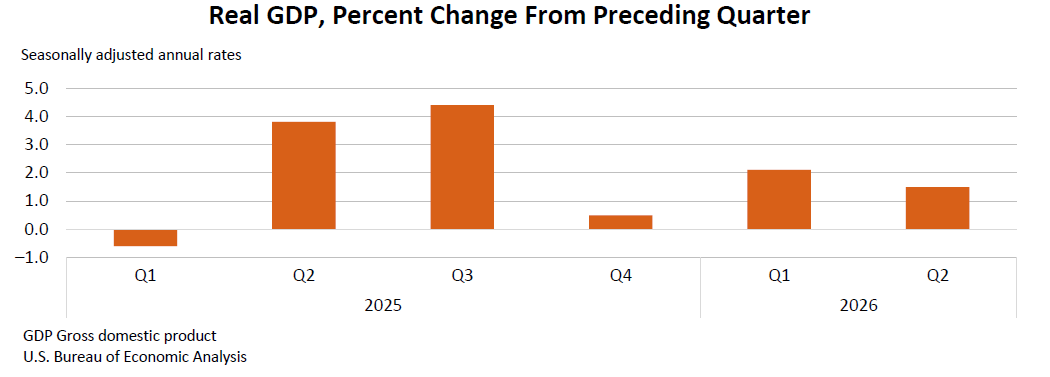
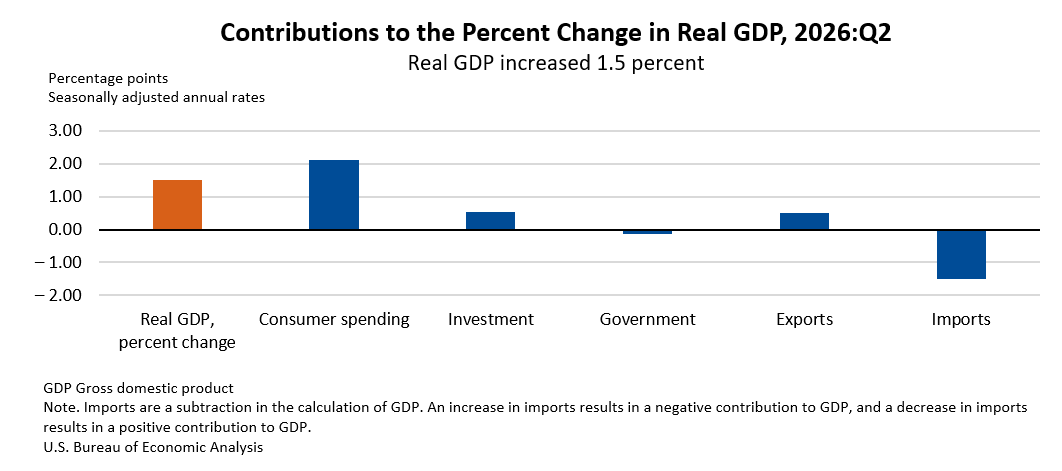
The United States economy experienced a deceleration in its growth rate during the second quarter of 2026, with real Gross Domestic Product (GDP) increasing at an annual rate of 1.5 percent. This marks a notable slowdown from the 2.1 percent growth recorded in the first quarter, as indicated by the advance estimate released by the U.S. Bureau of Economic Analysis (BEA). The dip in expansion reflects a complex interplay of factors, including a contraction in government spending and moderating growth in investment and exports, partially offset by a robust acceleration in consumer spending. Imports, which are subtracted in GDP calculations, also saw a significant increase.
Economic Landscape: A Shifting Terrain
The latest GDP figures paint a picture of an economy undergoing a transition. While consumer spending, a perennial engine of U.S. economic growth, demonstrated renewed vigor, other key components of the economic output experienced a cooling. Investment, which encompasses business spending on equipment, structures, and intellectual property, saw its growth rate diminish. Similarly, exports, a measure of goods and services sold to foreign buyers, also contributed less to the overall GDP increase compared to the previous quarter.
Government spending, a component that can fluctuate significantly based on policy decisions and budget cycles, contracted in the second quarter, acting as a drag on the overall economic expansion. This decline, coupled with the moderating trends in investment and exports, significantly influenced the overall GDP growth rate.
Imports, representing goods and services purchased from abroad, increased more substantially in the second quarter than in the first. As imports are a deduction in the calculation of GDP, a larger increase in imports naturally leads to a lower reported GDP growth rate, even if domestic economic activity is otherwise robust.
Consumer Spending Leads the Charge
Despite the overall slowdown, consumer spending emerged as a bright spot, accelerating in the second quarter. This surge in personal consumption expenditures (PCE) suggests that households continued to drive economic activity, likely fueled by factors such as accumulated savings, a still-tight labor market (though specific employment data for the second quarter would be needed for definitive analysis), and potentially evolving consumer confidence. The BEA data indicates that real final sales to private domestic purchasers, a key measure of demand from consumers and businesses excluding inventories, surged by 3.9 percent in the second quarter, a significant increase from the 1.7 percent rise in the first quarter. This metric is closely watched as it provides a clearer view of underlying domestic demand trends.
Inflationary Pressures and Price Dynamics
The second quarter also witnessed a notable uptick in inflation, as measured by the price index for gross domestic purchases, which rose by 5.7 percent. This represents a substantial acceleration from the 3.6 percent increase observed in the first quarter. This broad measure of inflation reflects price changes for all goods and services purchased domestically, including imports.
The Personal Consumption Expenditures (PCE) price index, a closely watched inflation gauge by the Federal Reserve, also increased to 5.1 percent, up from 4.6 percent in the first quarter. However, a more nuanced view is provided by the PCE price index excluding food and energy, often referred to as "core PCE." This measure, which aims to capture underlying inflation trends by stripping out the volatile food and energy components, saw a deceleration, increasing by 3.4 percent compared to 4.4 percent in the first quarter. This divergence between headline and core inflation suggests that while overall price pressures may be intensifying, some of the increase might be attributable to specific volatile sectors.
A Deeper Dive into the Components of GDP
To understand the GDP figures more comprehensively, it’s crucial to examine the detailed contributions of various economic sectors. The BEA’s advance estimate provides a breakdown of these influences:
- Consumer Spending: A primary driver of the GDP increase, consumer spending saw a significant acceleration in its growth rate. This suggests households were actively purchasing goods and services, contributing positively to economic output.
- Investment: While still contributing positively to GDP growth, investment experienced a deceleration. This could be due to various factors, including rising interest rates, supply chain disruptions impacting capital goods availability, or a more cautious outlook from businesses regarding future expansion.
- Exports: Similar to investment, exports contributed to GDP growth but at a slower pace than in the preceding quarter. Global economic conditions, trade policies, and currency exchange rates can all influence export performance.
- Government Spending: This sector was a negative contributor to GDP growth, experiencing a decrease. The specifics of this decline would likely be detailed in subsequent BEA releases, potentially related to changes in federal, state, and local government expenditures on infrastructure, defense, or social programs.
- Imports: An increase in imports acts as a subtraction in GDP calculations. The larger increase in imports in the second quarter compared to the first quarter directly reduced the reported GDP growth rate.
Historical Context and Economic Trends
The U.S. economy has been navigating a period of post-pandemic recovery and adaptation. Following a period of significant stimulus and pent-up demand in 2021 and early 2022, growth has moderated as supply chain issues persisted and inflation became a primary concern for policymakers. The Federal Reserve has been actively managing monetary policy, including interest rate adjustments, to curb inflation without triggering a severe recession. The current GDP figures suggest a continued balancing act, with underlying consumer resilience contending with broader economic headwinds.
The deceleration from 2.1% to 1.5% growth, while a slowdown, is not necessarily indicative of an impending recession. Economists often look for sustained periods of negative GDP growth to define a recession. However, the shift in momentum warrants close observation. The acceleration in consumer spending provides a degree of optimism, while the rise in inflation, particularly in headline measures, will likely remain a key focus for the Federal Reserve.
Implications for Policymakers and Businesses
The released data has immediate implications for economic policymakers. The Federal Reserve will be closely scrutinizing inflation figures and growth trends as it calibrates its monetary policy decisions. A sustained increase in inflation could prompt further interest rate hikes, potentially impacting borrowing costs for businesses and consumers, and could further dampen investment and consumer spending in future quarters. Conversely, a significant slowdown in growth might lead policymakers to consider adjustments to their approach.
For businesses, the mixed signals present both opportunities and challenges. The continued strength in consumer spending suggests that sectors catering to households may continue to perform well. However, rising input costs due to inflation and potentially higher borrowing costs could squeeze profit margins. Businesses will need to remain agile, monitoring economic indicators and adapting their strategies accordingly.
Looking Ahead: Annual Updates and Future Releases
The BEA also announced its schedule for the 2026 Annual Updates of the National and Regional Economic Accounts. These updates, which encompass GDP, gross domestic income, and various industry and regional economic statistics, are set to commence on September 30, 2026. This coordinated release aims to improve the concurrent production of BEA statistics.
The next release of GDP data is scheduled for August 26, 2026, at 8:30 a.m. EDT, which will provide the second estimate for the second quarter of 2026 and corporate profits. This subsequent release will incorporate more comprehensive data and potentially refine the initial estimates.
Technical Notes and Data Sources
The advance estimate of GDP is based on source data that are incomplete or subject to revision by the source agencies. The BEA notes that improvements to source data and the use of more timely source data have been incorporated into the GDP estimates. For a deeper understanding of the data and the methodologies employed, the BEA provides a wealth of resources, including detailed tables and technical notes, accessible through its interactive data application and website. These resources allow for a granular examination of the components driving economic performance and offer insights into the statistical conventions used in these important economic indicators. The data archive also serves as a repository for historical releases, allowing for comparisons and trend analysis.
The interplay of consumer resilience, moderating investment and trade, and a contraction in government spending, all set against a backdrop of rising inflation, presents a complex economic narrative for the second quarter of 2026. As the U.S. economy continues to evolve, ongoing monitoring of these key indicators will be essential for understanding its trajectory and the potential impacts on businesses and individuals.