Lana Rhoades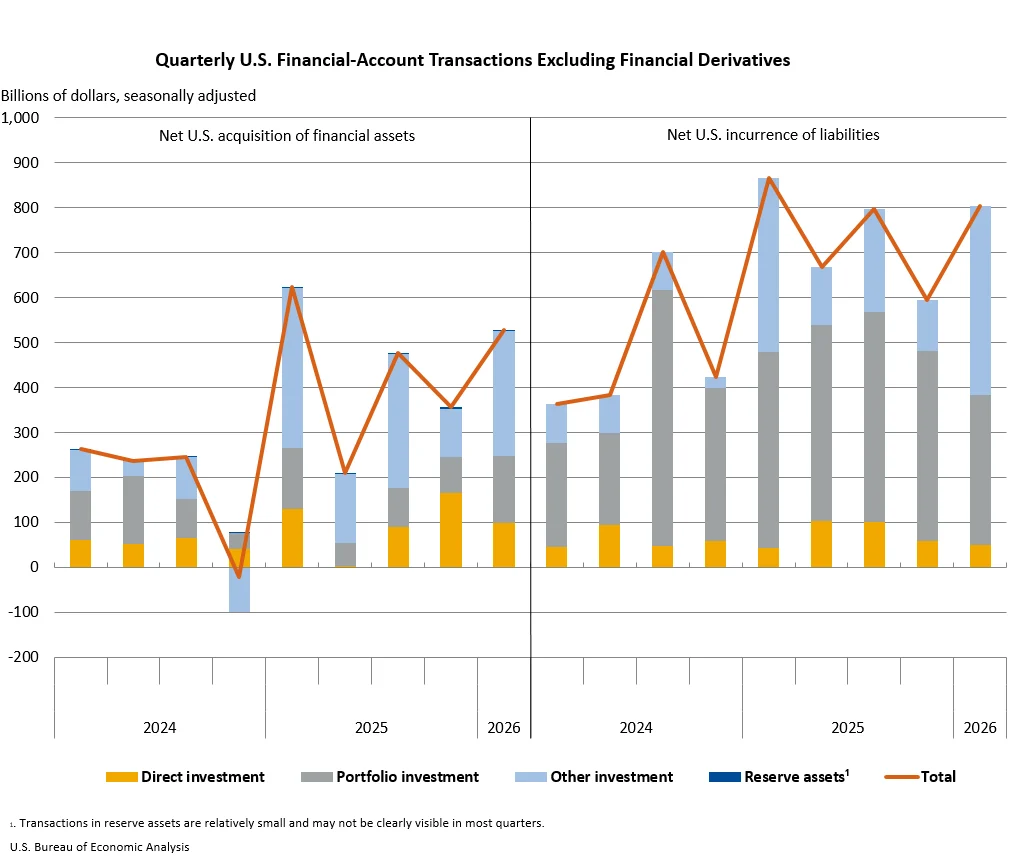
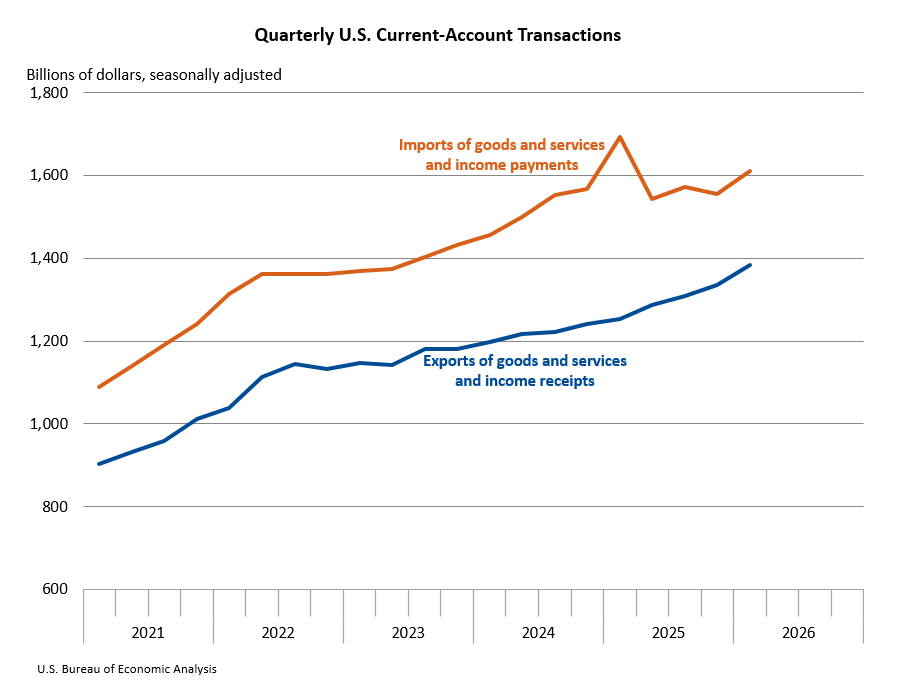
The U.S. current-account deficit, a key indicator of a nation’s international economic standing, expanded by $5.8 billion to $226.8 billion in the first quarter of 2026. This represents a 2.6 percent increase from the revised fourth-quarter deficit of $221.1 billion. The widening gap underscores shifts in international economic transactions, particularly a notable transition in the balance on primary income from a surplus to a deficit, which was only partially counteracted by a reduction in the deficit on goods. This figure also represented 2.9 percent of current-dollar gross domestic product (GDP), a slight uptick from 2.8 percent in the preceding quarter.
These statistics, released today by the U.S. Bureau of Economic Analysis (BEA), also highlighted a significant correction to previously published data. A typographical error in the initial release affected only the net financial transactions figure, which was erroneously reported without a negative sign. The correct figure for net financial transactions in the first quarter of 2026 is a deficit of $209.0 billion. This specific error, according to the BEA, was isolated to this single number and did not impact other figures within the news release, as the correct data was consistently available through the BEA’s Interactive Data Application and Application Programming Interface.
Shifting Dynamics in International Transactions
The widening current-account deficit in the first quarter of 2026 was primarily driven by a significant swing in the primary income balance. This component of the current account, which includes income earned from foreign investments and compensation of employees, moved from a surplus in the fourth quarter of 2025 to a deficit in the first quarter of 2026. While the exact drivers of this shift require deeper analysis of underlying source data, such movements can be influenced by fluctuations in dividend payments, interest income, and profits repatriated by U.S. companies operating abroad, as well as foreign companies’ earnings within the U.S.
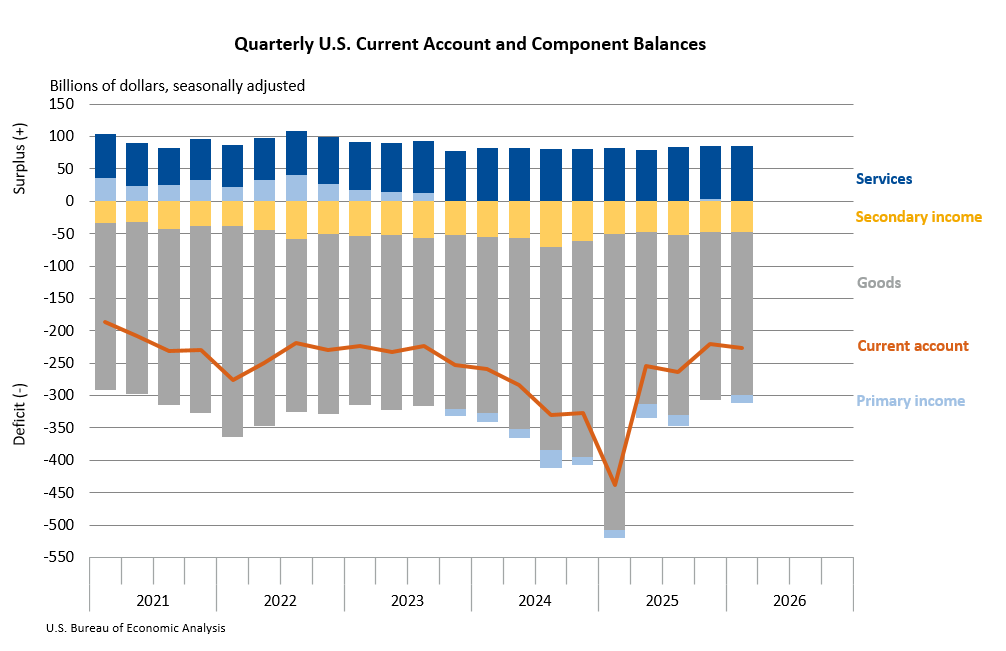
This negative shift in primary income was partially mitigated by a reduction in the deficit on goods. The U.S. has historically run a substantial deficit in its trade of physical goods, but an improvement in this balance suggests either an increase in goods exports or a decrease in goods imports, or a combination of both. However, the overall impact of these opposing forces resulted in an expansion of the current-account deficit.
Key Components of the Current Account
Goods and Services Trade: In the first quarter of 2026, exports of goods and services to foreign residents, along with income received from foreign residents, collectively rose by $50.0 billion to reach $1.38 trillion. This increase was largely propelled by a rise in goods exports. Conversely, primary (earned) income receipts from foreign residents experienced a decrease, tempering the overall growth in exports.
On the import side, the picture showed a more substantial increase. Imports of goods and services from foreign residents, coupled with income paid to foreign residents, surged by $55.8 billion to a total of $1.61 trillion. This rise was attributed to increases in both goods imports and primary (earned) income payments made to foreign residents. The net effect of these movements in goods and services trade, alongside the significant shift in primary income, contributed to the overall widening of the current-account deficit.
Capital Transfers: While not a primary driver of the current-account balance, capital transfers also saw notable activity. Capital-transfer receipts increased by $3.3 billion to $3.4 billion in the first quarter. Concurrently, capital-transfer payments decreased by $0.9 billion to $2.0 billion. These transfers represent one-off movements of capital, such as inheritances or the forgiveness of debt, and their impact on the broader economic accounts is typically less significant than trade and income flows.
Financial Account Dynamics and Net International Investment Position
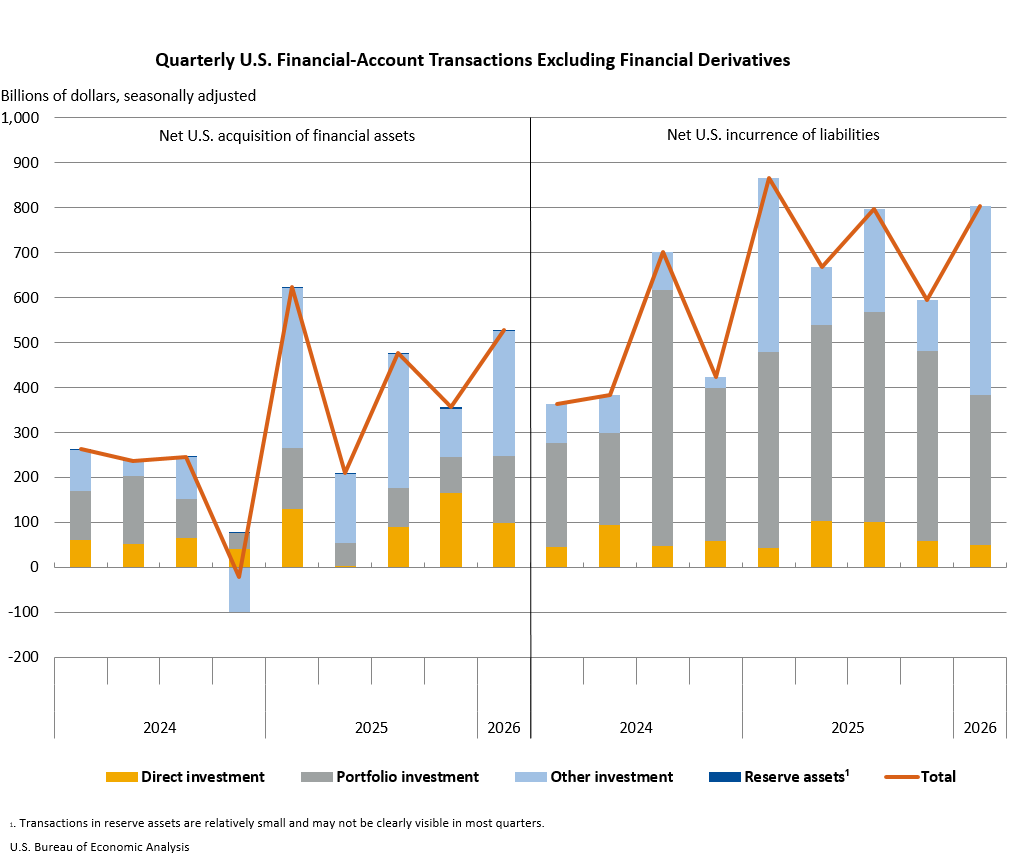
The financial account provides a crucial counterpoint to the current account, detailing the flow of investments across borders. In the first quarter of 2026, net financial-account transactions resulted in a deficit of $209.0 billion. This figure signifies that the U.S. borrowed more from foreign residents than it lent to them during the period. Specifically, U.S. residents increased their holdings of foreign financial assets by $527.3 billion, while simultaneously increasing their liabilities to foreign residents by a larger sum of $803.7 billion. This net outflow of capital, reflected in the financial account deficit, is consistent with a widening current-account deficit, as a nation typically finances its current-account imbalance through borrowing or selling assets.
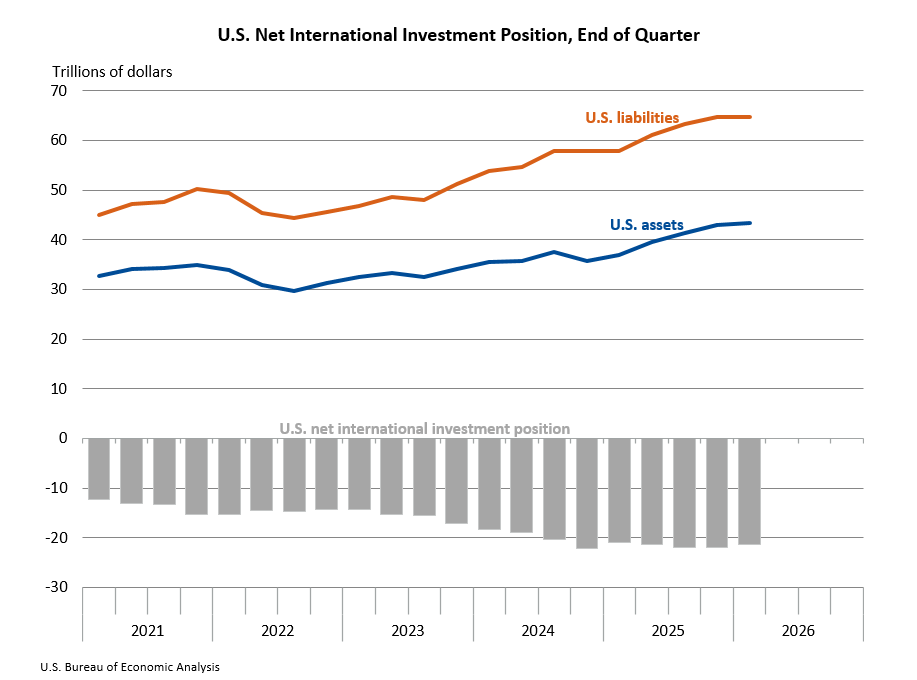
The cumulative effect of these international transactions is captured in the U.S. net international investment position (NIIP), which represents the difference between U.S. residents’ foreign financial assets and liabilities. At the end of the first quarter of 2026, the NIIP stood at a deficit of $21.27 trillion. This represents a slight improvement from the revised end-of-fourth-quarter 2025 position of -$21.87 trillion. U.S. assets abroad totaled $43.37 trillion, while U.S. liabilities to foreign residents amounted to $64.64 trillion. The narrowing of this net deficit can be attributed to a variety of factors, including valuation changes due to exchange rates and asset price movements, in addition to the net financial flows recorded in the financial account.
Changes in Assets and Liabilities:
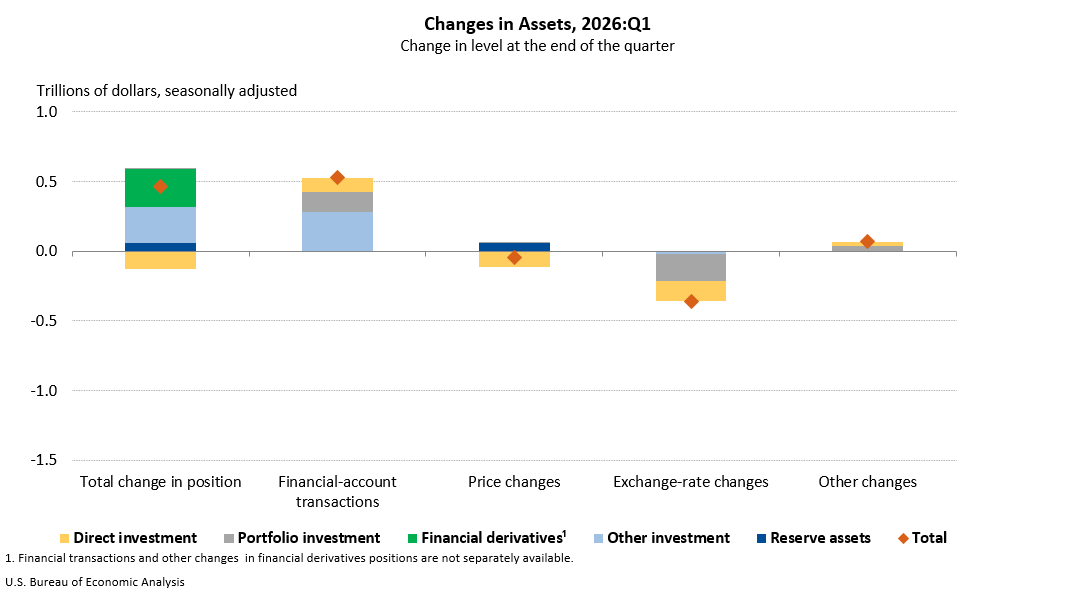
U.S. foreign financial assets saw a substantial increase of $462.9 billion in the first quarter. This growth was broadly distributed across most major investment categories, with the exception of direct investment. While financial transactions contributed positively to asset accumulation, these gains were significantly offset by exchange-rate fluctuations, which resulted in a decrease of $357.1 billion.
Conversely, U.S. liabilities to foreign residents decreased by $140.4 billion during the first quarter. This reduction was primarily driven by a decline in portfolio investment liabilities. However, this decrease was partially counteracted by increases in other major investment categories. The overall reduction in liabilities was significantly influenced by price changes, which led to a decrease of $1.18 trillion. This substantial downward valuation adjustment was then partly offset by the inflow of new financial transactions amounting to $803.7 billion.
Annual Updates to International Economic Accounts
The statistics released today reflect the annual updates to the U.S. International Transactions Accounts (ITAs) and the International Investment Position (IIP) Accounts. These updates are a critical component of the BEA’s statistical program, ensuring that the U.S. economic statistics remain comprehensive and reflect the latest available source data and methodological improvements.
With these annual updates, the BEA has incorporated a range of changes, including the integration of new and revised source data from various government agencies and private entities. These data sources are crucial for accurately measuring the complex web of international economic activities. The BEA also recalculates seasonal and trading-day adjustments, which are essential for smoothing out short-term fluctuations and revealing underlying trends in the data. These adjustments are applied to statistics beginning with data from 1999, ensuring a consistent historical perspective.
Key Data Providers and Affected Years:
The annual updates rely on extensive data collection efforts. Key providers and the periods their data affect include:
- BEA: Provides benchmark and quarterly insurance services surveys (2019–2025), quarterly international services surveys (2023–2025), and benchmark, annual, and quarterly direct investment surveys (2022–2025).
- U.S. Census Bureau: Supplies revised source data for Census-basis goods trade (2023–2025).
- U.S. Department of the Treasury: Contributes annual portfolio investment surveys (2024–2025) and quarterly and monthly portfolio and other investment surveys (2023–2025).
These comprehensive data integrations allow for a more accurate depiction of the U.S. economy’s engagement with the rest of the world.
Background and Broader Context
The current account balance is a fundamental measure of a country’s economic relationship with the rest of the world. It comprises the balance of trade in goods and services, net income from abroad (primary income), and net unilateral transfers (secondary income). A persistent current-account deficit, as has been the case for the United States for many years, indicates that a country is consuming more than it is producing and is therefore relying on foreign capital inflows to finance this difference.
The widening of the deficit in the first quarter of 2026, particularly driven by the shift in primary income, warrants attention from policymakers and economists. Primary income flows can be sensitive to global economic conditions, corporate profitability, and interest rate differentials. A sustained deficit in primary income could signal a long-term trend of declining returns on U.S. investments abroad relative to foreign investments in the U.S., or increased profit repatriation by foreign companies operating domestically.
The U.S. International Investment Position, on the other hand, provides a snapshot of a nation’s net worth in its dealings with foreign entities at a specific point in time. The significant negative net position reflects decades of accumulated current-account deficits, which have led to a substantial accumulation of foreign liabilities. While the net position can fluctuate due to market valuations, the underlying trend is a key indicator of a nation’s financial health and its reliance on foreign capital.
Analysis and Implications
The observed widening of the current-account deficit, coupled with the significant net borrowing reflected in the financial account, suggests that the U.S. economy continues to be a net importer of capital. This reliance on foreign financing can have several implications. While foreign capital inflows can help fund domestic investment and economic growth, they also increase a nation’s external debt obligations and can make it more vulnerable to shifts in global financial markets and investor sentiment.
The BEA’s commitment to regular annual updates of these crucial economic accounts underscores the dynamic nature of international economic relationships. The correction of the typographical error, while minor in its impact on the overall release, highlights the meticulous process involved in ensuring data accuracy. The consistent availability of correct data through BEA’s online platforms is a testament to the agency’s efforts to provide timely and reliable economic information to the public and the research community.
Looking ahead, continued monitoring of the primary income balance will be critical. Any sustained deterioration in this component could signal deeper structural issues within the U.S. economy’s international income generation capabilities. Similarly, trends in goods and services trade will remain a focal point, as they directly impact the balance of trade, a significant contributor to the current account. The interplay between these current account components and the financing flows detailed in the financial account will continue to shape the U.S. economic landscape in the global arena.
The next release of U.S. International Transactions and Investment Position statistics, covering the second quarter of 2026, is scheduled for September 24, 2026. This upcoming release will supersede the first-quarter data and provide further insights into the ongoing evolution of the U.S. economy’s international economic interactions.