Lana Rhoades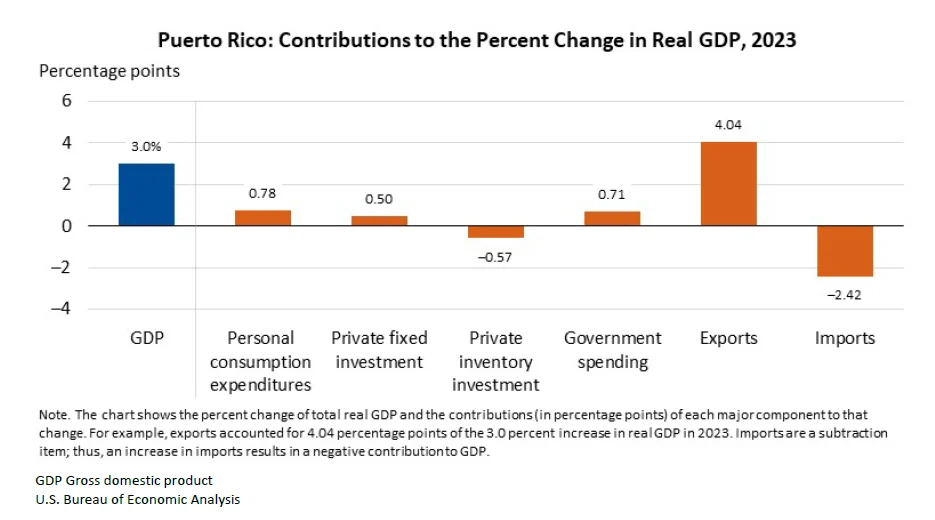
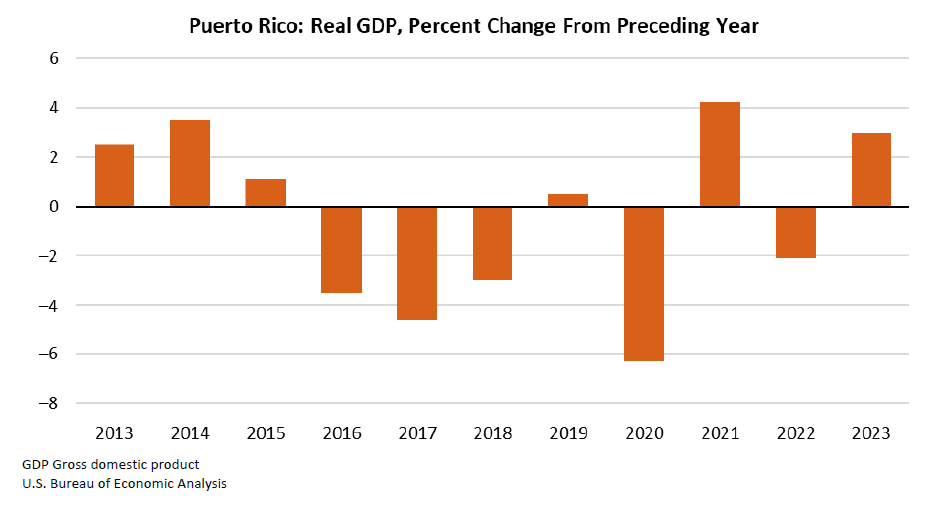
Puerto Rico’s economy demonstrated a robust rebound in 2023, with real gross domestic product (GDP) surging by 3.0 percent. This marks a significant turnaround from the 2.1 percent contraction experienced in 2022, according to the latest statistics released by the U.S. Bureau of Economic Analysis (BEA). This positive economic performance is primarily attributed to a substantial increase in exports, complemented by growth in personal consumption, government spending, and private fixed investment.
Economic Rebound Fueled by Export Strength and Domestic Demand
The upward trajectory of Puerto Rico’s real GDP in 2023 was largely propelled by a healthy expansion in its export sector. Real exports rose by an impressive 6.4 percent, encompassing both goods and services. Exports of goods saw a significant increase of 6.6 percent, while exports of services grew by 5.6 percent, indicating a broad-based demand for Puerto Rican products and services in international markets. This export growth plays a crucial role in the island’s economic vitality, contributing to job creation and overall economic output.
Beyond exports, domestic demand also showed positive signs. Personal consumption expenditures (PCE), a key indicator of consumer spending, increased by 1.2 percent. While spending on goods within PCE saw a slight decrease of 0.8 percent, this was more than offset by a strong 4.0 percent rise in PCE services, suggesting a shift in consumer preferences towards services, potentially reflecting a post-pandemic normalization of economic activities and increased spending on leisure, healthcare, and other service-oriented sectors.
Government spending also provided a significant boost to the economy, with real government spending climbing by 4.8 percent. This growth was observed across all levels of government and was particularly driven by substantial increases in investment spending by federal, central, and municipal entities.
Investment and Infrastructure Projects Drive Government Spending
The surge in government investment spending is directly linked to the ongoing disbursement of federal funds allocated for disaster recovery and infrastructure improvement projects. These funds are crucial for rebuilding and modernizing the island’s essential services, which have been severely impacted by a series of natural disasters. The ongoing efforts include critical work to enhance the resilience and efficiency of the power grid, the water and sewer systems, and the transportation network, including roads and bridges. Furthermore, significant investments are being channeled into projects such as the modernization of the National Guard’s Camp Santiago, underscoring a commitment to both immediate recovery and long-term development.
The allocation and utilization of federal recovery funds have been a cornerstone of Puerto Rico’s economic strategy in recent years. Following the devastating impacts of Hurricanes Irma and Maria in 2017, and subsequent natural events including earthquakes in 2019 and 2020, and Hurricane Fiona in 2022, the island has been in a continuous state of reconstruction. The BEA’s data highlights that the increased government investment spending directly reflects the pace and scale of these recovery efforts, acting as a significant economic stimulus.
Private Sector Investment Shows Resilience
The private sector also contributed positively to the economic growth, with real private fixed investment increasing by 3.8 percent. This growth was primarily driven by increased investment in equipment, particularly within the industrial sector. The purchase of industrial equipment, including engines, turbines, and electrical machinery, by businesses signals a confidence in future economic activity and an expansion of productive capacity. This trend suggests that businesses are reinvesting in their operations, a vital sign for sustained economic growth.
However, private inventory investment experienced a decrease, with the manufacturing sector being the largest contributor to this decline. This could indicate a strategic adjustment by manufacturers to optimize inventory levels, perhaps in response to changing demand patterns or supply chain dynamics.
Imports and Trade Dynamics
Real imports also saw an increase of 4.4 percent, primarily driven by a rise in the import of goods. Notably, the pharmaceutical and organic chemical sectors led this increase, with imports in these categories growing by 6.0 percent. This suggests a continued reliance on imported components or finished products within these key industries, which are significant contributors to Puerto Rico’s economy. While an increase in imports is a subtraction in the calculation of GDP, the overall economic expansion suggests that the growth in exports and domestic demand outpaced this increase, leading to a net positive GDP growth.
Historical Context and Revisions
The BEA’s release also included revisions to Puerto Rico’s real GDP for the years 2018 through 2022. These revisions, which incorporate updated source data, showed a minor upward adjustment for 2022, with the GDP contraction revised from a previous estimate to 2.1 percent from a prior figure. The largest revision in any year during this period was 0.4 percentage point in 2022, indicating a generally consistent trend in economic performance as previously reported. These revisions are a standard part of the BEA’s statistical process, ensuring the accuracy and reliability of economic data.
Acknowledging Collaboration and Data Production
The production of Puerto Rico’s GDP statistics is a collaborative effort. The BEA acknowledges the critical support and assistance provided by the government of Puerto Rico and numerous organizations and individuals on the island. Given that Puerto Rico is not included in most of the major surveys used by the BEA to estimate U.S. GDP, this localized support is indispensable for the accurate compilation of these vital economic indicators.
Transition in Data Production
It is important to note that this release marks the final publication of Puerto Rico GDP statistics by the BEA. Moving forward, the BEA will no longer produce these estimates. Previously published data can still be accessed through the BEA’s Data Archive. This transition underscores the unique challenges and collaborative nature of producing economic statistics for territories outside the mainland United States.
Broader Economic Implications and Future Outlook
The 3.0 percent growth in Puerto Rico’s real GDP in 2023 is a significant positive development, signaling a period of economic recovery and expansion. The robust performance of exports, coupled with increased government investment in critical infrastructure and a rebound in private investment, paints an optimistic picture for the island’s economic future.
The sustained inflow of federal disaster recovery funds continues to be a major driver of economic activity, particularly in construction and infrastructure development. This has a ripple effect across various sectors, creating jobs and stimulating demand for goods and services. The BEA’s data provides a quantitative measure of the impact of these recovery efforts on the island’s overall economic health.
The growth in PCE, especially in services, suggests a strengthening consumer base and a potential increase in disposable income or consumer confidence. As the island continues to rebuild and diversify its economy, maintaining this momentum in both domestic consumption and export markets will be crucial.
However, the island’s economy remains susceptible to external factors, including fluctuations in global demand for its exports, the pace of federal fund disbursement, and the ongoing challenges of climate resilience. The decrease in private inventory investment, while potentially a sign of efficient management, also warrants monitoring to ensure it does not signal a slowdown in production or future demand expectations.
The BEA’s detailed data tables provide an invaluable resource for policymakers, businesses, and researchers to understand the intricate workings of Puerto Rico’s economy. The insights gleaned from these statistics are essential for informed decision-making, strategic planning, and the continued pursuit of sustainable economic development for the island. The BEA’s commitment to providing these figures, even as they conclude their production, is a testament to their dedication to economic transparency and the understanding of diverse economic landscapes within the United States and its territories. The positive economic narrative of 2023 offers a hopeful outlook, built on resilience, strategic investment, and a renewed focus on infrastructure and economic diversification.