Lana Rhoades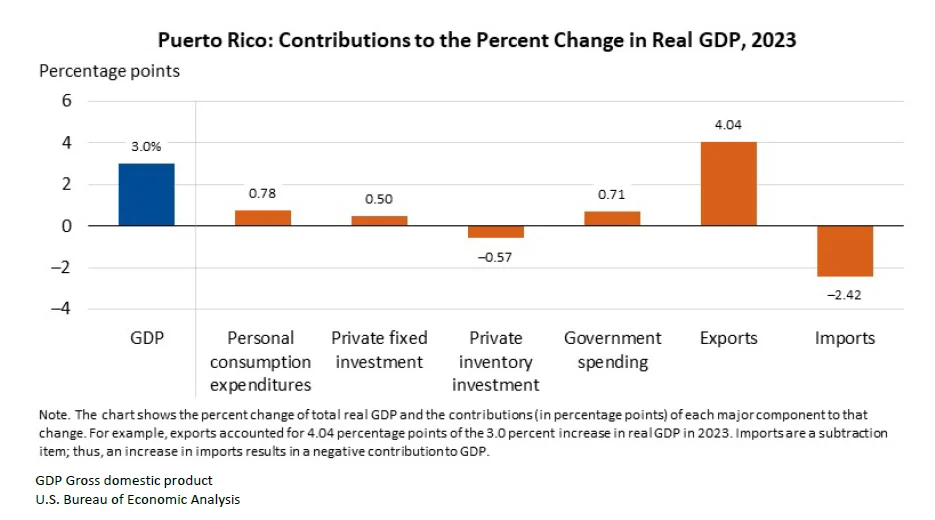
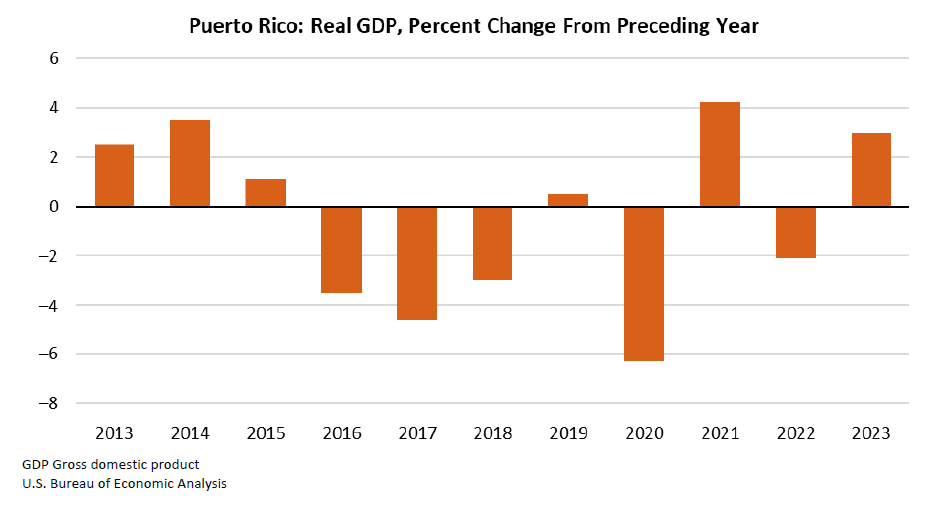
Puerto Rico’s economy demonstrated a significant rebound in 2023, with real gross domestic product (GDP) registering a robust increase of 3.0 percent. This marks a notable turnaround from the 2.1 percent contraction experienced in 2022, according to the latest statistics released by the U.S. Bureau of Economic Analysis (BEA). The positive growth trajectory signals a period of economic recovery and expansion for the island, driven by a confluence of factors including a surge in exports and increased domestic spending.
Economic Recovery Driven by Export Strength and Domestic Investment
The substantial uptick in Puerto Rico’s real GDP in 2023 was primarily fueled by a significant expansion in exports. Real exports climbed by 6.4 percent, encompassing both goods and services. Exports of goods saw a 6.6 percent increase, while exports of services grew by 5.6 percent. This surge in international trade activity indicates a strengthening demand for Puerto Rican products and services in global markets, a crucial component for the island’s economic vitality.
Beyond exports, several other key components of GDP also contributed positively to the island’s economic performance. Personal consumption expenditures (PCE) rose by 1.2 percent. While spending on goods within PCE saw a slight decrease of 0.8 percent, this was more than offset by a substantial 4.0 percent increase in PCE services, suggesting a growing demand for services among residents.
Government spending also played a vital role, with real government spending increasing by an impressive 4.8 percent. This expansion was observed across all levels of government – federal, central, and municipal – with a particular emphasis on investment spending. This surge in public investment is largely attributed to the ongoing disbursement of federal funds allocated for disaster recovery efforts. These funds are being channeled into critical infrastructure projects aimed at rebuilding and enhancing the island’s resilience. Notable initiatives include the ongoing work to modernize the power grid, upgrade the aqueduct system, repair roads and bridges, and rebuild infrastructure at the National Guard’s Camp Santiago. These investments not only stimulate economic activity in the short term but also lay the groundwork for long-term sustainable growth by improving essential services and infrastructure.
Furthermore, real private fixed investment grew by 3.8 percent, driven primarily by increased investment in equipment. This includes significant purchases of industrial equipment, such as engines, turbines, and electrical equipment, by businesses. This rise in private investment signals growing confidence among businesses in Puerto Rico’s economic future and their willingness to expand operations and upgrade facilities.
Factors Contributing to the Economic Rebound
The positive economic momentum in 2023 can be viewed against the backdrop of the island’s recent economic history, marked by significant challenges. The aftermath of Hurricanes Irma and Maria in 2017, followed by a series of earthquakes in 2019 and 2020, and Hurricane Fiona in 2022, had a profound impact on Puerto Rico’s infrastructure and economy. The subsequent efforts to rebuild and recover have been a continuous process, heavily reliant on federal aid. The BEA’s data highlights how these recovery efforts, particularly through increased government investment, are now translating into tangible economic growth.
The BEA’s detailed breakdown of GDP components reveals a multifaceted recovery. The increase in real exports reflects a diversification and strengthening of Puerto Rico’s trade relationships. The growth in personal consumption expenditures, particularly in services, suggests an improvement in household purchasing power and confidence. The robust increase in government spending, directly linked to reconstruction and infrastructure development, acts as a significant economic stimulus.
However, not all components of GDP experienced growth. Real private inventory investment saw a decrease, with the manufacturing sector being the largest contributor to this decline. This could indicate a strategic shift by manufacturers to streamline inventory management or a response to specific market conditions within the sector.
Real imports also increased by 4.4 percent, largely driven by an increase in imports of goods. Specifically, imports of pharmaceuticals and organic chemicals saw a notable rise of 6.0 percent. This increase in imports, while a subtraction in the GDP calculation, often reflects increased domestic demand and economic activity, as businesses and consumers procure necessary goods.
Historical Context and Revisions
The BEA’s release also included revisions to previously published GDP data for Puerto Rico covering the period from 2018 to 2022. These revisions, which incorporate updated source data, resulted in minor adjustments to the figures. The largest revision in any single year was 0.4 percentage point in 2022, which was the year that saw a contraction in real GDP. The revised estimates generally maintain the previously observed trend of inflation-adjusted GDP growth. The BEA noted that the pattern of growth in the revised estimates remains consistent with the previously published figures, reinforcing the overall economic narrative.
A Look at Specific Sectors and Components
Exports: The 6.4 percent increase in real exports is a cornerstone of the 2023 growth. This performance indicates a healthy demand for Puerto Rican goods and services internationally. The breakdown into goods (6.6% increase) and services (5.6% increase) suggests broad-based strength in the export sector. This could be attributed to various factors, including the competitiveness of Puerto Rican industries, favorable global market conditions, or successful trade initiatives.
Personal Consumption Expenditures (PCE): The 1.2 percent growth in real PCE indicates increased spending by households. The divergence between goods (-0.8%) and services (4.0%) is particularly interesting. The decline in spending on goods might reflect a shift in consumer preferences or a temporary slowdown in demand for certain goods. Conversely, the strong growth in services suggests increased expenditure on activities such as tourism, recreation, healthcare, and other personal services. This shift could be a sign of economic maturation and a growing service-oriented economy.
Government Spending: The substantial 4.8 percent increase in real government spending underscores the critical role of public investment in driving economic activity. The direct link to disaster recovery efforts highlights the ongoing commitment to rebuilding and strengthening the island’s infrastructure. The widespread increases in investment spending across federal, central, and municipal governments point to a coordinated effort to address long-standing vulnerabilities and stimulate economic growth through public works.
Private Fixed Investment: The 3.8 percent rise in real private fixed investment is a positive indicator of business confidence and future growth prospects. The emphasis on equipment, particularly industrial machinery, suggests that businesses are investing in their productive capacity, which can lead to increased efficiency and output in the long run. This type of investment is crucial for enhancing the island’s competitiveness and creating higher-value jobs.
Private Inventory Investment: The decrease in real private inventory investment, particularly within the manufacturing sector, warrants further observation. While it reduced the overall GDP growth figure, it could also signify improved inventory management efficiency by manufacturers, aiming to reduce carrying costs and respond more dynamically to market demand.
Imports: The 4.4 percent increase in real imports, led by pharmaceuticals and organic chemicals, reflects the island’s reliance on external supply chains for key goods. This increase, while a deduction in GDP calculation, often accompanies robust domestic economic activity, as businesses and consumers require imported inputs and finished products.
Acknowledging Collaboration and Future Outlook
The U.S. Bureau of Economic Analysis has consistently acknowledged the crucial support provided by the government of Puerto Rico and numerous organizations and individuals on the island for the successful production of these economic estimates. Given that Puerto Rico is not typically included in the major surveys used to estimate U.S. GDP, this collaborative effort is essential for accurate economic reporting.
A Transition in Data Production
It is important to note that the BEA has announced that it will no longer produce Puerto Rico GDP statistics after the release of the 2023 estimates. Previously published data will remain accessible through the BEA’s Data Archive. This marks the end of an era for the detailed tracking of Puerto Rico’s GDP by the BEA, though historical data will continue to be available for analysis.
Broader Implications for Puerto Rico
The positive GDP growth in 2023 offers a much-needed boost to Puerto Rico’s economy. The increase in exports suggests a growing integration into the global marketplace, while the rise in domestic consumption and investment points towards a strengthening internal economic base. The significant government investment in infrastructure is not only stimulating immediate economic activity but also building a more resilient and sustainable future for the island.
However, challenges remain. The island continues to grapple with debt, population migration, and the ongoing need for comprehensive economic development strategies. The BEA’s data provides a snapshot of economic performance, but sustained growth will depend on a continued focus on job creation, diversification of the economy, and effective management of public finances. The rebound in 2023 provides a foundation upon which to build, but sustained effort will be required to ensure long-term economic prosperity for Puerto Rico. The BEA’s detailed data tables, accessible through their Interactive Data Application, offer further insights into the intricacies of Puerto Rico’s economic landscape, allowing for deeper analysis by policymakers, researchers, and the public.