Lana Rhoades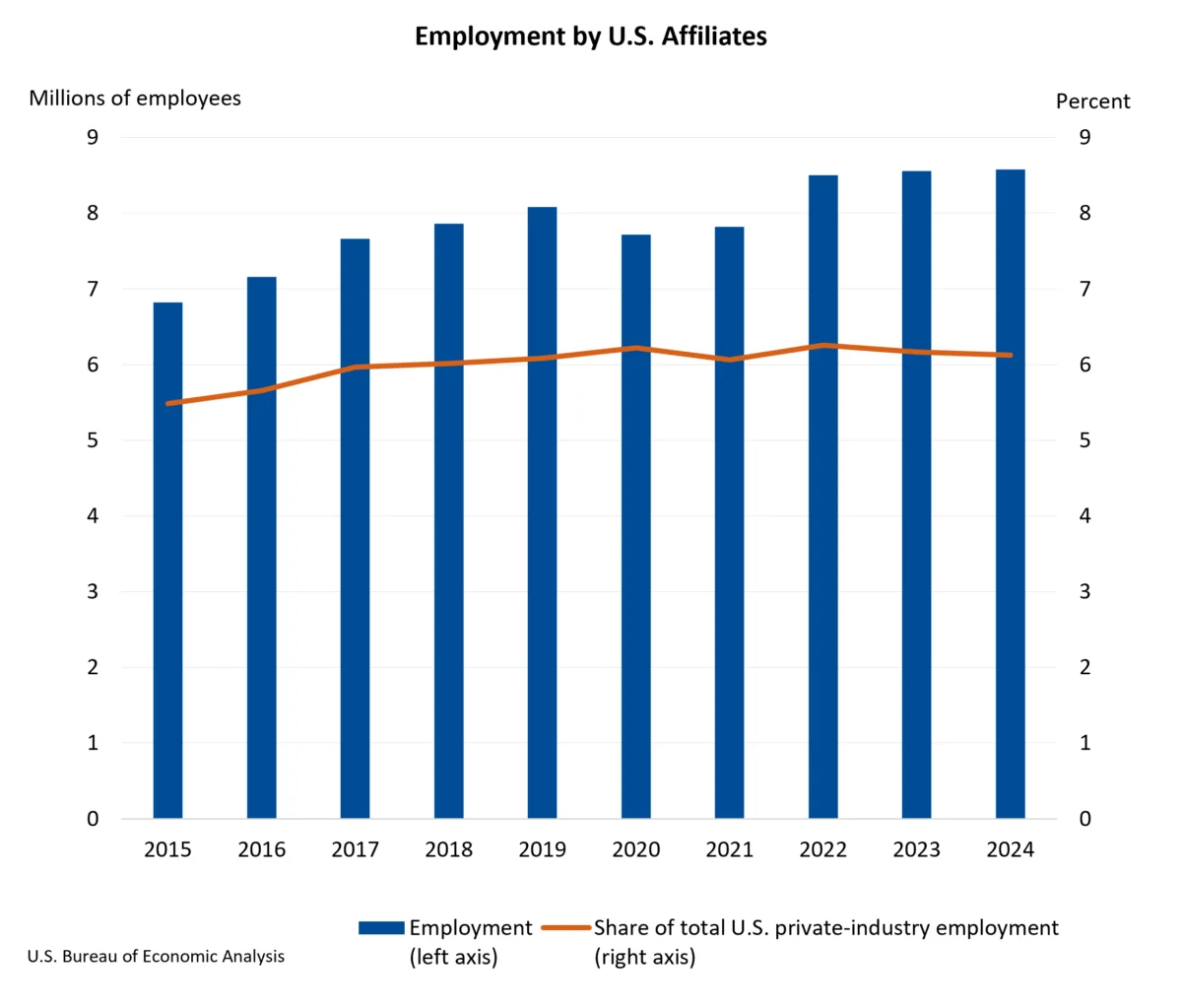
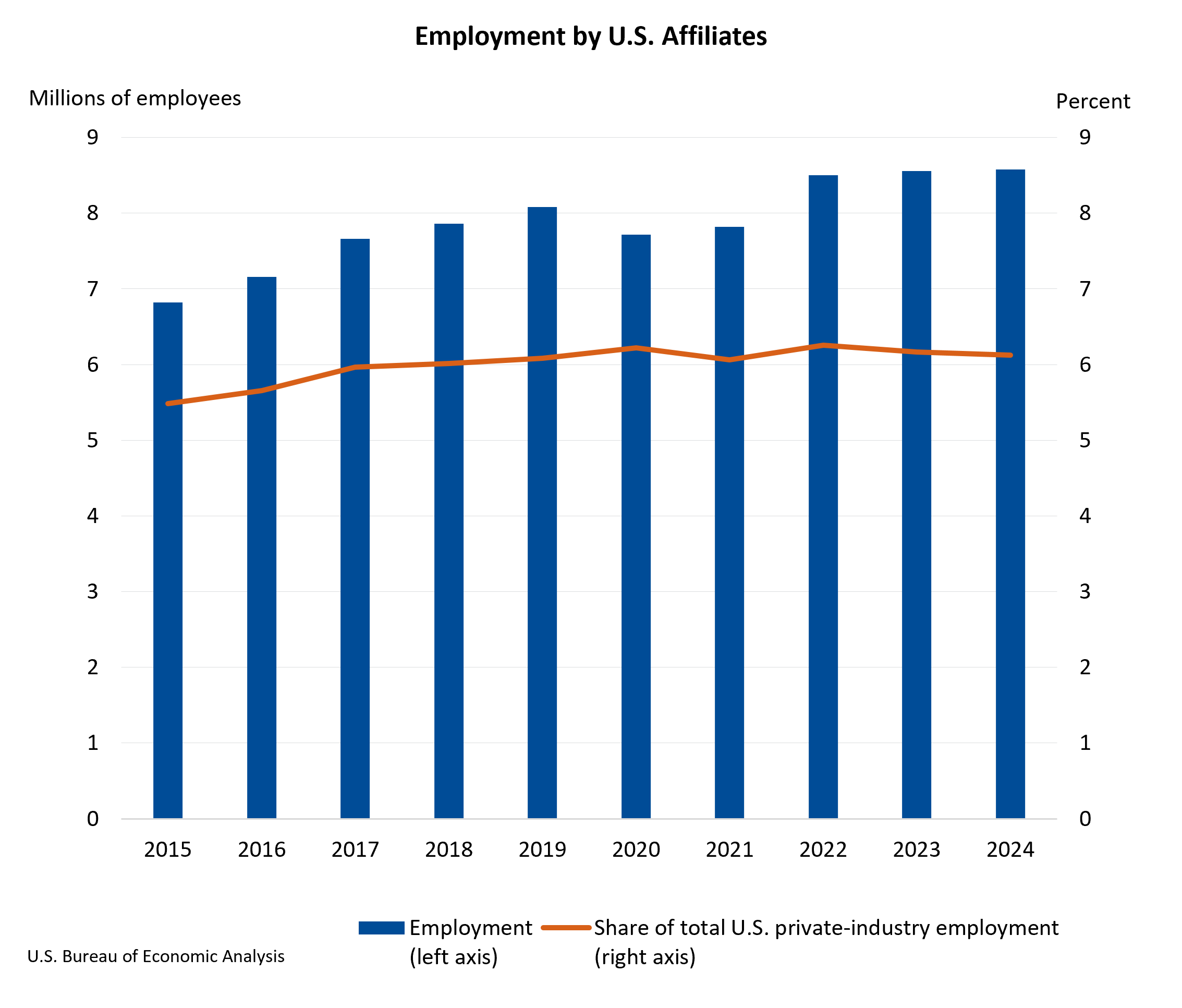
Majority-owned U.S. affiliates of foreign multinational enterprises (MNEs) continued to be a significant engine of employment and economic activity in the United States throughout 2024, according to newly released statistics from the U.S. Bureau of Economic Analysis (BEA). In the past year, these entities provided jobs for a substantial 8.57 million workers, marking a modest yet steady increase of 0.2 percent from the 8.56 million recorded in 2023. This growth, though incremental, underscores the persistent role of foreign investment in sustaining and expanding the American labor market.
The BEA’s comprehensive report, which details the operations and financial performance of these U.S.-based subsidiaries of foreign parent companies, paints a picture of sustained engagement. U.S. affiliates, by their very nature, represent foreign direct investment (FDI) and serve as a crucial conduit for international capital flowing into the American economy. Their operations span a wide array of industries, contributing not only to job creation but also to innovation, productivity, and overall economic output.
While the overall percentage of private-industry employment attributed to these affiliates saw a slight dip from 6.2 percent in 2023 to 6.1 percent in 2024, the absolute number of jobs maintained its upward trajectory. This marginal decrease in percentage share can be attributed to broader trends in the U.S. private sector employment landscape, which may have experienced faster growth in other areas. Nevertheless, the sheer volume of 8.57 million jobs highlights the indispensable contribution of foreign-owned enterprises to the nation’s employment base.
Key Sectors and Top Contributing Nations
The impact of foreign MNEs is not uniformly distributed across all sectors. The BEA data indicates that employment was most concentrated in two cornerstone industries: manufacturing and retail trade. These sectors, known for their substantial labor requirements and their direct connection to consumer spending and industrial production, continue to be primary beneficiaries of foreign investment and operational presence. The manufacturing sector, in particular, has historically been a significant area for FDI, often bringing advanced technologies, specialized skills, and substantial capital investment. Retail trade, on the other hand, reflects the direct engagement of foreign companies with American consumers, supporting a vast network of stores and related logistical operations.
Delving deeper into the origins of this investment, the report identifies the United Kingdom, Japan, and Germany as the leading countries of ultimate beneficial ownership (UBOs) for U.S. affiliates that were the largest contributors to employment. This trio of nations has long been established economic partners with the United States, and their sustained investment reflects a strong confidence in the stability and potential of the U.S. market. The historical ties and robust trade relationships between these countries and the U.S. have fostered an environment conducive to significant FDI, leading to the establishment and expansion of numerous affiliate operations.
Economic Value Added and Investment Trends
Beyond employment figures, the BEA’s report sheds light on the direct economic contribution of these foreign-affiliated firms to the U.S. gross domestic product (GDP). The current-dollar value added by U.S. affiliates surged by 4.3 percent in 2024, reaching an impressive $1.52 trillion. Value added is a critical measure of an entity’s contribution to the nation’s economic output, representing the difference between an industry’s total output and its intermediate consumption. This substantial increase signifies a growing economic footprint and a more significant role in the overall U.S. economy.
In terms of their share of total U.S. business-sector value added, these affiliates accounted for 6.7 percent in 2024, a slight decrease from 6.8 percent in the preceding year. Similar to the employment figures, this marginal percentage shift does not diminish the immense scale of their economic contribution, but rather reflects the dynamic nature of the broader U.S. economy.
Further underscoring the commitment of foreign MNEs to their U.S. operations, expenditures on property, plant, and equipment (PP&E) saw a healthy increase of 3.3 percent, totaling $328.0 billion in 2024. Investment in PP&E is a key indicator of future economic activity and expansion. It suggests that foreign companies are not merely maintaining their existing operations but are actively investing in new facilities, upgrading existing infrastructure, and acquiring new equipment, all of which have ripple effects throughout the U.S. economy, supporting construction, manufacturing, and technological advancements.
Innovation and Research & Development
In an era where innovation is a critical driver of economic competitiveness, the role of foreign-affiliated firms in U.S. research and development (R&D) is particularly noteworthy. The BEA data reveals that R&D performed by these U.S. affiliates experienced a significant increase of 5.3 percent, reaching $95.5 billion in 2024. This robust growth highlights the commitment of foreign companies to fostering innovation within the United States.
These affiliates were responsible for a substantial 12.4 percent of total U.S. business R&D in 2024. This figure is a testament to the strategic importance that foreign MNEs place on tapping into the U.S.’s skilled workforce, research institutions, and innovative ecosystem. By investing heavily in R&D within the United States, these companies contribute to the development of new technologies, products, and processes, benefiting not only their own global operations but also the broader U.S. scientific and technological landscape. This sustained investment in R&D can lead to the creation of high-skilled jobs, the advancement of American industries, and the enhancement of U.S. global competitiveness.
Geographic Distribution of Employment
The impact of foreign MNEs is felt across the nation, with significant concentrations of employment in key states. California, Texas, and New York emerged as the top three states for U.S. affiliate employment in 2024. California led the pack with 885,200 workers employed by majority-owned U.S. affiliates of foreign MNEs. Texas followed with 717,400 employees, and New York secured the third position with 556,700 workers. In all three of these economic powerhouses, the manufacturing sector was the primary driver of employment within these foreign-affiliated companies. This indicates that despite shifts in global manufacturing, these key states continue to attract and retain significant manufacturing operations from foreign investors.
The concentration of employment in these large, diverse economies is not surprising. These states offer a combination of factors attractive to foreign investors, including large consumer markets, skilled labor pools, robust transportation and logistics infrastructure, and often, supportive business environments. The presence of major ports, international airports, and well-developed highway systems facilitates the movement of goods and services, crucial for both manufacturing and retail operations.
Updates and Revisions to 2023 Data
The BEA also provided updated statistics for 2023, reflecting the incorporation of newly available and revised source data. These revisions offer a more refined picture of the activities of U.S. affiliates of foreign MNEs in the previous year. Key revisions include adjustments to the number of employees, value added, expenditures for property, plant, and equipment, and R&D expenditures.
For instance, the preliminary estimate for the number of employees in 2023 was 8,661.8 thousand, which was revised to 8,556.9 thousand. Similarly, value added saw a revision from a preliminary estimate of $1,469.1 billion to a revised $1,456.3 billion. Expenditures for PP&E were revised from $322.7 billion to $317.6 billion. In R&D expenditures, the preliminary estimate of $87.8 billion was revised upwards to $90.6 billion. These revisions are a standard part of statistical reporting, ensuring the accuracy and reliability of the data as more comprehensive information becomes available. They underscore the dynamic nature of economic data collection and the BEA’s commitment to providing the most accurate representation of economic activity.
Broader Implications and Analysis
The sustained growth in employment and economic value added by U.S. affiliates of foreign MNEs has several important implications for the U.S. economy. Firstly, it signifies the continued attractiveness of the United States as a destination for foreign direct investment. This investment not only brings capital but also expertise, technology, and access to global markets, all of which can enhance the competitiveness of U.S. industries.
Secondly, the significant contribution to R&D spending by these affiliates indicates that the U.S. remains a global hub for innovation. This investment in research and development is crucial for long-term economic growth and for maintaining a competitive edge in the global economy. It fosters a knowledge-based economy and can lead to the creation of high-value jobs and the development of cutting-edge technologies.
Thirdly, the concentration of employment in key sectors like manufacturing and retail trade suggests that foreign investment plays a vital role in supporting these foundational industries. While there have been global shifts in manufacturing, the continued presence and investment by foreign MNEs in this sector highlight its ongoing importance to the U.S. economy and its ability to adapt to new technologies and market demands.
From a geopolitical perspective, the strong investment ties with countries like the United Kingdom, Japan, and Germany reinforce the economic interdependence between the U.S. and its key allies. These investments can contribute to economic stability and foster stronger diplomatic relationships.
The BEA’s commitment to providing detailed data, including industry- and country-level specifics, allows for a deeper understanding of the intricate web of international economic engagement. The ongoing updates and modifications to data tables, such as those concerning affiliate counts, reflect the BEA’s efforts to enhance data transparency and accessibility while maintaining robust confidentiality protections for survey respondents through updated disclosure avoidance methods.
Future Outlook
The BEA’s release also provides a glimpse into the future, with the next release of statistics on the activities of U.S. affiliates of foreign MNEs for 2025 scheduled for Spring 2027. This forward-looking information indicates the ongoing commitment to tracking and reporting on these crucial economic indicators, allowing policymakers, businesses, and researchers to stay abreast of trends in foreign direct investment and its impact on the U.S. economy. As global economic landscapes continue to evolve, the data provided by the BEA will remain an essential resource for understanding the multifaceted role of foreign multinational enterprises in shaping the American economic future. The trends observed in 2024, particularly the growth in employment and R&D, suggest a continued positive trajectory, contingent on global economic stability and favorable investment conditions.