Lana Rhoades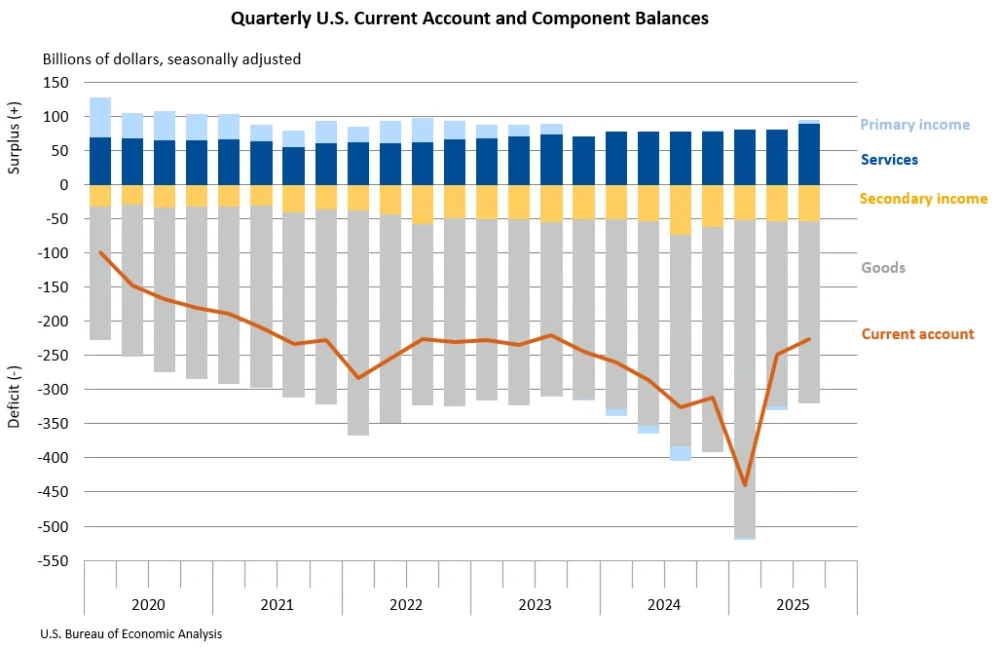
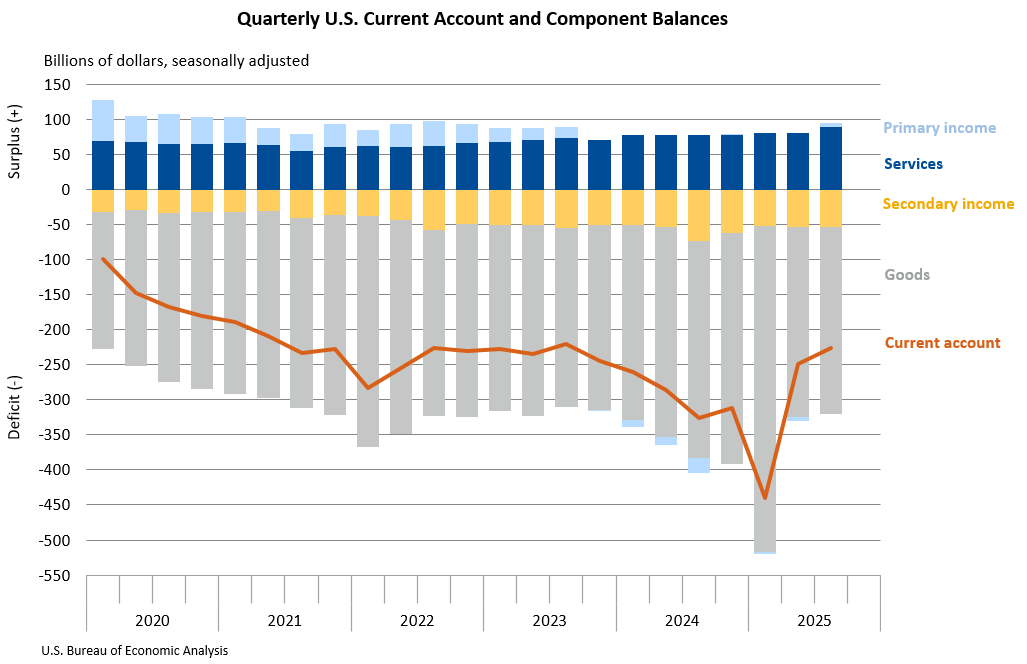
Washington D.C. – The United States witnessed a notable improvement in its international economic standing during the third quarter of 2025, as the current-account deficit contracted by $22.8 billion, or 9.2 percent, to reach $226.4 billion. This marks a significant narrowing from the revised $249.2 billion deficit recorded in the preceding second quarter, according to the latest statistics released by the U.S. Bureau of Economic Analysis (BEA). The deficit’s reduction, now representing 2.9 percent of current-dollar gross domestic product (GDP) compared to 3.3 percent in the second quarter, signals a positive shift in the nation’s balance of international transactions.
This positive development in the third quarter was primarily propelled by a pivotal turnaround in the balance on primary income, which swung from a deficit in the second quarter to a surplus. This income flow adjustment was complemented by an expansion in the surplus on services and a reduction in the deficit associated with trade in goods. These combined forces contributed to a more favorable overall current-account position, indicating increased foreign earnings for U.S. residents and a more balanced trade in goods and services.
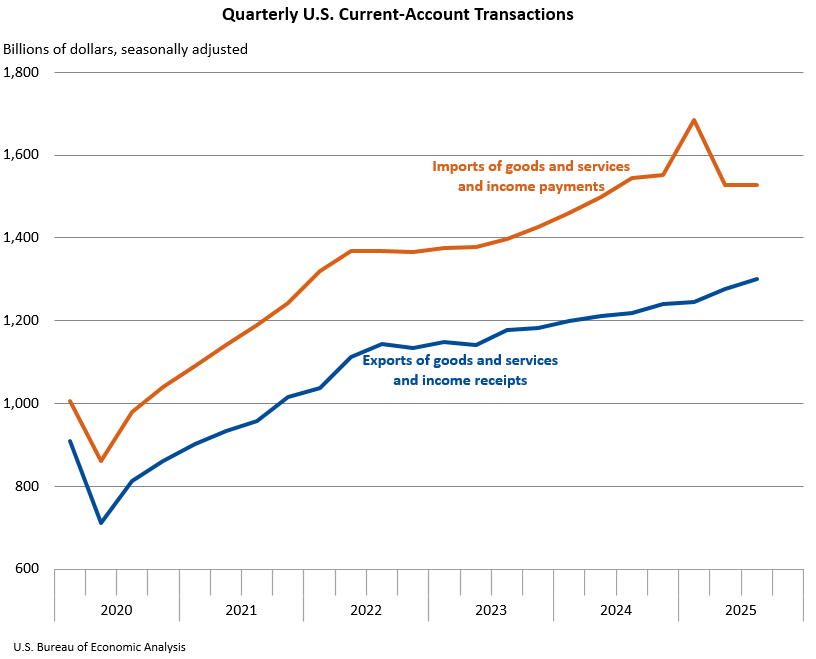
The BEA’s comprehensive report details the intricate movements within the U.S. international transactions accounts, offering a granular view of the nation’s economic interactions with the rest of the world. Total exports of goods and services, along with income received from foreign residents, saw a substantial increase, rising by $24.1 billion to a total of $1.30 trillion. Conversely, imports of goods and services, and income paid to foreign residents, also experienced an increase, albeit at a more modest pace of $1.3 billion, reaching $1.53 trillion. This disparity in growth rates between exports and imports contributed to the overall narrowing of the current-account deficit.
Detailed Breakdown of Current-Account Components
The intricacies of the U.S. current-account balance are best understood by examining its constituent parts: trade in goods, trade in services, primary income, and secondary income.
Trade in Goods: A Complex Balancing Act
During the third quarter of 2025, the trade in goods sector presented a mixed picture. Exports of goods saw a slight decrease of $1.9 billion, settling at $548.0 billion. This decline was largely attributed to a reduction in nonmonetary gold exports, a category that can be subject to significant fluctuations. However, this decrease was partially offset by increased shipments of capital goods and consumer goods, suggesting underlying strengths in other export categories.
On the import side, goods imports also experienced a decrease, falling by $5.0 billion to $815.4 billion. The primary driver of this reduction was a decline in consumer goods imports. Interestingly, this contraction was largely counterbalanced by an increase in nonmonetary gold imports. The BEA notes that the definition of "nonmonetary gold" in its reporting refers to gold that is not held as a reserve asset by monetary authorities, often including transactions by private entities and industrial users. Fluctuations in this category can significantly impact the headline goods balance, underscoring the importance of understanding its specific drivers.
Historically, the U.S. has maintained a persistent deficit in its trade of goods, a trend driven by strong domestic demand and a globalized supply chain that often favors imports. The slight improvement in the goods deficit during this quarter, while positive, does not fundamentally alter this long-standing structural characteristic of the U.S. economy. However, the nuanced movements within specific categories, such as capital and consumer goods, offer insights into the resilience of American manufacturing and consumer spending patterns.
Trade in Services: A Growing Surplus
In contrast to the goods balance, the trade in services sector demonstrated robust growth, further contributing to the narrowing of the current-account deficit. Exports of services surged by $11.7 billion to $314.2 billion, while imports of services also rose, albeit at a slower pace, by $3.1 billion to $225.0 billion. This resulted in an expanded surplus for the services sector.
The primary engine behind these increases in both service exports and imports was the category of "other business services," with a notable emphasis on professional and management consulting services. This trend reflects the increasing interconnectedness of the global economy and the growing demand for specialized expertise across borders. U.S. companies continue to be highly competitive in providing these high-value services, while American businesses also increasingly leverage international expertise. The growth in services trade is a critical component of the U.S. economy, often outpacing the growth in goods trade and serving as a bright spot in its international economic engagement.
Primary Income: The Key to the Deficit Reduction
The most significant driver of the overall reduction in the current-account deficit was the dramatic shift in the primary income balance. Receipts of primary income, which represent earnings by U.S. residents from their investments abroad, increased by $16.3 billion to $395.2 billion. This broad-based increase spanned across all major categories, with direct investment income leading the surge. This indicates that U.S. companies and individuals are earning more from their foreign assets and investments.
Complementing this rise in receipts, payments of primary income – earnings paid by U.S. residents to foreign residents on their investments in the U.S. – increased by a more moderate $5.3 billion to $390.0 billion. This increase was primarily driven by a rise in "other investment income," specifically interest on loans and deposits held by foreigners in the U.S. The widening gap between primary income receipts and payments, resulting in a surplus, was a pivotal factor in shrinking the current-account deficit. This turnaround suggests that U.S. investments abroad are now generating more income than foreign investments in the U.S., a significant positive development.
Secondary Income: Modest Declines
The secondary income balance, which encompasses current transfers like foreign aid and remittances, experienced modest declines in both receipts and payments. Receipts of secondary income decreased by $2.0 billion to $44.4 billion, primarily due to a reduction in private transfers. Similarly, payments of secondary income fell by $2.1 billion to $97.9 billion, largely attributed to a decrease in general government transfers. While these movements were not as impactful as those in primary income, they contributed slightly to the overall reduction in the current-account deficit.
Capital and Financial Accounts: Reflecting International Investment Flows
Beyond the current account, the BEA report also provides insights into the capital and financial accounts, which track the movement of capital and financial assets between the U.S. and the rest of the world.
Capital Account: Minor Adjustments
The capital account, which records non-financial asset transfers, showed minor adjustments. Capital-transfer receipts increased by $164 million to $181 million in the third quarter. Conversely, capital-transfer payments decreased by $659 million to $1.3 billion. These transactions are generally smaller in magnitude compared to financial account movements.
Financial Account: Net Borrowing from Abroad
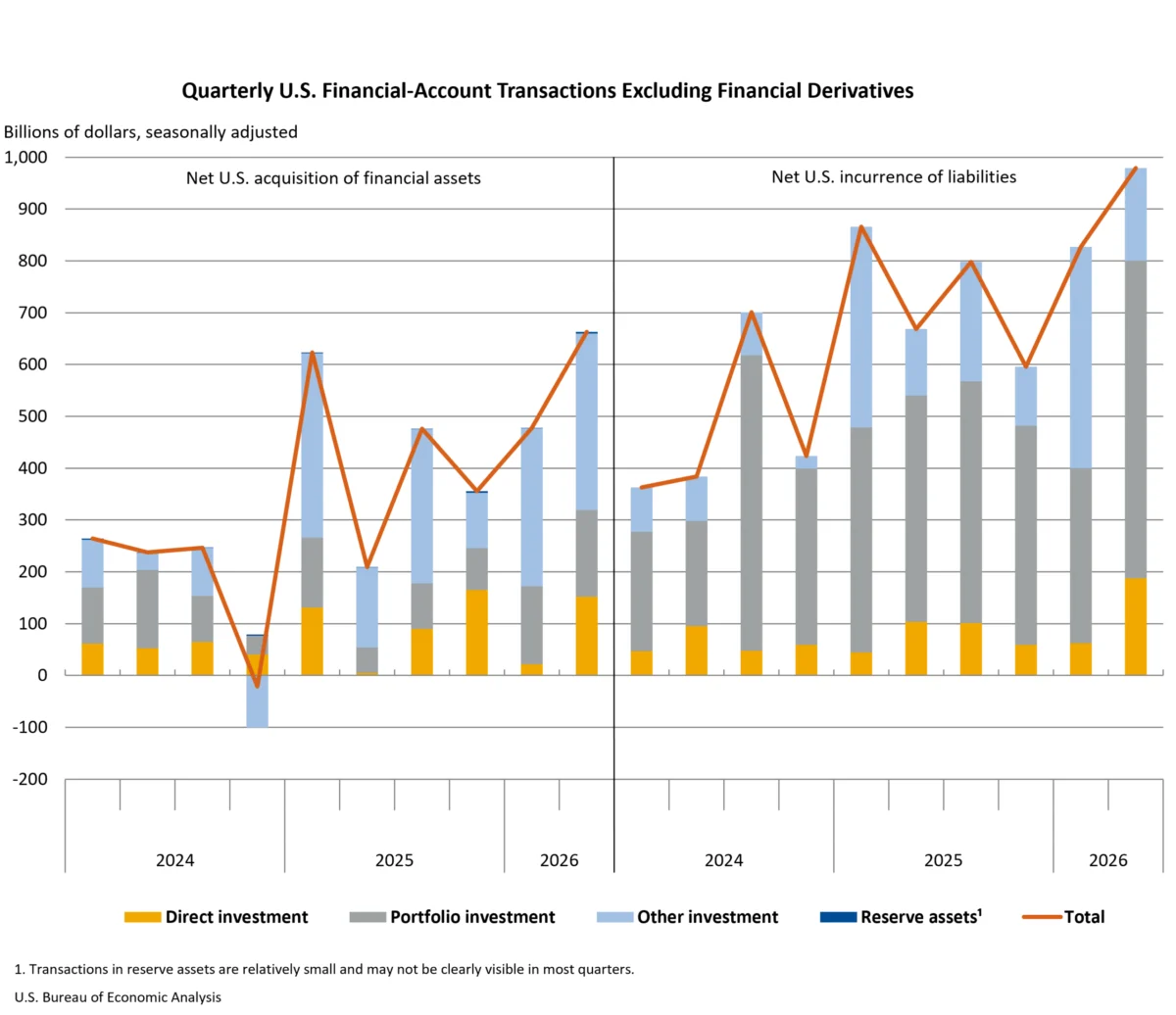
The financial account paints a picture of net U.S. borrowing from foreign residents. Net financial-account transactions were negative $409.9 billion in the third quarter, indicating that foreign residents acquired more financial assets in the U.S. than U.S. residents acquired in foreign financial assets. This net borrowing is the counterpart to the current-account deficit (and any net capital transfers).
Financial Assets: U.S. residents increased their holdings of foreign financial assets by $403.4 billion during the third quarter. This increase was broadly distributed across various asset types, with "other investment assets" seeing the largest growth at $224.4 billion. Direct investment assets rose by $91.9 billion, portfolio investment assets by $86.2 billion, and reserve assets by a modest $0.9 billion. This outward flow of capital signifies U.S. investment activities abroad.
Liabilities: Simultaneously, U.S. liabilities to foreign residents, meaning assets held by foreigners in the U.S., increased significantly by $797.2 billion. The largest component of this increase was in portfolio investment liabilities, which surged by $486.8 billion. "Other investment liabilities" also saw a substantial rise of $195.9 billion, and direct investment liabilities increased by $114.6 billion. The considerable increase in foreign holdings of U.S. assets underscores the ongoing attractiveness of the U.S. economy to international investors.
Financial Derivatives: Net transactions in financial derivatives resulted in net U.S. borrowing from foreign residents, amounting to negative $16.1 billion in the third quarter. These transactions, while often complex, reflect hedging activities and other financial strategies employed by market participants.
Context and Historical Perspective
The narrowing of the U.S. current-account deficit in the third quarter of 2025 arrives amidst a global economic landscape characterized by shifting trade dynamics, evolving monetary policies, and ongoing geopolitical considerations. For decades, the U.S. has grappled with a structural current-account deficit, often financed by inflows of foreign capital seeking the safety and opportunities of the American market. This deficit reflects a broader economic reality where the U.S. consumes more than it produces and invests more abroad than foreigners invest in the U.S.
The improvement in the primary income balance is particularly noteworthy. A sustained surplus in this category, rather than a deficit, would represent a fundamental shift in the U.S. international financial position. This could be attributed to a variety of factors, including increased profitability of U.S. multinational corporations operating abroad, a more favorable interest rate environment for U.S. assets held overseas, or strategic shifts in global investment portfolios.
The BEA’s commitment to enhancing data transparency and accessibility is also highlighted in the release. Beginning in March 2026, the BEA will consolidate its quarterly U.S. international transactions and international investment position accounts into a single, combined news release. This move aims to provide a more holistic view of U.S. engagement with the global economy and accelerate the availability of key international investment data. Furthermore, the BEA is transitioning from embedded tables within news releases to dynamic links to its Interactive Data Application. This modernization effort seeks to improve efficiency and direct users to more comprehensive and flexible data resources.
Implications and Future Outlook
The reduction in the current-account deficit, driven largely by a strong performance in primary income and services, offers a positive signal for the U.S. economy. It suggests that the nation’s international earnings are growing at a faster pace than its international spending, contributing to a more sustainable external economic position. This could potentially lead to a reduced reliance on foreign borrowing over time, which could have implications for the U.S. dollar’s stability and interest rate dynamics.
However, the underlying trends in goods trade, with persistent deficits, and the significant net borrowing reflected in the financial account, indicate that substantial challenges remain. The global economic environment is subject to numerous variables, including trade disputes, commodity price fluctuations, and the economic health of major trading partners, all of which can impact U.S. international transactions.
Analysts will be closely watching the trajectory of these components in subsequent quarters. A sustained surplus in primary income would be a significant development, while continued strength in services exports offers a reliable source of economic growth. The upcoming combined news release and the shift towards interactive data applications by the BEA will likely provide even richer insights into these complex international economic flows, enabling a more informed understanding of the U.S. role in the global economy. The next release, scheduled for March 25, 2026, will cover the 4th quarter and the full year of 2025, offering a comprehensive look at the nation’s international economic performance.