Lana Rhoades
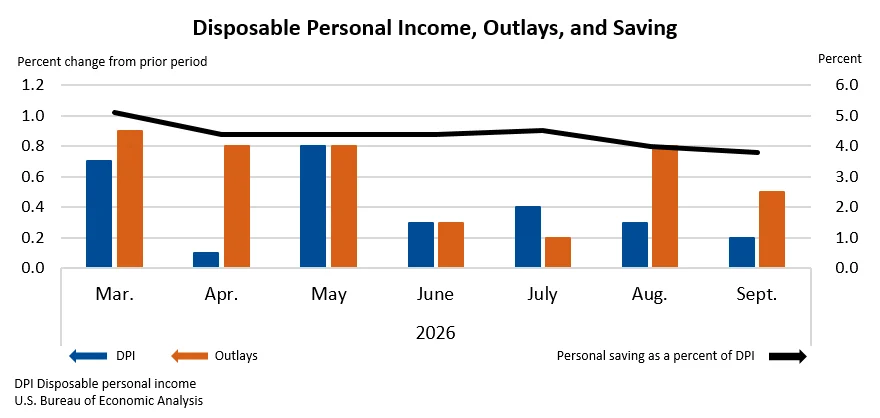
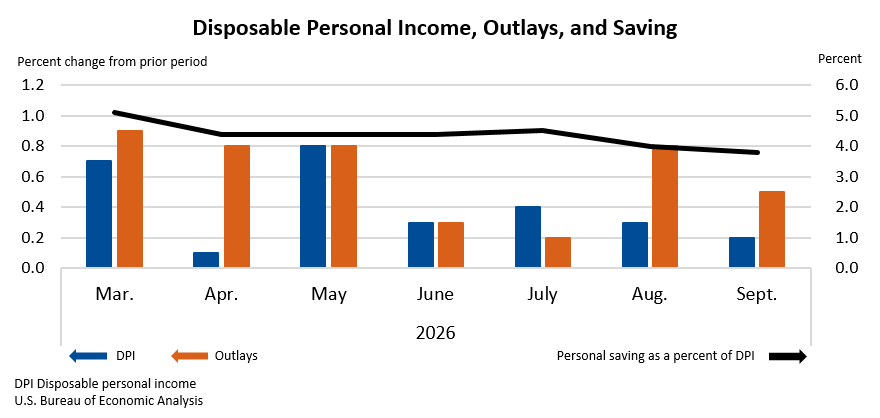
Personal income experienced a notable, albeit measured, increase of $54.5 billion, or 0.2 percent on a monthly basis, in September, according to the latest figures released by the U.S. Bureau of Economic Analysis (BEA). This growth in overall earnings was accompanied by a parallel rise in disposable personal income (DPI), which advanced by $52.7 billion, also representing a 0.2 percent increase. DPI, a critical measure of household financial capacity after taxes, has been a focal point for economists monitoring consumer resilience. Concurrently, personal consumption expenditures (PCE), a key indicator of consumer spending, surged by a more substantial $113.1 billion, marking a 0.5 percent rise. This divergence between income growth and spending acceleration suggests a potential drawdown of savings or an increase in borrowing to finance consumption.
The broader measure of personal outlays, encompassing PCE, personal interest payments, and personal current transfer payments, climbed by $113.0 billion in September. This robust increase in spending outpaced the growth in income, leading to a decrease in personal saving. Personal saving stood at $911.1 billion for the month, and the personal saving rate—defined as personal saving as a percentage of disposable personal income—dipped to 3.8 percent. This rate is a significant decrease from the elevated levels seen during the pandemic, reflecting a return to more typical consumer behavior and potentially indicating increased confidence in the economic outlook, or a response to persistent inflation.
The primary drivers behind the increase in current-dollar personal income during September were attributed to gains in compensation and government social benefits. Compensation, which includes wages, salaries, and benefits, often serves as a primary barometer of labor market health. The increase in government social benefits suggests continued support mechanisms or a rise in specific program disbursements.
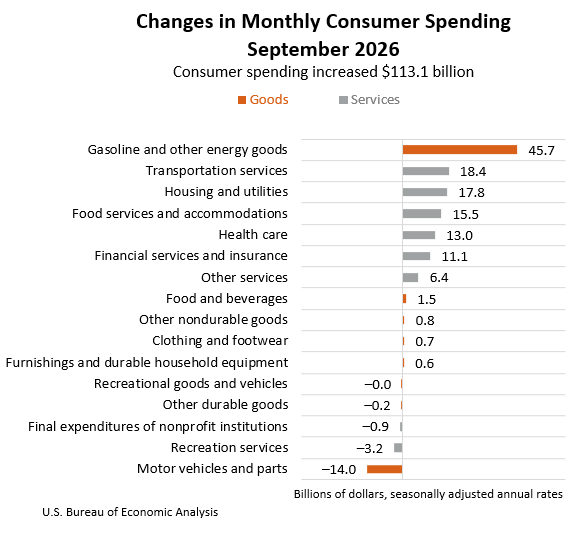
Consumer spending, a cornerstone of the U.S. economy, demonstrated a strong upward trend in September, with current-dollar PCE increasing by $113.1 billion. This broad-based expansion was bifurcated between spending on goods and services. Spending on goods saw a significant uplift of $35.1 billion, while spending on services experienced an even more pronounced increase of $78.1 billion. This shift underscores the ongoing normalization of consumer behavior, with a greater proportion of spending returning to services, such as travel, entertainment, and healthcare, which were disproportionately affected during periods of pandemic-related restrictions.
Despite the nominal increase in consumer spending, the impact of inflation is evident when examining real PCE, which measures consumer spending adjusted for price changes. Real PCE in September saw a modest increase of $2.6 billion, translating to less than 0.1 percent on a monthly basis. This minimal real growth suggests that much of the increase in nominal spending was absorbed by rising prices, rather than an actual increase in the volume of goods and services consumed.
Inflationary pressures also manifested in the Personal Consumption Expenditures (PCE) price index. From the preceding month, the PCE price index rose by 0.5 percent in September. When excluding the volatile categories of food and energy, the core PCE price index, a closely watched indicator by the Federal Reserve for its insights into underlying inflation trends, increased by 0.3 percent. This indicates persistent, though not accelerating, inflationary forces in the broader economy.
On a year-over-year basis, the PCE price index for September showed an increase of 3.6 percent compared to the same month in the previous year. The core PCE price index, excluding food and energy, was up 3.1 percent from September of the prior year. These figures highlight that while inflation may have moderated from its peak, it remains elevated and continues to impact household purchasing power.
Economic Context: A Shifting Landscape
The September data arrives at a critical juncture for the U.S. economy. Following a period of robust recovery fueled by significant fiscal stimulus and pent-up demand, consumers are now navigating an environment characterized by higher interest rates, persistent inflation, and a normalizing labor market. The BEA’s release provides a snapshot of how these factors are influencing personal income and spending patterns.
The modest growth in personal income suggests that wage increases and other earnings are keeping pace with inflation to some extent, but the real purchasing power of many households may be under strain. The increase in government social benefits could point to ongoing support programs or a rise in specific claims, such as unemployment benefits, though the latter would typically be accompanied by a slowdown in overall income growth.
The strong growth in personal consumption expenditures, particularly in services, indicates that consumers are actively engaging with the economy. However, the widening gap between nominal spending and real spending growth is a clear signal of the impact of inflation. Households are spending more dollars, but they are not necessarily acquiring more goods and services. This can lead to a sense of diminished financial well-being, even if nominal incomes are rising.
The decline in the personal saving rate is also a significant development. During the pandemic, many households accumulated substantial savings due to reduced spending opportunities and government stimulus. As the economy reopens and inflation pressures persist, consumers are increasingly drawing down these savings to maintain their consumption levels. This trend is sustainable only for a limited period, and a continued decline in savings could signal future constraints on consumer spending.
Drivers of Income Growth
The primary contributors to the $54.5 billion increase in personal income were compensation and government social benefits. Compensation, which comprises wages and salaries, is a direct reflection of labor market activity. An increase in this category suggests that employers are either hiring more workers, increasing wages, or both. The BEA’s report typically provides further detail on the components of compensation, such as private wages and salaries, government wages and salaries, and supplementary labor activities.
Government social benefits, which include programs like Social Security, Medicare, Medicaid, and unemployment insurance, also played a role in boosting personal income. An increase in this area could be due to adjustments in benefit levels, an increase in the number of beneficiaries, or specific legislative actions. For instance, a rise in unemployment insurance claims would contribute to this category, although this would typically be counteracted by a slowdown in wage growth.
Analysis of Consumer Spending Patterns
The $113.1 billion increase in personal consumption expenditures (PCE) highlights the resilience of consumer demand. The breakdown between goods and services offers further insight into evolving consumer behavior. The $35.1 billion rise in spending on goods suggests continued demand for durable and non-durable goods. However, the more substantial $78.1 billion increase in spending on services indicates a clear trend of consumers returning to pre-pandemic spending habits, prioritizing experiences and services over goods. This is a positive sign for sectors such as hospitality, travel, and entertainment, which have been recovering from significant disruptions.
The divergence between nominal and real PCE is a critical aspect of the current economic narrative. The minimal growth in real PCE means that the purchasing power of consumers is not expanding significantly, despite higher nominal spending. This implies that a larger portion of income is being allocated to cover the rising costs of essential goods and services, leaving less discretionary income for other purchases.
Inflationary Headwinds: The PCE Price Index
The PCE price index, a broad measure of inflation, saw a 0.5 percent increase in September. This figure is closely monitored by policymakers, as it directly impacts the cost of living for households. The exclusion of food and energy prices, which are often subject to greater volatility, provides a clearer picture of underlying inflation trends. The core PCE price index’s increase of 0.3 percent suggests that inflationary pressures are broad-based and persistent, though not accelerating at a rapid pace.
The year-over-year figures further emphasize the ongoing inflationary challenge. The 3.6 percent increase in the overall PCE price index and the 3.1 percent increase in the core PCE price index from the previous year indicate that prices have risen considerably over the past twelve months. This sustained inflation erodes the purchasing power of consumers and can lead to a slowdown in spending if incomes do not keep pace.
Implications for the Economy
The BEA’s September report paints a picture of an economy characterized by continued consumer demand, but also by the persistent effects of inflation. The moderate growth in personal income, coupled with robust spending that outpaces real income gains, suggests that households are increasingly relying on savings or credit to maintain their consumption levels.
The declining personal saving rate is a potential concern for future economic growth. If consumers exhaust their savings, they may be forced to cut back on spending, which could lead to a broader economic slowdown. This scenario is particularly relevant in the context of rising interest rates, which increase the cost of borrowing and can further constrain household budgets.
The persistent inflation indicated by the PCE price index also poses a challenge. While the Federal Reserve has been actively working to bring inflation under control through interest rate hikes, the recent data suggest that these efforts may take time to fully materialize. Continued high inflation can lead to uncertainty and reduce consumer confidence, potentially impacting investment and hiring decisions by businesses.
Expert Reactions and Inferences
While the report does not include direct quotes, economic analysts often interpret such data in the context of broader economic trends. Many economists would likely view the September figures as indicative of a resilient but challenged consumer. The increase in spending, particularly on services, signals a healthy demand for experiences, but the impact of inflation on real purchasing power remains a key concern.
The BEA’s data serves as crucial input for policymakers at the Federal Reserve. The persistence of inflation, even at a moderating pace, will likely influence future decisions regarding interest rates. The central bank aims to strike a balance between curbing inflation and avoiding a significant economic downturn. The interplay between income, spending, and inflation will be closely watched in the coming months.
Looking Ahead: The October Report and Beyond
The next release from the BEA, covering Personal Income and Outlays for October, will be critical for understanding whether the trends observed in September continue or evolve. Economists will be particularly interested in whether income growth accelerates, if consumer spending maintains its momentum, and how inflation figures evolve.
The BEA’s detailed data tables, referenced in the release, provide a granular view of these economic indicators. For instance, Table 2.6, "Personal Income and Its Disposition," offers a comprehensive breakdown of income sources and how it is spent or saved. Tables related to PCE by major type of product and their price changes offer deeper insights into the composition and inflationary impact of consumer spending.
The BEA’s commitment to providing timely and detailed economic data is essential for businesses, policymakers, and the public to make informed decisions. As the U.S. economy navigates a complex landscape of post-pandemic recovery, inflationary pressures, and monetary policy adjustments, these statistics serve as vital indicators of the nation’s economic health. The September data underscores a consumer economy that is active and spending, but one that is also grappling with the persistent reality of higher prices eroding the value of every dollar earned.