Julia Chirkova
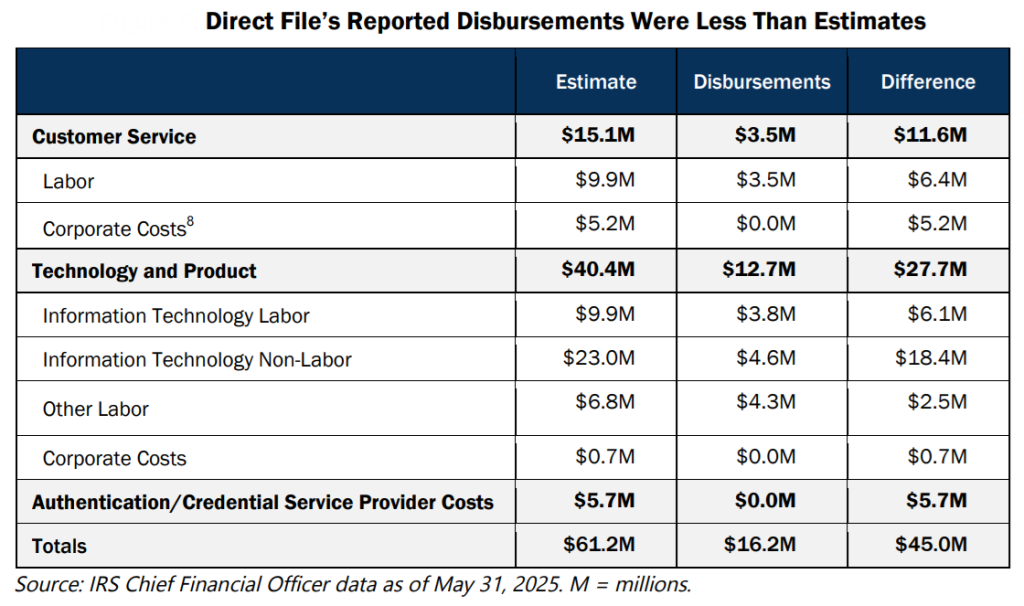
A comprehensive report released by the Treasury Inspector General for Tax Administration (TIGTA) has indicated that the operational costs for the now-defunct IRS Direct File free tax preparation program were substantially lower than initially projected by the Internal Revenue Service (IRS). While the IRS had estimated a fiscal year 2025 expenditure of $61.2 million for the program, TIGTA’s findings reveal that actual costs as of May 2025 amounted to only $16.2 million. This significant discrepancy raises questions about the IRS’s initial cost assessments and highlights potential areas for improved financial oversight in future government initiatives.
The TIGTA report, dated March 2026, delves into the financial underpinnings of the Direct File program, which was designed to offer a free, digital pathway for eligible taxpayers to file their federal tax returns directly through the IRS website. The program, launched as a pilot in 2024 under the Biden administration and later discontinued by the Trump administration, aimed to simplify the tax filing process and provide an alternative to commercial tax preparation software.
Unpacking the Cost Discrepancies
The core of TIGTA’s findings centers on the IRS’s underestimation of actual program expenses. The inspector general’s office attributes the lower-than-reported costs to several factors, including the exclusion of significant indirect expenses and the IRS’s own method of calculating user-dependent costs.
One of the most notable findings is the exclusion of costs associated with personnel detailed to the IRS from other federal agencies for the development and piloting of Direct File. Additionally, the report points out that the time and associated costs of other IRS employees who provided support to the program were not consistently tracked or included in the official cost figures. TIGTA has previously recommended that the IRS improve its tracking of time for such detailed employees, a recommendation that appears to have not been fully implemented, leading to ongoing underreporting of costs.
The TIGTA report states, "We previously reported that the IRS’s Direct File costs for FYs 2023 and 2024 did not include an estimated $8.8 million in costs incurred by the government. For example, Direct File did not include costs for employees detailed to the IRS by another federal agency to help develop and pilot Direct File, costs for other IRS functions’ employees who supported the program, and authentication costs. The costs of detailed employees and other IRS employees are largely unknown since the IRS did not generally track the time associated with these employees, as we previously recommended. As a result, the IRS’s reported costs for FY 2025 continue to exclude the costs from all support functions."
Authentication Costs: A Significant Omission
A crucial element contributing to the cost variance is the exclusion of authentication expenses. The IRS management indicated that Direct File costs are contingent on the number of users. However, the agency failed to report the costs associated with taxpayers authenticating their identities to use the system. To create a Direct File account, users were required to authenticate through a Credential Service Provider if they had not previously done so for other IRS systems.
Management acknowledged an inability to definitively determine how Direct File users first authenticated themselves – whether through Direct File itself or another IRS system. TIGTA’s analysis suggests that if all new Direct File users had first authenticated using the Direct File system, the IRS would have incurred an estimated $2.5 million in authentication costs.
The IRS reports that the average cost for a new Credential Service Provider account is $3.64, while a returning user incurs a cost of $1.35. During the 2025 filing season, TIGTA’s examination of Direct File users revealed that 88% were new users and 12% were returning users. Based on the 751,000 Direct File users during this period, TIGTA estimated these unreported authentication costs to be approximately $2.5 million. This figure represents a substantial portion of the overall cost difference.
Program Usage and Outreach Challenges
Beyond financial discrepancies, the TIGTA report also sheds light on the program’s user engagement. For the 2025 filing season, the IRS had estimated that 32 million taxpayers would be eligible for Direct File. However, only 751,000 taxpayers actually registered with the program. While this represents a 78% increase from the 423,000 registered taxpayers in the 2024 filing season, it falls significantly short of the IRS’s ambitious eligibility projections.
Direct File management attributed this lower-than-expected usage to several factors, including confusion stemming from media coverage regarding the program’s availability and a perceived lack of sufficient outreach efforts. Furthermore, a significant portion of registered users did not proceed to file their tax returns through the system. Specifically, 59% of the 751,000 Direct File users did not submit a tax return using the platform during the 2025 filing season, indicating potential usability issues or a failure to convert registered users into active filers.
The Direct File Initiative: A Brief History and Context
The Direct File program was conceived as a direct response to concerns about the complexity and cost of tax preparation in the United States. The IRS, empowered by provisions in the Inflation Reduction Act, initiated a pilot program in 2024. This pilot phase made the platform available to taxpayers in 13 states, with the intention of expanding its reach. By the time the program was in full swing for the 2025 filing season, its availability had been broadened to include 25 states, encompassing major tax jurisdictions such as California, New York, Florida, Texas, Illinois, North Carolina, and Pennsylvania.

The core offering of Direct File was its simplicity and cost-effectiveness. Eligible taxpayers could log onto the IRS website and use a guided, digital system to prepare and e-file their federal tax returns without incurring any fees. This was a stark contrast to the commercial tax preparation industry, which often charges substantial fees for similar services. The program was envisioned as a way to democratize tax filing, particularly for individuals with simpler tax situations who might otherwise be deterred by the cost of professional assistance or the complexity of tax software.
The decision by the Trump administration to discontinue the Direct File program last year marked a significant turning point for the initiative. This discontinuation followed a period of intense debate regarding the IRS’s authority to offer such a service and the potential impact on the private tax preparation industry. The TIGTA report, released after the program’s cessation, provides a critical retrospective on its operational and financial aspects.
Broader Implications and Future Considerations
The findings of the TIGTA report carry significant implications for future IRS initiatives and government-funded digital services. The substantial difference between estimated and actual costs, coupled with the identified omissions in reporting, underscores the need for enhanced transparency and rigor in cost accounting for large-scale government projects.

The report suggests that the IRS may need to refine its methodologies for estimating program costs, particularly concerning indirect expenses and user-related operational costs like authentication. This could involve more robust tracking mechanisms for employee time, better integration of support function costs, and more precise methodologies for calculating per-user expenses.
Furthermore, the low uptake of Direct File, despite its potential cost savings for taxpayers, highlights the challenges of public outreach and user adoption for government digital platforms. The factors cited by Direct File management – media confusion and insufficient outreach – point to the critical importance of clear communication strategies and targeted marketing efforts when launching new public services. The fact that a significant percentage of registered users did not complete their filings also raises questions about the user experience and the effectiveness of the platform in meeting the needs of its intended audience.
The discontinuation of Direct File means that taxpayers in the participating states will once again rely on commercial software or tax preparers, potentially incurring costs that the Direct File program aimed to eliminate. The TIGTA report provides valuable data for policymakers considering future iterations of free tax preparation services, offering lessons learned from both the financial and operational perspectives of the Direct File experiment. As the IRS continues to modernize its operations and explore new service delivery models, the insights from this report will be crucial in ensuring efficiency, cost-effectiveness, and successful public engagement.