Nila Kartika Wati
In the architectural and civic landscape of the United States, public art serves as a permanent record of national priorities, signaling which histories a democracy chooses to canonize and which it relegates to the periphery. While the Vietnam War remains one of the most documented and publicly memorialized conflicts in American history, the narrative has traditionally centered on military service and domestic political upheaval. However, a growing movement of Vietnamese American artists and cultural organizers is working to reshape this landscape, seeking to integrate the stories of refugee survival, displacement, and community rebuilding into the nation’s public memory. At the forefront of this effort is 1975: A Vietnamese Diaspora Memorial, a permanent installation project in Boston’s Dorchester neighborhood that aims to provide a visible site for the 2.2 million Vietnamese Americans to encounter their own history in the public square.
The initiative comes at a critical juncture in the history of the diaspora. As the 50th anniversary of the end of the Vietnam War approaches in 2025, the community is transitioning from a period of immediate survival and economic establishment to one of cultural preservation and civic advocacy. Led by artist and cultural organizer Ngoc-Tran Vu, the Boston project represents a shift away from militaristic iconography toward a more nuanced exploration of the refugee experience. By focusing on the intergenerational impact of the 1975 exodus, the project challenges the historical "absence" of Vietnamese narratives in the Northeastern United States, where public memorials dedicated to the Southeast Asian refugee experience remain scarce compared to traditional war monuments.
The Evolution of Vietnamese American Presence and the 1975 Memorial
The historical trajectory of the Vietnamese community in Boston is deeply intertwined with the federal policies that shaped the post-war era. Following the Fall of Saigon on April 30, 1975, the United States saw an initial influx of approximately 125,000 Vietnamese evacuees. Subsequent waves of migration occurred throughout the 1980s and 1990s, driven by the "boat people" crisis and the U.S. Humanitarian Operation (HO) program. The HO program was specifically designed to resettle former South Vietnamese military personnel and political prisoners who had been detained in reeducation camps by the communist government.
Among those resettled through the HO program was the family of Ngoc-Tran Vu, who arrived in Boston in 1992. Like many others, they settled in Dorchester’s Fields Corner, an area that has since evolved into the commercial and cultural heart of the community. In 2021, this significance was formally recognized when the Massachusetts Cultural Council designated the area as the Boston Little Saigon Cultural District. This designation provided the institutional framework necessary for projects like the 1975 Memorial to gain traction.
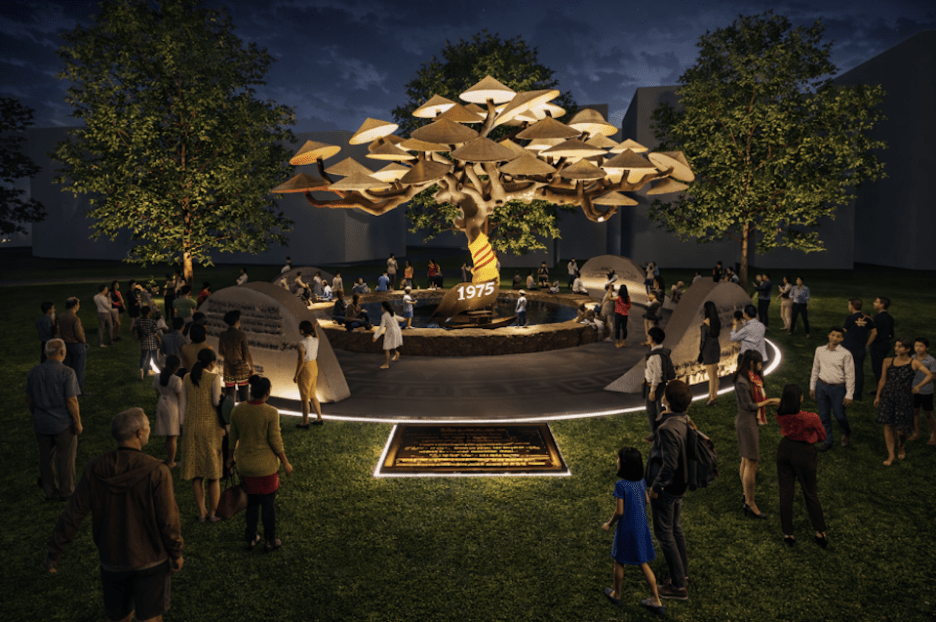
The 1975: A Vietnamese Diaspora Memorial project began as a grassroots effort to mark the half-century milestone of the diaspora. Unlike traditional commissions, the project was born out of a community-led desire to reflect on the legacy of April 30, 1975, without centering on the conflict’s combatants. In 2025, a temporary precursor to the permanent memorial, titled Journey of Light: A 1975 Memory Field, was installed in Dorchester’s Town Field Park. The installation featured illuminated nón lá (traditional Vietnamese conical hats), lanterns, and bilingual storytelling projections. This temporary activation served as a "proof of concept," demonstrating the community’s demand for a permanent space where the history of reeducation camp survivors, separated families, and the wisdom of the elders could be publicly acknowledged.
A Comparative Analysis of Public Memory: Beyond the Veterans Memorial
To understand the necessity of the 1975 Memorial, one must examine the existing landscape of Vietnam-related public art in the United States. The most prominent landmark is Maya Lin’s Vietnam Veterans Memorial in Washington, D.C. Completed in 1982, the wall was initially met with significant controversy for its unconventional design, yet it has since become a sacred site for national mourning. While the memorial provides a vital space for honoring American military loss, scholars and community leaders argue that the story of the war remains incomplete if it excludes the millions of Vietnamese lives altered by the conflict.

The disparity in public memory is particularly stark in the Northeast. While Southern California and the Gulf Coast have long-established Vietnamese enclaves with visible markers of their history, Boston’s Vietnamese community—the largest in New England—has lacked a permanent, large-scale public art installation that speaks to the refugee journey. The 1975 Memorial aims to bridge this gap, asserting that the refugee story is not merely a "sub-narrative" of the war, but a central component of the American civic inheritance.
The project’s leadership emphasizes that public art is not merely decorative; it is a form of cultural infrastructure. For displaced communities, the ability to shape public land is a form of civic belonging. By securing a permanent site, the Vietnamese diaspora moves from being a community that "occupies" space in restaurants and nail salons to one that "authors" the public narrative of the city.
National Precedents: Arlington and San Jose
The push for Vietnamese American public art in Boston is part of a broader national trend where communities are using creative placemaking to combat the erasure caused by urban redevelopment and gentrification.
In Clarendon, Virginia, a neighborhood once known as "Little Saigon" in the late 1970s and 1980s, the community was largely displaced by rising rents and the development of the Metro system. Artist Khánh H. Lê’s project, Voices from Little Saigon of Clarendon, sought to reclaim this lost history. Through oral histories, sculptural apricot blossom trees, and folded paper boats, the installation reminded the public that the area was once a vital sanctuary where refugees learned the mechanics of American life. The project highlighted a recurring theme in Vietnamese American public art: the use of memory as a tool against the "invisibility" that often follows economic displacement.
On the West Coast, Santa Clara County and the city of San Jose have set the standard for institutional support of Vietnamese cultural spaces. San Jose is home to the largest population of Vietnamese residents of any city outside of Vietnam. The Vietnamese Heritage Garden serves as a multi-functional public site, hosting community garden plots, flag-raising ceremonies, and the Thank You America monument by Tuan Nguyen. Furthermore, the Vietnamese American Service Center (VASC) features Kyungmi Shin’s Home, an installation that uses imagery of Hạ Long Bay and terraced rice fields to create a culturally competent environment for healthcare and social services. These examples demonstrate that when local governments partner with diaspora communities, public art can facilitate both cultural survival and civic integration.
The Socio-Political Impact of the Diaspora
The push for permanent memorials is also reflective of the growing political and demographic power of Vietnamese Americans. According to data from AAPI Data and the Migration Policy Institute, there are approximately 2.2 million people of Vietnamese descent in the United States. This population is highly engaged; more than 1.3 million Vietnamese American adults are eligible to vote, making them a significant constituency in key metropolitan areas.
The transition from "refugee" to "citizen" is often reflected in the themes of public art. While earlier monuments might focus on gratitude toward the United States (such as the Thank You America monument in San Jose), newer works like the 1975 Memorial in Boston tend to focus on the internal resilience of the community and the complexities of inherited trauma. This evolution suggests a community that is increasingly comfortable asserting its own agency and defining its legacy on its own terms.
Challenges in Securing Permanent Civic Space
Despite the success of temporary installations, the path to permanent public art remains fraught with bureaucratic and financial hurdles. The 1975 Memorial team in Boston is currently navigating a complex civic process that includes:
- Site Approval and Land Access: Negotiating with city departments to secure a permanent footprint in a neighborhood where public land is at a premium.
- Design Review: Ensuring the artistic vision meets municipal safety and maintenance standards while retaining its cultural authenticity.
- Sustainable Funding: Moving beyond one-time grants to secure long-term endowments for the upkeep and programming of the site.
- Political Will: Cultivating champions within city hall who view refugee history as an essential part of the city’s identity.
Advocates argue that these hurdles are often higher for immigrant communities who may lack the generational wealth or established political connections of older civic organizations. However, the success of the Boston Little Saigon Cultural District indicates a growing recognition among city officials that cultural preservation is a key component of urban stability and social cohesion.
Implications for American Democracy
The emergence of Vietnamese diaspora memorials carries profound implications for how the United States understands itself as a "nation of immigrants." Public art functions as a mirror; when that mirror fails to reflect the histories of millions of its citizens, the democratic narrative is skewed. By integrating the Vietnamese refugee experience into the public square, these projects force a more honest accounting of U.S. foreign policy and its domestic consequences.
The 1975 Memorial and its counterparts across the country are not merely about the past. They are about the future of civic life. They provide a framework for other displaced communities—from Somali and Afghan refugees to more recent arrivals from Haiti and Ukraine—to see that their stories of rupture and rebuilding also belong in the American story.
As the 1975 Memorial team continues its advocacy for a permanent home in Dorchester, the project stands as a testament to the endurance of memory. It asserts that the labor, rituals, and histories of the Vietnamese diaspora are woven into the fabric of American neighborhoods, and it is the responsibility of the public square to finally acknowledge that presence. In doing so, public art transforms from a decorative element into a vital tool for democratic inclusion, ensuring that the lessons of survival and mutual aid learned by the refugee generation are preserved for the generations to come.